essay 34 - etiology and pathogenesis oof endocrine disorders

0.0(0)
Studied by 0 people
call kaiCall Kai
learnLearn
examPractice Test
spaced repetitionSpaced Repetition
heart puzzleMatch
flashcardsFlashcards
GameKnowt Play
Card Sorting

1/3

encourage image

There's no tags or description

Looks like no tags are added yet.

Last updated 8:48 AM on 6/17/26
Name
Mastery
Learn
Test
Matching
Spaced
Call with Kai

No analytics yet

Send a link to your students to track their progress

4 Terms

1
New cards

what are endocrine disorders

knowt flashcard image
2
New cards

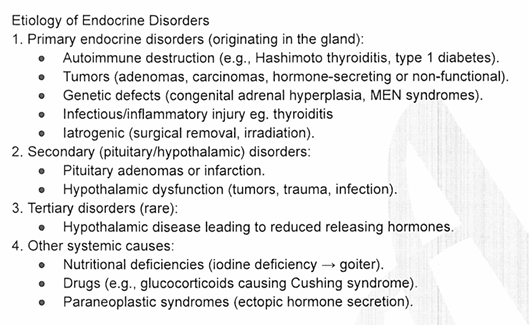
etiology of endocrine disorders

1) Primary (problem in the gland itself)

  • Autoimmune destruction → Hashimoto, Type 1 DM

  • Tumors → adenoma/carcinoma

  • Genetic → CAH, MEN

  • Inflammation/infection → thyroiditis

  • Iatrogenic → surgery, radiation

2) Secondary (pituitary or hypothalamus problem)

  • Pituitary adenoma or infarction

  • Hypothalamic damage → tumor, trauma, infection

3) Tertiary (rare)

  • Hypothalamic failure → ↓ releasing hormones

4) Other systemic causes

  • Nutritional deficiency → iodine → goiter

  • Drugs → steroids → Cushing

  • Paraneoplastic → ectopic hormone secretion
<p><strong>1) Primary (problem in the gland itself)</strong></p><ul><li><p><span>Autoimmune destruction → Hashimoto, Type 1 DM</span></p></li><li><p><span>Tumors → adenoma/carcinoma</span></p></li><li><p><span>Genetic → CAH, MEN</span></p></li><li><p><span>Inflammation/infection → thyroiditis</span></p></li><li><p><span>Iatrogenic → surgery, radiation</span></p></li></ul><p><strong>2) Secondary (pituitary or hypothalamus problem)</strong></p><ul><li><p><span>Pituitary adenoma or infarction</span></p></li><li><p><span>Hypothalamic damage → tumor, trauma, infection</span></p></li></ul><p><strong>3) Tertiary (rare)</strong></p><ul><li><p><span>Hypothalamic failure → ↓ releasing hormones</span></p></li></ul><p><strong>4) Other systemic causes</strong></p><ul><li><p><span>Nutritional deficiency → iodine → goiter</span></p></li><li><p><span>Drugs → steroids → Cushing</span></p></li><li><p><span>Paraneoplastic → ectopic hormone secretion</span></p></li></ul><p></p>
3
New cards

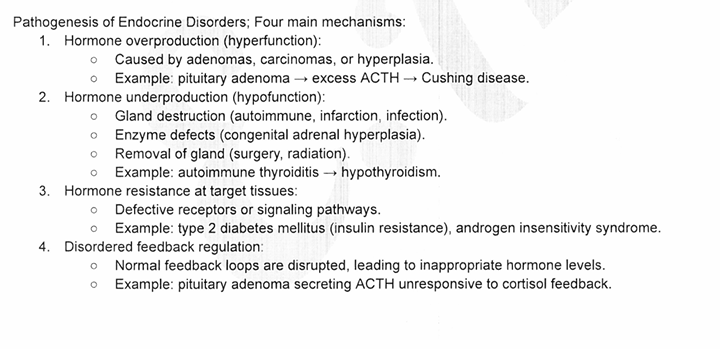
pathogenesis of endocrine disorders

1) Hormone Overproduction (Hyperfunction)

Too much hormone is made.
Causes:

  • Tumors (adenoma, carcinoma)

  • Hyperplasia

Example:
Pituitary adenoma → ↑ ACTH → Cushing disease

2) Hormone Underproduction (Hypofunction)

Too little hormone is made.
Causes:

  • Autoimmune destruction

  • Infarction, infection

  • Enzyme defects (CAH)

  • Surgical removal / radiation

Example:
Autoimmune thyroiditis → hypothyroidism

3) Hormone Resistance

Hormone is normal, but tissues don’t respond.
Causes:

  • Receptor defects

  • Signaling pathway defects

Examples:

  • Type 2 diabetes (insulin resistance)

  • Androgen insensitivity syndrome

4) Disordered Feedback Regulation

Feedback loops fail → inappropriate hormone levels.
Example:
Pituitary adenoma keeps secreting ACTH despite high cortisol
<p><strong><mark data-color="#ff0000" style="background-color: rgb(255, 0, 0); color: inherit;">1) Hormone Overproduction (Hyperfunction)</mark></strong></p><p><span><strong>Too much hormone is made.</strong>  <br>Causes:</span></p><ul><li><p><span>Tumors (adenoma, carcinoma)</span></p></li><li><p><span>Hyperplasia</span></p></li></ul><p><span>Example:<br><strong>Pituitary adenoma → ↑ ACTH → Cushing disease</strong></span></p><p><strong><mark data-color="#ff0000" style="background-color: rgb(255, 0, 0); color: inherit;">2) Hormone Underproduction (Hypofunction)</mark></strong></p><p><span><strong>Too little hormone is made.</strong>  <br>Causes:</span></p><ul><li><p><span>Autoimmune destruction</span></p></li><li><p><span>Infarction, infection</span></p></li><li><p><span>Enzyme defects (CAH)</span></p></li><li><p><span>Surgical removal / radiation</span></p></li></ul><p><span>Example:<br><strong>Autoimmune thyroiditis → hypothyroidism</strong></span></p><p><strong><mark data-color="#ff0000" style="background-color: rgb(255, 0, 0); color: inherit;">3) Hormone Resistance</mark></strong></p><p><span><strong>Hormone is normal, but tissues don’t respond.</strong>  <br>Causes:</span></p><ul><li><p><span>Receptor defects</span></p></li><li><p><span>Signaling pathway defects</span></p></li></ul><p><span>Examples:</span></p><ul><li><p><span><strong>Type 2 diabetes</strong> (insulin resistance)</span></p></li><li><p><span><strong>Androgen insensitivity syndrome</strong></span></p></li></ul><p><strong><mark data-color="#ff0000" style="background-color: rgb(255, 0, 0); color: inherit;">4) Disordered Feedback Regulation</mark></strong></p><p><span><strong>Feedback loops fail → inappropriate hormone levels.</strong>  <br>Example:<br><strong>Pituitary adenoma keeps secreting ACTH despite high cortisol</strong></span></p>
4
New cards

NONE!

NONE!




