Ecology Exam 3 Sp26
 Call Kai
 Learn
Learn Practice Test
 Spaced Repetition
 Match
Match Flashcards
 Knowt Play
1/113

There's no tags or description
Looks like no tags are added yet.
Name | Mastery | Learn | Test | Matching | Spaced | Call with Kai |
|---|
No analytics yet
Send a link to your students to track their progress
114 Terms
Leaf Cutter Ants (chp 15)
Leaf-cutter ants (Atta cephalotes) Costa Rica carry leaf segments to their colony, where
the leaves will be fed to the fungus (the gray material) the ants cultivate for food.
Positive interactions
One or both species benfit and neiter is harmed (Example Mycorrhizae
Symbiosis
Two species in close physical contact with each other
Symbiosis → Parasitism
(+ / -) interaction
Symbiosis → Commensalism
(+ / 0) relatioship
Individuals of one species benefit; individuals of the other species do not benefit byt are not harmed
Symbiosis → Mutualism
(+ / +) relatioship
Mutually beneficial interaction between individuals of two species
Cost vs Benefits of Mutualisms
Benefits take many forms—food, shelter,
transport, etc.
cost to one or both partners, but the net
effect is positive.
For each species, the benefits are greater
than the costs.
Ectomycorrhizae
A type of Mutualism fungus that forms a sheath around the roots of certain trees (like pines and oaks), helping the plant absorb water and nutrients (especially phosphorus and nitrogen) while receiving sugars in return. It stays mostly outside root cells, forming a network between root cells called the Hartig net.
Arbuscular mycorrhizae (VAM)
A type of symbiotic fungus ( Mutualism) that penetrates the root cells of most herbaceous plants, forming tree-like structures called arbuscules inside the cells. These structures help the plant absorb nutrients (especially phosphorus) and water more efficiently, while the fungus receives sugars from the plant.
Corals and algae
Tiny algae called zooxanthellae live inside coral tissues. The algae perform photosynthesis, providing the coral with sugars for energy, while the coral offers the algae a protected home and access to sunlight. Both benefit, making this a mutualistic relationship.
Ruminants
Ruminants are animals (like cattle and sheep) that have a multi-chambered stomach (rumen, reticulum, omasum, abomasum) to digest cellulose from plant material. Microbes in the rumen ferment plant fibers, producing volatile fatty acids for energy, while the microbes get a steady food supply.
mutualistic relationship.
Wood Eating insects (cockroach)
wood-eating cockroach (and other wood-eating insects, e.g. termites) would starve if gut mutualists such as the protist (hypermastigote) did not help it to digest wood (cellulose)
mutualistic relationship.
Lichens on Trees
Commensalism
Bacteria on human skin
Commensalism
Obligate/ coevolution
Obligate means necessary – both species depend entirely on each other to survive and reproduce.
Coevolution means the species have evolved together, influencing each other’s traits over time.
Example:
Fig trees produce flowers that can only be pollinated by specific fig wasps.
Fig wasps can only reproduce by laying eggs inside fig flowers.
The wasp pollinates the fig while laying its eggs, so both species’ survival is linked.
Facultative commensalisms are not Coevolution
In deserts, the shade of adult plants creates cooler, moister conditions. Seeds of many plants can only germinate in this shade. The adult is called a nurse plant. But seeds can germinate under various pecies of nurse plants.
Relative Neighbor Effect
A concept in ecology that measures how neighboring plants influence the growth or survival of a focal plant.
If neighbors help the focal plant (e.g., by providing shade or nutrients), the RNE is positive.
If neighbors harm the focal plant (e.g., through competition for light, water, or nutrients), the RNE is negative.
Trophic mutualisms (examples)
Mutualist receives energy or nutrients from its partner.
Mycorrhizae
Coral-alga symbiosis
Leafcutter ant + fungus
Habitat mutualisms (example)
One partner provides the other with shelter, living space, or favorable habitat
Shrimp and Goby
How do Medicago truncatula plants “reward” mycorrhizal fungi in terms of phosphorus supply?
Plants selectively allocate more carbohydrates to fungi that provide higher phosphorus, rewarding helpful partners, rather than giving sugars equally to all fungi. (Selective mutualism vs. promiscuous)
Selective Mutualism
A type of mutualism where a species rewards partners that provide the most benefit, giving more resources or attention to the most helpful partner.
Promiscuous Mutualism
A type of mutualism where a species gives benefits equally to all partners, regardless of how much each partner contributes.
Yuccas and Yucca Moths
This is a classic example of obligate mutualism:
Yucca plants rely on yucca moths for pollination. Without the moth, the plant cannot reproduce.
Yucca moths rely on yucca flowers to lay their eggs. Their larvae feed on some of the developing seeds.
The moth actively pollinates the flower while laying eggs, ensuring both species benefit.
Cheaters lose: If the plant detects poor pollination or too many eggs, it may abandon or abort the flower, killing the moth’s larvae.
Janzen (1966)
studied Acacia trees and their ant defenders. He found that ants protect the tree from herbivores in exchange for food (nectar) and shelter (hollow thorns). Trees with ants grow bigger, survive better, and are less damaged by insects.
Communities (chp 16)
groups of interacting species that occur together at the same place and time
Caulerpa taxifolia (Killer alga)
It was unintentionally released into the Mediterranean by the Oceanographic Museum of Monaco.
Its invasive range extends at least as far as Spain on the west and Croatia on the east.
has evolved cold resistance.
What is the primary difference between interaction webs and food webs?
Interaction webs include non-trophic interactions, where food webs do not.
omnivores
Species that feed on more than one trophic level are called
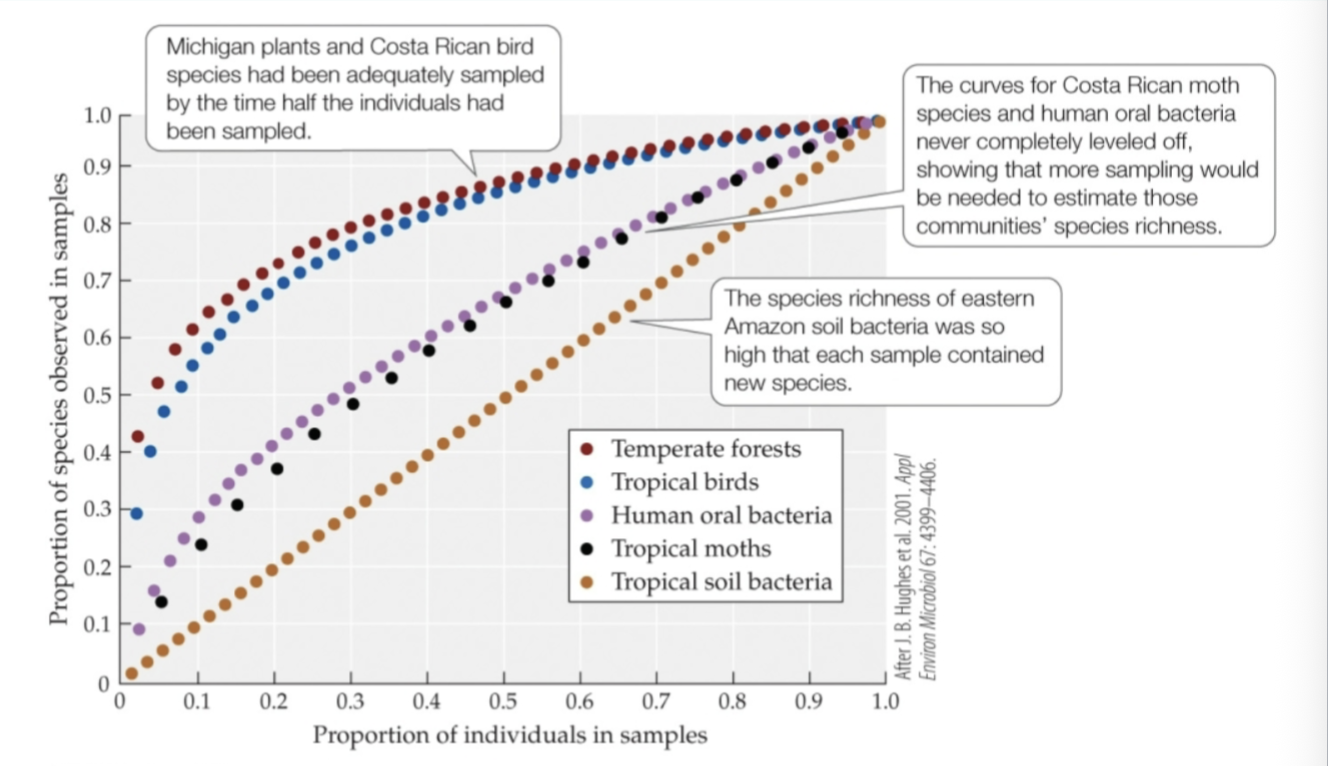
The Shannon index is a measure of
species diversity.
Which statement describes a limitation of a species accumulation curve in terms of its ability to determine whether species diversity has been adequately sampled?
It assumes that the sampling methods are consistent throughout the study.
functional group.
All the plant species in a community that have nitrogen-fixing bacteria (e.g., legumes) could be placed in the same functional group
Guild
All the species that use pollen as a resource could be grouped together as a guild
Trophic levels Autotrophs
primary producers
Trophic levels Herbivores
Primary consumers
Trophic levels carnivores
Secondary consumers
Trophic levels- carnivores²
Tertiary consumers
Species Richness
species number
Species Evenness
relative abundances
In Shannon index pi
proportion of individuals in the ith species (relative abundance)
In shannon idex equation “s”
Number of species in the community
Biodiversity
describes diversity at multiple spatial scales, from genes to species to communities.
Genetic diversity affects population viability
Which affects species diversity in a community
Which influences the diversity of communities at larger scales
Hughes and colleagues
found that communities of five different types varied greatly in the sampling effort that would be needed to estimate their species richness.
Trophic cascade
trophic cascade occurs when a carnivore feeds on an herbivore and thus has an indirect positive effect on a primary producer that is eaten by that herbivore.
Sea otters feed on urchins saving kelp
Trophic facilitation
Trophic facilitation occurs when a consumer is indirectly helped by a positive interaction between its prey and another species
The interaction between Juncus and Iva has an indirect positive effect on the aphids that feed on Iva
Juncus and Iva relatioship
Juncus shades the soil surface, decreasing evaporation and salt buildup.
Juncus also has aerenchyma, a tissue that allows oxygen to move to the roots. Some oxygen moves into the soil where other plants can use it.
Competitive network
Circular network, indirect species interactions buffer strond direct competition so no one species dominates the interaction
Competitive hierarchy
A linear hierarchical view speceies A always dominates the interaction
Keystone species
have large effects on their communities despite their small size and abundance
Foundation speceis
Have large effects on their communities by virtue of their large size and abundance
Interaction strength
Magnitude of the effect of one species on the abundance of another
Measured by removing one species from the community and observig the effect on the other species
Per capita interaction strength = (Ln(C/E))/I
C= Number of target individuals with interactor present
E= Number of target individuals with interactor absent
I= Number of interactor individuals
Menge et al 1996
Measured interaction strength of sea star (pisaster) predation of mussels (Mythilus) in wave-exposed versus wave protected areas
Interaction strenght was greater in protected areas
What species can be both Foundation and Ecosystem engineering species
Trees
Tress leaves branches and trunk provide habitat for other species
Tress affect temp and moisture
Fallen trees can serve as nurse logs
Trees leaves fall to the forest floor providint more habitat
Tree roots aerate soil, and stabilizing forest floor
Beavers are…
Keystone species and Ecosystem engineers
Increase wetland area by building dams
Which statement about keystone predators is true?
They usually influence primary producers indirectly.
The lowest possible value of the Shannon index is _______. Low values indicate _______ species diversity.
0 and low
A linear species accumulation curve
Means more sampling is nessary
Hacker and colleagues (Juncus and Iva)
trophic facilitation phenomenon: the Juncus and Iva have
Commensalism Juncus help Iva
Aphids then eat Iva
Power and colleagues of northern California rivers
showed that the strengths of species interactions can vary depending on the environmental context
Estimates show that oceans absorb about what percentage of atmospheric CO2?
48%
The invasion of the seaweed Caulerpa into Mediterranean coastal communities has had which major effect on these communities?
It has damaged these communities by causing a decline in the foundation seagrass species Posidonia
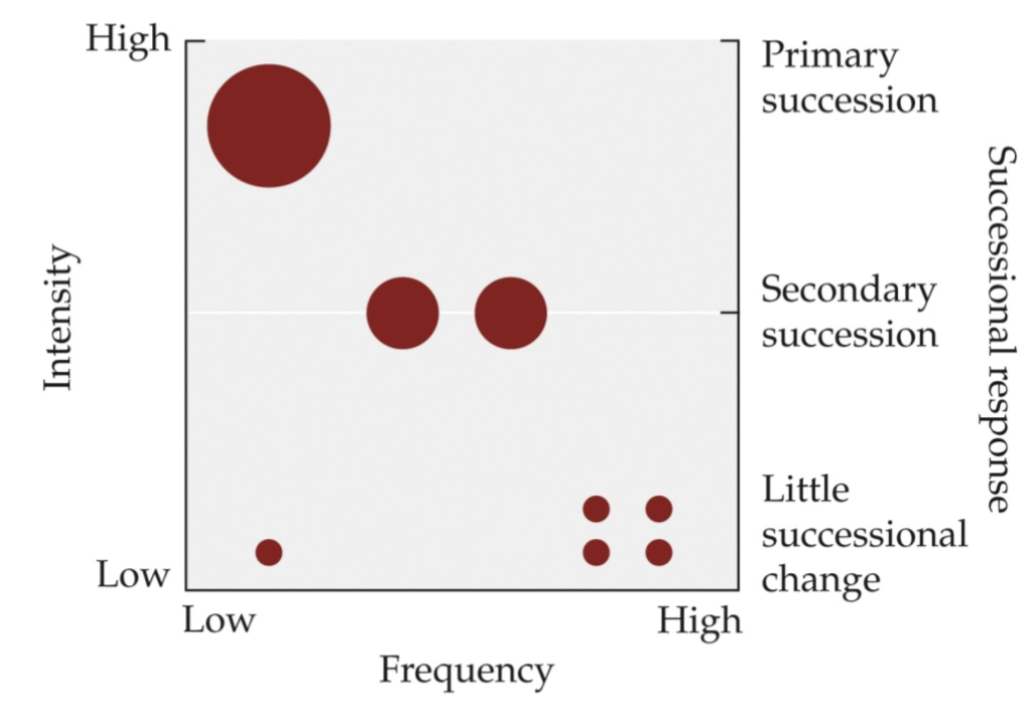
Succession
A regular pattern of change through time in the composition and structure of a community following a disturbance.
Primary succession
starts at a new substrate where no plants have been before and proceeds to a new community. This is usually from bare rock to lichens to soil to trees in most texts.
Secondary succession
starts at a disturbed substrate where there has been life before and proceeds to climax. Usual examples are old field to forest succession or bog to coniferous forest succession.
Climax
Theoretical “steady state” wherein composition and structure do not change.
Disturbance
Events that injure or kill some individuals and create opportunities for other individuals (like a tsunami)
Stress (agents of change)
Abiotic factors that reduce growth, reproduction, or survival of individuals
GPP
Gross primary Production
NPP
GPP (minus) - energy used by plants
NEP
NPP- Energy used by all life
Pioneer/Early Successional ( Primary succession)
Usually small, stress tolerant organisms (lichens weeds)
Intermediate (seconday succession)
Usually grasses to shrubs and trees
Climax (seral stages of succession)
Usually thought to be trees, long lived and can reproduce in their own shade and under normal disturbance conditions
Chronosequence
A study of succession in which variation in composition and structure is due to time since disturbance. Disturbances assumed to be the same
H. C. Cowles, Indiana. Dunes (1898): assuming communities closest to the lake were primary and as they get farther from the disturbance the successional stages increased,
Frederic Clements said
plant communities are “superorganisms,” groups of species working together toward some deterministic “climax” community
Henry Gleason
thought that communities are the random product of fluctuating environmental conditions acting on individual species
Charles Elton
was influenced by these botanists (Gleason and Clemens) and by his interest in animals. worked with English Pine Forests.
Wetlands → sphagnum bogs
Drier areas. → Grass and sedge marshes
Facilitation model
Early species modify the environment in ways that benefit later
species. But- inhibit early species. The sequence of species facilitations leads to a climax community.
Inhibition model
early species modify conditions in negative ways that hinder later successional species.
Tolerance Model
early species modify the environment in neutral ways that neither benefit nor inhibit later species but inhibit early species
Glacier Bay has elements of all three models proposed by Connell and Slatyer (1977)
Facilitaion (early stage plants)
Tolerance (Spruce Climax)
Inhabition (alders, intermidaites)
Bertness and Shumway (1993)
They studied how the plant Spartina alterniflora affects other plants. In harsh, stressful conditions (like high salinity and flooding), Spartina actually helps neighboring plants survive by reducing stress (facilitation). But in less stressful conditions, it competes with them for resources like light and nutrients.
found that Distichlis facilitated colonixation by juncus
Mechanisms of Succession
Crabs like Ulva (early stage) removing primary successor
Mid-successional species more susceptible to stress and epitytes
Gigartina dominated becasy least susceptible to stress and herbivores (Climax)
Chthamalus dalli (Farrell 1991) experiment
supporting the facilitation model
Macroalgae reached the highest densities in plots where balanus was present and limpets were absent
Lewontin (1969): alternative stable states
A community is thought to be stable when it returns to its original state after perturbation.
Alternative Stable States
there are multiple valleys that a community can rest in and be stable
a change can push the community to move to a differnt state (valley)
reversal of change does not alwasy result in orginal conditioins
MOUNT St HELEN is an example of this
Dwarf lupine (Lupinus lepidus),
A legume with symbiotic nitrogen-fixing bacteria was the first plant to colonize Mount St. Helens.
Kauris (North Island of New Zeland)
One of the largest trees species on eath
Biological Dynamics of Forest Fragments Project (BDFFP)
Manaus Brazil
to study the effects of habitat fragment size on species diversity
Spatial scales of species Diversity
Global Scale ( on earth)
Regional scale ( y= gamma), drived by dispersal
Landscape scale ( b= beta/turnover),
Local scale (a= alpha), driven by physical condition and species interactiosn
Species Richness curve
When Local and regional species richness are equal (slope=1). All species will be found in the communities of that region
When local richness values are lower then regional richness values (slope<1, still straight)
Local richness stays the same as regional richness increases (a curce levels off)
Witman et al (2004)
showed that in 49 sampling sites had a slope of 0.75
this shows that regional species pools largerly determine local species richness
Alfred Russel Wallace
Father of Biogeography
Also natural selection
Wallace and Weber Lines
Wallaces Line (1859
Webers Line (1900
Vicariance
Separation of species by barriers such as those formed by continental drift
Wallaces Biogeographic regions
They roughly correspond to earths major tectonic plates
Nearctic= North american
Neotropical= South american
Ethiopian= African
Palearctic= Eurasian plate
Oriental
Australasian
Subduction Zone
One plate is forced under another
Pangaea Breakup
251 MYBP
Diversification rate
The tropics have high diversitcation rate; due to stable environment and large land area= low extinction
Michael Rosenzweig