Scatter Slides

0.0(0)
Studied by 0 people
call kaiCall Kai
learnLearn
examPractice Test
spaced repetitionSpaced Repetition
heart puzzleMatch
flashcardsFlashcards
GameKnowt Play
Card Sorting

1/9

encourage image

There's no tags or description

Looks like no tags are added yet.

Last updated 3:09 PM on 4/22/26
Name
Mastery
Learn
Test
Matching
Spaced
Call with Kai

No analytics yet

Send a link to your students to track their progress

10 Terms
1
New cards
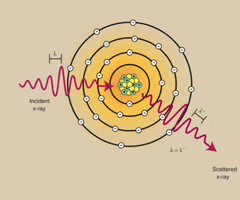
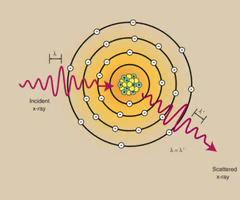
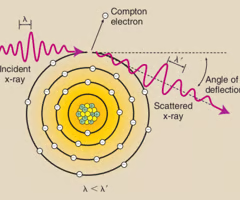
<p>What image is this?</p>

What image is this?

Coherent (classical,thompson)
2
New cards
<p>What image is this?</p>

What image is this?

Compton

3
New cards
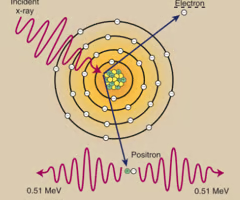
<p>What image is this?</p>

What image is this?

Pair Production

4
New cards
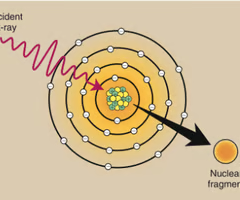
<p>What image is this?</p>

What image is this?

Photodisintegration
5
New cards
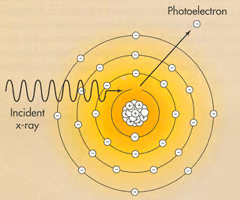
<p>What image is this?</p>

What image is this?

Photoelectric

6
New cards
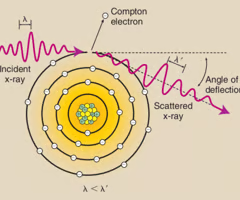
<ul><li><p><span style="background-color: transparent; font-family: &quot;Century Gothic&quot;, sans-serif;">Very low-energy photons interact with outer shell electron.</span></p></li><li><p><span style="background-color: transparent; font-family: &quot;Century Gothic&quot;, sans-serif;">Excitation, no ionization.</span></p></li><li><p><span style="background-color: transparent; font-family: &quot;Century Gothic&quot;, sans-serif;">Scattered x-ray will travel in different direction, but with same energy.</span></p></li></ul><p></p>
  • Very low-energy photons interact with outer shell electron.

  • Excitation, no ionization.

  • Scattered x-ray will travel in different direction, but with same energy.

Coherent (classical,thompson)
7
New cards
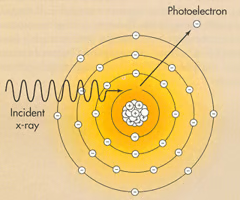
<ul><li><p><span style="background-color: transparent; font-family: &quot;Century Gothic&quot;, sans-serif;">Medium-high energy photon kicks out outer shell electron.</span></p></li><li><p><span style="background-color: transparent; font-family: &quot;Century Gothic&quot;, sans-serif;">Ionization.</span></p></li><li><p><span style="background-color: transparent; font-family: &quot;Century Gothic&quot;, sans-serif;">Partial absorption.</span></p></li><li><p><span style="background-color: transparent; font-family: &quot;Century Gothic&quot;, sans-serif;">Scattered photon has less energy than incoming photon.</span></p></li><li><p><span style="background-color: transparent; font-family: &quot;Century Gothic&quot;, sans-serif;">Main contributor to occupational dose.</span></p></li></ul><p></p>
  • Medium-high energy photon kicks out outer shell electron.

  • Ionization.

  • Partial absorption.

  • Scattered photon has less energy than incoming photon.

  • Main contributor to occupational dose.

Compton Scatter
8
New cards
<ul><li><p><span style="background-color: transparent; font-family: &quot;Century Gothic&quot;, sans-serif;">Medium-low energy photon kicks out inner shell electron.</span></p></li><li><p><span style="background-color: transparent; font-family: &quot;Century Gothic&quot;, sans-serif;">Characteristic cascade.</span></p></li><li><p><span style="background-color: transparent; font-family: &quot;Century Gothic&quot;, sans-serif;">Ionization.</span></p></li><li><p><span style="background-color: transparent; font-family: &quot;Century Gothic&quot;, sans-serif;">Total absorption.</span></p></li><li><p><span style="background-color: transparent; font-family: &quot;Century Gothic&quot;, sans-serif;">Creates white parts of radiographic image.</span></p></li></ul><p></p>
  • Medium-low energy photon kicks out inner shell electron.

  • Characteristic cascade.

  • Ionization.

  • Total absorption.

  • Creates white parts of radiographic image.

Photoelectric effect
9
New cards
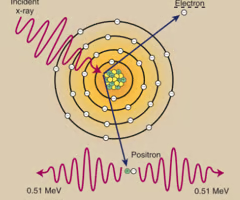
<ul><li><p><span style="background-color: transparent; font-family: &quot;Century Gothic&quot;, sans-serif;">Very high-energy photons (at least 1.02 MeV) interacts with nucleus.</span></p></li><li><p><span style="background-color: transparent; font-family: &quot;Century Gothic&quot;, sans-serif;">Nucleus absorbs photons and produces two particles: electron and positron (anti-electron).</span></p></li><li><p><span style="background-color: transparent; font-family: &quot;Century Gothic&quot;, sans-serif;">Positron interacts with another electron and both particles annihilate.</span></p></li><li><p><span style="background-color: transparent; font-family: &quot;Century Gothic&quot;, sans-serif;">Result is two photons with 0.51 MeV.</span></p></li><li><p><span style="background-color: transparent; font-family: &quot;Century Gothic&quot;, sans-serif;">Does not happen in radiography, might happen in nuclear medicine.</span></p></li></ul><p></p>
  • Very high-energy photons (at least 1.02 MeV) interacts with nucleus.

  • Nucleus absorbs photons and produces two particles: electron and positron (anti-electron).

  • Positron interacts with another electron and both particles annihilate.

  • Result is two photons with 0.51 MeV.

  • Does not happen in radiography, might happen in nuclear medicine.

Pair production
10
New cards
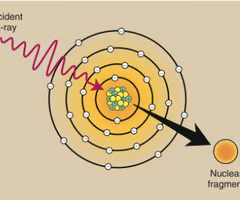
<ul><li><p><span style="background-color: transparent; font-family: &quot;Century Gothic&quot;, sans-serif;">Extremely high-energy photon (at least 10 MeV) is absorbed by the nucleus.</span></p></li><li><p><span style="background-color: transparent; font-family: &quot;Century Gothic&quot;, sans-serif;">The extremely excited nucleus breaks and releases a nuclear fragment.</span></p></li><li><p><span style="background-color: transparent; font-family: &quot;Century Gothic&quot;, sans-serif;">It does not happen in any diagnostic modality.</span></p></li></ul><p></p>
  • Extremely high-energy photon (at least 10 MeV) is absorbed by the nucleus.

  • The extremely excited nucleus breaks and releases a nuclear fragment.

  • It does not happen in any diagnostic modality.

Photodisintegration