L30 - Neurons: Action Potentials

0.0(0)
Studied by 0 people
call kaiCall Kai
learnLearn
examPractice Test
spaced repetitionSpaced Repetition
heart puzzleMatch
flashcardsFlashcards
GameKnowt Play
Card Sorting

1/6

encourage image

There's no tags or description

Looks like no tags are added yet.

Last updated 3:32 AM on 6/1/26
Name
Mastery
Learn
Test
Matching
Spaced
Call with Kai

No analytics yet

Send a link to your students to track their progress

7 Terms

1
New cards

overview

2
New cards

Neurons: Ions

Resting: more Na+ outside cell & more K+ inside → more (-) inside
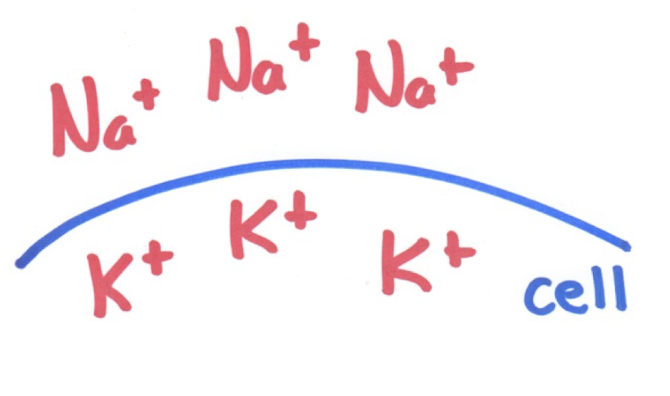
  • resting memb. potential: -60mv

    • measured using electrodes

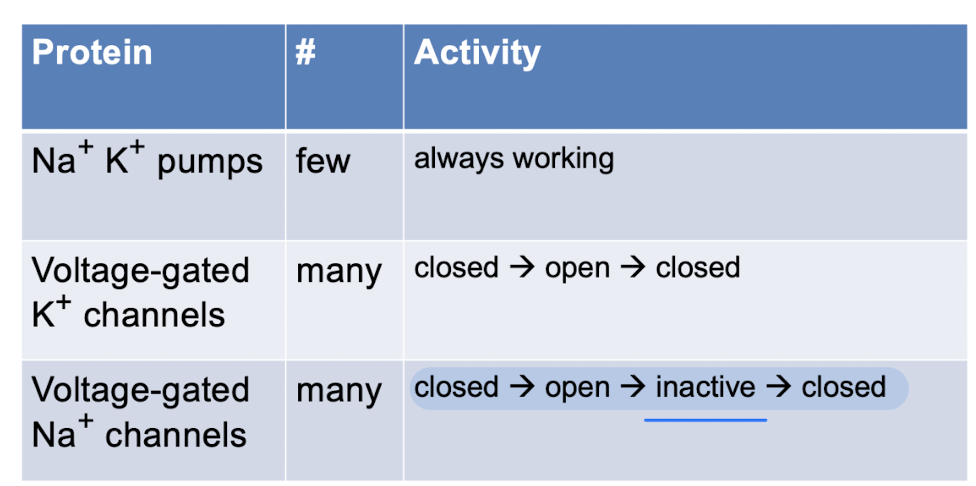
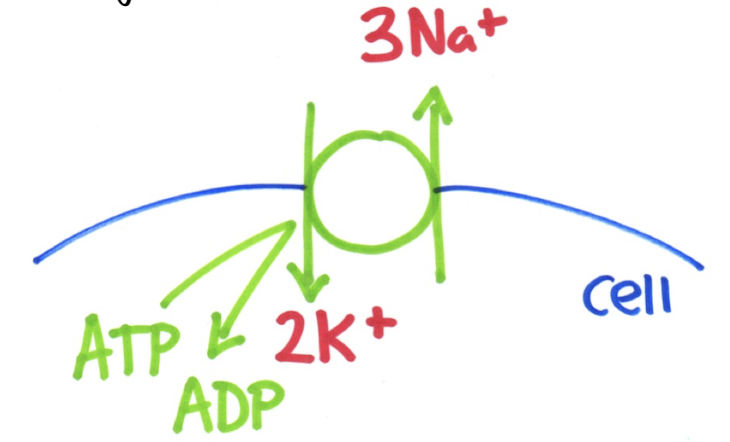
  • Sodium Potassium pump = exports 3 Na+ & imports 2K+ using ATP

    • non-gated (transporter) & antiport

→ responsible for ion gradient & membrane potential
3
New cards
<p>Neurons: Ion Channels</p>

Neurons: Ion Channels

2 Types:

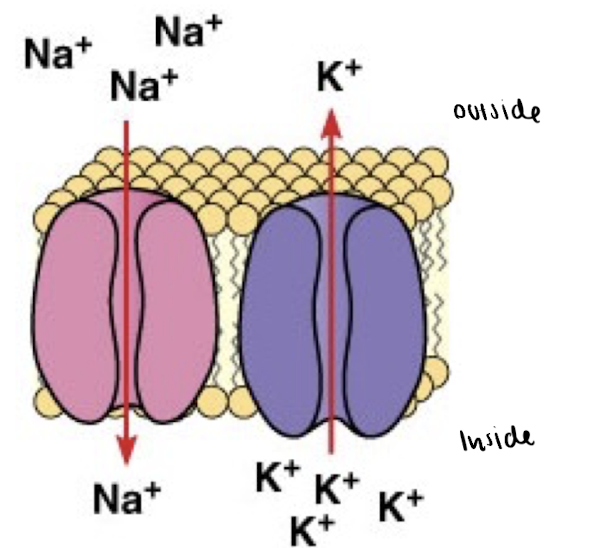
→ channels, passive, uniport, voltage-gated

below -40mv = CLOSED (resting)

→ above -40mv = OPEN
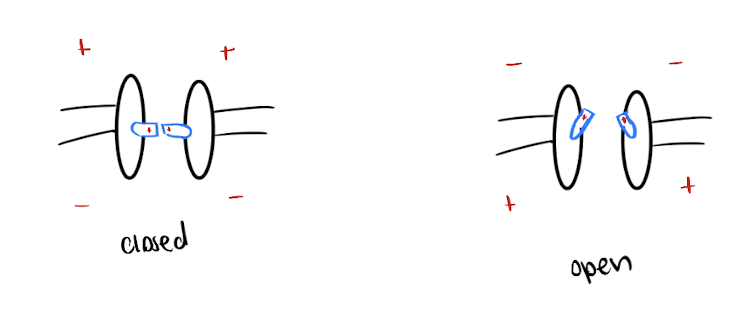
simplified view of voltage-gating
  1. Na+ channel (into cell)

  • quicker to open

  • channel inactivated → 3 states instead of 2

  • states: closed → depolarized (open) → inactivated (membrane refractory)
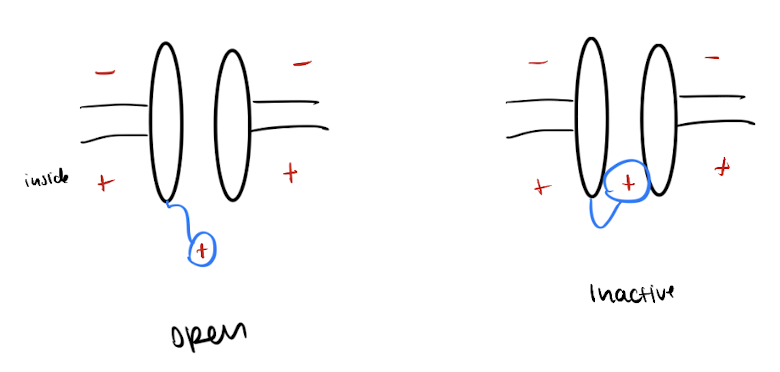
    simplified view of channel inactivation

  1. K+ channel (out of cell)

  • homotetramer

  • states: closed → depolarized (open)

<p><u>2 Types:</u></p><p>     → channels, passive, uniport, <strong>voltage-gated </strong></p><p><strong>     → </strong>below -40mv = CLOSED<em> (resting)</em></p><p>     → above -40mv = OPEN</p><img src="https://assets.knowt.com/user-attachments/ad6b1536-5d57-4896-a77e-022d1a52f05d.png" data-width="50%" data-align="center" alt="simplified view of voltage-gating"><ol><li><p>Na+ channel (into cell)</p></li></ol><ul><li><p><em>quicker to open</em></p></li><li><p><strong>channel inactivated → 3 states instead of 2</strong></p></li><li><p>states: closed → depolarized (open) → inactivated (membrane refractory)</p><img src="https://assets.knowt.com/user-attachments/5acfebfb-a596-4362-8a0c-4edc00f0cbb8.png" data-width="50%" data-align="center" alt="simplified view of channel inactivation"><p></p></li></ul><ol start="2"><li><p>K+ channel (out of cell)</p></li></ol><ul><li><p><em>homotetramer</em></p></li><li><p><em>states: closed → depolarized (open)</em></p></li></ul><p></p>
4
New cards
<p>Action Potential: Stages</p>

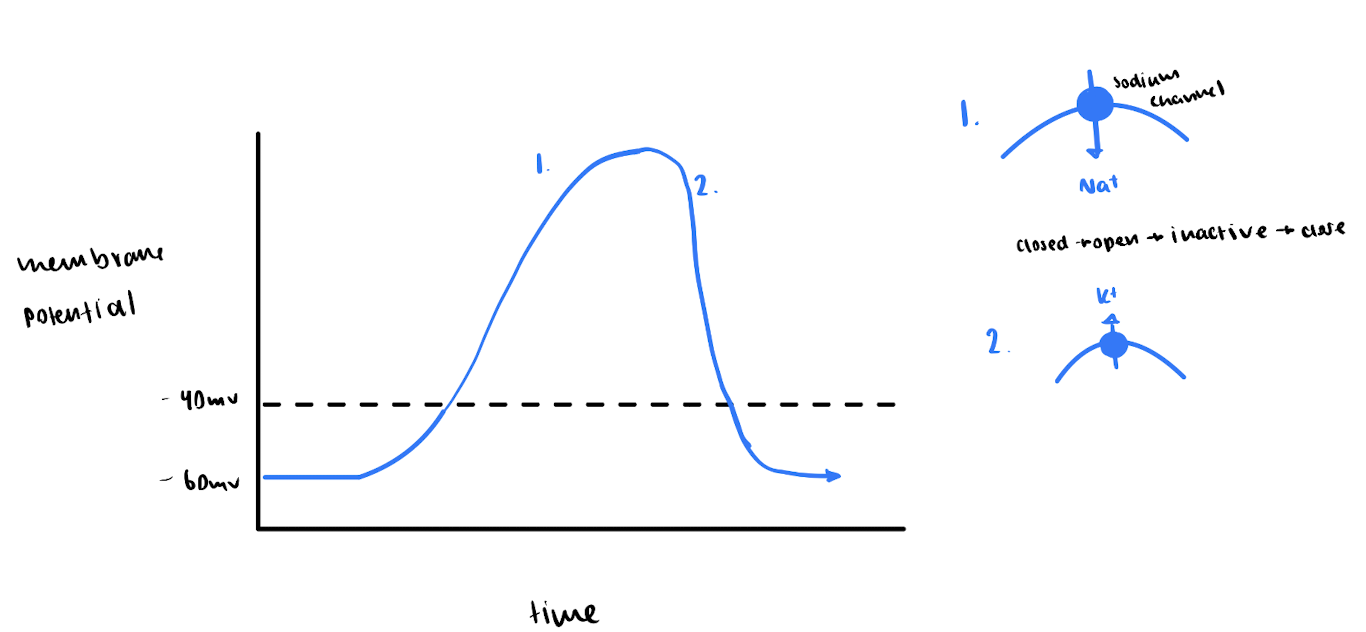
Action Potential: Stages

  1. resting potential: closed channels

  2. threshold depolarization: nearby Na+ channels open → raise membrane potential

  3. depolarizing phase: once it passes -40mv → ALL Na+ channels open

  • increase potential

  1. repolarizing phase: Na+ channels inactivate → K+ channels open

  • decrease potential

  1. refractory period: no action potentials

  • Na+ channels are inactive & K+ channels are open

  1. ready for new action potential: Na+ & K+ channels close

5
New cards

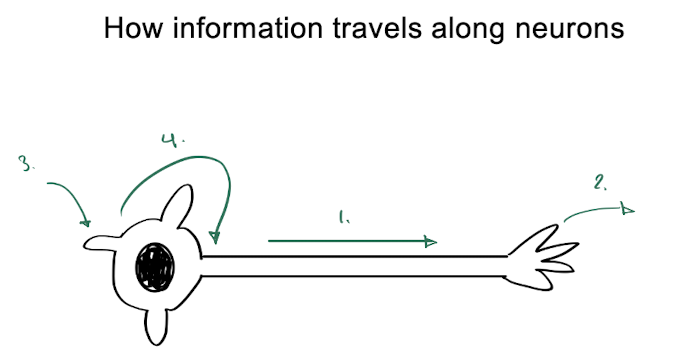
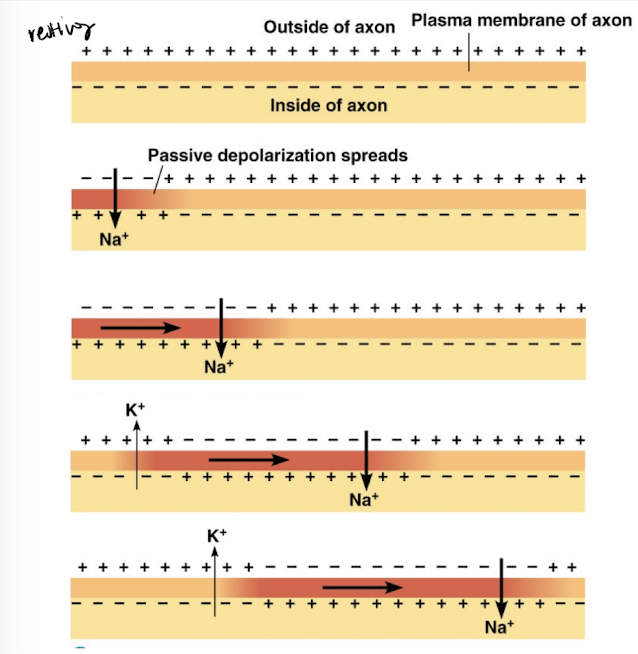
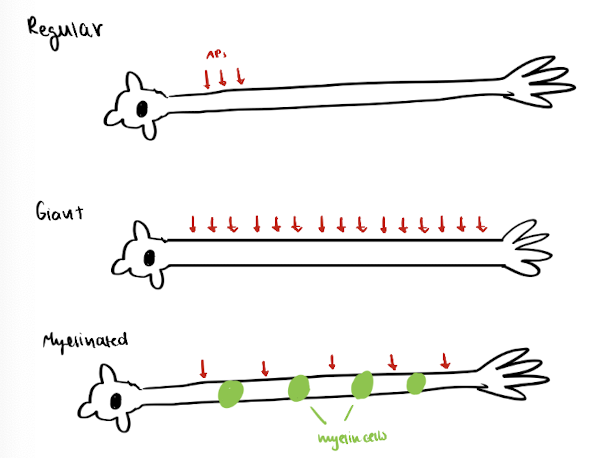
How Action Potentials Travel

Regular axons: ~5m/sec

  • doesn’t lose strength as it travels

Giant diameter axons = ~100m/sec

  • found in large invertebrates

Myelinated axons = ~100m/sec

  • found in vertebrates

  • use glial cells to wrap neuron with myelin
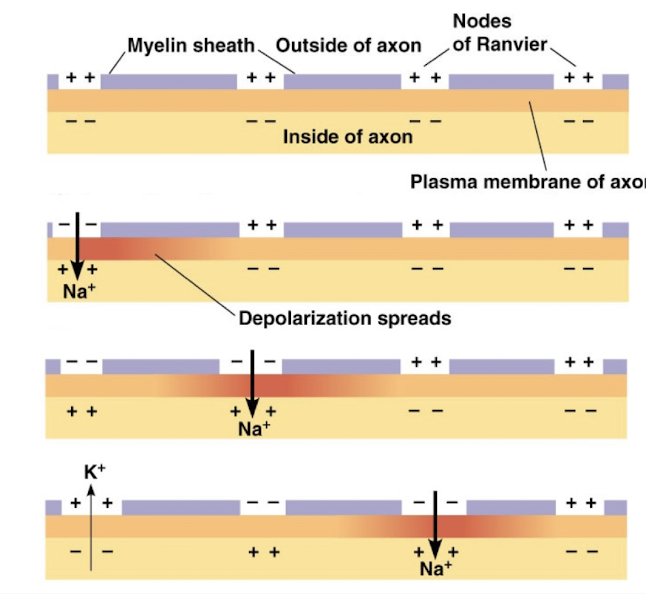
<p><strong>Regular axons</strong>: ~5m/sec</p><ul><li><p>doesn’t lose strength as it travels </p></li></ul><img src="https://assets.knowt.com/user-attachments/f999c879-c08b-4d43-93bf-733394367013.png" data-width="50%" data-align="center"><p></p><p><strong>Giant diameter axons</strong> = ~100m/sec</p><ul><li><p>found in large invertebrates </p></li></ul><p></p><p><strong>Myelinated axons</strong> = ~100m/sec</p><ul><li><p>found in vertebrates </p></li><li><p>use glial cells to wrap neuron with myelin </p></li></ul><img src="https://assets.knowt.com/user-attachments/82bbe15f-7e9a-47c6-84e4-325448fd3aba.png" data-width="50%" data-align="center"><p></p>
6
New cards

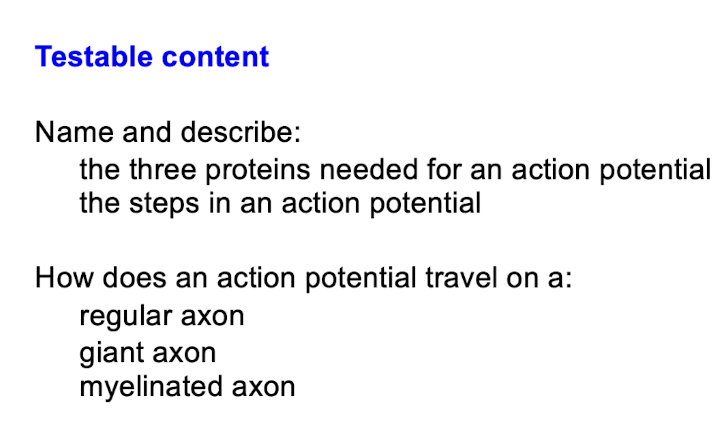
what are the 3 proteins needed for an action potential?

  1. sodium-potassium pumps

  2. voltage-gated Na+ channels

  3. voltage-gated K+ channels

7
New cards
<p>Examinable Content</p>

Examinable Content