Week 11 - Data Bias and Ethics
 Call Kai
 Learn
Learn Practice Test
 Spaced Repetition
 Match
Match Flashcards
 Knowt Play
1/6

There's no tags or description
Looks like no tags are added yet.
Name | Mastery | Learn | Test | Matching | Spaced | Call with Kai |
|---|
No analytics yet
Send a link to your students to track their progress
7 Terms
Ethics in ML
About value-driven decision-making, encompassing whether and how ML systems should be used, including (but not limited to) bias considerations.
Example: Deciding whether to deploy a facial recognition system at all in a public space due to concerns about privacy and mass surveillance, regardless of how biased it is.
Bias in ML
A technical property of models that can often be measured and mitigated.
Refers to systematic errors leading to consistent distortions in the output of a machine learning model, often resulting from inherent limitations in the data used for training or from the algorithm itself.
Biases can lead to unfair or discriminatory outcomes, as the model may exhibit preferences or inaccuracies that disproportionately impact certain groups or individuals
Example: A facial recognition system that performs worse on certain groups of people due to under-representation in the training data.
Types of Bias in ML
Data Collection
Sampling Bias - We sample data from the wider population in a non-uniform way
Exclusion Bias - During data cleaning, we may wish to exclude certain features and omit some data (outliers, missing data, etc)
Model Training
Technical Bias - We decide what method, type of regularization, hyperparameters, etc that all impact model output prediction.
Model Deployment
Contextual Bias
We may misuse the model by
deploying it in a way not intended
during training.We may selectively censor the
model's output.We may deploy the model in a way
that does not benefit all of society
equally.
Real World
Real world (historical) bias - High-quality data does not exist for all groups and events equally
Techniques to Prevent Bias
To ensure your model is ethical you should create an outer feedback loop to ensure that the model is compliant with stakeholder ethical concerns.
You may make modifications to any of the stages in your ML pipeline to ensure the model is ethical.
This includes checking how the model is being used and what impact is having on certain groups.
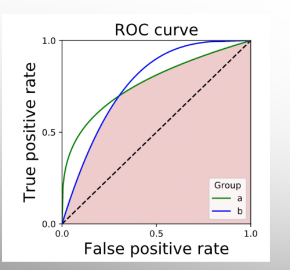
Tuning Thresholds for Fairer Models
Given a trained Bayesian binary classification model, suppose there are two groups within the training data set.
Plot the ROC curve for both groups separately.
Pick the model threshold where the model gives the same TPR and FPR for both groups.
The challenge of understanding AI decisions
Issue: ML systems often lack explanations for their decisions
Challenge: Understanding the logic becomes harder as we develop more powerful algorithms
Consequence: Black box models can cause harm due to their opaque nature
Interpretability
In safety-critical domains, such as driverless cars, ensuring human life's safety is paramount. To achieve this, it's imperative to comprehend how machine learning (ML) models arrive at their predictions. By doing so, we empower ourselves to rectify potential failure modes and make ethical decisions proactively, rather than relying solely on algorithmic outputs.
Neural Networks (NN) exhibit remarkable capability in expressing a wide array of functions. However, deep NNs comprising thousands of neurons intricately anipulate and combine feature variables in ways beyond human comprehension
Simpler models like decision trees provide interpretable frameworks. By tracing the path of a decision tree, we can easily deduce the logic underpinning each decision, offering valuable insights into the model's decision-making process.