Altruism and Helping Behaviour
 Call Kai
 Learn
Learn Practice Test
 Spaced Repetition
 Match
Match Flashcards
 Knowt Play
1/58

Earn XP
Description and Tags
Why people are altruistic, when we help, how to increase helping behaviour
Name | Mastery | Learn | Test | Matching | Spaced | Call with Kai | Chat |
|---|
No analytics yet
Send a link to your students to track their progress
59 Terms
What is positive psychology?
Movement within behavioural sciences aimed at enhancing human strengths that make life worth living (e.g. creativity, joy, flow); focuses on how people + communities can fulfil their emotional, creative + behavioural potential + experience positive emotions + personalities within positive institutions
Martin Seligman (1991)
Home in dev psych + organisational sciences
Applied + action-research focus
Prosocial behaviour contributes to this + positive view of humankind
What is prosocial behaviour?
Broad range of beneficial behaviours (usually others benefit, but the person acting may benefit too
Acts that are positively valued by society (helpful + altruistic)
Opposite of antisocial
Independent of reinforcement
Goes against egoist paradigm
Wispé (1972) → behaviour that has positive social consequences + contributes to the physical or psych WB of another person
Voluntary + intended to benefit others (Eisenberg, Fabes, Karbon, Murphy, Wosinski, Polazzi, et al., 1996)
Includes acts of charity, cooperation, friendship, rescue, sacrifice, sharing, sympathy and trust
Defined by social norms
What is helping behaviour?
Subset/form of prosocial behaviour (benefits others)
Acts that intentionally benefit someone else (can't be self-serving)
Can even be antisocial
Overhelping → when giving help is designed to make others look inferior (Gilbert & Silvera, 1996)
What is altruism?
Special form of helping behaviour, sometimes costly, that shows concern for fellow human beings + performed without expectation of personal gain (selfless)
What is the biological position on helping behaviour?
Humans have innate tendency to help others
Evolutionary social psychology = an extension of evolutionary psychology that views complex social behaviour as adaptive, helping the individual, kin and the species as a whole to survive
Explanations of cooperative behaviour in animals + humans
Mutualism = benefits the cooperator as well as other (a defector will do worse than a cooperator)
Kin selection = those who cooperate are biased towards blood relatives because it helps propagate their own genes (a lack of direct benefit to the cooperator indicates altruism)
Burnstein (1994) → favoured sick over healthy in daily situs but not in life or death situs, took more account of kinship in daily situs, more likely to help very young or old in daily situs but 10 or 18 yos under famine conditions
Accepted to a limited extent + rarely exclusively
What are the problems with the biological position on helping behaviour?
Lack of convincing human evidence (e.g. KG hard to explain at bio level -> 38 witnesses)
Doesn't consider SLT (especially modelling)
Buck + Ginsburg (1991) -> communicative gene disposes animals + humans to communicate ( incl. emotional signals important to social bond maintenance -> possibility of prosocial behaviour)
What is the biosocial position on helping behaviour?
Helping members of the same species evolved through natural selection BUT is shaped by contextual influences (Hoffman, 1981, Vine, 1983)
Bio mechs predispose you to act BUT if, when + how you act depends on history + immediate circumstances
A common experience before acting prosocially is a state of arousal followed by empathy (Gaertner & Dovidio, 1977; Hoffman, 1981) -> emotional response to someone's distress; ability to feel another person's experiences; identifying with and experiencing another person's emotions, thoughts and attitudes.
Affect + feeling-based (not just perspective taking -> cog based)
Why do people help?
Social exchange/potential rewards
Benefit self
Expect materials or sociopsych rewards in return → suggests we weight up costs/benefits of helping
Relieve distress (Piliavin, 1981) or guilt (McMillem + Austin, 1971)
Social norms
Reciprocity + social responsibility
BUT depends on reasons for their need for help (Barnes, 1979) or if your attributions evoke sympathy (Rudolph, 2004)
Evolutionary explanation
Kin protection + reciprocity in helping (benefits both individuals)
Genuine altruism
Solely to benefit another people because we empathise with them (Batson, 1981) → empathy-altruism hypothesis
Does genuine altruism exist?
No → all helping ebenfits self psychologically (Piliavin, Cialdini)
Yes
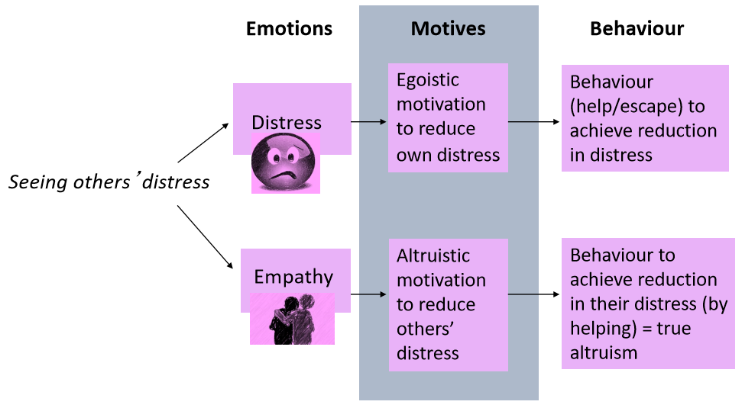
Batson → 2 primary routes to helping, 1 is driven by empathy
Empathy involves understanding others’ subjective experiences + the more we can do this, the more we are likely to help
Helping which is motivated by empathy is true altruism
What is the bystander-calculus model? What does it suggest about altruism?
In attending to an emergency, the bystander calculates the perceived costs and benefits of providing help compared with those associated with not helping
Involves body + mind (physio + cog processes)
Find it unpleasantly arousing + seek relief → help
Altruism is motivated by self-interest
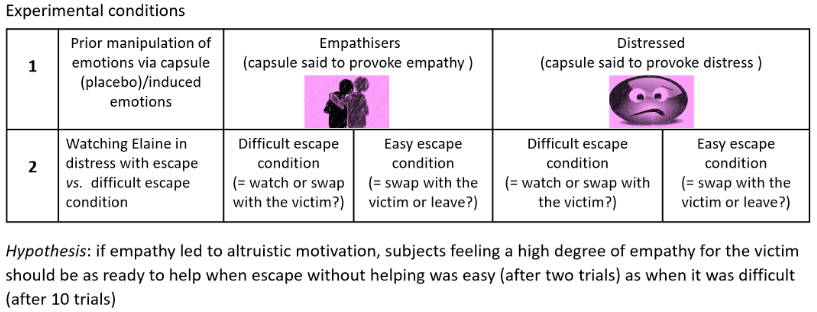
Bierhoff + Rohmann (2004) → true altruism is most likely to emerge in situations where the potential helper could easily not help (just quietly escape or slip away)
Empathy directs us to action
What concepts are involved in the bystander-calculus model?
Empathy costs of not helping = can cause distress to a bystander who empathises with a victim's plight (e.g. anxiety)
Personal costs of not helping = can be costly to a bystander (e.g. experiencing blame)
Critical factor = relationship between bystander + victim
Other factors = clarity + severity of emergency, characteristics of victim (greater need for help = greater cost of not helping), similarity to bystander (Krebs, 1975, greater arousal -> greater empathy costs))
According to Goetz (2010), what is the difference between empathy and compassion?
Compassion = 'the feeling that arises in witnessing another's suffering and that motivates a subsequent desire to help'
Compassion = distinct emotion (can be linked to compassionate love felt for others) BUT empathy = vicarious emption triggers by the plight of others
What are Piliavin’s (1981) steps involved in the bystander-calculus model?
Physiological arousal (more arousal = more likely to help, quicker we react = quicker response)
Labelling the arousal (cognitions about arousal determine emotions e.g. distress)
Evaluating the consequences
How does Piliavin’s position explain KG’s murder?
Empathy costs weren't sufficiently high despite feeling arousal, personal distress + empathetic concern, personal costs were low (chance of getting hurt themselves)
According to Oswald (1996), what does empathy require?
Perspective taking
Decety + Lamm (2006) -> PT has evolutionary significance
Some non-human primates respond to the feelings of others, but humans can both feel and act intentionally on behalf of others -> this capacity may account for the importance of empathic concern in altruism
Empathetic concern = element in Batson's theory of helping behaviour, in contrast to personal distress (which may lead us to flee from the situation), it includes feelings of warmth, being soft-hearted and having compassion for a person in need
Batson
Appreciating how another person feels vs taking on the other's feelings as your own -> different kinds of empathy lead to different kinds of motivation to help (altruistic motivation vs empathy + self-oriented distress/egoism)
Women seem to be more empathetic than men (Klein & Hodges, 2001) -> Batson explains in terms of socialisation
Women value interdependence + are more other-oriented, while men value independence + are more self-oriented
How does Batson’s (1981) research support the 2 routes to helping?
48 F psych students watched video of F confederate in distress (receiving shocks in performance task through 10 trials)
Results
Those who felt empathy helped by swapping with F in both conditions
Those who felt distressed helped only to relieve their own distress → only helped when they couldn’t escape
How do Schaller and Cialdini (1988) disagree with Batson’s empathy-altruism hypothesis?
Empathetic PPTs experience a negative mood + help to relieve this mood (selfish psych reasons) → negative state relief model
Evidence: if they’re given an alt way to improve mood (e.g. watching comedy) they won’t help mood
BUT Schroeder (1988) → PPTs were told that their mood had been frozen by a mood fixing drug + empathetic PPTs still wanted to help
What did Batson (2001) conclude about egoism and altruism?
Sometimes people do act altruistically
Empathy-induced altruism is part of human nature
Bethlehem (2016) → empathetic people (questionnaire) are more likely to help in a real-life situation (cyclist study with only 7% of empathetic passerby helping)
BUT altruism is mostly determined by love + caring about others (rather than empathy) (Farsides, 2007)
What is the social position on helping behaviour?
Classical + instrumental conditioning + observational learning contribute to being prosocial
How does Zahn-Waxler relate helping behaviour to childhood learning?
How we respond to distress in others is connected to the way we learn to share, help and provide comfort, and that these patterns emerge between the ages of 1 and 2
Children who behave prosocially are also able to tolerate a delay in gratification (Long & Lerner, 1974) + are more popular with their peers (Dekovic & Janssens, 1992)
Close developmental links between prosocial skills, coping and social competence (Eisenberg, 1996) → suggests an overall socialisation process into adulthood
In what ways can helpful responses be learnt in childhood?
Giving instructions
Establishes an expectation + later guide for action in children
Grusec (1978) → telling children to be helpful to others works
BUT must model this behaviour too
Using reinforcement
BUT also less likely to help again if there's no reward
Exposure to models
Rushton (1976) → modelling is even more effective than reinforcement
Viewing prosocial behaviour improves attitudes towards it (Coates, 1976; Rushton, 1979)
BUT effect on prosocial behaviour was weak + even weaker was time passed
What else can children profit from? What is the evidence of this?
Simple education in moral reasoning
Rosenkoetter (1999) → children who watched television comedies that included a moral lesson engaged more frequently in prosocial behaviour than children who did not (provided they understood the principle involved)
Gentile (2009) → when the video content was prosocial, PPTs acted in more helpful ways BUT when it was violent, they acted in more hurtful ways (effects were consistent across cultures + age groups)
Effects of the media includes music
Greitmeyer (2009) → both German + British PPTs who listened to prosocial songs were more willing to offer help to other people, without request
Greitmeyer + Osswald (2010) → viewing prosocial videos increased the rate of helping behaviour + these videos made prosocial cognitions more accessible
What can be an even more powerful source of learning helping behaviour than reinforcement? What is the evidence of this?
Self-attribution
Young children who were told they were 'helpful people' donated more tokens to a needy child than those who were reinforced with verbal praise + this effect persisted over time (Grusec & Redler, 1980)
Evaluate people's character to decide whether to help them
Just-world hypothesis (learned attribution) = do this to make the world seem like a just place where bad things happen to bad people + good things to good people (don't have to help them if they're bad)
What are Miller’s (1977) factors that can convince a would-be helper (allows us to decide that giving aid 'right now' will be effective)?
The victim is a special case rather than one of many
The need is temporary rather than persisting
Warren + Walker (1991) → more donations were recorded when the letter highlighted that: the donation was restricted to this specific family (not extended to other people in Sudan) + the family's need was only short term (the case was just and action would be effective)
What are other explanations for helping behaviour?
Attributing own arousal experiences by encountering a person in need of help to this situation + then weighting costs/benefits of helping for victim + bystander (Piliavin, 1981; Dovidio, 2006)
Attributing causes to the problem of the person seeking help (Weiner, 1987; Hao, 2023)
Studennts asked to lend their lecture notes were more ready to do so when the student asking claimed they had eye treatment → less controllability = less culpability (vs went to beach)
What is bystander intervention?
Occurs when an individual breaks out of the role of a bystander and helps another person in an emergency
What stimulated the programme of research on bystander intervention?
Kitty Genovese’s murder
Who started a programme of research on bystander intervention? What were the results of this?
Latané + Darley (1968) → bystanders are less likely to help when others are present (bystander effect = the greater the number, the less likely it is that anyone will help)
Reality + consistency confirmed by Latané & Nida (1981) + Fischer (2011) (1960-2020, 7,700 PPTs → also found that BE weakened in dangerously-perceives situs, perpetrators were present + costs of intervention were physical + other bystanders were not strangers + all M
What is Latané and Darley’s (1970) cognitive model of helping behaviour?
Whether people help depends on the outcome of a series of cognitive decisions
These decision become more difficult the more people that’re present
In an emergency we have to:
Notice + attend to what’s happening
Interpret the situation as an emergency
Assuming responsibility
Decide what to do]=
![<ul><li><p>Whether people help depends on the outcome of a series of cognitive decisions</p><ul><li><p>These decision become more difficult the more people that’re present</p></li></ul></li><li><p>In an emergency we have to:</p><ul><li><p>Notice + attend to what’s happening</p></li><li><p>Interpret the situation as an emergency</p></li><li><p>Assuming responsibility</p></li><li><p>Decide what to do]=</p></li></ul></li></ul><p></p>](https://assets.knowt.com/user-attachments/d2679e29-8d7e-41c3-a93a-cead40fd611a.png)
What is involving in the ‘Noticing’ phase of Latané and Darley’s (1970) cognitive model of helping behaviour?
Latané and Darley (1968) → where’s the smoke experiment
Alone → noticed in <5s + 75% took action
With others → noticed in 20s + only 38% took action
Only 10% if the others were passive confederates
What is involving in the ‘Interpreting the situation as an emergency’ phase of Latané and Darley’s (1970) cognitive model of helping behaviour?
Latané and Darley (1968) → where’s the smoke experiment led to differences in interpretation (fire vs leak in air conditioning vs steam pipes vs truth gas)
Use others’ behaviours as clues (info influence) → may fuel misinterpretation (Prentice + Miller, 1996)
Aided by illusion of transparency (Gilovich, 1998) → overestimate others’ ability to read our internal states
IRL situations often involve dilemmas of interpretation as the situation is ambiguous
Latané + Rodin (1969) → woman in distress experiment
Less ambiguous situation → struggle with cabinet, crash + cry of pain
Alone → 70% helped
In pairs → 40% helped or 7% when passive confederate
In pairs of friends → 70% helped
Even in less ambiguous situations, our interpretations/explanations justified inaction (e.g. ‘I didn’t want to embarrass her’; a mild sprain)
What is involving in the ‘Assuming responsibility’ phase of Latané and Darley’s (1970) cognitive model of helping behaviour?
Diffusion of responsibility
Latané + Darley (1968) → having a fit experiment
Students discussed problems in adjusting to college life via mics in separate cubicles
Thought they were in groups of 2, 4 or 6
Heard person with epilepsy choke
Alone → 85% helped
With 2 others → 62% helped
With 4 others → 31% helped
What leads to bystander apathy?
Diffusion of responsibility
Transfer responsibility of (not) acting onto other present bystanders
1< is enough
People who are alone are most likely to help a victim because they believe they carry the entire responsibility for action (if they don't act, nobody will)
Audience inhibition → no intervention because of fear of social blunders (bystanders make us self-conscious)
Social influence → info influence (others as a model for action)
Ambiguity of emergency situations → people are more likely to help others when need is clear (Shotland + Shaw, 1976)
Communication → more likely to intervene when with friends than strangers
How does being strangers influence the bystander effect?
Slower communication
Less inhibition of prosocial behaviour when bystanders know each other
Gottlieb + Carver (1980) -> even among strangers, inhibition is reduced if the bystanders know that there will be an opportunity to interact later and possibly explain their actions
Christy + Voigt (1994) -> bystander apathy is reduced if the victim is an acquaintance, friend or relative, or is a child being abused in a public place
Levine & Manning (2013) -> even when bystanders are strangers, they may still help provided they share a self-relevant social category membership and associated social identity
Normative expectations about how to respond in a particular situation come into play if a social identity is primed by the context
What situational factors influence helping behaviour?
Seeing someone else help
Bryan + Test (1967) → M who had previously seen a M helping a W with her car were 50% more likely to help a woman with a flat tyre
Time pressures
Darley + Batson (1973) → good Samaritan experiment
If late only 10% of students stopped to help vs 66% who thought they had time
Perceived social similarity
Levine (2005) → sense of similarity with victim increases likelihood of helping
Daner
Fischer (2006) → depends on whether the situation is regarded as dangerous
Found not difference in helping between PPTs who were alone or with others when confronted with a dangerous situation (bystander effects didn’t occur)
When danger was low, the usual bystander effects were found
Dangerous situs are unambiguous + costs of not helping are higher
How can we increase helping behaviour?
Reduce ambiguity of situation (Bickman, 1975; Solomon + Solomon, 1981)
Increase individual’s sense of responsibility (Moriarty, 1975)
Personalise requests (Jason, 1984)
Provide more altruistic models + teach altruism (Beaman, 1978)
Greitmeyer (2009) → tested idea that exposure to prosocial music increases helping behaviour
Students who had listened to prosocial songs helped experimenter pick up more pencils she’d knocked over vs neutral songs
Music increased empathy
How do good moods influence helping behaviour?
Isen (1970) → teachers who were more successful on a task were more likely to contribute later to a school fundraising drive (7x more) → creates 'warm glow of success'
Momentary feelings on a relatively innocuous task can dramatically affect prosocial behaviour
When people feel good, they are less preoccupied with themselves +are more sensitive to the needs and problems of others
Being in a good mood means that people are more likely to focus on positive things (Isen, 1976), to have a more optimistic outlook on life + to see the world in pleasant ways (Isen & Stalker, 1982)
Even experiences such as reading aloud statements expressing elation, or recalling pleasant events from our childhood, can increase the rate of helping
How do bad moods influence helping behaviour?
Internally focused when in bad mood
BUT doesn't always reduce helping
Isen (1973) -> some kinds of concern (e.g. guilt) cause people to be more helpful
Van Doorn (2014) -> there can be prosocial behavioural consequences that revolve around combating injustice and promoting moral principles and cooperative conduct despite being in an angry mood
They concentrate on themselves, their problems and worries (Berkowitz, 1970), are less concerned with the welfare of others and help others less (Weyant, 1978)
Darley + Batson (1973) -> 10% 'quite late', 45% when 'just in time', 63% when 'early'
Is helping behaviour related to personality?
Lantané + Darley (1970) → helping behaviour CAN'T be predicted from personality measures (e.g. authoritarianism, alienation, trustworthiness, Machiavellianism + need for approval)
BUT Caprara (2012) → people who scored high on the attributes of agreeableness, self-transcendence values + empathic self-efficacy were more likely to engage in prosocial behaviour
BUT Huston (1981) → people who are consistently helpful in emergencies tend to be taller, heavier, physically stronger + better trained to cope with crimes and emergencies
Evidence for a 'Good Samaritan' syndrome of attributes is generally weak (Schwartz, 1977)
Helping behaviour is associated with the belief that our fate lies within our control, mature moral judgement, and the tendency to take responsibility for others' welfare (Eisenberg-Berg, 1979; Staub, 1974)
BUT small correlations
Willingness to forgive
Karremans (2005) → people who are willing to forgive a significant other (e.g. a partner) for offending them can later be more prosocial in general
Feinberg (2012) → evidence that differences in our capacity to feel embarrassed are a guide to how helpful we might be to others
People who are securely attached are more likely to be compassionate and altruistic (Mikulincer & Shaver, 2005)
Common view shared by researchers is that there is no stand-alone, altruistic or prosocial personality (Bierhoff & Rohmann, 2004)
Whether a person acts prosocially might, at best, be determined by their personality acting in unison with attributes of the situation and of the person requiring help (Gergen, Gergen, & Meter, 1972; Snyder & Cantor, 1998)
Sharrif (2016) -> religious priming did indeed significantly predict various measures of prosocial behaviour primarily directed towards religious ingroup members, and the effect was stronger among believers BUT also on-prosocial attitudes directed at out-groups + nonbelievers (e.g. racism)
How does living in big cities influence helping behaviour?
Latané + Darley (1970) -> size of one's hometown correlates with helping behaviour (smaller-town = more likely to help)
Amato (1983) -> negative correlation between population sizes in Australiana towns + helping strangers
What is terror management theory? How does this relate to helping behaviour?
The most fundamental human motivation is to reduce the terror of the inevitability of death (self-esteem may be centrally implicated in effective terror management)
Jonas (2002) -> a charity was rated more favourably when the pedestrians were in front of the funeral parlour
When people confront the inevitability of their own death they strive for symbolic immortality by defending their cultural world views
How does competence improve helping behaviour?
Awareness that 'I know what I'm doing' (Korte, 1971)
Specifically
People who were told they had a high tolerance for electric shock were more willing to help others move electrically charged objects (Midlarsky & Midlarsky, 1976)
People who were told they were good at handling rats were more likely to help to recapture a 'dangerous' laboratory rat (Schwartz & David, 1976)
The competence effect may even generalise: Kazdin + Bryan (1971) found that people who thought they had done well on a health examination, or even on a creativity task, were later more willing to donate blood
Relevance to emergencies
In reacting to a stranger who was bleeding, people with first-aid training intervened more often than those who were untrained (Shotland & Heinold, 1985)
Pantin + Carver (1982) -> bystander effect was weakened when PPTs felt more confident (saw films on first aid) at helping someone choking
Professional vs novice
Cramer (1988) -> nurses were more likely than the general students to help a workman who had apparently fallen off a ladder (nursers said they felt they had the skills to help)
Implied responsibility to use skills
How does being a leader vs a follower influence helping behaviour?
Baumeister (1988) -> being a leader acts as a cue to generalised responsibility (goes beyond has skill, will help) + in an emergency, the leader does not experience the same degree of diffusion of responsibility as ordinary group members
What are the gender differences in helping behaviour?
When the person in need of help is F, passing cars are much more likely to stop than for a M or for a M–F pair (Pomazal & Clore, 1973; West, Whitney, & Schnedler, 1975) + those who stop are typically young M driving alone
Eagly + Crowley (1986) → strongest combo of M being more helpful to F despite F generally showing more empathy than M
Eagly (2009) → M + F are alike in the degree to which their behaviour is prosocial, but differ in the kinds of actions that they perform
"the specialty of F is prosocial behaviours that are more communal + relational + that of M is behaviours that are more agentic + collectively oriented as well as strength intensive"
When are people most likely to engage in non-violent crime?
If the benefits are high and the costs are low -> fraud and tax evasion are often perceived as having high benefits and low costs (Hassett, 1981; Lockard, Kirkevold, & Kalk, 1980)
What factors of prosocial behaviour relate to property theft?
Responsibility + commitment
Prior commitment (can induce a prosocial act) = an individual's agreement in advance to be responsible if trouble occurs (e.g. committing oneself to protect the property of another person against theft -> responsible bystander)
Moriarty (1975) -> 20% vs 95% objected to theft when not committed vs committed
How does shoplifting relate to prosocial behaviour?
Bickman + Rosenbaum (1977) -> most people would report a thief to the management, if reminded by an experimental confederate
Mass media messages (e.g. posters) aren't effective in reducing shoplifting
Might influence attitudes about shoplifting and about reporting thieves, but not change the behaviour itself ( Bickman & Green, 1977)
Most effective tactic: lecture stressing how + why to report thefts + reasons why bystanders are sometimes inhibited from getting involved (Klentz & Beaman, 1981)
What evidence is there of cheating being dispositional (MacKinnon)?
Tend to be low in ability to delay gratification (Yates & Mischel, 1979)
High in sociopathic tendencies (Lueger, 1980)
High in need for approval (Milham, 1974)
Low in interpersonal trust (Rotter, 1980)
High in chronic self-destructive tendencies (Kelley, Byrne, Przybyla, Eberly, Eberly, Greenlinger, et al., 1985)
Low in adherence to the work ethic and in the desire to perform tasks industriously (Eisenberger & Shank, 1985)
High in the belief that transgressions are not automatically punished (Karniol, 1982)
How can cheating be explained in terms of arousal?
Why not cheat, at least when there is little chance of being caught (Scitovsky, 1980)?
Arousal as a thrill
Leuger (1980) -> arousal as distracting (unable to regulate behaviour)
43% cheated in relaxed condition
70% cheated in aroused condition
Warning students about to sit an exam of the penalties for being caught cheating paradoxically may increase cheating (Heisler, 1974), perhaps because they are more aroused
How can cheating be reduced?
Increase severity of punishments BUT only about one in five self-reported cheaters are ever caught (Gallup, 1978)
Guilt
Those who do cheat disapprove as strongly as those who do not (Hughes, 1981)
Dienstbier (1980) → reported some success from focusing less on students' assumed lack of morality and more on how to make ethical standards salient
Reducing student cheating by priming socially approved norms of academic honesty continues to show promise as an intervention in more recent experimental work (Lonsbary, 2007)
How do support networks relate to prosocial behaviour?
Dakof + Taylor (1990) → reactions of members of a support network are moderated by the nature of the relationship that people have with the victim + by the cultural constraints imposed on social interactions
55 cancer patients
Helpful acts (of intimate providers) = related to the victim's self-esteem + emotional support (concern, empathy + affection)
Helpful acts (of medical providers/other cancer patients) = informational + tangible support (prognosis + technical/medical care
Acts became misguided + unhelpful when either group stepped out of appropriate role
How is helping behaviour culturally relative?
Nadler (1986)
People in kibbutzim (socialised to cherish collectivism) sought help on a difficult task only when they thought the performance of their group was to be compared with other groups
Israeli city people (typically more Western + individualistic) sought help only when they thought their individual performance was to be compared with other individuals
How can prosocial behaviour be related to stereotypes?
People can also resist or react negatively to help when they feel that being helped confirms a negative stereotype that they are dependent and powerless in society
Wakefield (2012) -> women made aware of the dependency stereotype were less willing to seek help + those who did seek help felt worse the more help they sought
What did Ames (2004) argue about prosocial behaviour and judgement?
When we receive help, we attend 'to help from the heart (affect), from the head (cost–benefit), or by the book (roles)'
Recipient makes attributions about the helper's motives + interpret the help given in terms of what it means to the relationship
Which norms determine prosocial behaviour?
Reciprocity norm = we should help those who help us
We feel deeply indebted when someone freely makes a big sacrifice for us, but much less so if what they do is smaller and expected (Tesser, 1968)
People might give help only in return for help given in the past or anticipated in the future
People driven by egoism are more likely to act prosocially when they believe their reputations are at stake (Simpson & Willer, 2008)
Social responsibility norm = we should give help freely to those in need without regard to future exchanges
Members of a community are often willing to help the needy, even when they remain anonymous donors and do not expect or anticipate any social reward (Berkowitz, 1972b)
Usually applied selectively
Norms distinct to humans → BUT ideal that does not readily translate into actual behaviour (Teger, 1970) (depends on situational factors outlined)
What did Batson (1994, 2002) argue about prosocial behaviour and motivation?
What prompts us to help others is a matter of motivation, and motivation involves goals
Instrumental goal = intermediate step on the path to a person's ultimate self-interest
If instrumental goals only serve self-interest, then instrumental goal-oriented helping is not altruistic BUT if the 'self' in self-interest collective then instrumental goal-oriented behaviour that benefits the group or community and thus ourselves as part of the collective is closer to altruism
Ultimate goal= self-benefit is an unintended side-effect
What are Batson’s motives for helping others?
Egoism
Altruism (contributes to welfare of others)
Collectivism (contributes to welfare of social group)
Principlism (follows moral principle)
How does volunteering relate to prosocial behaviour?
Volunteering is critical to the maintenance of society + of communities embedded in society, particularly in times of economic + social hardship (Wilson, 2000)
For a community to benefit from a high level of volunteering, it must clearly identify situations + opportunities + enhance a sense of personal control among the volunteers (Clary & Snyder, 1991, 1999)
Volunteers commonly offer to others a sense of community, or civic participation (Omoto & Snyder, 2002)
E.g. acting as a companion for the elderly, counselling troubled people, tutoring the illiterate, making home visits to the terminally ill through the hospice movement or supporting people with AIDS
Batson allows that community involvement can be driven by an egoistic motive (Batson, 2002) BUT argues that it is just one of four + each have strengths + weaknesses
In recruiting volunteers, an effective strategy is to guide potential volunteers in ways that help them supplement egoism with additional reasons to volunteer based on altruism, principlism, or both
Can der Vliert (2004) -> the weight given to egoism + altruism depends on a country's ecology + overall wealth
Is martydom a form of altruism?
Not always altruistic (e.g. suicide bombers)
Suicide terrorism is better characterised as intergroup behaviour → designed to promote one's own group over a competing group + can be personally instrumental (terrorist organisations lure disadvantaged people into suicide attacks with the promise of substantial financial support for their family)
Bélanger (2009) → typically driven by religious + political ideologies
Ideology is not psychopathology, when martyrs + suicide terrorists are willing to die for a cause, they are neither altruists nor psychopaths