Biol 286 MC Exam Questions
 Call Kai
 Learn
Learn Practice Test
 Spaced Repetition
 Match
Match Flashcards
 Knowt Play
1/53

There's no tags or description
Looks like no tags are added yet.
Name | Mastery | Learn | Test | Matching | Spaced | Call with Kai |
|---|
No analytics yet
Send a link to your students to track their progress
54 Terms
In which of the following do microevolutionary changes occur?
A. gene
B. biomolecule
C. community
D. population
E. individual
D. population
Which of the following would NOT be a factor that influences how rapidly organisms may evolve?
A. The size of the population.
B. The number of haplotypes within the population.
C. The rates of environmental change organisms experience.
D. The generation time of the population.
E. The amount of genetic variation within the species.
B. The number of haplotypes within the population.
Horizontal gene transfer
A. may allow organisms to acquire genes that can contribute to increased fitness.
B. is most common among prokaryotes.
C. may occur between prokaryotes and eukaryotes.
D. All of the above are correct.
E. Only A and B are correct.
D. All of the above are correct.
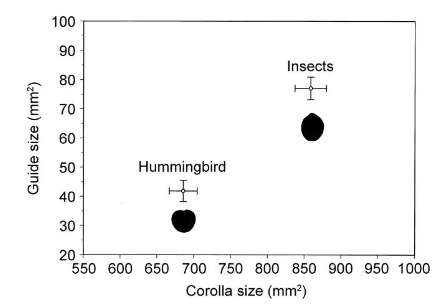
The figure below shows the average flower guide size as a function of corolla size preferred by
different pollinators of the monkey flower, Mimulus luteus, in Chile. This is an example of
A. directional selection favoring large corolla size.
B. directional selection favoring large guide size.
C. directional selection favoring small corolla and large guide size.
D. disruptive selection.
E. stabilizing selection
D. disruptive selection.
Individuals affected by Huntington’s chorea have high numbers (e.g. 40+) of a CAG trinucleotide
repeat in their huntingtin protein gene. This is an example of
A. directional selection
B. mutation
C. recombination
D. horizontal gene transfer
E. natural selection
B. mutation
When an island population of great tits, Parus major, was first sampled, researchers found between 8
and 17 eggs per nest (clutch size), with an average of 12. When the bird population was sampled
three years later, researchers found between 9 and 15 eggs per nest, with an average of 12. This is
an example of:
A. artificial selection.
B. directional selection favoring large clutch size.
C. directional selection favoring small clutch size.
D. disruptive selection.
E. stabilizing selection.
E. stabilizing selection.
Which of the following correctly describes phenotypic plasticity?
A. Different genotypes are found in different frequencies in different environments.
B. A phenotypically plastic population contains less genetic variation than a population that lacks
phenotypic plasticity for the same trait.
C. The degree of phenotypic plasticity in a population may be estimated by looking at reaction
norms.
D. All of the above are correct.
E. Only B and C are correct.
C. The degree of phenotypic plasticity in a population may be estimated by looking at reaction
norms.
If a population has a genetic locus with two alleles, what has occurred when one of the alleles goes to
fixation?
A. one of the alleles was eliminated from the population.
B. a new allele was introduced into the population.
C. one of the alleles occurs at a frequency of 1.0.
D. Both A and B are correct.
E. Both A and C are correct.
E. Both A and C are correct.
Which of the following is NOT an assumption of the Hardy-Weinberg Theorem?
A. no emigration
B. genetic drift
C. no immigration
D. no mutation
E. no natural selection
B. genetic drift
(For questions 10 and 11) The mean number of bristles on the abdomens of a population of Drosophila
pseudoobscura was 32. The mean number of bristles of D. pseudoobscura who survived to breed was
36. (Recall that R = h2S).
10. What is the selection differential on bristle number?
A. 36 bristles
B. 16 bristles
C. 32 bristles
D. 8 bristles
E. 4 bristles
E. 4 bristles
(For questions 10 and 11) The mean number of bristles on the abdomens of a population of Drosophila
pseudoobscura was 32. The mean number of bristles of D. pseudoobscura who survived to breed was
36. (Recall that R = h2S).
11. If the heritability of bristle number is 0.3, what is the average bristle number you expect to find in
the next generation of flies?
A. 32.36
B. 33.2
C. 34.8
D. 36.36
E. 37.2
B. 33.2
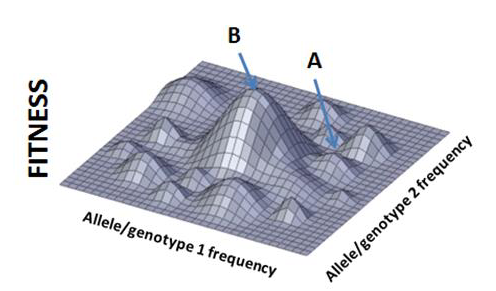
12. The above figure represents Wright’s adaptive landscape. What is the most plausible way for a
population to move from Point B to Point A?
A. Genetic drift
B. Mutation
C. Recombination
D. Natural selection
E. Gene flow
A. Genetic drift
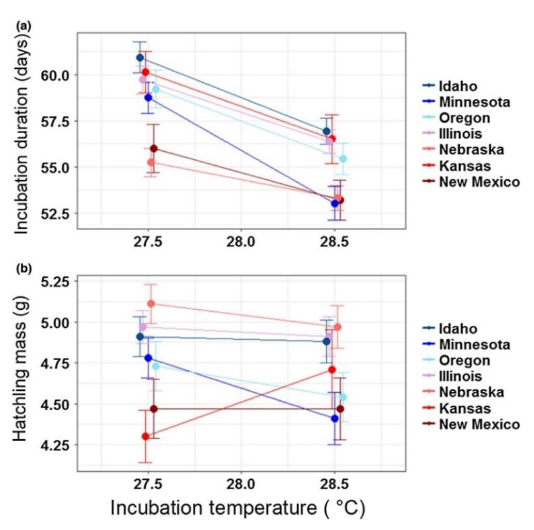
13. The figure below shows data on the effects of incubation temperature on: how long it takes eggs to
incubate to maturity (a; top graph) and the mass of the hatchings (b; bottom graph) for different
genotypes of painted turtles (bottom right) from different US states.
Based on the information in these figures, which of the following is/are correct?
A. All genotypes are plastic for incubation duration.
B. The environment has a greater effect on the duration of incubation than on the mass of
turtle hatchlings.
C. All genotypes are plastic for hatchling mass.
D. All of the above are correct.
E. Both A and B only.
E. Both A and B only.
14. If a plant breeding experiment that crossed two inbred parental strains resulted in heterosis, you
know that
A. sexual recombination occurred.
B. mutation occurred.
C. the offspring have higher fitness relative to either parental strain.
D. All of the above are correct.
E. Only A and C are correct.
E. Only A and C are correct.
15. In a population of pigs two influenza strains are present initially – A (H3 N2) and A (H5 N1). If a new
strain of influenza, A (H5 N2) is discovered in that pig population, what is the most plausible
explanation for how this new strain arose?
A. Inversion
B. Mutation
C. Recombination
D. Horizontal gene transfer
E. duplication
C. Recombination
16. Which of the following is/are a quantitative trait?
A. Bill depth in medium ground finches
B. Abdominal bristle number in Drosophila
C. Human height
D. All of the above
E. Both A and B only
D. All of the above
17. Trimethylaminuria is a genetic condition in humans which causes them to have a ‘fishy’ odor (fish
odor syndrome). This is because they have a defect in the enzyme flavin-containing monooxygenase
3 (FMO3), making it nonfunctional. This enzyme normally converts trimethylamine to
trimethylamine N-oxide. Trimethylamine N-oxide is odorless, but trimethylamine has a fishy odor
(and is what gives fish their fishy smell, but also protects the fishes’ proteins from destabilization).
Individuals with a nonfunctioning form of the enzyme have trimethylaminuria. This is the syndrome
the character Paul Hunham had in the 2023 movie The Holdovers.
The allele that produces the functioning form of the enzyme (use the symbol F) is dominant, and the
nonfunctioning form of the enzyme is produced by a recessive allele (f). The alleles follow the rules
of Mendelian inheritance.
In a population of 1000 individuals, the allele frequencies are F=0.7 and f=0.3. Assuming that there is
no immediate selection on this trait, how many individuals with trimethylaminuria would you expect
to find?
A. 490
B. 210
C. 90
D. 9
E. 420
C. 90
(For questions 18 – 20) The peppered moth, Biston betularia, experienced a dominant mutation in the
cortex gene, located on chromosome 17, about 1819 in England. This mutation is responsible for the
melanism mutation that causes dark coloration. The mutation is due to an insertion of a large, tandemly
repeated, transposable element into the gene’s first intron. The ‘normal’ (non-mutant) coloration
pattern is peppered light grey.
18. Melanism is a Mendelian trait. Refer to the alleles as M and m. The allele frequencies in a
population at Hardy-Weinberg equilibrium are M=0.3, m=0.7. Assuming that there is no immediate
selection on this trait, what is the expected frequency of melanistic moths in a population of 100
individuals?
A. 0.09
B. 0.51
C. 0.21
D. 0.42
E. 0.49
B. 0.51
(For questions 18 – 20) The peppered moth, Biston betularia, experienced a dominant mutation in the
cortex gene, located on chromosome 17, about 1819 in England. This mutation is responsible for the
melanism mutation that causes dark coloration. The mutation is due to an insertion of a large, tandemly
repeated, transposable element into the gene’s first intron. The ‘normal’ (non-mutant) coloration
pattern is peppered light grey.
After a coal power plant is established in the area, the number of individuals of each genotype that
survived is given below.
Which of the following represents how you would calculate absolute fitness
of the Mm genotype?
Genotype Number of surviving individuals
MM 9
Mm 3
mm 9
A. 3/9
B. 3/42
C. 3/0.42
D. 3/21
E. 3/18
B. 3/42
(For questions 18 – 20) The peppered moth, Biston betularia, experienced a dominant mutation in the
cortex gene, located on chromosome 17, about 1819 in England. This mutation is responsible for the
melanism mutation that causes dark coloration. The mutation is due to an insertion of a large, tandemly
repeated, transposable element into the gene’s first intron. The ‘normal’ (non-mutant) coloration
pattern is peppered light grey.
Genotype Number of surviving individuals
MM 9
Mm 3
mm 9
Which genotype will have the largest selection coefficient?
A. MM
B. Mm
C. mm
D. MM and mm will have equally large selection coefficients.
B. Mm
21. We discussed epigenetic modifications to the genome. Which of the following are correct about
these modifications?
A. Histone acetylation would decrease gene expression.
B. DNA methylation would decrease gene expression.
C. epigenetic modifications may be heritable.
D. All of the above are correct.
E. Both B and C are correct.
E. Both B and C are correct.
22. Altruistic behaviors
A. are expected to evolve when the benefit of the behavior outweighs the cost of the behavior.
B. may result in the death of the individual exhibiting the behavior.
C. may be detected by family as well as non-family members.
D. All of the above are correct.
E. Only A and B are correct.
D. All of the above are correct.
23. Among Belding’s ground squirrels, males leave the area where they were born when they reach a
threshold body mass, which may vary slightly given particular individual’s boldness behavior. The
explanation for this male Belding’s ground squirrel behavior of is an example of
A. a proximate mechanism
B. an ultimate mechanism
C. a stimulus response behavior.
D. Both A and C only.
E. Both B and C only.
A. a proximate mechanism
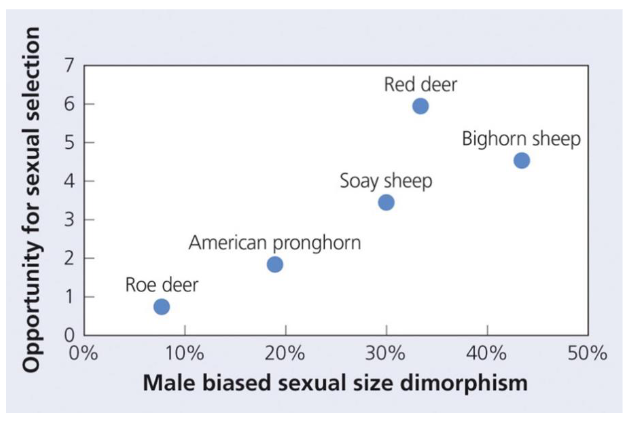
24. Consider the figure below:
Which of the following would you expect to find for the different species represented in the figure?
A. Variation in mating success among red deer males is likely to be more than variation in mating
success among roe deer males.
B. Variation in mating success among bighorn sheep males is likely to be more than variation in
mating success among American pronghorn males.
C. Mating success among red deer females is likely to be similar to mating success among roe deer
females.
D. All of the above are expected.
E. Both A and B are expected.
D. All of the above are expected.
25. Belding’s ground squirrels produce a different vocalization in response to detecting an aerial
predator versus a terrestrial predator. This is an example of:
A. a stimulus response behavior.
B. behavioral plasticity.
C. a fixed action pattern.
D. All of the above.
E. Both A and C only.
B. behavioral plasticity.
26. (Bonus) What is the most current conservation status, under the Endangered Species Act, of Grizzly
Bears (Ursus arctos horribilis) in the lower 48 states?
A. threatened
B. endangered
C. vulnerable
D. no current protection
A. threatened
27. (Bonus) Which of the following individuals defined evolution as ‘a change in the frequency
of an allele within the gene pool?
A. James Crow
B. Theodosius Dobzhansky
C. R.A. Fisher
D. JBS Haldane
E. Sewall Wright
B. Theodosius Dobzhansky
1. Which of the following is/are likely to result in stabilizing selection?
A. Positive assortative mating
B. Negative assortative mating
C. Polygyny
D. Both A and C only.
E. Both B and C only.
B. Negative assortative mating
2. Which of the following organisms would be classified as cooperative breeders?
A. Florida scrub jays
B. White-throated sparrows
C. Naked mole rats
D. All of the above.
E. Both A and C only.
E. Both A and C only.
3. In order to maximize your fitness, which of the following should you do? (Read each option carefully)
A. Have two children of your own instead of helping your parents raise two additional siblings that
they would not be able to raise without your help, to maximize direct fitness.
B. Help your parents raise four additional siblings that they would not be able to raise without
your help instead of having two children of your own, to maximize indirect fitness.
C. Help your parents raise two additional siblings that they would not be able to raise without your
help instead of having two children of your own, to maximize direct fitness.
D. Have two children of your own instead of helping your parents raise two additional siblings that
they would not be able to raise without your help, to maximize indirect fitness.
E. Help your parents raise four additional siblings that they would not be able to raise without your
help instead of having two children of your own, to maximize direct fitness.
B. Help your parents raise four additional siblings that they would not be able to raise without
your help instead of having two children of your own, to maximize indirect fitness.
4. The patagium (webbed skin between the forelimb and hindlimb) of sugar gliders and flying squirrels
are an example of
A. homologous characteristics
B. analogous characteristics
C. parallel evolution
D. Both A and C only.
E. Both B and C only.
B. analogous characteristics
5. Which of the following describe the mating strategies among male ruff (Calidris pugnax)?
A. The independent males are the ancestral breeding phenotype.
B. Female mimics are the more recently evolved phenotype.
C. The strategies are correlated with different amounts of testosterone circulating in the male’s
blood.
D. All of the above are correct.
E. Both A and C are correct.
E. Both A and C are correct.
6. Which of the following can be true for an organism that migrates?
A. It may reproduce in an area where it was born.
B. It may never return to the area where it was born.
C. It may change habitats to track abundant resources.
D. All of the above are correct.
E. Both A and C are correct.
D. All of the above are correct.
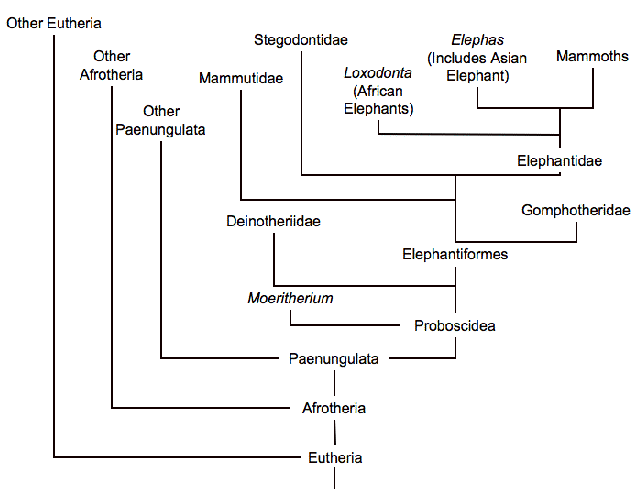
7. Based on the evolutionary tree above, which of the following belong to the Elephantidae clade?
A. Mammoths
B. Stegodontidae
C. Mammutidae
D. All of the above do.
E. Both A and C only do.
A. Mammoths
8. If a new species evolved by peripatric speciation, you would expect that the new species
A. became reproductively isolated from the ‘parent’ species.
B. had a change in ploidy relative to the parent species.
C. was subject to genetic drift.
D. All of the above are expected.
E. Both A and C are expected.
E. Both A and C are expected.
9. If a species has ecotypes
A. The ecotypes may become reproductively isolated from other ecotypes.
B. There may be a reduction in gene flow among the different ecotypes.
C. Emigration to a new habitat may result in selective pressures that produce more ecotypes.
D. All of the above are expected.
E. Both A and C are expected.
D. All of the above are expected.
10. In their analyses of giraffe genomes, Fennessy et al. used different genetic data, including
microsatellites. Microsatellites
A. may be found in mitochondria.
B. are only found in eukaryotes.
C. are short segments of repeated DNA.
D. All of the above are correct.
E. Both A and C are correct.
E. Both A and C are correct.
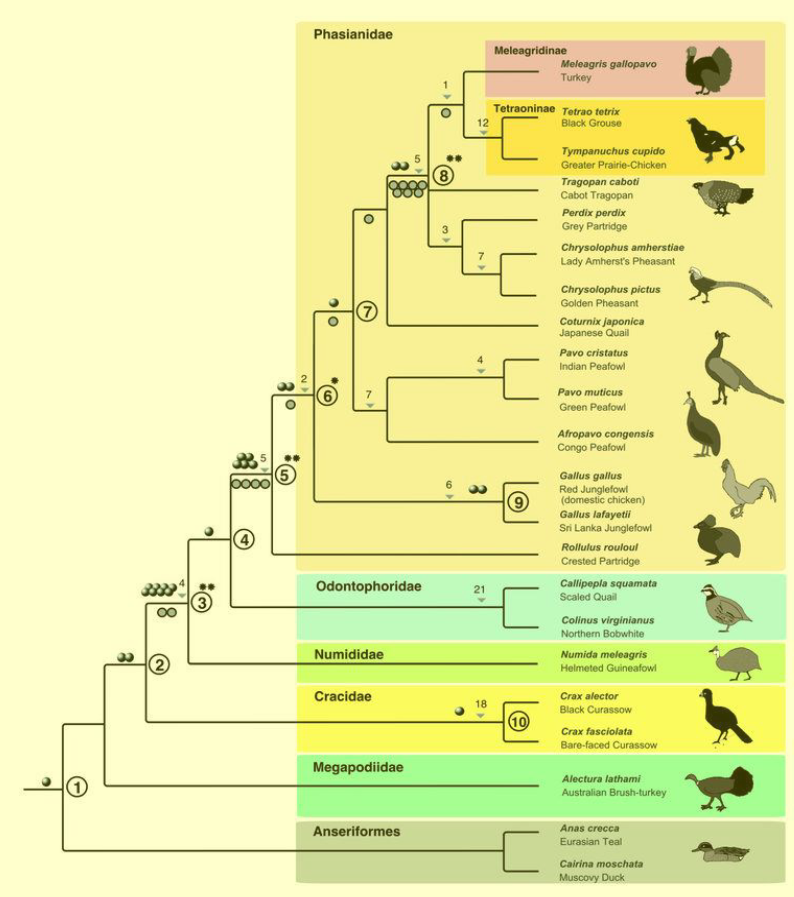
11. The phylogenetic tree below by Kreigs et al. represents a hypothesized evolutionary relationship
among the gamebirds (Galliformes). Based on the tree, which of these birds evolved most recently?
A. Crested partridge
B. Congo peafowl
C. Golden pheasant
D. Japanese quail
E. Grey partridge
C. Golden pheasant
12. Which of the following is NOT a prerequisite to demonstrate adaptive radiation?
A. Demonstrated adaptive value of trait in different environments.
B. Demonstrated common ancestry.
C. Heritability of traits.
D. Phenotype-environment correlation that links divergent phenotypes of descendant species and
their differing environments
E. Rapid speciation.
C. Heritability of traits.
13. Although we have discussed species on the verge of extinction, new species get identified every
year, and there is not general agreement on the number of species that actually exist. Which of the
following is/are correct?
A. Larsen et al. (2017) hypothesized that the majority of species on the planet are protists.
B. Fossil remains may not be used to identify a new species.
C. Different organizations oversee the approval and naming of new species, depending upon the
type of organism it is.
D. All of the above are correct.
E. Both A and C are correct.
C. Different organizations oversee the approval and naming of new species, depending upon the type of organism it is.
14. Which of the following great apes was the first to diverge from the remainder of the great apes?
A. bonobos
B. chimpanzees
C. gibbons
D. gorillas
E. orangutans
E. orangutans
15. Introgression
A. Allows alleles from the gene pool of one species to get incorporated into the gene pool of
another species.
B. Does not involve hybridization.
C. Has not been observed in Homo sapiens but has been observed in other great apes.
D. All of the above are correct.
E. Both A and C only.
A. Allows alleles from the gene pool of one species to get incorporated into the gene pool of
another species.
16. Sequential hermaphrodites
A. are able to produce sperm and eggs over the course of their lifetime.
B. Function first as a female and later as a male if they are a protandrous species.
C. Function reproductively as a male and female simultaneously.
D. Both A and B are correct.
E. Both B and C are correct.
A. are able to produce sperm and eggs over the course of their lifetime.
17. Which of the following organisms have overlapping generations?
A. Greater sage grouse
B. Kaliella paraparesis snails
C. mayflies
D. All of the above.
E. Both A and B only.
E. Both A and B only.
18. Which of the following is true about data in a cohort life table?
A. Age-specific survivorship may only decrease over time.
B. Age-specific survivorship and the mean number of individuals alive between one age class and
the next can be used to calculate the net reproductive rate.
C. Age-specific fecundity may decrease over time.
D. All of the above are true.
E. Only B and C are true.
C. Age-specific fecundity may decrease over time.
19. The Disposable Soma hypothesis gives rise to the testable prediction(s) that
A. Selection has maximized organisms’ abilities to resist and repair damage.
B. There is a tradeoff between energy allocation to cellular repair versus reproduction.
C. Senescence is caused by an accumulation of cellular damage.
D. All of the above are correct.
E. Only B and C are correct.
E. Only B and C are correct.

20. The figure below shows the population of Japan from 2014 - 2025. Considering the data from 2021,
what do you expect to be true about the R0 value?
A. It is less than zero.
B. It is less than 1.0
C. It is greater than 1.0
D. It is equal to 1.0
B. It is less than 1.0
21. Which of the following characteristics would prevent an organism from achieving relatively high
population densities?
A. Resource specialization
B. The absence of pathogens in their environment
C. Small body size
D. Social cooperation
E. The absence of predators in their environment
A. Resource specialization
22. If a population is growing exponentially,
A. Recruitment rate increases as a function of N.
B. Resources are not limiting.
C. Population growth is density-dependent.
D. All of the above are correct.
E. Only A and B are correct.
E. Only A and B are correct.
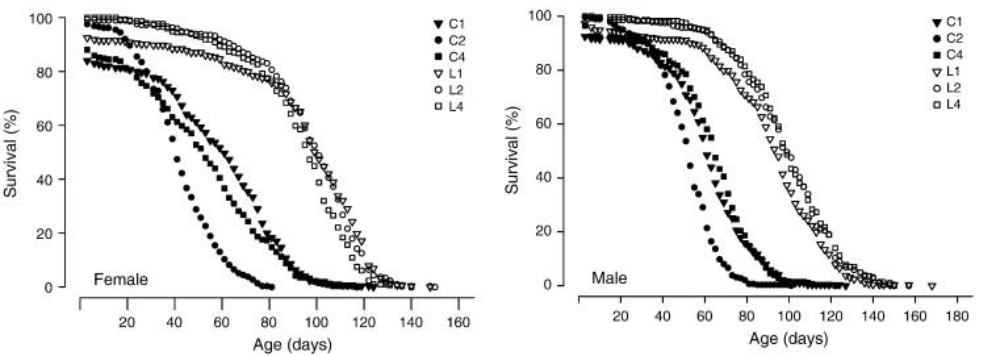
23. The figures below show the survivorship curves of female (left) and male (right) Drosophila of
different genetic lineages, grown under the same environmental conditions. Based on the data in
these figures, you can conclude that:
A. There is phenotypic variation in Drosophila survivorship.
B. There is phenotypic variation in Drosophila longevity.
C. Longevity in Drosophila is a trait that has evolved by natural selection.
D. All of the above are correct.
E. Only A and B are correct.
E. Only A and B are correct.
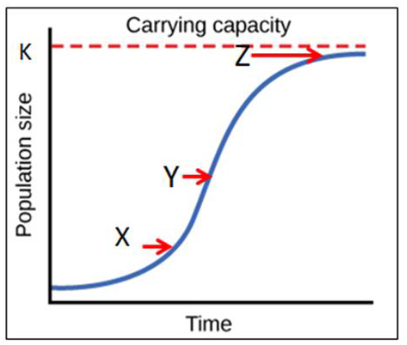
24. Consider the population growth curve below:
Rank the points (X, Y, Z) in order from LOWEST recruitment rate value to GREATEST recruitment rate
value:
A. X, Y, Z
B. Y, Z, X
C. Z, X, Y
D. X, Z, Y
E. Y, X, Z
C. Z, X, Y
25. If mortality in early life stages occurs due to infanticide, this is an example of
A. Top-down, density-dependent population regulation.
B. Bottom-up, density-dependent population regulation.
C. Top-down, density-independent population regulation.
D. Bottom-up, density-independent population regulation.
A. Top-down, density-dependent population regulation.
26. (Bonus) Of the four species of giraffe now recognized, which has the smallest population size?
A. Masai
B. Northern
C. Reticulated
D. Southern
B. Northern
27. (Bonus) What is Charles Darwin’s birthdate?
A. February 21, 1819
B. February 21, 1809
C. February 12, 1809
D. February 12, 1819
E. February 12, 1829
C. February 12, 1809