Topic 20: Biotechnology & Genetic Modification
 Call Kai
 Learn
Learn Practice Test
 Spaced Repetition
 Match
Match Flashcards
 Knowt Play
1/13

There's no tags or description
Looks like no tags are added yet.
Name | Mastery | Learn | Test | Matching | Spaced | Call with Kai |
|---|
No analytics yet
Send a link to your students to track their progress
14 Terms
Why is bacteria useful in biotechnology and genetic modification?
Due to their rapid reproduction rate and their ability to make complex molecules.
What are 2 reasons that bacteria is useful in biotechnology and genetic modification?
There are few ethical considerations to growing them in large numbers in the laboratory.
They possess plasmids, small, circular loops of DNA which can be an ideal way of transferring DNA from one cell to another during genetic manipulation.
What is the the role of anaerobic respiration in yeast during the production of ethanol for biofuels?
To break down sugar from plant material without oxygen. Yeast uses the sugar as a substrate during respiration and produces ethanol and carbon dioxide. The ethanol produced is then separated from the mixture and concentrated by removing water. This ethanol can be used as a biofuel, either on its own or mixed with petrol to power vehicles.
What is the role of anaerobic respiration in yeast during bread making?
To break down sugar and produce carbon dioxide without oxygen. Yeast respires anaerobically when mixed with flour and water. The carbon dioxide produced becomes trapped in the dough. This causes the dough to expand and rise, making the bread light and soft.
What is the use of pectinase in fruit juice production?
To break down pectin found in plant cell walls. This causes the cell walls to break more easily when the fruit is squeezed. As a result, more juice is released from the fruit. Pectinase also helps produce clearer juice because breaking down pectin reduces cloudiness.
What is the use of biological washing powders that contain enzymes?
To break down large stain molecules such as fats and proteins. The enzymes convert these large insoluble molecules into smaller soluble molecules. This makes stains easier to remove in water. Biological washing powders also work effectively at lower temperatures, saving energy and protecting delicate fabrics.
What is the use of lactase to produce lactose free milk?
To break down lactose, the sugar found in milk, into simpler sugars. Lactase is added to milk and left to stand for some time so the enzyme can act on the lactose. This is important for people who are lactose intolerant because they do not produce enough lactase naturally. Removing lactose prevents symptoms such as nausea, flatulence and diarrhoea.
How can fermenters be used for large scale production of useful products by bacteria and fungi, including insulin, penicillin and mycoprotein?
Fermenters are large containers used to culture microorganisms such as bacteria and fungi under controlled conditions so large quantities of useful products can be made.
For insulin, genetically modified bacteria are used because the human insulin gene is inserted into the bacteria, allowing them to produce insulin, which is then collected and purified for medical use.
For penicillin, the mould Penicillium is grown in a fermenter, where it produces penicillin that is extracted and purified as an antibiotic.
For mycoprotein, the fungus Fusarium is grown in aerobic conditions with glucose syrup as a food source, and the fungal biomass is harvested and purified to make a protein-rich food.
The advantage of using fermenters is that conditions can be carefully controlled to produce large amounts of the correct microorganism and product.
What are the conditions that need to be controlled in a fermenter?
Temperature must be kept at the optimum level because enzymes control metabolic reactions; if temperature is too high enzymes may denature, and if too low reactions slow down.
pH must be maintained at the optimum value because enzyme activity is affected by pH, and unsuitable pH can reduce growth.
Oxygen must be supplied for aerobic respiration when microorganisms such as fungi need oxygen to release energy for growth.
Nutrient supply, such as glucose, must be continuously provided so microorganisms have raw materials and energy for respiration and reproduction.
Waste products must be removed because their accumulation can become toxic and slow or stop microbial growth.
What is genetic modification?
Changing the genetic material of an organism by removing, changing or inserting individual genes.
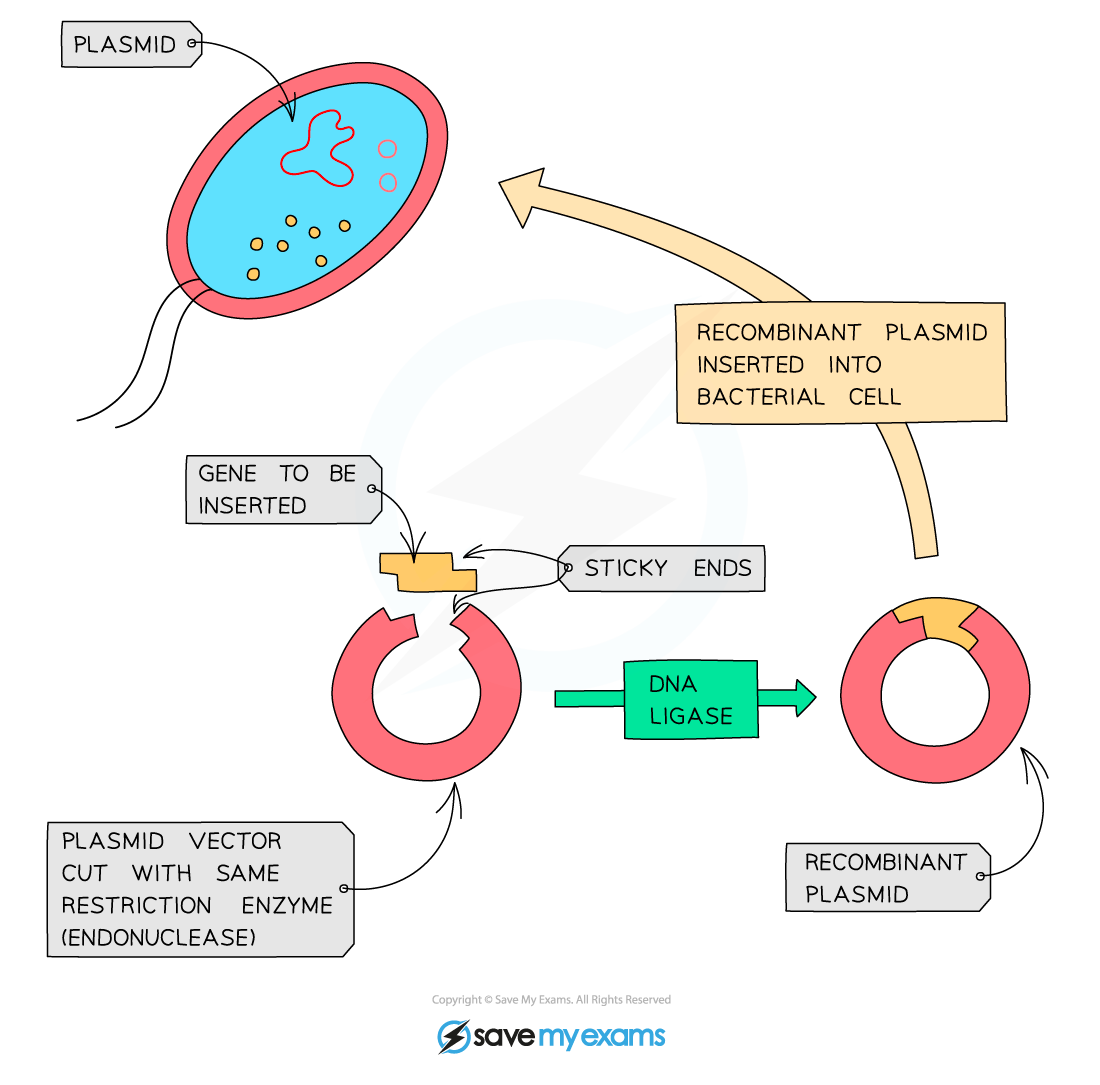
What is the process of genetic modification using bacterial production of a human protein?
The process of genetic modification using bacterial production of a human protein begins by isolating the required human gene, such as the insulin gene, using a restriction enzyme. The restriction enzyme cuts the DNA and leaves sticky ends. A bacterial plasmid is then removed and cut using the same restriction enzyme, producing complementary sticky ends.
The human gene is inserted into the plasmid and joined by DNA ligase, forming a recombinant plasmid. The recombinant plasmid is then inserted into a bacterial cell. As the bacteria reproduce, the plasmids are copied as well, so many bacteria contain the recombinant plasmid. The bacteria then express the human gene and produce the human protein, which can be collected in large quantities, often using a fermenter.
What are some examples of genetic modification?
The insertion of human genes into bacteria to produce human proteins. For example, the human insulin gene is inserted into bacteria, which then produce human insulin that can be collected and purified for use in treating diabetes.
The insertion of genes into crop plants to confer resistance to herbicides. Crop plants are modified so they can survive herbicide spraying, allowing weeds to be killed without damaging the crop.
The insertion of genes into crop plants to confer resistance to insect pests. For example, crops such as maize or wheat are given a gene from a bacterium that produces a toxin which kills insects such as caterpillars.
The insertion of genes into crop plants to improve nutritional qualities. For example, Golden Rice has genes added so it produces a substance that is converted into vitamin A in the human body, helping prevent deficiency diseases.
What are the advantages of genetically modifying crops?
One advantage of genetically modifying crops is that they can be made resistant to herbicides, so weeds can be killed without harming the crop. This reduces competition for water, minerals and light, which can increase yield. For example, genetically modified Soya bean can survive herbicide spraying.
Another advantage is that crops can be made resistant to insect pests. For example, genetically modified Maize contains a gene from bacteria that produces a toxin which kills insects such as caterpillars. This reduces the use of pesticides, making farming less time-consuming and potentially better for the environment.
Nutritional value can be improved. For example, Golden Rice has been genetically modified to produce a substance that is converted into vitamin A in the body, helping reduce deficiency diseases.
What are the disadvantages of genetically modifying crops?
Genetically modified seeds are often more expensive, so smaller farmers may not be able to afford them. Farmers may also become dependent on buying seeds and specific chemicals from the same companies.
Inserted genes may spread to wild plants through pollination, creating herbicide-resistant weeds, which reduces the usefulness of the modification.
GM crops may also reduce biodiversity, because herbicides remove many wild plants, affecting insects and birds that depend on them.