Unit 5 test- C2.2, C3.1, C3.2, D3.3
 Call Kai
 Learn
Learn Practice Test
 Spaced Repetition
 Match
Match Flashcards
 Knowt Play
1/19

There's no tags or description
Looks like no tags are added yet.
Name | Mastery | Learn | Test | Matching | Spaced | Call with Kai |
|---|
No analytics yet
Send a link to your students to track their progress
20 Terms
Why do we need to integrate systems?
To maintain homeostasis— Different systems must communicate and coordinate so the body responds effectively
Rank levels of biological organization (least → most complex)
Cells(specialized for a task)—> tissues(group of cells working toward a specific function)—>organs(group of tissues that perform a part of a function for life)—> Body systems(group of organs working together to do a function for life)
Define emergent properties with an example
New functions that arise when simpler components work together
Example: The heart (organ) can pump blood, but individual muscle cells cannot do this alone
What is the role of the blood system in integration?
Acts as a transport and communication network that can link organs by carrying substances throughout the body such as nutrients, hormones, gases, glucose, wastes, O2, etc.
Type of signal in hormonal signaling vs nervous signaling
Hormonal has a chemical signal (Endocrine gland cells release hormones)
Nervous has an electrical signal (Neurons transmit electrical nerve impulses)
Location of hormonal signaling vs nervous signaling
Hormonal: in the bloodstream (around the whole body)
Widespread, but only certain target cells respond
Nervous: along the neurons
Signal passes only to specific cells via synapse (tiny gap between two nerve cells)
Duration of hormonal vs nervous signaling
Hormonal signaling is slower
Nervous signaling is very rapid
Outcome of hormonal vs nervous signaling
Hormonal:
Broader, widespread effects
Growth development (puberty)
Reproduction
changes to metabolic rate
Changes to solute concentration the the blood
Mood
Nervous:
Precise, targeted response
Muscle contraction
Secretion by glands
What are the input sources of the brain?
Input signals from our senses:
Eyes, mouth, ears, touch, internal. systems
Processes all of these signals by comparing them against memories and then making a decision
How does the brain use memory to process info and how is memory related to learning?
The brain compares new info with stored memories to recognize patterns, interpret situations, and make decisions
Learning occurs when experiences create/strengthen memories—> allowing future behavior or responses to change
What are the two main roles of the cerebellum?
Coordination of muscles and movement/precision and timing of muscle coordination
Supports posture and balance
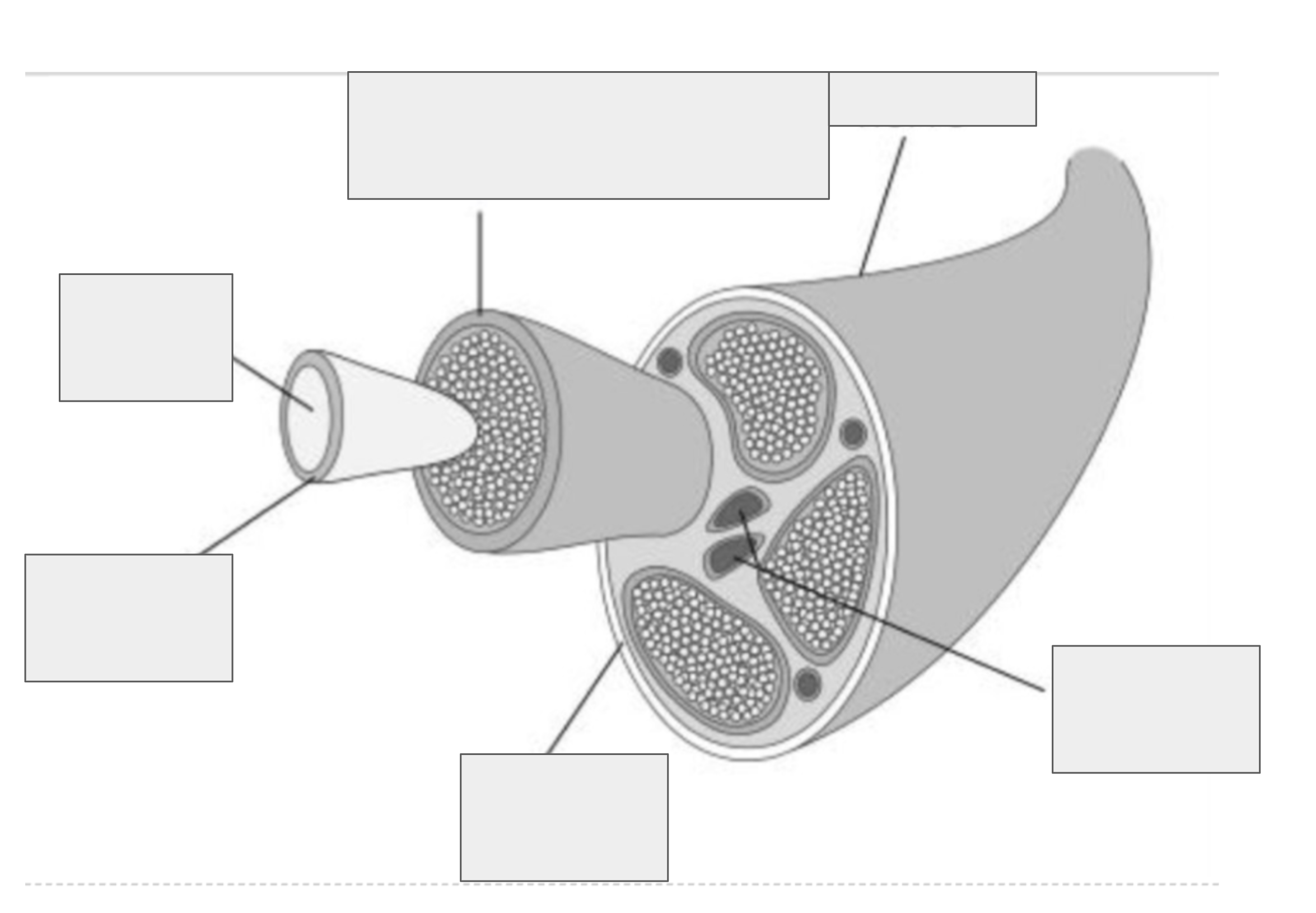
Label a cross-section of a bundle of nerves
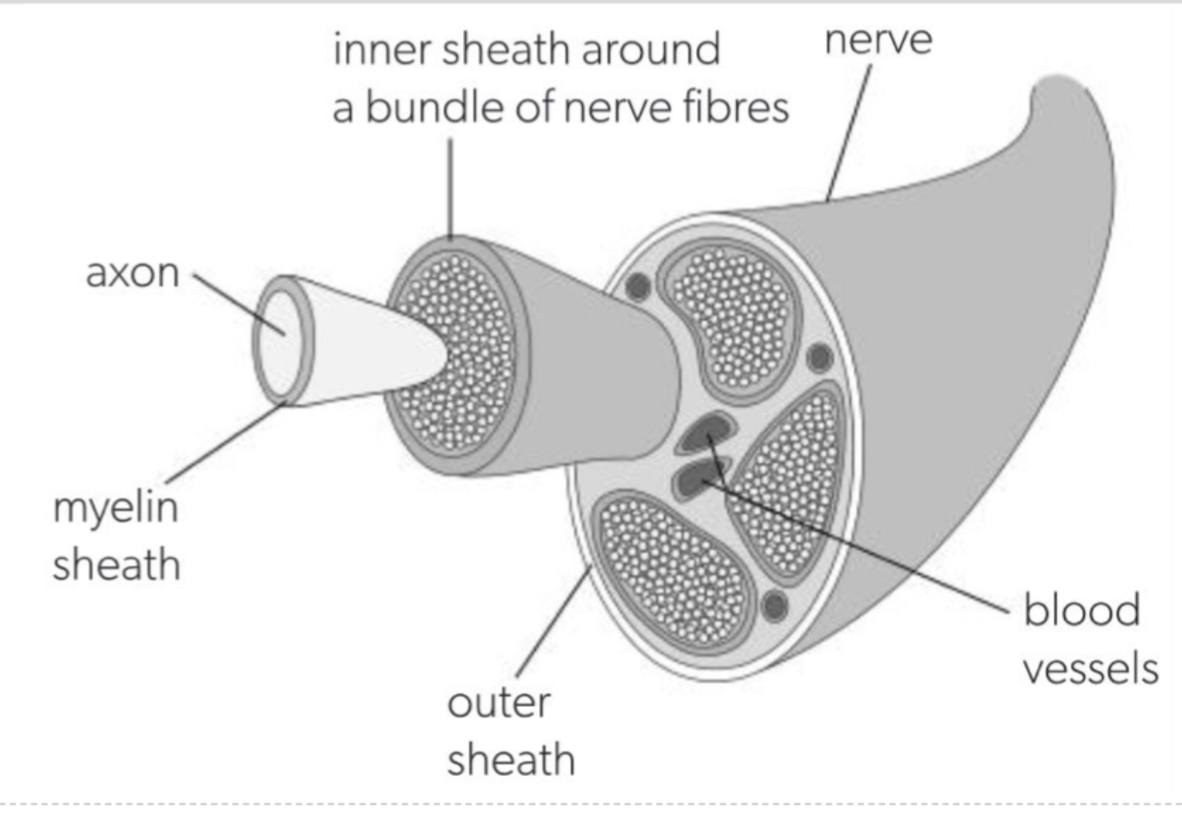
What is in the middle of a nerve bundle?
Axon and blood vessels
Draw and label a diagram of nerve cells
Dendrite: receives signals from other neurons and carries torward cell body
Axon: carries electrical impulses away from cell body
Cell body: contains organelles, controls the neurons activities
Axon terminus: releases neurotransmitters to communicate with the next cell
Nucleus: contains DNA, controls cell functions
Node of Ranvier: gaps in the myelin sheath that speed up nerve impulse transmission
Myelin Sheath: Insulates the axon and increases speed of impulse
Schwann Cells: produces myelin sheath
List the three types of nerve cells and their purpose
Sensory Neuron
Receives input form sensory cells(skin, eyes, etc) to the central nervous system
Motor Neuron
Carries signals from the central nervous system to muscles or glands to produce a response
Interneuron
Connects sensory neurons and motor neurons within the CNS and process information
Found only in the brain and spinal chord
What is resting potential and what voltage is the resting potential in?
Neurons maintain a resting potential when unstimulated, characterized by an electrical potential across the plasma membrane
-70mV