WHB Final Exam v23: WWI/Russian Revolution
 Call Kai
 Learn
Learn Practice Test
 Spaced Repetition
 Match
Match Flashcards
1/21

There's no tags or description
Looks like no tags are added yet.
Name | Mastery | Learn | Test | Matching | Spaced | Call with Kai |
|---|
No analytics yet
Send a link to your students to track their progress
22 Terms
Which are the component of genocide, according to the United Nations defintion:
1. Killing members of a group based on race;
2. Causing serious harm or injury to members of national or ethnic group;
3. Imposing measures intended to prevent births within ethnic group
4. Forcibly transfering children of the group to another group.
Which component of genocide was NOT present in the atrocities committed against the Armenians during WWI:
Imposing measures intended to prevent births within the group.
Why were the Armenians targeted for "deportation" by the Ottoman Turks?
Muslim Turks felt that the Armenians would naturally favor their Christian counterparts in Russia (a country that bordered Turkey)
The tactic (MAIN cause) used to gain support in the picture of a Soldier with a British Flag saying "Fight for it"
Nationalism
Study chart. Which of the MAIN CAUSES was most responsible for turning the conflicts that started World War I into a world war?
extensive alliances formed among nations
View map of Germany surrounded by Allies in WWI. Which situation shown on this map shaped Germany's military strategy in World War I?
the alliance between France and Russia
Study chart. In which historically male occupation did women likely work during WWI?
Industrial workers
Study chart. The information in the table supports which of the following generalizations?
World War I had a major political and social impact on Europe and countries throughout the world.
"There were vast stretches of mud, of fields once cultivated, but now scarred with pits ... rusty barbed wires. The roads were rivers of clay. They were lined with dugouts, cellars, and caves." —Richard Harding Davis, war correspondent
This passage describes the impact of
trench warfare
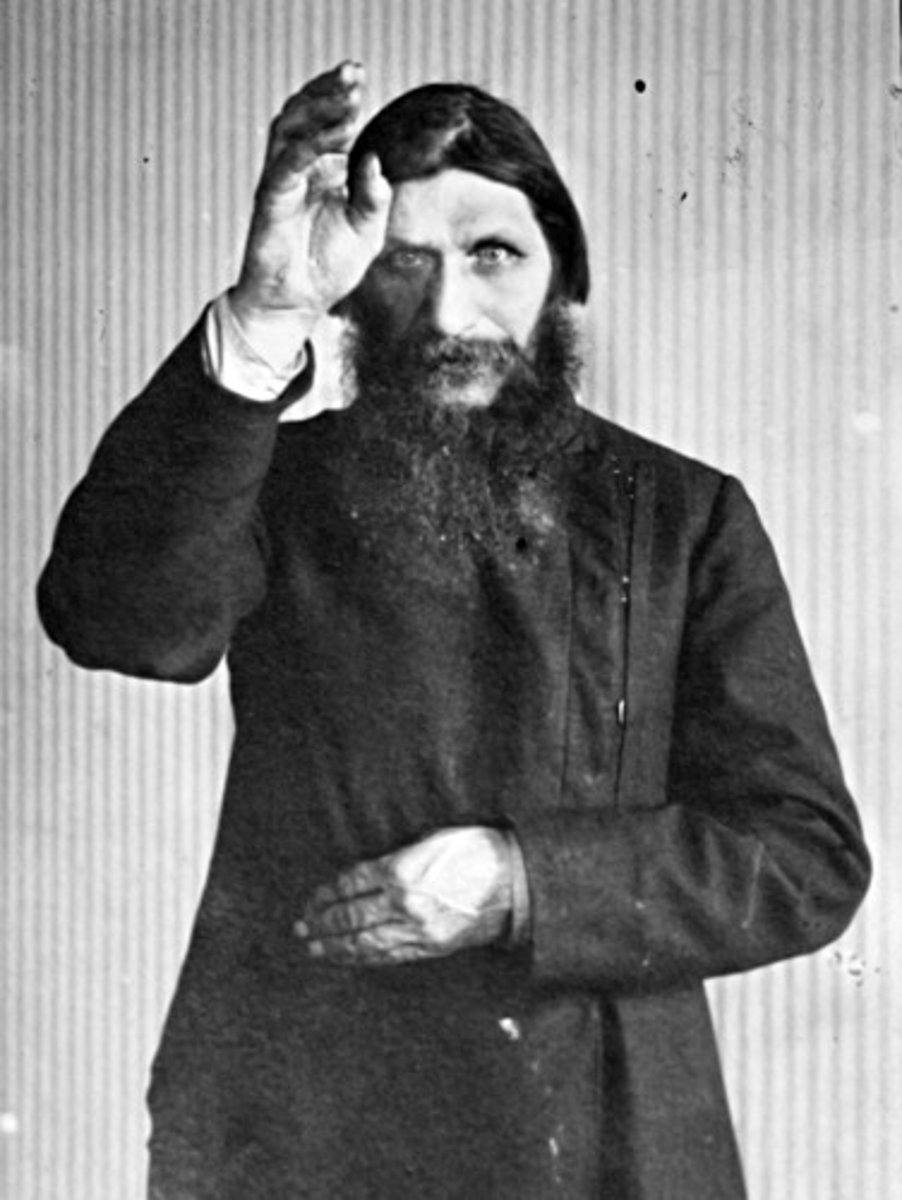
How did Rasputin (identify photo) contribute to the outbreak of the February/March revolution in Russia?
His influence over the Czarina weakened faith in the government.
Which statement completes this chart?
Rasputin was killed---1916
The Tsar abdicated from the throne--1917
Russia signed the Treaty of Brest-Litovsk--1918
????--1922
The old Russian empire became the Union of Soviet Socialist Republics.
Which statement best describes Lenin's contribution to the creation of the Soviet Union?
He provided the new state with political and ideological leadership.
Widespread poverty and political unrest plagued Russia in the early 1900s. When Russia became involved in World War I in 1914, the war strained the nation to the breaking point. In 1917, Russia's ruler, Czar Nicholas II, resigned. A temporary government was set up until elections could be held. But before they occurred, Russian Communists called Bolsheviks, led by V. I. Lenin, overthrew the government and pulled Russia out of the war. A bloody civil war began, which ended in a Communist victory in 1922. The Communists maintained their control of Russia until the collapse of the Soviet Union in 1991.
Which of the following is a conclusion that can be drawn from this information?
Although the Bolsheviks had ardent supporters, there was also those that opposed a Communist government.
Russia left World War I early because
A combination of the Bolshevik revolution and unpopularity of the war drove its exit.
What impact did the Treaty of Brest-Litovsk have on Germany?
It allowed Germany to focus all their efforts on the Western Front.
What was the Zimmerman Telegram?
A proposal by a German official that Mexico attack the United States in return for territory.
Identify one of Woodrow Wilson's Fourteen Points re: self-determination
the right of Eastern Europeans to choose their own form of government
What was the purpose of the Fourteen Points?
to achieve a lasting peace by addressing the causes of WWI
It is demanded of us that we shall confess ourselves alone to be guilty of the war. Such a confession from my lips would be a lie. We are far from declining all responsibility for the fact that this great World War took place or that it was fought in the way that it was. . . . But we energetically deny that [we] are alone guilty.
The excerpt above is most likely a response to
the Treaty of Versailles
What was the impact economic reparations in Treaty of Versailles? Identify on chart.
Germany was forced to assume complete responsibility for financial reparations.
• Robespierre and the Jacobins begin the reign of terror in France
• The Bolsheviks set-up a communist government in Russia
• The Nazi Party controls Germany.
Which statement describes a similarity in these situations?
One group seized power and limited opposition.
One way in which the government under Czar Nicholas II of Russia and the
government under Benito Mussolini of Italy are similar is that both governments
established policies of censorship and repression