ethical implications of research studies
 Call Kai
 Learn
Learn Practice Test
 Spaced Repetition
 Match
Match Flashcards
 Knowt Play
1/14

There's no tags or description
Looks like no tags are added yet.
Name | Mastery | Learn | Test | Matching | Spaced | Call with Kai |
|---|
No analytics yet
Send a link to your students to track their progress
15 Terms
what are ethical implications
Ethical issues are the problems that arise from research
Ethical implications are the consequences or effects that psychological theories and studies may have
Research that has many ethical implications can be described as socially sensitive
Some areas of psychology/psychological research have greater social sensitivity than others
For example, research on LTM in student population is unlikely to have serious ethical implications
Contrastingly, research on depression may have consequences in relation to reinforcing harmful stereotypes or affecting policies in relation to treatment
Socially sensitive research refers to:
“Studies in which there are potential consequences or implications either directly for the participants in the research or for the class of individuals represented by the research.”
It is important to note that the social consequences and implications could be for individuals and also be for society as a whole, particularly if public policy is influenced.
social sensitivity of Bowlby
Bowlby's emphasis on the "monotropic" bond with the mother can be interpreted as placing undue pressure on women to be primary caregivers.
It can be used to reinforce traditional gender roles, potentially disadvantaging women in the workplace and limiting men's involvement in childcare.
His work was used to justify policies that encouraged women to stay home and assume the role of the default parent.
social sensitivity of Zimbardo
Zimbardo's research touches on sensitive issues of power, authority, and human cruelty.
It raises questions about individual responsibility versus situational influence, which can have legal and social implications.
The research can be used to excuse/justify harmful behaviour, potentially minimizing the personal responsibility of individuals who commit atrocities.
social sensitivity of EE of PP
The evolutionary explanations of partner preference can reinforce heteronormative views and potentially stigmatize non-heterosexual relationships.
The explanations given for relationships which completely overlook non-heterosexual couples can be seen as dismissive or disrespectful of LGBTQI+ identities.
These can lead to harmful stereotypes about sexual orientation and discrimination.
Could influence social attitudes and policies related to sexual orientation (e.g. right to marry, right to adopt).
social sensitivity of IQ
Could lead to Black Americans expecting less from themselves (self-fulfilling prophecy).
People being prejudice in terms of employment.
High unemployment leads to labelling of Black Americans as ‘lazy’.
Ripple effect could lead to protests as a result of inequality.
ways to deal with ethical implications/social sensitivity
Researchers must have knowledge of when research is socially sensitive to ensure additional assurances about ppts' confidentiality, follow ups to ensure no harm and more sensitivity in the debriefing process
value-free objective way
Consider the wider effects of publication of findings
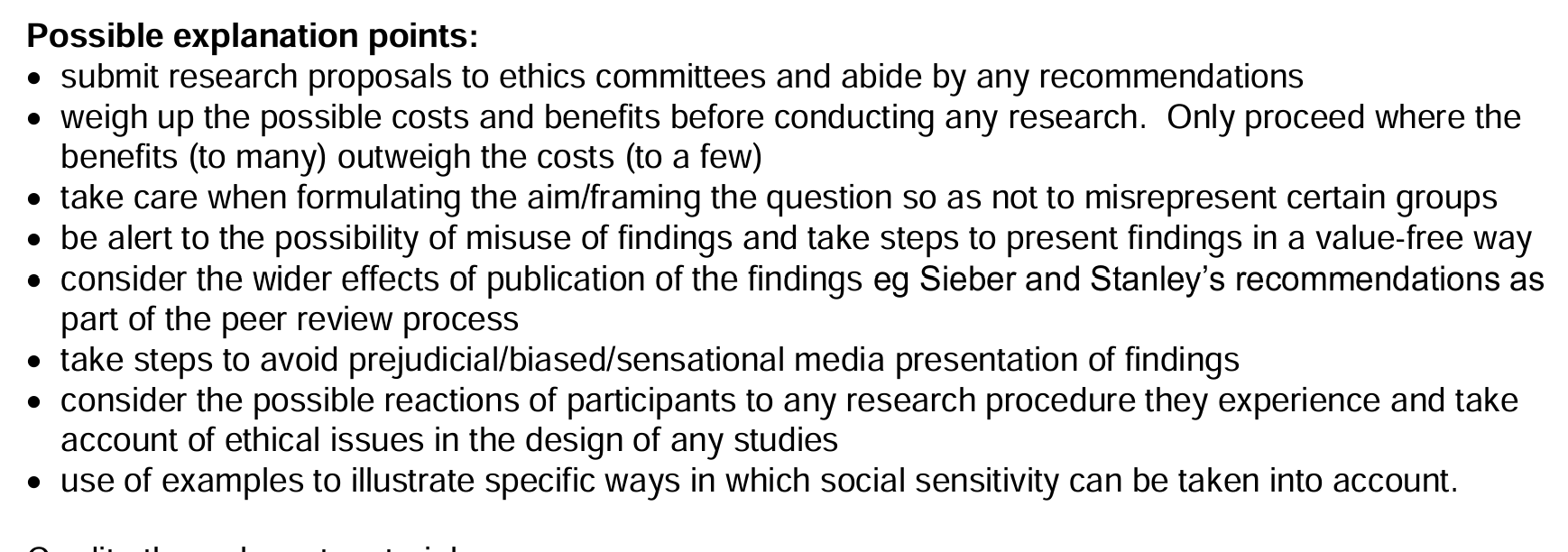
SS - deciding what to research
Even the act of phrasing a hypothesis – deciding who and what to be investigated has ethical implications.
Choosing a topic or hypothesis is not neutral - has ethical implications
It might be argued that certain topics that are controversial and socially sensitive, such as the link between ethnicity and IQ or homosexuality and genetics should be avoided to as it could be used to justify discriminatory practises.
SS - use of knowledge/application of findings
Sometimes research may have implications that were not originally intended. However, it is the responsibility of psychologists to consider how their findings will be used and who will be affected by them.
Bowlby’s became an advisor for WHO and his claim that mother love in infancy is as important for mental health as vitamins for physical health was criticised for its use in justifying why women should stay at home and look after the children in the 1950s.
SS - influence on society and public policy
Psychologists can be influential in respect to helping shape public and political policy so bias and error by the psychologist must be avoided, (or where it happens, acknowledged) if it is to have a real-world impact and lead to positive changes in society.
Cyril Burt’s research claiming a genetic link to IQ was used to inform government educational policy and led to the introduction of 11+ exams to select students for secondary education. His research has been widely discredited but the 11+ is still used in some contexts today.
SS - availability of research
In areas of research that are socially sensitive the researcher has a responsibility to clarify exactly who has direct access to their work. They should also be aware of any misuses/distortions of their work by the media.
Open availability of findings helps to prevent exploitation of the results. When research is hidden behind paywalls, it is more easily manipulated, ignored, or used by a few to serve narrow interests. To prevent psychological knowledge being exploited it should be given away freely, allowing for public, scientific and ethical scrutiny.
SS - institutional context and sources of research funding
Research may be funded and managed by private institutions who may misuse the data or misunderstand the data that is produced.
Nearly all research on drug therapies is funded by ‘big pharma’ who have been accused of selective publication of data from research. For example, it is likely that companies do not publish data that may be harmful to their sales.
strength of SS 1
One strength of socially sensitive research is that it can have benefits for the group who have been studied.
One example of this is homosexuality. In 1952 the DSM-1 listed this as a 'sociopathic personality disorder' but finally removed it in 1973.
This change has been credited to the Kinsey report which was based on anonymous interviews with men about their sexual behaviour (Kinsey et al. 1948).
The report concluded that homosexuality is a normal variant of human sexual behaviour.
Scarr (1988) argues that studies of under-represented groups and issues may promote greater understanding to help reduce prejudice and encourage acceptance.
HOWEVER
In some studies there could be negative consequences for the groups being studied, which in some cases could have been anticipated
For example, research investigating the genetic basis of criminality has found that there is a 'criminal gene' - if this is true does it mean that someone could be convicted on the basis that they have such a gene or should they be excused because they cannot be held responsible for any wrongdoing
This suggests that socially sensitive research may play a valuable role in society and illustrates the importance of researchers tackling topics that are sensitive.
strength of SS 2
Another strength is that certain groups (e.g., policymakers) rely on research related to socially sensitive issues.
The government looks to research when developing important social policies, for example decisions related to childcare, education, mental health provision, crime and so on.
It is clearly preferable to base such policies on scientific research rather than politically motivated views.
Furthermore, an example of when socially sensitive research has benefitted society is research into unreliability of EWT which caused loads of cases to be reviewed and also has reduced the risk of miscarriages of justice within the legal system.
This means that psychologists have an important role to play in providing high quality research on socially sensitive topics in order to lead to changes in policy.
weakness of SS 1
One limitation is that poor research design may lead to erroneous findings which, once in the public arena, continue to have an impact.
This was certainly the case in relation to Burt's research because, even after the fraud was exposed, the 11+ continued to be used.
Indeed, the 11+ is still used as a selection tool in parts of the UK today.
Similarly, access to many independent schools is based on a child's performance in an entrance exam taken in Year 6 and is likely based on the same reasoning - that genetic potential has revealed itself.
Furthermore, issues may also lead to indirect impact on people’s families, their co-workers or even the group they represent (e.g., addicts).
Researchers need to think beyond simply safeguarding the interests of participants and think about the likely impact of the research on the larger group of which participants are members of.
Therefore, any research on socially sensitive topics needs to be planned with the greatest care to ensure the findings are valid because of the enduring effects on particular groups of people.
weakness of SS 2
Another limitation is that the costs and benefits of socially sensitive research may be difficult to predict.
Research that carries ethical implications (or socially sensitive research) is scrutinised by an ethics committee – it is their job to weigh up the costs and benefits of the research.
However, some of the social consequences of research involving vulnerable groups may be difficult to anticipate.
The American Psychological Association (APA, 2001) reported that ethical committees approved 95% of non-sensitive proposals that didn't include ethical problems whereas 'sensitive’ proposals were only approved about 50% of the time.
Which suggests that in order to deal with socially sensitive research, ethics committees’ solution is to avoid letting researchers do it.
This is a problem as assessments of the ‘worth’ of such research are typically subjective, and the real impact of research can only ever be known once research has been conducted and the conclusions made public.