ACC 203
 Call Kai
 Learn
Learn Practice Test
 Spaced Repetition
 Match
Match Flashcards
 Knowt Play
1/201

There's no tags or description
Looks like no tags are added yet.
Name | Mastery | Learn | Test | Matching | Spaced | Call with Kai |
|---|
No analytics yet
Send a link to your students to track their progress
202 Terms
Information is verified by external auditors, Focus is on the past.
Financial Accounting
Main characteristic of information is that it must be relevant
managerial accounting
Reports tend to be prepared for the parts of the organization rather than the whole organization.
managerial accounting
Primary users are internal (i.e., company managers).
managerial accounting
It is governed by Generally Accepted Accounting Principles (GAAP) or International Financial Reporting Standards (IFRS).
Financial Accounting
The primary characteristics of information are that it must be reliable and objective.
Financial Accounting
Reports are prepared as needed, It is not governed by legal requirements.
managerial accounting
Primary users are external (i.e., creditors, investors).
Financial Accounting
Focus is on the ruture.
managerial accounting
Reporting is based mainly on the company as a whole.
Financial Accounting
My business paid Facebook for Advertising Expense, my cash would __ and my earnings (equity) would _
Decrease, Decrease
report 3 types of inventory on the balance sheet
Manufacturing companies
for a company such as Best Buy (consumer electronics) includes all of the costs necessary to purchase products and get them onto the store shelves.
Inventory (merchandise)
most for-profit organizations can be described as being in one (or more) of 3 categories
service companies, manufacturing companies, & merchandising companirs
typically do not have an inventory account
Service companies
Wholesalers
but products in bulk from producers, mark them up, & resell to retailers
Direct Cost
cost that can be easily and accurately traced to a specific cost object
Indirect Cost
relates to the cost object but cannot be traced to it in an economically feasible way because it supports multiple departments
product costs
all costs required to manufacture a physical product. Recorded as “inventory” on the B/S & only become an “Expense” (COGS) when the product is sold
If it happens inside the factory
Direct Materials (DM)
The primary raw materials that become a physical part of the finished product. Tracer: must be easily & cost-effectively traceable to a specific unit.
Ex. Milk in a bottle of yogurt
Direct Labor (DL)
The compensation of employees who physically convert raw materials into finished goods. AKA: “touch labor”
Ex. Wages of the assembly line worker
Manufacturing Overhead (MOH)
All indirect costs incurred in the factory that are NOT direct materials or direct labor.
Includes: Indirect materials, indirect labor (supervisors/janitors), factory utilities, factory rent, and factory depreciation
Period costs
costs related to the passage of time rather than the production process. They are expensed on the I/S in the period they are incurred. Categories: Selling, General, & Administratice (SG&A) expenses.
Ex. Advertising, CEO salary, corporate office rent
Calculate COGS
Beginning Inventory
+Purchases
=COG available for sale
-Ending Inventory
= COGS
prepare income statement
Sales Revenues
-COGS
=Gross Profit
-Operating Expenses
=operating income (net)
gross margin
aka gross profit
classify: airplane seats cost object airplaine
Product - DM
classify: Production supervisors’ salaries
Product - MOH
Depreciation on forklifts in factory
Product - MOH
Machine lubricants
Product - MOH
Factory janitors’ wages
Product - MOH
Assembly workers’ wages
Product - DL
Property tax on corporate marketing office
Period
Plant utilities
Product - MOH
Cost of warranty repairs
Period
Machine operators’ health insurance
Product - DL
Depreciation on administrative offices
Period
Cost of designing new plant layout
Period (Design on value chain)
jet engines
Product - DM
Prime costs
Direct materials + Direct Labor
DM + DL
Conversion Costs
Direct Labor + Manufacturing Overhead
DL + MOH
Costs of converting raw materials into finished goods
Relevant Costs
has potential to influence a decision. Must occur in the future & have a differential cost (diff btwn alternatives)
Irrelavant costs
should not influence a decision. Do not differ among alternatives, ignore sunk costs (costs that have alr been incurred & cannot be changed)
Current Assets in B/S of Service, Merchandisers, & Manufacturers
Service companies have no inventory
Merchandisers show inventory (or merchandise Inventory)
Manufacturers show inventory, including the breakdown of Inventory accounts (Raw Materials, Work in Progress, & finished goods)
Manufacturing overhead
visualize the factory if it happens inside those walls it is a manufacturing cost.
Product Costs (Manufacturing costs)
INSIDE the 4 Walls of factory
- Treated as inventory until sold
- For manufacturers:
o Direct Materials (DM)
o Direct Labor (DL)
o Manufacturing Overhead (MOH) (indirect materials, indirect labor, factory utilities, depreciation, etc.)
Period costs
OUTSIDE the factory
- Nonmanufacturing costs
- Expensed immediately
- Includes selling, general, & administrative (SG&A)
Predetermined MOH Rate = __ per DL hour
Estimated Manufacturing Overhead / Estimated Direct Labor Hours
Predetermined MOH Rate = __ % of DL Cost
Estimated Manufacturing Overhead / Estimated Direct Labor Cost
Predetermined MOH Rate = __ $ per machine hour
Estimated Manufacturing Overhead / Estimated Machine Hours
Predetermined Manufacturing Overhead Rate (POHR) =
Estimated Manufacturing Overhead / Estimated DL Hours = $ per DL hour
Total MOH = (use PHOR)
= POHR * Actual DL hours
POHR =
Estimated mOH cost / Estimated total cost driver (hours)
allocation base (i e cost driver)
what causes the overhead costs to be incurred (ex DL hours or Machine hours
Job Costing Systems
used by companies that produce unique products or services (e.g. acounting firms, custom designers, motion picture studios)
costs are recorded in separate WIP accounts by job
goal is to track & accumulate costs of each unique product, project or service
Process Costing systems
used by companies that produce homogenous/identical products or services (e.g. oil manufacturers, soft drink manufacturers).
○ Costs are recorded in separate WIP accounts by stage of the production process. (FYI only. Beyond the scope of this course)
determine direct materials (DM) cost?
Traced directly to jobs in the WIP inventory account (based on materials used)
determine direct labor (DL) cost?
Traced directly to jobs in the WIP inventory account (based on hours worked)
determine manufacturing overhead (MOH) cost ?
○ cannot be traced directly to specific jobs, so we have to allocate some reasonable amount of these costs to each job.
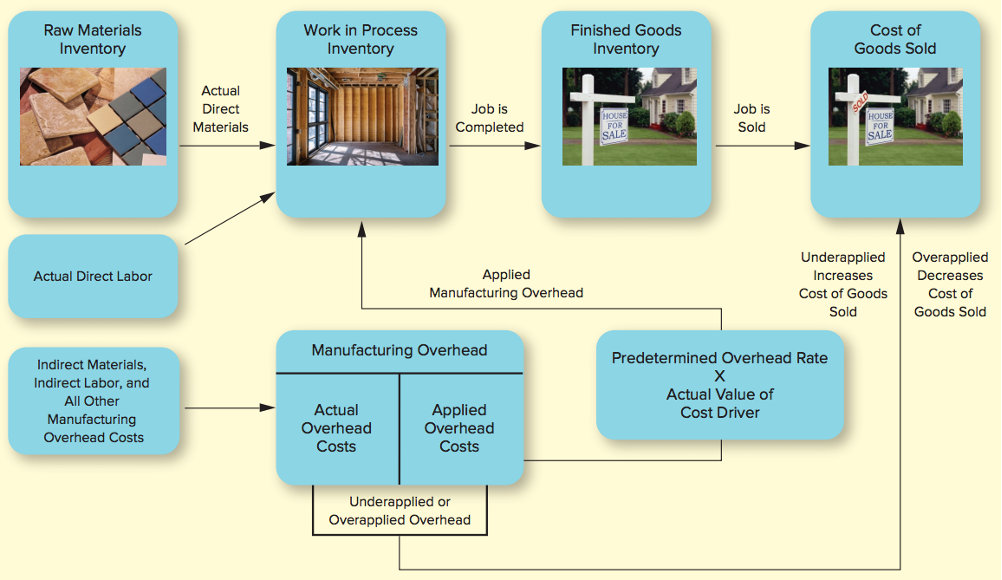
○ Job costing approach involves “applying” overhead using a predetermined overhead rate (POHR)
Apply manufacturing overhead to jobs by multiplying the POHR by the ACTUAL cost driver
POHR × Actual cost driver = Applied MOH
Raw Materials Inventory, WIP Inventory, Finished goods inventory
Inventory
COGS is an..
Expense.
after a job is sold, it is transferred out of inventory & into COGS
Process
=Gross profit (per unit)
Sales price (per unit) – Total job cost (per unit)
Allocated (Applied) MOH
Predetermined Rate × Actual Activity (e.g., Actual Hours).
What it is: The "estimated" cost added to jobs while they are being worked on.
Overallocated
Allocated > Actual.
Meaning: You put too much cost on the jobs.
Fix: Decrease Cost of Goods Sold (COGS).
Underallocated
Allocated < Actual.
Meaning: You didn't put enough cost on the jobs.
Fix: Increase Cost of Goods Sold (COGS).
3 numbers: estimated, actual, allocated
Estimated: Used only to find the Rate at the start of the year.
Actual: What was actually spent (the "real" bills).
Allocated: The amount assigned to jobs (Rate × Actual Hours).
Why Estimate?
To provide immediate cost info for pricing and bidding without waiting for year-end utility bills.
Allocated MOH =
Predetermined overhead rate * actual amount of the allocation base used by the specific job
cost allocation
Assigning manufacturing overhead costs and other indirect costs to jobs is called:
If manufacturing overhead is overallocated for the period by $100, then
Jobs have been overcosted during the period
When a company uses direct labor, it traces the cost to the job by debiting:
Work in Process Inventory.
Direct labor always increases WIP because it’s a direct, traceable production cost.
materials requisitioned for production aka
DM used
Applied MOH =
POHR * actual hours
Production Supervisor, factory rent, factory utilities, maintenance on machines
MOH
left End. Bal on manufacturing overhead T account
overhead was under-applied, inc COGS
right End. Bal on manufacturing overhead T account
overhead was over-applied, dec. COGS
Gross profit %
gross profit / sales revenue
sales commissions, marketing costs
period costs
Operating income =
gross profit - period costs
when products are sold, the journal entry to record the sale of goods includes
a credit to finished goods inventory
Variable Costs
change in total with changes in activity (e.g., total vc inc as activity Inc.)
vc per unit is constant as activity Inc
Fixed Costs
remain the same in total regardless of activity level (e.g., total fixed costs remain constant as activity increses
Mixed costs
have a fixed and variable component. fixed portion represents the base amount that will be incurred regardless of activity
(ex. 0 units - 350, 100 units - 400, 200 units-450, 300 units-500, 400 units- 550)
Step costs
fixed over small range of activity and then jump to a new fixed level
(ex. to allow more customers to be served, Starbucks might hire an additional supervisor or rent additional space or equipment)
(ex. 0 units, 100 units, & 200 units - 500, 300 units, 400 units - 750)
Variable or Fixed: Rubber used in bike tires
Variable
Variable or Fixed: Recycled aluminum used to make the bike frame
Variable
Variable or Fixed: Lubricant used on clipless pedal springs
variable
Variable or Fixed: Quality inspector’s salary
Fixed
Variable or Fixed: Depreciation on equipment used to make the aluminum in the bike frame
fixed
Variable or Fixed: renewable cork used to make the saddle
variable
Variable or Fixed: patent on belt drive (used instead of a chain)
fixed
When choosing the high point for the high-low method, how is the high point selected?
The point w the highest volume of activity is chosen
Regression analysis
A statistical procedure for determining the line, and association cost, that best fits all of the data points in the data set
what’s the advantage of using regression analysis:
A. The method is objective
B. All data points are used to calculate the terms for the cost equation.
C. Regression analysis will generally be more accurate than the high-low method.
• D. All of the listed statements are true about regression analysis.
D. All
The only difference between variable costing and absorption costing is in the treatment of
• A. variable manufacturing overhead costs.
• B. fixed manufacturing overhead costs.
• C. direct materials and direct labor costs.
• D. variable nonmanufacturing costs.
fixed MOH
Fixed or Variable: finance charges on car loan
fixed
Fixed or Variable: Car washes (one per week)
fixed
Fixed or Variable: traffic violation ticked
fixed???