Intentional Torts - MC questions
 Call Kai
 Learn
Learn Practice Test
 Spaced Repetition
 Match
Match Flashcards
 Knowt Play
1/88

There's no tags or description
Looks like no tags are added yet.
Name | Mastery | Learn | Test | Matching | Spaced | Call with Kai |
|---|
No analytics yet
Send a link to your students to track their progress
89 Terms
I’d someone throws a baseball and accidentally hits someone in the head that is a:
Tort
Which of the following scenarios best illustrates the difference between an intentional tort and an unintentional tort (negligence)?
A) Sarah deliberately pushes John off his bicycle, breaking his arm. Later that day, Sarah accidentally spills coffee on John's laptop while rushing through a crowded café without watching where she was going.
B) Sarah accidentally bumps into John in a crowded hallway, and Sarah also forgets to hold the door open for John causing it to hit him.
C) Sarah deliberately pushes John off his bicycle, breaking his arm. Later that day, John deliberately throws Sarah's laptop on the ground.
D) Sarah accidentally spills coffee on John's laptop, and while cleaning it up, accidentally knocks his phone off the table as well.
A is correct
B is incorrect because neither act is clearly intentional — both are accidents
C is incorrect because both acts are intentional — there is no negligence example
D is incorrect because both acts are accidental — there is no intentional tort example
Which of the following is an example of special damages in a tort case?
A) A plaintiff is awarded $50,000 to compensate for the emotional distress and anxiety they experienced following a car accident caused by a negligent driver.
B) A plaintiff submits $14,750 in ambulance fees, emergency room bills, and physiotherapy invoices following a slip-and-fall injury at a grocery store.
C) A plaintiff is awarded $100,000 to punish the defendant for reckless and outrageous conduct during a workplace accident.
D) A plaintiff is awarded damages to compensate for the permanent loss of enjoyment of their favourite hobbies following a back injury.
B
A = General DamagesEmotional distress has no specific dollar value — it cannot be precisely calculated
B = ✅Special DamagesMedical bills are specific, calculable, out-of-pocket expenses with exact monetary values supported by invoices
C = Punitive DamagesAwarded to punish the defendant, not to reimburse a specific loss
D = General DamagesLoss of enjoyment of life has no precise monetary value — it cannot be calculated from a receipt or invoice
Which of the following is an example of general damages in a tort case?
A) A plaintiff seeks $8,400 to cover three months of prescription medication costs following a workplace injury caused by an employer's negligence.
B) A plaintiff seeks reimbursement of $23,500 for the total cost of vehicle repairs and a replacement rental car after a rear-end collision.
C) A plaintiff is awarded $200,000 to compensate for the chronic pain, suffering, and permanent reduced quality of life following a spinal injury caused by a negligent driver.
D) A plaintiff seeks $5,200 to recover lost wages for the six weeks they were unable to work immediately following a slip-and-fall accident.
A = Special DamagesPrescription costs are specific, calculable out-of-pocket expenses supported by pharmacy receipts
B = Special DamagesVehicle repair and rental costs are exact, documented expenses with specific invoice values
C = ✅General DamagesChronic pain and reduced quality of life cannot be assigned a precise dollar value — no receipt or invoice can capture the extent of suffering
D = Special DamagesLost wages for a known period are specifically calculable using pay stubs and employment records
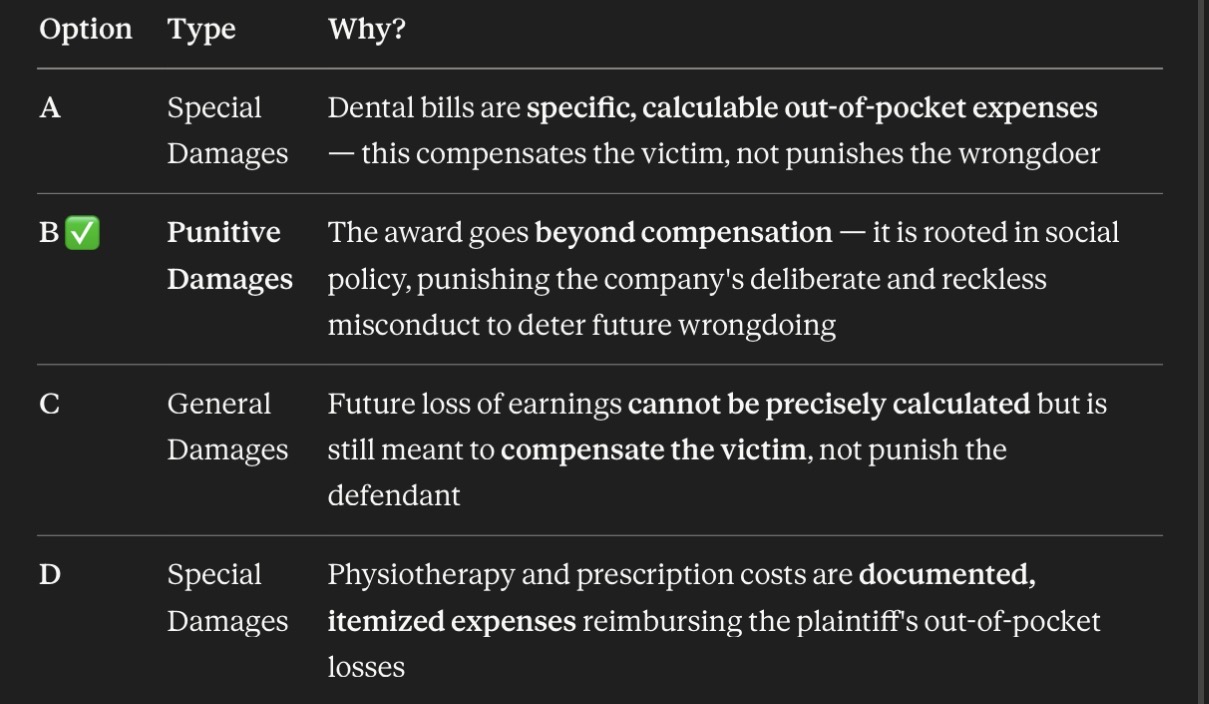
Which of the following is an example of punitive damages in a tort case?
A) A plaintiff is awarded $12,300 to cover the exact cost of dental surgery and follow-up appointments after being assaulted outside a nightclub.
B) A pharmaceutical company knowingly conceals dangerous side effects of a drug to protect profits, causing serious harm to thousands of patients. The court awards the plaintiff $2,000,000 beyond their compensatory damages to punish the company and deter future misconduct.
C) A plaintiff is awarded compensation for the estimated future loss of earnings after a back injury permanently prevents them from returning to their career as a surgeon.
D) A plaintiff seeks reimbursement for $3,800 in physiotherapy sessions and $1,200 in prescription costs following a slip-and-fall at a poorly maintained apartment complex.
A construction worker is involved in a serious car accident caused by a negligent driver. He submits $4,200 in emergency room bills, $1,800 in physiotherapy receipts, and $3,000 in lost paycheques from the six weeks he missed work. What type of damages is he claiming?
A) General damages, because the court needs to estimate the value of his injuries
B) Punitive damages, because the driver behaved recklessly and must be punished
C) Special damages, because all losses have a specific monetary value supported by receipts and documents
D) Both punitive and general damages, because the accident caused him significant suffering
C ✅Correct — every loss is provable with a receipt or document and has an exact dollar amount
A well-known local chef is defamed by a competitor who spreads false rumours that the chef uses unsafe food practices. As a result, the chef loses customers and suffers significant damage to his professional reputation. What type of damages would the chef most likely claim?
A) Special damages, because the chef can calculate exactly how much business he lost using sales receipts
B) Punitive damages, because the competitor acted intentionally and must be made an example of
C) General damages, because harm to reputation cannot be assigned a precise monetary value and the court must estimate based on precedent
D) Special damages, because the chef can prove his losses with tax returns
C ✅Correct — harm to reputation is a classic example of general damages, requiring the court to estimate value using past precedent cases
A university student is subjected to a severe and prolonged hazing ritual by a fraternity. Beyond the physical injuries, the court finds the fraternity's behaviour so extreme and deliberately humiliating that it decides to send a message to deter similar conduct in the future. What type of additional damages would the court most likely award?
A) Special damages, because the student's medical bills can be proved with receipts
B) General damages, because the emotional trauma and humiliation cannot be precisely valued
C) Punitive damages, because the fraternity's behaviour was so outrageous that the court wants to punish them beyond normal compensation
D) No damages, because hazing is a known risk of joining a fraternity
C ✅Correct — hazing is a textbook punitive damages scenario; the conduct is so extreme and humiliating that the court adds extra damages to punish the tortfeasor beyond normal compensation
A labour worker suffers severe injuries in a car accident caused by a negligent driver. He submits $6,500 in emergency room bills, $2,800 in physiotherapy receipts, and $4,200 in lost paycheques during his three month recovery. On top of this, he can no longer perform physical work and now earns $22,000 per year at a desk job instead of his previous $65,000 per year. He also experiences chronic pain and emotional distress from his injuries. What types of damages would the court most likely award?
A) Special damages only, because all of his losses can be proved with receipts and pay stubs
B) Punitive and general damages, because the driver behaved recklessly and the worker suffered emotionally
C) Both special and general damages — special damages for his provable out-of-pocket losses, and general damages for his future estimated income gap, chronic pain and emotional distress
D) Punitive damages only, because the negligent driver destroyed his career and must be severely punished
C is correct
Which of the following best describes the correct order from most common to least common in terms of how frequently each type of damages is awarded?
A) Punitive → General → Special
B) General → Punitive → Special
C) Special → General → Punitive
D) Special → Punitive → General
C ✅Correct — special damages are claimed in almost every case (receipts and bills), general damages are very common but require court estimation, and punitive damages are reserved for only the most extreme conduct and are very rarely awarded
Logan owns a house with a lot of weeds in his front yard. He buys a chemical for his weeds and sprays them to get rid of them. Meanwhile Meat is walking his dog by this house and the chemical gets inhaled by Meat and he has a uncroontrollatble allergic reaction that hits immedetaly causes Meat to start dying on the sidewalk. He drops the dogs leash and the Dog starts chasing a cat too a Tim Hortions. At the Tim Hortons two girls, Emily and Ann walk out. Ann with hot coffee trips over the running dog and cat, causing Ann to spill her coffee on the other Emily causing burning injuries. Emily wants to sue for compensation.
Who is liable for who?
A) Logan is liable to both Meat and Emily, because none of this would have happened if Logan hadn't sprayed the chemicals
B) Logan is liable to Meat, Meat is liable to Emily, and Logan is NOT liable to Emily
C) Nobody is liable because the entire chain of events was accidental
D) Logan is liable to Emily only, because he started the chain of events that ultimately caused her injury
B - This illustrates the remoteness test — even if Logan technically started the chain of events, Emily's injury was too far removed and unforeseeable for Logan to be held liable.
Which of the following best illustrates the concept of REMOTENESS in tort law causation?
A) A driver runs a red light and directly hits a pedestrian, breaking their leg — the driver is found liable
B) A chef accidentally spills boiling water on a customer causing severe burns — the chef is found liable
C) A factory illegally dumps chemicals in a river, a fish absorbs the chemicals, the fish is caught and sold at a market, a customer eats the fish and gets sick three months later — the factory may avoid liability because the injury was too remote and unforeseeable
D) A landlord fails to fix a broken staircase, a tenant trips and breaks their ankle — the landlord is found liable
C ✅Remote and unforeseeableMay avoid liability — the chain of events from dumping to illness is too long and indirect
In 1850, John intentionally shoves Peter to the ground causing him to break his wrist. Peter also claims he has been suffering from severe anxiety and emotional distress since the incident. Under 1800s tort law, what could Peter successfully sue for?
A) Both the broken wrist and emotional distress, as John's conduct was intentional
B) Emotional distress only, as the psychological harm was the most significant injury
C) The broken wrist only, as courts in the 1800s only recognized physical/bodily injuries and intentional torts
D) Nothing, because shoving someone was not considered a tort in the 1800s
C
In the 1800s Peter would only succeed on the broken wrist — intentional tort ✅, physical injury ✅. His emotional distress claim would fail because courts had not yet recognized psychological harm as compensable.
Which of the following best describes how the requirement of FAULT in tort law has changed over time?
A) Fault has become harder to prove over time — courts now require clear evidence of deliberate and malicious intent
B) Fault requirements have stayed exactly the same since tort law was established
C) Fault originally required intentional or deliberate conduct, but has broadened over time so that unintentional careless conduct is now sufficient and is actually the most common basis for tort claims today
D) Fault no longer needs to be proved at all — a plaintiff simply needs to show they were injured
C
The law evolved because restricting tort claims to intentional acts left many legitimately injured people without compensation — careless and reckless behaviour can cause just as much harm as deliberate conduct.
Sarah is involved in a minor car accident caused by a negligent driver. She has no physical injuries but is so shaken by the accident that she develops severe anxiety and is unable to return to work for two months, losing $8,000 in income. Under MODERN tort law, what can Sarah sue for?
A) Nothing, because she has no physical injuries
B) Lost income only, because emotional distress is not a recognized injury
C) Emotional distress and lost income, because modern tort law now recognizes both psychological injuries and economic losses as compensable
D) She could only sue under 1800s tort law when emotional injuries were first recognized
C - Sarah has no physical injury which would have made her claim fail entirely under 1800s tort law. Under modern tort law however, both her emotional distress and her $8,000 in lost income are fully recognized as compensable injuries — demonstrating how broadly the courts have expanded the types of harm for which victims can seek compensation.
Over time FAULT as a trend in tort law has Broadened. True or False?
TRUE.
Intention conduct → unintentional, but falling below and acceptable standard “negligent”
Over time CAUSATION as a trend in tort law has Broadened. True or False?
FALSE (courts have narrowed causation)
Everything you caused directly → foreseeable injury
Over time TYPE OF INJURY as a trend in tort law has Broadened. True or False?
TRUE
Physical or bodily → physical, bodily, economic, mental, emotional
A Canadian court is deciding how much compensation to award a plaintiff who suffered moderate injuries in a slip-and-fall accident at a grocery store. The plaintiff is fully recovered and has no permanent disability. Which principle best guides the court in determining the appropriate award?
A) The court should award as much as possible to fully punish the grocery store and deter future negligence
B) The court should balance compensating the innocent victim while avoiding an award so excessive that it inhibits people and businesses from conducting their normal daily activities
C) The court should follow American court precedents and award damages in the millions to properly compensate the victim
D) The court should award nothing since the plaintiff has fully recovered and has no permanent injuries
B ✅Correct — Canadian courts explicitly balance two competing interests: compensating innocent victims vs. avoiding awards so large they inhibit beneficial everyday conduct
Which of the following plaintiffs would most likely receive the highest damages award in a Canadian court?
A) A woman spills her own hot coffee on herself in her car after purchasing it from a drive-through and sues the coffee shop for $2,000,000
B) A man suffers a broken arm in a car accident caused by a negligent driver, recovers fully after 8 weeks, and sues for pain and suffering
C) A 28-year-old construction worker is struck by a negligent driver and suffers a permanent spinal injury leaving him unable to walk or work for the rest of his life
D) A university student trips on a cracked sidewalk, suffers minor bruising, misses one week of classes and sues the city for $1,500,000
C - The key distinction in Canadian tort law: permanent disability or injury is the threshold where damage awards climb significantly higher. For injuries where the victim fully recovers, the Supreme Court of Canada's upper limit on pain and suffering keeps awards far more modest than what American courts typically award.
A customer is in a bar, very drunk, asked to leave by a bouncer, does not leave, so the bouncer takes him out in the back parking lot and beats him up. Who can this drunk customer sue?
A) Bartender
B) Owner of the bar
C) neither
D) both
D)
Via Vicarious Liability the owner of the bar is responsible for the actions of its employees.
Which of the following scenarios best illustrates vicarious liability?
A) A self-employed electrician accidentally causes a fire at a client's home while completing a renovation — the client sues the electrician directly
B) A delivery driver, while making deliveries on behalf of his employer, runs a red light and crashes into another vehicle injuring the other driver — the injured driver sues both the delivery driver and the company he works for
C) A man slips on ice in his neighbor's driveway and sues his neighbor for failing to salt the walkway
D) Two co-workers get into a fight after work at a bar unrelated to their job — the injured co-worker sues the other employee personally
B- The key test for vicarious liability: "Was the employee acting within the scope of their employment when the tort occurred?" In option B the answer is clearly yes — making the employer jointly liable alongside the employee.
Jody was walking down Whyte Avenue when she was struck
by cyclist who was riding on the sidewalk. She was
knocked out; an ambulance was called and she was
hospitalized for three days. The ambulance transport
alone cost her $180. Jody now suffers from persistent
headaches that affect her ability to work. She also has a
broken arm. Were she to sue the negligent cyclist, it is
unlikely that the court would award the following:
(a) General damages
(b) Punitive damages
(c) Special damages
B) Punitive Damages
Which of the following statements is correct in relation to tort
law?
(a) An act must be intentional to be classified as a tort.
(b) The main purpose of tort law is to impose punishment on a wrongdoer.
(c) Tort law grants huge awards to victims of wrongful conduct.
(d) Sometimes a wrongful act will be both a crime and a tort.
(D)
Kevin walks up behind Sarah at a party and removes her hat and starts playing with her hair without her permission. Sarah is uncomfortable but not physically harmed. Under Canadian TORT law, what has Kevin committed?
A) Nothing, because Sarah was not physically harmed or injured
B) Tort assault, because Sarah feared unwanted physical contact
C) Tort battery, because Kevin made deliberate physical contact with Sarah without her consent
D) Criminal battery, because intentionally touching someone without consent is a crime in Canada
C ✅Correct — deliberately touching someone without their consent is the exact definition of tort battery in Canadian tort law
Brady catches Owen flirting with his girlfriend and tells Owen "if I ever catch you doing that again I will break both your legs." Owen takes the threat seriously and is genuinely afraid. Under Canadian TORT law, what has Brady committed?
A) Tort battery, because Brady made a deliberate threat that created real fear of unwanted physical contact in Owen
B) Tort assault, because Brady made a deliberate threat that created real fear of unwanted physical contact in Owen
C) Nothing, because Brady never actually touched Owen or followed through with the threat
D) Criminal assault, because threatening someone is a criminal offence only
B) - Key distinction: Under criminal law, assault involves actual physical contact. Under tort law, assault only requires a deliberate threat that creates genuine fear — no contact needed.
Two close friends, Jake and Mike, are joking around and Jake says "say that again and I'll knock you out!" Both Jake and Mike laugh it off and neither takes it seriously. Under Canadian TORT law, has Jake committed tort assault?
A) Yes, because Jake made a deliberate verbal threat of physical contact
B) Yes, because any threat of physical contact automatically constitutes tort assault regardless of context
C) No, because both parties understood the threat as a joke and no genuine fear was created
D) No, because tort assault only applies to written threats, not verbal ones
C - This is a critical nuance — the same words can constitute tort assault in one context and mean nothing in another. The presence of real, genuine fear is what separates tort assault from everyday banter.
Which of the following correctly identifies a key difference between how ASSAULT is defined under Canadian CRIMINAL law versus Canadian TORT law?
A) Criminal assault requires a threat only, while tort assault requires actual physical contact
B) Tort assault requires actual physical contact, while criminal assault only requires a threat
C) Criminal assault involves actual physical contact, while tort assault involves a deliberate threat that creates genuine fear of contact — no actual contact required
D) There is no difference — assault means the same thing under both criminal and tort law in Canada
C
Lisa is walking alone at night when a stranger steps in front of her, raises his fist and says "give me your bag or else." Lisa is terrified. The stranger never touches her. Under Canadian TORT law, which of the following is correct?
A) No tort has been committed because the stranger never made physical contact with Lisa
B) The stranger has committed tort battery because he raised his fist in a threatening manner
C) The stranger has committed tort assault because he made a deliberate threat that created genuine and serious fear of unwanted physical contact in Lisa
D) The stranger has only committed a criminal offence and cannot be sued under tort law
C
During a recreational hockey game, Player A delivers a hard but legal body check on Player B, causing Player B to fall and break his wrist. Player B decides to sue Player A for tort battery. What is the most likely outcome?
A) Player A is fully liable because he intentionally made physical contact with Player B without verbal consent
B) Player B will successfully sue because breaking a wrist goes beyond normal hockey contact
C) Player B will successfully sue because body checks are not an official part of recreational hockey
D) Player A will not be liable because Player B gave informed consent by voluntarily participating in a hockey game, accepting the normal and expected risks of the sport
D - The key principle: by voluntarily stepping onto the ice, Player B accepted all normal and expected risks of the sport — including body checks and the injuries they may cause.
During a football game, a player becomes enraged and pulls out a weapon and strikes an opposing player with it causing serious injury. The offending player argues consent defence claiming the injured player accepted the risks of physical contact by participating in football. Will the consent defence succeed?
A) Yes — the injured player accepted all risks of physical contact by choosing to play football
B) Yes — the consent defence always applies in professional sporting events regardless of the conduct
C) No — the consent defence only applies to normal and accepted risks of the sport; using a weapon goes far beyond what any player consents to when joining a football game and therefore the defence fails completely
D) No — consent defence only applies in hockey, not football
C)
Ryan and Tyler are the same size and build. Tyler throws the first punch at Ryan. Ryan responds by pulling out a knife. Tyler sues Ryan for tort battery. Can Ryan successfully claim self-defence?
A) No — self defence is never a valid defence to tort battery under Canadian tort law
B) Yes — Ryan was attacked first so he has the right to defend himself by any means necessary
C) Yes — Ryan pulling a knife is reasonable because Tyler initiated the confrontation
D) No — while Ryan had the right to defend himself, his response was neither reasonable nor proportionate; matching a punch with a knife far exceeds the level of force used against him, so the self-defence claim fails
D - Self-defence requires the response to mirror the threat — you cannot escalate to a deadly weapon simply because someone punched you.
Jason starts a fight by shoving and punching Marcus. Marcus punches Jason back with a similar level of force. Jason sues Marcus for tort battery claiming Marcus deliberately hit him without consent. What is the most likely outcome?
A) Jason will succeed because Marcus did deliberately and intentionally punch him, satisfying the definition of tort battery
B) Marcus will not be liable because he was responding to Jason's attack with reasonable and proportionate force — Jason cannot initiate a fight and then claim battery when the other person defends themselves
C) Jason will succeed because consent defence applies — Jason consented to the fight by throwing the first punch
D) Marcus will be liable because self-defence only applies when you are attacked by a stranger, not someone you know
B) This is a critical rule — the person who starts the fight cannot claim battery against someone who responds with reasonable and proportionate force. Jason's own conduct is what led to him being hit.
Brady and Owen fighting over woman scenario:
Owen is successful and Bradys woman left him for Owen
Brady goes to Owen’s house and starts arguing with him and tells him to “fight like a man”, Owen refuses to come out and fight.
Brady grabs Owen out of the door and starts punching him first.
Owen hits Brady back and Brady suffers a serious eye injury.
Brady sues Owen, who is liable?
At court its one word against the other, the court determines that Owen’s story is more credible.
The court determined that since Brady was the aggressor, Owen used no more force than what was necessary, absolving him from liability. Also since “you cannot complain about fights that you started” and Brady started the fight, he is liable.
Runcer and a companion went onto the defendant's property at
night and stole two quad recreational vehicles. Gould suspected
that Runcer took the quads, so he arranged for Runcer to attend at his property.
Gould's business partner brought a helicopter to Gould's place.
When Runcer arrived, Gould grabbed him, carried him to the
helicopter and threatened to throw Runcer out of the helicopter if
Runcer failed to disclose where the stolen vehicles were hidden.
One quad was returned.
Runcer sued for damages for assault, battery, trespass to the person, false imprisonment, detention, intimidation and mental distress.
Gould counterclaimed for the cost of one quad, plus damages for trespass, and for loss of use of the quads.
Who should be charged?
Runcer was charged with stealing the two quads
Gould and Hunley were charged with kidnapping, forcibly seizing and assaulting Runcer while threatening him to obtain information.
The moral of the story: the cost of taking the law into one's own hands can outweigh any benefits recovered.
When is okay to touch a patient without their consent
Emergency doctrine:
IF a patient cannot consent & IF
IMMEDIATE Treatment is required to
preserve LIFE or preserve HEALTH
THEN IT IS IMPLIED that the
patient would consent if he could
Otherwise = battery
A patient clearly refused a blood transfusion, but the doctor proceeded with the transfusion anyway. Which legal principle best applies to this situation?
A. The doctor is not liable because they acted in the patient’s best interest
B. The doctor committed battery because there was physical contact without consent
C. The doctor is only liable if the patient was harmed physically
D. The doctor’s actions are justified because they are a licensed professional
Correct Answer:
B. The doctor committed battery because there was physical contact without consent
Question 1
Mark borrows his neighbor's bicycle without asking and rides it across town to run errands, returning it undamaged. His neighbor never gave permission. Under tort law, what has Mark committed?
A) Trespass to chattels only, because he interfered with personal property without consent but did not keep it permanently
B) Detinue only, because he wrongfully kept the bicycle from its owner
C) Both conversion and trespass to chattels, because he took and used the bicycle without consent — and conversion always also constitutes trespass to chattels
D) Nothing, because he returned the bicycle undamaged and his neighbor suffered no financial loss
A - The key insight: you do not need to damage or permanently keep property for conversion to occur — using it without consent as if it were your own is sufficient.
Sarah lends her lawn mower to her neighbor Greg with full permission. A week later Sarah asks Greg to return it, but Greg refuses and continues using it. What tort has Greg committed?
A) Conversion, because Greg is now using the lawnmower as if it were his own without consent
B) Nothing, because Sarah originally gave Greg permission to use the lawnmower
C) Conversion and detinue, because stealing property and refusing to return it are the same tort
D) Detinue and trespass to chattels, because Greg is wrongfully detaining Sarah's property after being asked to return it — which also constitutes trespass to chattels
D - The critical distinction: Greg had permission at the start so conversion does not apply — but the moment Sarah asked for her lawnmower back and Greg refused, he committed detinue.
Which of the following correctly identifies the relationship between Conversion, Detinue, and Trespass to Chattels?
A) Conversion and detinue are completely separate torts that have nothing to do with trespass to chattels
B) Trespass to chattels is the most serious tort — committing it always means you have also committed both conversion and detinue
C) Detinue and conversion are the same tort under a different name
D) Both conversion and detinue are specific forms of trespass to chattels — whenever either is committed, trespass to chattels is always also committed, but not the other way around
D
Tyler finds his roommate's expensive camera and sells it to a classmate for cash without permission. Which of the following correctly identifies all torts Tyler has committed?
A) Trespass to chattels only, because Tyler deliberately interfered with his roommate's personal property
B) Conversion and trespass to chattels, because selling another person's property without consent is conversion — which always also constitutes trespass to chattels
C) Detinue and trespass to chattels only, because Tyler wrongfully kept the camera from its owner before selling it
D) No tort has been committed because Tyler's roommate can simply retrieve the camera from the classmate who bought it
B - Selling someone else's property without consent is the clearest possible example of conversion — and since conversion always constitutes trespass to chattels, Tyler has committed both simultaneously. The fact that the roommate could theoretically track down the camera does not eliminate Tyler's tortious conduct.
What is required to prove trespass to land?
A. That the property was damaged
B. That the person deliberately entered or remained on land without permission
C. That the owner suffered financial loss
D. That the police were called
Correct Answer:
B. That the person deliberately entered or remained on land without permission
Which statement about trespass to land is TRUE?
A. Damage to the property must occur
B. Only the legal owner can sue for trespass
C. A person can be trespassing even if no damage is done
D. Trespass only applies to businesses
Correct Answer:
C. A person can be trespassing even if no damage is done
A guest is invited into a home but refuses to leave after being asked. What is the legal situation?
A. They are still allowed to stay because they were invited
B. They are trespassing once they refuse to leave
C. The homeowner must call police before doing anything
D. There is no legal issue
Correct Answer:
B. They are trespassing once they refuse to leave
In the “bartender case,” what is the correct legal approach when removing a drunk and disorderly patron?
A. Use any force necessary immediately
B. Do nothing because they were initially invited
C. Give them a reasonable opportunity to leave, then use reasonable force if needed
D. Only the police can remove them
Correct Answer:
C. Give them a reasonable opportunity to leave, then use reasonable force if needed
Every member of the public is initially a guest, however when one of the patron became drunk and disorderly and were asked to leave. The drunk patron must be given a reasonable opportunity to leave. If the.drunk still refuses to leave, the bouncers are allowed to use reasonable force to get the drunk to leave. However it is not reasonable to throw them out and then punch and kick the drunk until they are unable to move.
Under occupiers’ liability, when can a trespasser who is injured on someone’s property successfully sue?
A. Always, because the occupier is fully responsible
B. Only if there is property damage
C. In some cases, especially if there was deliberate harm or certain risks to minors
D. Never, because trespassers have no rights
Correct Answer:
C. In some cases, especially if there was deliberate harm or certain risks to minors
Jordan owns a fenced property with a “No Trespassing” sign. One night, a teenager climbs over the fence to explore and trips over a hidden wire Jordan intentionally set up to catch trespassers. The teen is injured. Who is most likely liable?
A. No one, because the teen was trespassing
B. The teen, for entering without permission
C. Jordan, because setting a deliberate trap breaches the duty owed
D. Both equally liable regardless of circumstances
Correct Answer:
C. Jordan, because setting a deliberate trap breaches the duty owed
A child frequently cuts through Sam’s yard to get to school. Sam knows this and also has an unfenced, uncovered pool in the yard. One day, the child enters the yard and is injured in the pool area. What is the likely outcome?
A. Sam is not liable because the child was trespassing
B. Sam may be liable due to a higher duty owed to minors and a foreseeable risk
C. The child is fully responsible for their injuries
D. Liability only exists if the child was invited
Correct Answer:
B. Sam may be liable due to a higher duty owed to minors and a foreseeable risk
Chris runs a small business from home that involves operating loud machinery late into the night. Neighbours complain that the noise regularly disrupts their sleep. Chris argues that they are allowed to use their property however they want. What is the most likely legal outcome?
A. Chris is not liable because it is their property
B. Chris may be liable for private nuisance due to ongoing interference
C. The neighbours must prove physical damage to win
D. There is no issue unless the police are involved
Correct Answer:
B. Chris may be liable for private nuisance due to ongoing interference
Taylor hosts a single loud party that lasts 2 hours one night, causing noise for neighbours. The neighbours sue for private nuisance. What is the likely result?
A. Taylor is liable because the noise was loud
B. Taylor is liable because neighbours were annoyed
C. Taylor is likely not liable because the interference was not ongoing
D. Taylor is automatically liable for any disturbance
Correct Answer:
C. Taylor is likely not liable because the interference was not ongoing
Morgan allows garbage to pile up along the edge of their property, creating strong odours that drift into nearby homes over several weeks. Neighbours complain that they cannot enjoy their yards. What factor best supports a claim of private nuisance?
A. The garbage is on Morgan’s property
B. The smell is unpleasant but legal
C. The ongoing interference affecting neighbours’ use of their property
D. The neighbours live nearby
Correct Answer:
C. The ongoing interference affecting neighbours’ use of their property
Who can sue for a Private Nuisance case:
A) Neighbours
B) companies and Businesses
C) anyone who is negatively affected
D) all of the above
D)
A company stores large amounts of toxic chemicals on its property using proper safety measures. Despite this, a storage tank unexpectedly leaks and contaminates nearby land. What is the most likely legal outcome?
A. The company is not liable because they took proper precautions
B. The company is only liable if negligence is proven
C. No one is liable because it was an accident
D. The company is liable under strict liability because the dangerous substance escaped
Correct Answer:
D. The company is liable under strict liability because the dangerous substance escaped
Jamie brings a propane tank to a friend’s house for a barbecue. Unknown to the friend, the tank is faulty and explodes, causing damage. Jamie had no intention to harm anyone. What is the likely result?
A. Jamie is not liable because there was no intent
B. Jamie is liable under strict liability for bringing a dangerous item that caused harm
C. The friend is liable because it happened on their property
D. No one is liable because it was an accident
Correct Answer:
B. Jamie is liable under strict liability for bringing a dangerous item that caused harm
A person brings their dog to another person’s property. The dog suddenly attacks a guest, even though the owner believed the dog was well-trained. What principle most likely applies?
A. No liability because the owner did not expect the attack
B. Negligence only, if poor training is proven
C. Strict liability because the owner brought a potentially dangerous animal
D. The victim is responsible for approaching the dog
Correct Answer:
C. Strict liability because the owner brought a potentially dangerous animal
Frank had the unfortunate experience of running into a
bouncer with attitude! Without cause, the bouncer threw
Frank out of the bar, ripping Frank’s leather jacket in the
process. In light of these facts, Frank is best advised:
(a) to sue the bouncer for the tort of assault.
(b) to sue the bouncer for the tort of trespass to chattels.
(c) to sue the owner of the bar and the bouncer for battery
and trespass to chattels.
(d) to sue the bouncer and the owner of the bar for
nuisance.
(c) to sue the owner of the bar and the bouncer for battery
and trespass to chattels.
“WITHOUT CAUSE”
“RIPPING LEATHER JACKET”
Which of the following actions constitutes an
actionable assault?
(a) an offensive gesture from another
motorist.
(b) bumping into someone on the staircase.
(c) striking a spectator with an errant shot-
put during a track meet.
(d) pointing an unloaded gun at another who
does not know whether or not the gun is loaded.
(d) pointing an unloaded gun at another who
does not know whether or not the gun is loaded.
In which of the following situations has a battery taken place?
(a) a paramedic applying a splint to her
patient’s broken leg.
(b) a vandal smashing a storefront window.
(c) a hockey player checking someone into
the boards during a game.
(d) an uninvited and offensive kiss.
(d) an uninvited and offensive kiss.
A store employee suspects a customer of shoplifting but has no evidence. The employee blocks the exit and tells the customer they must wait for the police. The customer feels they cannot leave. What is the most likely legal outcome?
A. No issue, because the employee was protecting the store
B. False imprisonment, because the customer was unlawfully detained
C. Only theft laws apply
D. It is legal as long as no physical force was used
Correct Answer:
B. False imprisonment, because the customer was unlawfully detained
A police officer stops someone on the street and asks questions, even though the person has done nothing wrong. The person feels pressured to stay but is not physically restrained. Which statement is most accurate?
A. This is always false imprisonment
B. This is never false imprisonment
C. It may be false imprisonment if the person felt they had no choice but to stay
D. It is only false imprisonment if force is used
Correct Answer:
C. It may be false imprisonment if the person felt they had no choice but to stay
Alex sees someone running out of a store but did not witness any crime. A bystander yells, “Stop them, they stole something!” Alex tackles the person and holds them until police arrive. What is the legal situation?
A. This is a valid citizen’s arrest
B. This is not valid because Alex did not witness the crime
C. This is always legal in emergencies
D. There is no legal issue
Correct Answer:
B. This is not valid because Alex did not witness the crime
Jordan witnesses a person committing an armed robbery and tackles them to stop them, then immediately calls police. Which statement is most accurate?
A. This is false imprisonment
B. This is battery
C. This is a valid citizen’s arrest
D. This is illegal because only police can detain people
Correct Answer:
C. This is a valid citizen’s arrest
A doctor performs a medical procedure on a patient after the patient clearly refused it. What tort has most likely occurred?
A. Negligence
B. Battery
C. False imprisonment
D. Private nuisance
Correct Answer:
B. Battery
A store employee blocks a customer from leaving without proof of theft, making them wait for police. The customer feels forced to stay. What tort may apply?
A. Trespass
B. Battery
C. False imprisonment
D. Strict liability
Correct Answer:
C. False imprisonment
A neighbour plays loud music every night, preventing others from sleeping. What tort may apply?
A. Battery
B. False imprisonment
C. Private nuisance
D. Trespass to land
Correct Answer:
C. Private nuisance
A patient refuses a specific treatment for religious reasons. The doctor believes the treatment is necessary to save the patient’s life and performs it anyway. What is the most accurate legal outcome?
A. No liability because the doctor acted in the patient’s best interest
B. Battery, because there was no consent
C. Negligence, because the doctor failed to follow proper procedure
D. No tort applies in emergency situations
Correct Answer:
B. Battery, because there was no consent
A guest is invited into a home. After an argument, the host demands the guest leave immediately. The guest delays for several minutes to gather belongings. The host instantly uses force to remove them. What is the likely result?
A. The guest is trespassing immediately, so any force is justified
B. The host may be liable because reasonable time to leave was not given
C. The guest cannot be trespassing since they were invited
D. The host must call police before acting
Correct Answer:
B. The host may be liable because reasonable time to leave was not given
A tenant rents a house and has full control over the property. A trespasser is injured by a hazard on the property. Who may be liable?
A. Only the landlord
B. No one, because the person was trespassing
C. The tenant, as the occupier
D. The government
Correct Answer:
C. The tenant, as the occupier
Alex tells two coworkers that Jordan “probably cheated to get their job,” even though Alex has no proof and it is untrue. Jordan’s reputation is harmed. Which is the BEST answer?
A. Not defamation because it was only said to two people
B. Not defamation because it was an opinion
C. Defamation because a false statement was communicated and harmed reputation
D. Only slander applies if it is written
Correct Answer:
C. Defamation because a false statement was communicated and harmed reputation
A newspaper publishes a story accusing a business owner of fraud. The statement is later proven to be completely true. Which is the BEST answer?
A. Defamation because it harmed reputation
B. Defamation unless the owner consents
C. Not defamation because truth is a complete defence
D. Only slander applies
Correct Answer:
C. Not defamation because truth is a complete defence
During a court trial, a lawyer makes a harsh and false statement about a witness that damages their reputation. Which is the BEST answer?
A. Not defamation due to absolute privilege
B. Not defamation due to qualified privilege
C. Defamation always applies
D. Defamation unless proven true
Correct Answer:
A. Not defamation due to absolute privilege
Question 4:
Taylor believes a coworker is stealing and reports it to their manager in good faith, but it turns out to be false. Which is the BEST answer?
A. Not defamation due to qualified privilege
B. Not defamation due to absolute privilege
C. Defamation because reputation was harmed
D. Defamation because the statement was false
Correct Answer:
A. Not defamation due to qualified privilege
(Key: no malice + duty to report.)
A comedian performs a parody skit exaggerating a celebrity’s behavior in an obviously humorous way. The celebrity claims defamation. Which is the BEST answer?
A. Defamation because it harms reputation
B. Defamation unless the celebrity agrees
C. Not defamation because parody is a defence
D. Only libel applies
Correct Answer:
C. Not defamation because parody is a defence
Jamie posts online, “I guess we all know how Chris got promoted…” after seeing Chris having dinner with their boss. The implication is false and harms Chris’s reputation. Which is the BEST answer?
A. Defamation because innuendo can be defamatory
B. Not defamation because nothing explicit was said
C. Not defamation because it is an opinion
D. Only defamation if written in a newspaper
Correct Answer:
A. Defamation because innuendo can be defamatory
In which of the following situations, would liability for the tort of false imprisonment be most likely?
A) A mall security guard instructing an innocent shopper to sit and wait on a bench in the mall, while he went to call the police. The security guard thought he saw the shopper take something from one of the shops. The shopper left once the guard turned away.
B) A homeowner catching someone breaking into his home, and forcing the trespasser into a garage. The police were not called for two days.
C) A teacher detaining a student at the school until the police arrived. The student was caught selling drugs to a classmate.
D) An elderly lady using her dog to force a burglar into the basement of her home. The burglar was kept in the basement by the dog until the police arrived.
B) A homeowner catching someone breaking into his home, and forcing the trespasser into a garage. The police were not called for two days.
Alice went shopping with three schoolmates. At the store, the
security guard detained Alice and, in front of her friends, accused
her of stealing. To Alice’s embarrassment, the police were called
but they released her when no stolen property was found on her
person. Based on these facts, Alice would best be advised:
A) Just to sue the security guard for false imprisonment, seeing as he was the only party committing the tort.
B) Not to sue as no tort has been committed.
C) To contact the police and lay charges of false imprisonment against the security guard.
D) To sue the store and its employee, the security guard, for false imprisonment and defamation.
John has hay fever and is allergic to pollen so he decided to
get rid of the plants in his yard, including the lawn. He
sprayed everything with Round-Up and covered his yard
with ornamental stones. He killed his neighbours’ plants in
the process. Were John’s neighbours to sue, they would be
best advised to:
(a) sue alleging battery.
(b) sue alleging nuisance.
(c) sue alleging trespass to land.
(d) sue alleging assault.
(b) sue alleging nuisance.
An Alberta businessman brought a proposal to the Alberta government to convert an Alberta hospital into a private facility. The “Hotel de Health” would offer fast-tracked surgeries to patients willing to pay a premium. Before the Legislative Assembly, the opposition members openly examined and criticized this businessman’s past record, revealing that he had history of failed business adventures. The businessman retaliated by suing the opposition M.L.A.’s for defamation of character.
Based on the forgoing facts, which of the following defences is most appropriate for the opposition members to raise?
(a) Qualified privilege
(b) Voluntary assumption of risk
(c) Fair comment
(d) Absolute privilege
(d) Absolute privilege
A provincial government department in Alberta collects personal information from citizens. Which law MOST likely applies today?
A. FOIP
B. PIPEDA
C. ATIA and POPA
D. Privacy Act
Correct Answer:
C. ATIA and POPA
A private retail company in Alberta collects customer data for marketing purposes. Which law MOST likely governs this?
A. Privacy Act
B. PIPA
C. ATIA
D. POPA
Correct Answer:
B. PIPA
A federal government agency collects personal information about citizens. Which is the BEST answer?
A. PIPEDA applies
B. Privacy Act applies
C. PIPA applies
D. POPA applies
Correct Answer:
B. Privacy Act applies
(Federal government = Privacy Act, not PIPEDA.)
A large Canadian tech company (non-government) operates across provinces and collects user data online. Which law is MOST relevant?
A. Privacy Act
B. ATIA
C. PIPEDA
D. POPA
Correct Answer:
C. PIPEDA
(Federal law for private-sector organizations, especially in digital/commercial contexts.)
Which statement BEST distinguishes PIPA from PIPEDA?
A. PIPA applies to federal government, PIPEDA applies to provincial government
B. PIPA applies to Alberta private organizations, while PIPEDA applies federally to private organizations
C. PIPA only applies to public bodies
D. There is no difference
Correct Answer:
B. PIPA applies to Alberta private organizations, while PIPEDA applies federally to private organizations
A small Alberta-based private business collects customer emails ONLY within Alberta. Which is the BEST answer?
A. PIPEDA always applies
B. PIPA applies
C. Privacy Act applies
D. ATIA applies
Correct Answer:
B. PIPA applies
10. What is the aim of tort law?
(a) Punishing the wrongdoer
(b) Compensating the victim
B
When liability is imposed upon an employer whose
careless waitress scalded a patron, this is an
example of:
(a) Strict liability
(b) Vicarious liability
B
Delta Kappa Epsilon decides to host an all-night, outdoor
concert in the park. Neighbouring residents are
complaining about the noise.
(a) assault
(b) battery
(c) nuisance
(d) defamation
(e) trespass to land
C
A nurse injects a patient with Demerol – despite the
patient’s objections.
(a) assault
(b) battery
(c) nuisance
(d) defamation
(e) trespass to land
B
Jane, upset that her neighbour’s dog regularly soils her
yard, leaves a bag of doggy-doo on her neighbour’s
front step.
(a) assault
(b) battery
(c) nuisance
(d) defamation
(e) trespass to land
E)