ch 11-1 jovian planets
 Call Kai
 Learn
Learn Practice Test
 Spaced Repetition
 Match
Match Flashcards
 Knowt Play
1/29

There's no tags or description
Looks like no tags are added yet.
Name | Mastery | Learn | Test | Matching | Spaced | Call with Kai |
|---|
No analytics yet
Send a link to your students to track their progress
30 Terms
What is the mass of Jupiter?
Approximately 1.9 × 10²⁷ kg, or about 318 Earth masses.
why is there enormous pressure in Jupiter’s interior?
Jupiter has strong gravity that greatly compresses these light gases
what is the reason for Jupiter’s strong magnetic field?
due to shape and assume core is dense, compact, and rocky
what are the jovian planets?
Jupiter, Saturn, Uranus, Neptune
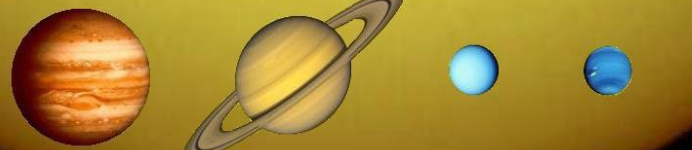
What is the general structure of a Jovian planet?
A small, dense core surrounded by massive layers of gas.
What are the primary gases in Jovian planets?
Hydrogen (H) and helium (He).
How do Jovian planets differ from terrestrial planets?
Jovian planets are large, low-density gas giants with thick atmospheres, while terrestrial planets are smaller, rocky, and denser.
which jovian planets are the gas giants?
Jupiter and Saturn
which jovian planets are the ice giants?
Uranus and Neptune
What types of satellites do Jovian planets have?
Jovian planets have extensive systems of moons.
Do all Jovian planets have rings?
Yes. Jupiter, Saturn, Uranus, and Neptune all have ring systems.
Saturn being the most famous
What kind of magnetic fields do Jovian planets possess?
They have powerful magnetic fields generated by their interiors.
more powerful than Earth
What are dynamic weather systems?
Rapidly changing atmospheric features such as winds, storms, clouds, and jet streams.
Which Jovian planets can be seen with the naked eye?
Jupiter and Saturn.
(Uranus and Neptune are too far away)
Who first observed Jupiter's moons?
Galileo Galilei in 1609.
Why was Galileo's observation of Jupiter's moons important?
It showed that not everything in the universe orbited Earth, supporting the heliocentric model.
What did Galileo discover in 1609?
The four largest moons of Jupiter using a telescope.
what was Galileo’s observations about Jupiter’s moons?
first believed they were stars
then noticed they moved in wrong direct in regard to background stars
remained in Jupiter’s proximity but changed relative to each other
Was Saturn known before the invention of the telescope?
Yes. Saturn was known to ancient astronomers and can be seen with the naked eye.
Who first observed Saturn through a telescope?
Galileo Galilei.
Who proposed that Saturn was surrounded by a ring?
Christiaan Huygens.
Why was Galileo confused by Saturn?
His telescope was not powerful enough to clearly resolve the rings, so Saturn appeared to have strange side structures.
saw pair of objects on their side → “tripled bodied”
When was Uranus discovered?
1781.
Why was Uranus not immediately recognized as a planet?
It was initially thought to be a star.
When was it determined that Uranus orbited the Sun?
1783
Bodah determined that it revolved around the sun.
Why wasn't Uranus discovered by ancient astronomers?
Although visible to the naked eye under ideal conditions, it is very faint and was mistaken for a star.
Who first recorded Neptune, although he did not recognize it as a planet?
Galileo Galilei in 1612.
Who predicted the existence and location of Neptune?
John Couch Adams and Urbain Le Verrier.
mathematically predicted that some unknown planet was helping Uranus motion
When was Neptune first observed as a planet?
1846.
applied Kepler’s Laws of motions motion and Newtons
What was the first planet discovered by mathematical prediction?
Neptune.