psyc 211 - Brain anatomy
 Call Kai
 Learn
Learn Practice Test
 Spaced Repetition
 Match
Match Flashcards
 Knowt Play
1/47

There's no tags or description
Looks like no tags are added yet.
Name | Mastery | Learn | Test | Matching | Spaced | Call with Kai | Chat |
|---|
No analytics yet
Send a link to your students to track their progress
48 Terms
What are the two parts of the nervous system
The central nervous system ( CNS )→ every thing in the brain and spinal cord
Peripheral nervous system ( PNS )→ any part of the nervous system outside the brain and spinal
Sensory neurons and motor neurons typically span in both regions
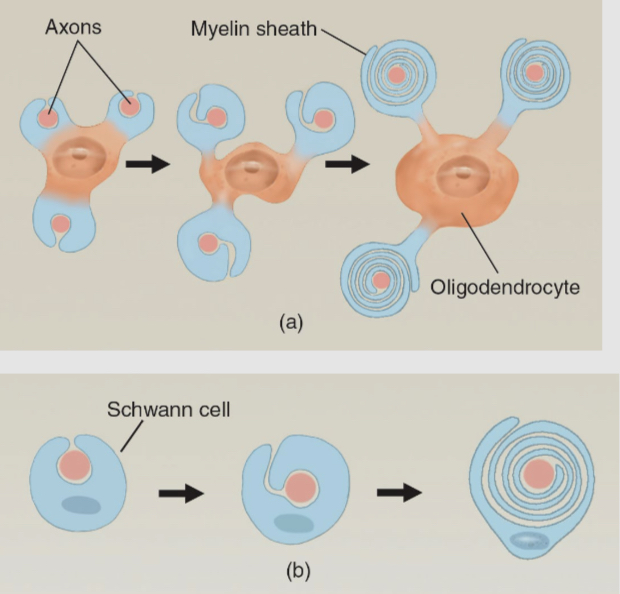
How is myelin created in the CNS and in the PNS
In the CNS, myelin is created by oligodendrocytes
In the PNS myelin is created by Schwann cells
Each Schwann cell provides one myelin
What is the blood brain barrier
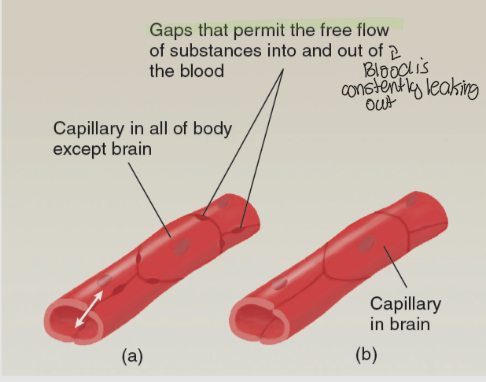
This barrier is formed by the tight arrangement of the cells that form the walls of the capillaries in the brain, which don’t let blood pass through
Everywhere else on the body, blood is constantly flowing out of capillaries
What is extracellular fluid
it is the liquid that leaks out of vessels (ex: blood vessels and blood plasma)
It flows around cells providing nutrients and collecting waste
Extracellular liquid in the body get collected into lymph vessels, which carry it to lymph nodes and lymph organs
Why does the lymphatic system does not reach the CNS and what is the cerebrospinal fluid
that is because there are no holes in the blood vessels that pass though the brain and spinal cord.
Rather than letting plasma directly leak out of the circulatory system, the brain makes its own extracellular solution by actively licking out what it needs from the blood
This liquid is called cerebrospinal fluid (CSF)
What are the two types of neurons in the CNS
projection neurons send an axon to a distal area of the brain (they synapse on neurons far away from where the axon started
Inter neurons (only synapses on local, nearby neurons. TheIr axons don’t go far
In the brain, projection neurons typically release glutamate and interneurons typically release GABA
What are the two types of neurons found in the PNS
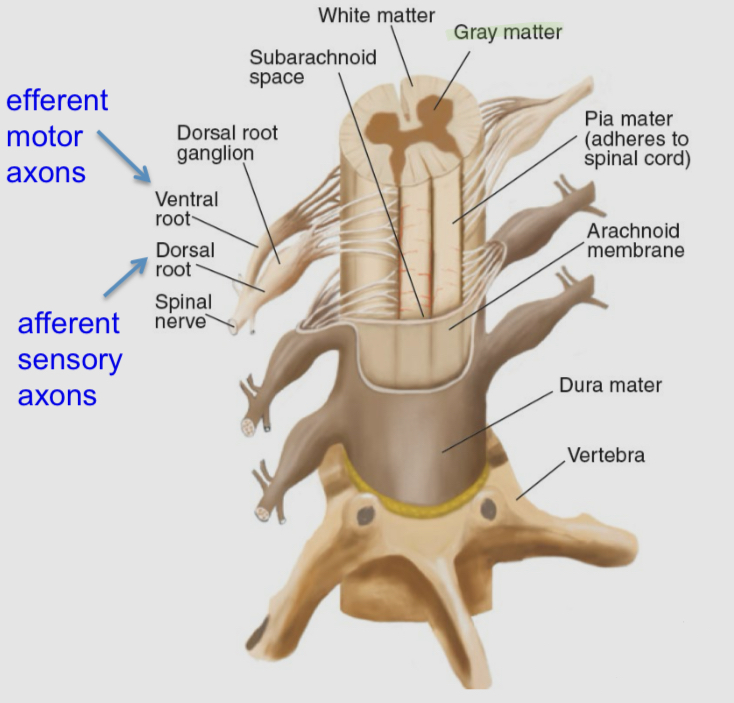
sensory neurons detect stimuli in the external and internal environment . Their cells are found throughout the body and their axons enter the CNS. These axons are afférent fibres (inputs); they carry info towards the CNS
Motor neurons control muscle contraction and gland secretion. Their cells bodies are usually in the spinal cord, and their axons leave the CNS. These axons are efferent fivers (outputs); they carry information away from the CNS
What are nerves
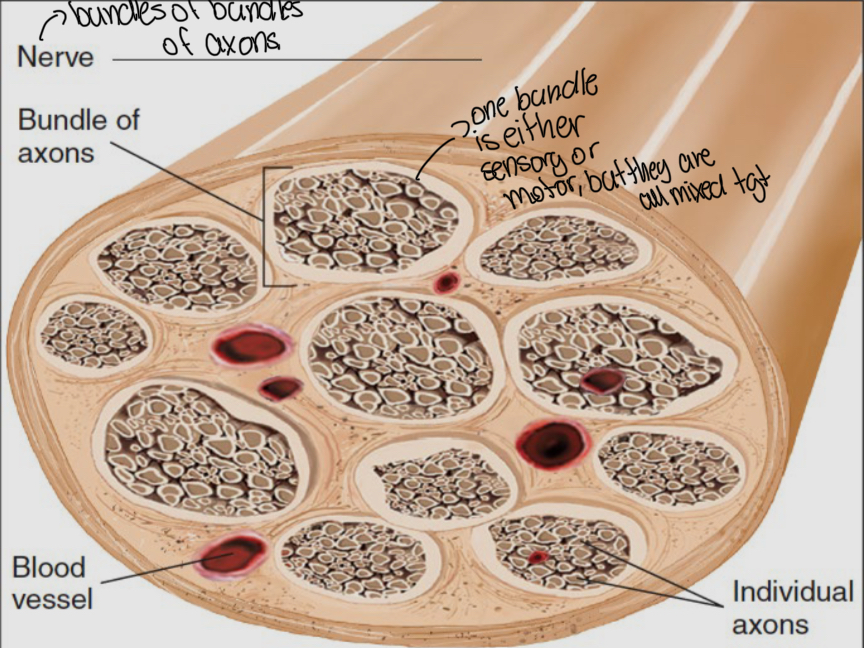
they are enclosed, cable-like bundles of axons in the peripheral nervous system
The brain an spinal cord communicate with the rest of the body via nerves
Most nerves are a combination of sensory axons and motor neurons
What are the two types of nerves
Spinal nerves: we have 31 pairs of spinal nerves, nearly one pair for each vertebrae in our spine. Spinal nerves connect to the spinal cord
We have 12 pairs of cranial nerves, which connect to the brain directly
All cranial nerves, epxcept for #10, process movements and sensory information
The 10th cranial nerve, the vagus, branches extensively in the upper half of the body. The vagus nerve regulates the function of multiple organs, including the heart lungs and digestive track
What is the spinal cord
It is a long, conical structure that is approximately as thick as an adult's little finger
The principal function of the spinal cord is to bring sensory info to the brain and to bring motor fibers to effector organs throughout the body (glands and muscles)
The spinal cord has a certain degree of autonomy from the brain, as various reflexive control circuits are located there
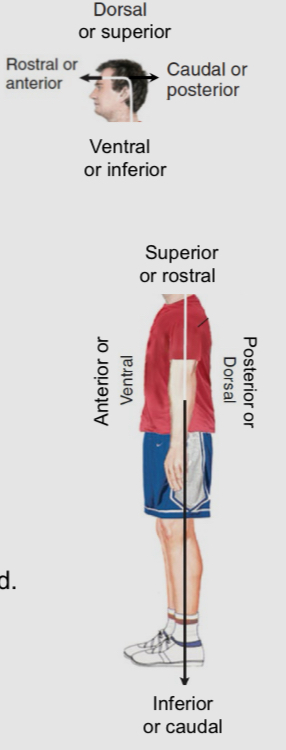
Name all anatomical directions
Neuraxis: imaginary line that runs along the length of the CNS
Anterior: in front of
Posterior:behind
Superior: above
Inferior: below
Rosral: towards the beak
Caudal: towards the tail
Dorsal: towards the back
Ventral: towards the belly
Lateral: away from the midline
Medial: toward the midline
What is the somatic nervous system
it is all about the external environment
Its afferent fibers collect sensory information from outside the body
Its efferent filers control skeletal muscles (body movements)
What is the autonomic nervous system
It is all about the body's internal environment
Its afferent fibers collect sensory information from outside the body
Its efferent fibers regulate internal bodily functions by controlling smooth muscle, cardiac muscle and glands
The efferent branch of the ANS has two distinct parts: the sympathetic and parasympathetic divisions.
What is the sympathetic division
It prepares the body for action, especially in life threatening situations
It is always active to some extent, as it regulates heart rate, blood flow, and the activity of nearly every organ in the body
When strongly stimulated, the sympathetic system increases blood flow to organs that are involved in intense physical activity, and it shunts blood away from organs that are not necessary for immdediate survival
what is the parasympathetic division
it supports functions that occur when th wordy is in a relaxed state, when all is well
It is always active to some extent, as it regulates urination, defacation, salvation, and sexual arousal. It is responsible for the body’s energy stores
It is involved in “feed and breed” and “rest and digest” activities
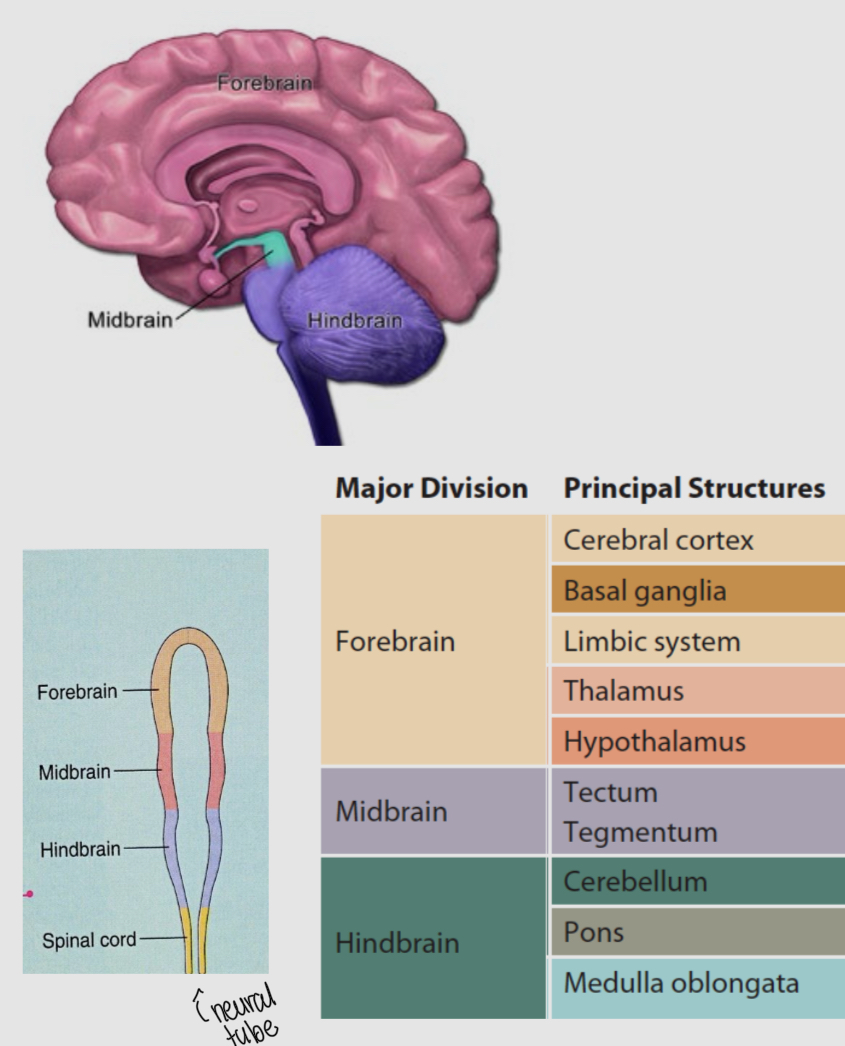
What are the three major divisions of the brain
forebrain
midbrain
Hindbrain
What is the brainstem composed of
It refers to the stem of the brain
It includes the medial, pons, and midbrain
What is the cerebrum composed of
it is composed of the cerebral cortex, basal ganglia, and lambic system
Which parts of the brain are the oldest
the medulla and pons
These areas contain several cranial nerve nuclei, which process sensations and movements around the mouth and face
Some brain nuclei in these areas process automatic sensations, such as a full bladder, or autonomic muscles that control heart rate or breathing
what brain nuclei are in the medulla oblongata
It connect to the spinal cord and contains several brain nuclei:
Cranial nerves nuclei (mouth, face, heart, stomach)
Autonomic nuclei (breathing, heart rate, blood pressure)
Sensorimotor relay nuclei (controlling information flow)
The blood-brain barrier is noticeably weak in area posteema, where poisons are detected to initiate vomiting
The medulla also contains part of the reticular formations, which regulates sleep and arousal
What are the parts of the pons
it is a bulge in the brainstem that interconnect the cerebellum
It contains sensorimotor relays nuclei that pass information in and out of the cerebellum as well as up and down
It contains several cranial nerve nuclei that process information related to the face and hearing
It contains part if the reticular information
What is the role of the cerebellum
It does not initiate movement, but it contributes to the coordination, precision and accurate timing of movements
Intergrafing sensory and motor information from throughout the brain and spinal cord, the cerebellum does some kind of sensimotor integration on the timescale of milliseconds/ seconds, which exerts a smoothing effect on movement and cognition
Cerebellum function is critical for picking up a cup and drinking without spilling, particularly if you are also walking and ensuring your backpack isn’t sliding off and you are sore from a workout
It it also plays an important role in motor learning, particularly as the body grows and changes over time (which necessitates adjustments in sensimotor intergration
Damage to this part of tern results in jerky, exaggerated, poorly coordinated movements.
What are inputs to the cerebellum synapse in the superficial cerebrellae cortex
It is a thin continuous layer of cells that is thickly folded in the style of an accordion
Where do neurons in the cerebellar cortex send axons
they send them to the deep cerebellar nuclei
in turn, those neurons project out of the cerebellum to the brain or spinal cord
Proximal
Nearby
Distal
Far away
Superficial
Located close to the surface/ exterior of animal
Deep
Located deep in the interior of the animal, far from the surface
Contralateral
Structures on the opposite side of the body
Ipsilateral
Structure on that same side of body
taste and smell are the only sensory systems that do not have contralateral organization
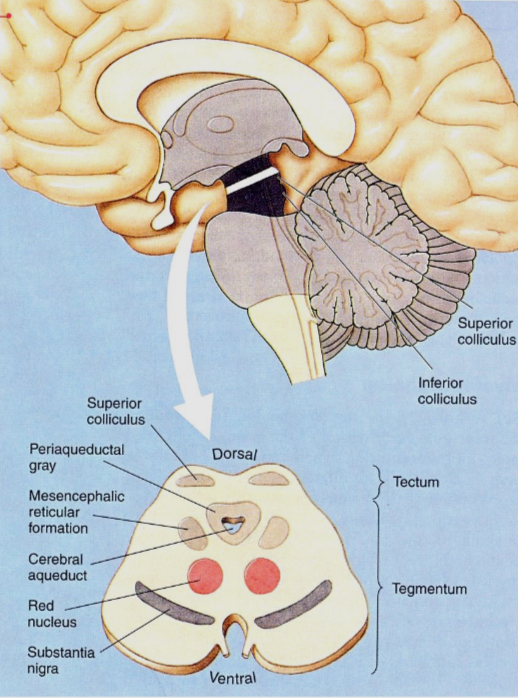
What are the parts of the midbrain
the tectum
The tegmentum
What is the tectum
the tectum appears as two oaks of bumps on the dorsal , surface of the midbrain
The two bumps are the superior colliculi, and they are involved in orienting the animal to things in peripheral visions
The bottom two bumps are the inferior colliculli and are involved in orienting the animal to unexpected sounds
What is the tegmentum
it includes several structures that coordinate complex species- typical movements. Some areas process pain pain and orchestrate behavioural responses to threats
What is the hypothalamus
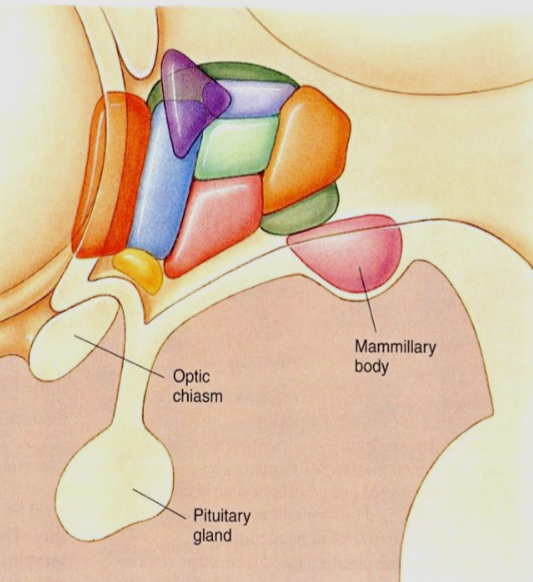
it is a bilateral structure made up of several brain nuclei, which generally regulate autonomic nervous system activity
It is involved in behaviours that directly relate to survival (i.e. the four F’s: feeding, fighting, fleeing, and mating)
Different hypothalamic nuclei control body temperature, sleep-wake cycles, hunger
One of its most important structures is to control the endocrine system by releasing hormones into the blood via the pituitary gland
What is an hormone
it is a chemical substance that is released into the blood by an endocrine gland. It has effects on cells in other organs
What is an endocrine gland
it is a gland that secretes hormones into the blood.
the master regulator of the endocrine system is the hypothalamus, as it releases hormones that regulate the function of other endocrine glands

What is the thalamus
it is another bilateral structure that contains several brain nuclei many of which relay ascending sensory information to different regions of the cerebral cortex
Ex: visual information from the eye passes through the lateral geniculate nuclei of the thalamus
Many nuclei of the thalamus have widespread cortical projections
What is the cerebral cortex
it is where sensory information enters conscious awareness
It is where our understanding of the world is formed and where we decide how to purposefully move in the world
It is not made up of distinct nuclei (except in birds)
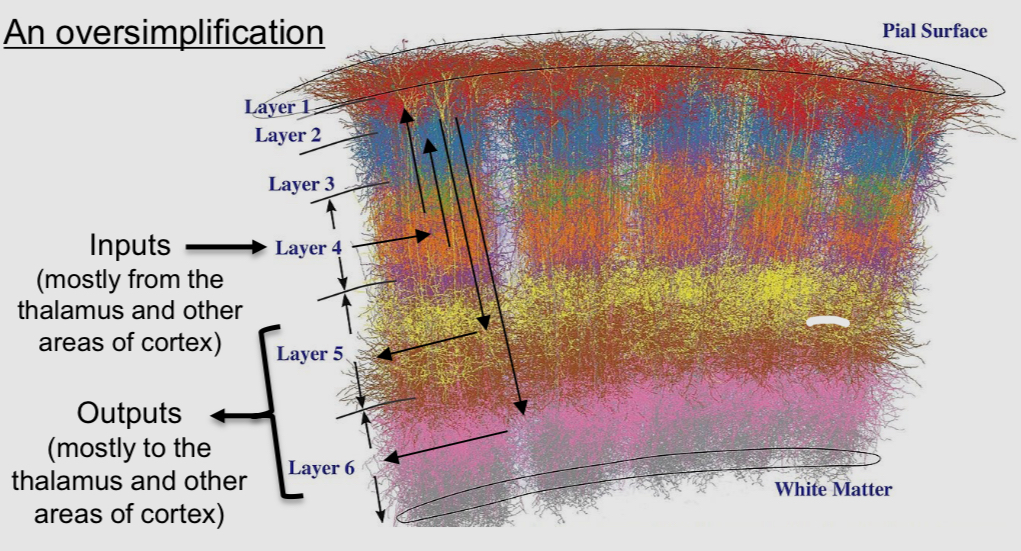
It is a multilayered structure (6 layers in mammals, 3 in reptiles)
Neurons are interconnected between layers in a way that gives rise to cortical columns, which are thought to be partially distcint functional units
What parts are contained on the top surface of the cerebral cortex
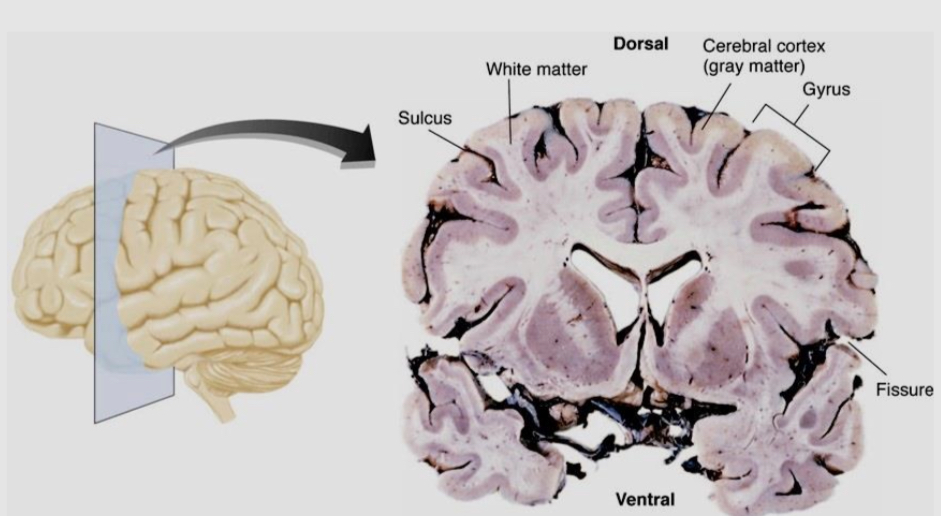
sulci → small grooves
Fissures → large grooves
Gyri → ridges between the sucking and fissures
These convolutions increasae the surface area of the cerebral cortex
The outermost portion of the cerebral cortex is gray matter where there is a high concentration of cell bodies
Beneath the gray matter is white matter, which is primarily just myelinated axons
What are the different ways of cutting the brain
coronal cut → frontal cut
medial → toward midline
Lateral → away from midline
Sagittal cut → exactly in the middle (between the eyes)
Horizontal cut
What are the four lobes of the cerebral cortex
the frontal lobe which controls movement
the parietal lobe which processes touch information
The occipital lobe which processes visual information
The temporal lobe which processes auditory information
What separates different parts of the brain
the longitudinal fissure spearages the two hemispheres
The lateral fissure separates the frontal lobe and the temporal lobe
The central sulcus separates the frontal lobs and the parietal lobe
What are the primary cortical areas
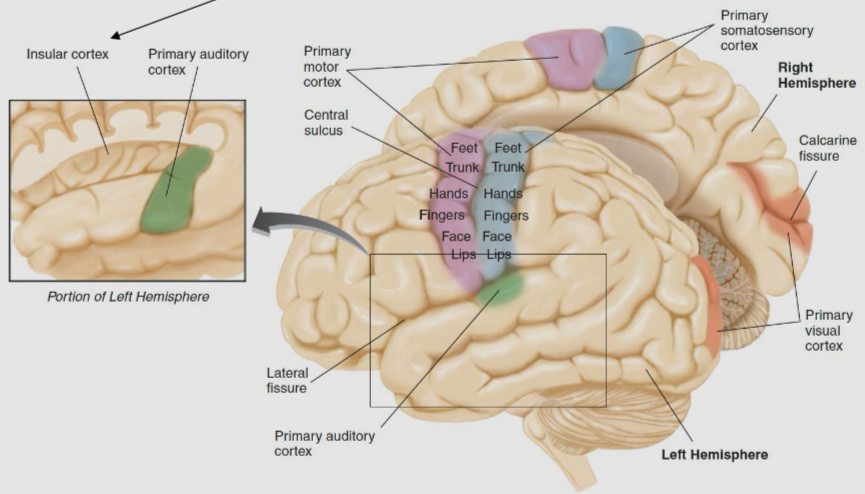
primary motor cortex (frontal lobe) contains motor neurons that synapse in the spinal cord. Different regions of primary motor cortex control different parts of the body
Somatosensory cortex (paretial lobe) is where touch information enters the cerebral cortex. Different regions of somatosensory cortex receive information from all different parts of the body
Primary auditory cortex (temporal lobe) is where auditory enters the cerebral cortex
Primary visual cortex (occipital lobe) is where visual information enters the cerebral cortex
Insular cortex when gustatory information enters the cerebral cortex
What is the sensory association cortex
it is where perception takes place and memories are stored
Areas of sensory association cortex nearest to the primary sensory areas receive information from only one sensory system
What is the basal ganglia
it is referred to as subcortical structures, since it sit beneath the cerebral cortex (along with the limbic system)
It used to be called the primitive “reptilian” brain, but it is now clear that reptiles have other forebrain areas as well
They are a collection of subcortical nuclei. A a circuit, they regulate motivation, reinforcement learning, and habits
Inputs to the basal ganglia come from all over the forebrain, especially the frontal lobe
Outputs of the basal ganglia descent to midbrain and hindbrain to regulate movement. Other outputs descend the cerebral cortex to regulate sensory processing and decision making
Many neurological disorders are associated with basal ganglia dysfunction
What is the limbic system
it is a collection of subcortical areas that regulate emotions and the formation of episodic memories
Its principle areas include the hippocampus, amygdala, and cingulate cortex
What is the cingulate cortex
it is a large cortical area that overlies the corpus callosum. This region interconnects many limbic areas of the brain
What are the hippocampus and amygdala
they are both hidden in the temporal lobe
the hippocampus is critical for explicit memory formation
The amygdala is critical for process in emotion, especially fear