BIOL214 Post Exam - Behavioral Ecology (Lec 25+26)
 Call Kai
 Learn
Learn Practice Test
 Spaced Repetition
 Match
Match Flashcards
 Knowt Play
1/83

There's no tags or description
Looks like no tags are added yet.
Name | Mastery | Learn | Test | Matching | Spaced | Call with Kai |
|---|
No analytics yet
Send a link to your students to track their progress
84 Terms
Behavioral Ecology
the observable response of organisms to external and internal stimuli
Proximate Causes of Behavior
focus on genetic and physiological mechanisms
Ultimate Causes of Behavior
focus on its effects on reproductive success
Altruism
behavior that benefits others at personal cost
some individuals forego reproducing to benefit the group
most altruistic acts serve to benefit the individual’s close relatives
Reciprocal Altruism Definition
evolution of altruism among nonkin
Group Selection
the first attempt to explain the existence of altruism (Edwards, 1962)
natural selection produces outcomes beneficial for the whole group/species
a group consisting of selfish individuals would overexploit resources and die out, while the fitness of a group with altruists would be enhanced
Individual Selection
counter argument to group selection made by George Williams
proposes that particular traits are selected for because they benefit the survival and reproduction of the individual rather than the group
3 arguments
mutation, immigration, and the lack of an ability to predict future source availability tend to prevent group selection
Argument #1: Mutation
in a population where individuals limit their resource use, mutant individuals that readily use resources for themselves or their offspring will have an advantage
ex. birds with a clutch size of two
two eggs ensures replacement of the parent birds but prevents a population explosion
if a bird lays three eggs, sufficient food may be available for all three young to survive
3-egg genotype will eventually become more common than the 2-egg genotype
brood size could continue to increase until the parents can no longer provide for all their young
Argument #2: Immigration
selfish individuals that lay more eggs could immigrate from other areas
populations are rarely sufficiently isolated to prevent immigration of selfish individuals from other populations
Argument #3: Resource Predication
group selection assumes that individuals can assess and predict future food availability and population density within their own habitat
Infanticide
population size is more often controlled by competition in which individuals strive to command as much of a resource as they can
rather than cooperation
can result in infanticide
Altruism with Relatives
William D. Hamilton (1964)
coefficient of relatedness is associated with the evolution of altruism
not only does an organism pass on its genes through having offspring, but it can pass them on through ensuring survival of relatives
an organism has a vested interest in protecting its brothers and sisters and even their offspring
Hamilton’s Rule
Hamilton proposed that an altruistic gene will be favored by natural selection when:
rB > C
r - coefficient of relatedness of the donor (the altruist) to the recipient
B - benefit received by the recipient of altruism
C - the cost incurred by the donor
Inclusive Fitness
used to designate the total number of copies of genes passed on through one’s relatives, as well as one’s own reproductive output
Kin Selection
used to designate the behavior that lowers an individual’s own fitness but enhances the reproductive success of a relative
Eusociality
organisms that have reproductive division of labor, overlapping generations, and cooperative care of young
Eusociality in Ants
vast majority of females (worker ants) rarely reproduce, but instead help one reproductive female (the queen) raise offspring
males develop from the queen’s unfertilized eggs and are haploid (their sperm are genetically identical)
each daughter receives an identical set of genes from her father; the other half of a female’s genes come from her diploid mother
coefficient of relatedness r of sisters is 0.50 (from father) + 0.25 (from mother) = 0.75
haplodiploidy
females are more related to their sisters (0.75) than their own offspring
more advantageous for females to stay in the nest and care for other female offspring of the queen (their full sisters)
Eusociality Continued
Richard Alexander suggested it was the lifestyle that promotes eusociality in animals instead of genetics
suggested eusocial species exist when the following conditions are met:
individuals are confined to burrows/nests and escape is difficult
a dominant individual can prevent other individuals from reproducing
food is abundant enough to support high concentrations of individuals
these conditions are met in naked mole rat colonies
females do not reproduce and only the queen has offspring
Reciprocal Altruism
occurs when the cost to the animal of behaving altruistically is offset by the likelihood of a return benefit
ex. female vampire bats
will regurgitate food to an unrelated female if needed, because at other times, she may be the recipient of such food
the recipient delays starvation by about 18 hours whereas the donor accelerates time toward starvation by 6
Prisoner’s Dilemma
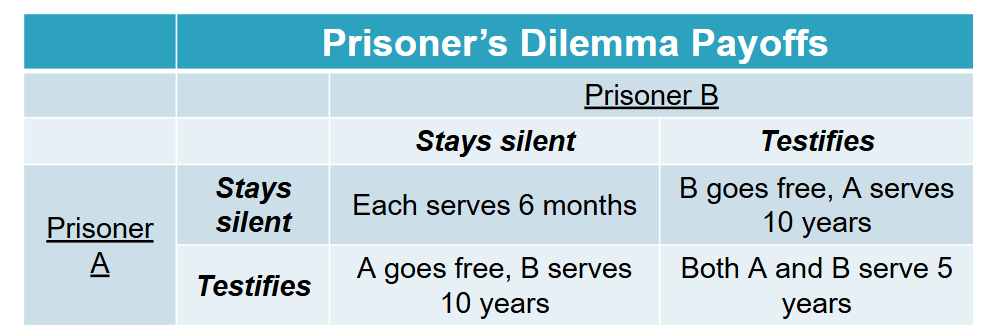
Evolutionary Stable Strategy
a strategy, if which, adopted by a population of players in a given environment, cannot be invaded by any alternative strategy that is initially rare
Group Living
has advantages and disadvantages
benefits include group defense against predators (increased vigilance) and protection in numbers
ex. pigeons
if each pigeon occasionally looks up to scan for a hawk, then the bigger the group, the more likely one bird will spot the hawk early enough for the flock to take flight
many eyes hypothesis
Scan Frequency
scan frequency declines with increasing group size
Group Living and Food
group living allows predators to take down prey of a disproportionately larger size than a single predator would be able to
when animals search for food in groups, they are able to exploit the discovery of others
may result in higher encounter with food items than searching individuals
Orca Group Hunting
highest payoff is a group size of 3 (optimal group size)
solitary individuals would benefit from joining the group until 5 individuals
in a group size of 6, an individual would be better off on its own
stable group size is 5
Selfish Herd
William Hamilton
within a group, each individual can minimize the danger to itself by choosing the location that is as close to the center of the group as possible
predators are likely to attack prey on the periphery
when animals are under attack they tend to bunch close together which makes it physically difficult for the predator to get to the center
Foraging Behavior
food gathering, or foraging, often involves decisions about whether to remain at a resource patch and look for more food or look for a completely new patch
the analysis of these decisions is often performed in terms of optimality modeling
optimality modeling predicts that an animal should behave in a way that maximizes the benefits of a behavior minus its cost
the benefits are nutritional or caloric value of the food items and the costs are the energetic or caloric costs of movement
An Organism is Optimizing its Foraging Behavior When…
the difference between the energetic benefits of food consumption and energetic costs of food gathering is maximized
Optimal Foraging Theory
maximize the benefits and minimize the costs of food gathering
optimal foraging proposes that in a given circumstance, an animal seeks to maximize the rate of energy gain
proposes natural selection favors animals that are maximally efficient at propagating their reproductive success and at performing all other functions that serve this function
the more net energy an individual gains in a limited time → the greater the reproductive success
Northwestern Crow Optimal Foraging
crows take only large whelks and always drop them from a height of 5m to break them on rocks
this is because this size whelk dropped from this height needs the fewest drops to break it open
Atta cephalotes Optimal Foraging
these leaf cutting ants are larger individuals
however, larger individuals are restricted to foraging at night because of the activity of parasitic flies during the day
during the day, only small ants forage as these are not subject to the same levels of parasitism
North Atlantic Oscillation
climatic phenomenon in the North Atlantic Ocean of fluctuations in the difference of atmospheric pressure at sea level between the Icelandic low and the Azores high
controls the strength and direction of westerly winds and storm tracks across the North Atlantic
it is part of the arctic oscillation, and varies over time
North Atlantic Oscillation Effects on Wolves, Moose, and Trees
heavier snowfall → larger wolf packs
larger wolf packs kill more moose
larger wolf packs reduce moose density
smaller moose density permits greater fir growth
Defending Territories
a territory is a fixed area in which an individual or group excludes other members of its own species, and sometimes other species, by aggressive behavior or territory marking
territory owners tend to optimize territory size according to the costs and benefits involved
primary benefit of a territory is that it provides exclusive access to a particular resource
Foraging Behavior
large territories may provide more of a resource but cost more to defend
small territories that are less costly to defend may not provide enough of a resource
territory size differs considerably among species
optimality modeling predicts territory size should evolve to maximize the difference between energetic benefits and costs, thus maximizing the profit to the territory holder
territories set up solely to defend areas for mating or nesting are often relatively small
Game Theory
the study of mathematical models of conflict and cooperation between intelligent rational decision-makers (Myerson 1991)
John Maynard Smith (1976, 1982) investigated fighting behavior in animals by considering contests in which there were different sorts of strategies, modifying the Prisoner’s Dilemma game
asking if its better to attack or submit to the attacker
Bourgeois
hawk if a territory owner
dove if not a territory owner
hawk average reward = 12.5
dove average reward = 7.5
Bourgeois reward = 25
Game Theory Consequences
fighting strategy is frequency dependent
the ESS is often a mixture of different strategy types like Hawk, Dove, and Bourgeois
the frequency of Hawk behavior increases as the payoff increases
Mating Systems
Fisher’s Principle states that a 1:1 sex ratio is an ESS as the fitness of one gender is reduced when there is an overproduction of that gender
Promiscuous Mating Systems
each male or female may mate with many partners
ex. chimpanzees and bonobos
each male mates with many females and vice versa
ex. intertidal and terrestrial mollusks
the risk of not finding a mate is believed to promote promiscuity
Mate-Guarding Hypothesis
theorizes that males stay with a female to protect her from being fertilized by other males
ex. Dunnocks
Male Assistance Hypothesis
maintains that males remain with females to help them rear their offspring
70% of bird species
Female Enforced Monogamy
suggests that females stop their male partners from being polygynous
Purple Martin EPC
older males mate with the females of less experienced males
the young fathers only fertilized 1.3 eggs out of clutch of 4.5 eggs
the older males father 4.5 fertilized eggs with their mates, plus another 3.6 fertilized eggs with the mates of less experienced males
Mating Systems and Ecology
species living in stable environments with uniform food distribution tend to be territorial and monogamous
ex. dark-backed weaver
species living in areas that occasionally have superabundant food tend to be polygynous
ex. red bishop
birds that produce precocial young are more likely to be polygynous
Resource-Based Polygyny
male lark buntings hold territories in shade
females need shaded nests to promote chick survival
Harem Mating Structures
more common when females congregate in groups or herds
ex. elephant seals
Communal Courting
where males display in designated communal courting areas
ex. sand grouse
Polyandry
ex. honeybees
the queen often mates with multiple males
ex. spotted sandpiper
the productivity of their breeding grounds is so high, the female can lay five clutches of 20 eggs in 40 days
reproductive success is not limited by food but by the number of males she can find to incubate the eggs
females compete for males, defending territories where the males sit
females compete for social rank by fighting
Sexual Selection
selection that promotes traits that will increase an organism’s mating success and can take two forms:
1. intrasexual selection
2. intersexual selection
Intersexual Selection
members of one sex choose mates based on particular characteristics
ex. color of plumage or courtship song
usually females
Intrasexual Selection
members of one sex compete over partners
winner performs most of matings
usually males
New Caledonian Crows
research suggests that New Caledonian crows have capacity for abstract thought
can use one tool to access another tool that will help them reach food
discovered by Dr. Alex Taylor
Behavior Evolves
a behavior is an internally generated response to an external stimulus
can evolve through natural selection because it can influence the fitness of individuals
can vary from individual to individual and the variation is at least partly genetic
Dmitry Belyaev (1917-1985)
demonstrated that docility could be selected for in foxes, resulting in individuals that were reportedly as tame as dogs
Genes Influence Behavior in Foxes
behavior appeared to be heritable
Kukekova used QTL to begin identifying genes associated with aggressiveness and Nelson et al. suggested that neural crest cells were particularly important
Derived Freshwater Sticklebacks
differ in behavior from marine ancestors
juvenile sticklebacks from freshwater lakes were less social, more aggressive, less likely to school
Oldfield Mice
most Peromyscus dig only one short tunnel to their nest
oldfield mice dig elaborate shelters with a long tunnel to the surface and a second tunnel that goes the opposite way
3 loci having strong additive effects on escape tunnel length
Behavioral Ecology
the science that explores the relationship between behavior, ecology, and evolution to elucidate the adaptive significance of animal actions
Proximate Causation
explains biological function in terms of immediate physiological or environmental factors
Ultimate Causation
explains traits in terms of evolutionary forces acting on them
Dictyostelium discoides
to cope with starvation, the cells join to form a slug, which produces spores (but die in the process)
Animals use Neurons to Control Behavior
spikes of voltage travel down the length of a neurotransmitters at synapse, triggering activity in neighboring neurons
Animal Nervous System Evolution
evolved through co-opting of genes with other functions
agreement that genes for cell-to-cell communication were co-opted
uncertain whether earliest multicellular animals had a nervous system or whether it evolved in more derived animals
Sponges
lack nervous systems but make homologs of proteins found in neurons
hypothesized that sponge larvae use these proteins to build sensory cells to detect suitable places to settle and develop
Ctenophores Play Pivotal Role in Debate About Origins of Nervous Systems
Hypothesis 1
nervous system evolved in common ancestor to all animals but was lost in sponges
Hypothesis 2
nervous system evolved in ctenophores independently
evidence supports this one
Innate Behavior
is behavior that’s genetically hardwired in an organism and can be performed in response to a cue without prior experience
ex. Tinbergen’s gull beak color
Synaptic Plasticity Allows for Learning
is the ability of synapses to strengthen or weaken over time, in response to increases or decreases in their activity
occurs when the number or strength of synaptic connections between neurons is altered in response to stimuli
Earliest Fossil Evidence of Brain
Haikouichthys ~530mya
Vertebrate Brains are Divided into Specialized Regions
Somatosensory cortex
proprioception
exteroception
interoception
Broca’s area
speech
Visual cortex
Cerebellum
maintaining balance
Brain stem
Amygdala
emotional responses
Hypothalamus
homeostasis
Prefrontal cortex
attention
thought
perception
episodic memory
Vertebrate Brain Organization is…
relatively conserved
Evolutionary Stable Strategy
a behavior that, when adopted by the majority of the population, cannot be invaded by another strategy
Dilution Effect
refers to the safety in numbers that arise through swamping the foraging capacity of local predators
Cooperative Foraging
wild dogs benefit more from hunting in packs than hunting on their own
Group Defense Cost
group living comes at the cost of an increase of parasite load (contact)
Benefits of Sociality
increased vigilance
dilution effect
enhanced defense
cooperative foraging/hunting
improved defense of critical resources
Costs of Sociality
increased conspicuousness to predators
increased competition for food
increased competition for mates
decreased certainty of paternity/maternity
increased transmission of disease/parasites
Direct Fitness
an organism’s own success in transmitting alleles to future generations
Indirect Fitness
reproductive success of other individuals carrying the same alleles
Inclusive Fitness
direct fitness + indirect fitness
Kin Selection
selection arising from the indirect benefits of helping relatives
Kin Selection in Ground Squirrels
Belding’s ground squirrels
females don’t disperse very far (unlike males)
females more likely to give alarm calls
Kin Selection in White-Fronted Bee-Eaters
White-Fronted Bee-Eaters
sometimes help parents during first 2 years of life
during harsh environmental conditions
Certainty of Paternity Makes Parental Care Profitable
male giant water bugs
carry eggs on the back and aerate them by rocking back-and-forth on the water surface
only accept eggs from females after they have mated with them several times
Kin Recognition
kin recognition can be challenging for males
organisms may recognize kin through:
physical proximity
physical features or odors