seasonal breeding
 Call Kai
 Learn
Learn Practice Test
 Spaced Repetition
 Match
Match Flashcards
 Knowt Play
1/15

There's no tags or description
Looks like no tags are added yet.
Name | Mastery | Learn | Test | Matching | Spaced | Call with Kai | Chat |
|---|
No analytics yet
Send a link to your students to track their progress
16 Terms
how can temperature reduce fertility
altered ovarian follicle dynamics
incresed oocyte polyploidy and altered oviducal function leading to:
- fertilisation failur- early embryonic death
- changes in oestrus behaviour
problems in high yielding dairy cow
high milk yield →NEB→metabolic stress→ decrease in metabolic hormones
how do external signals influence seasonal reproduction
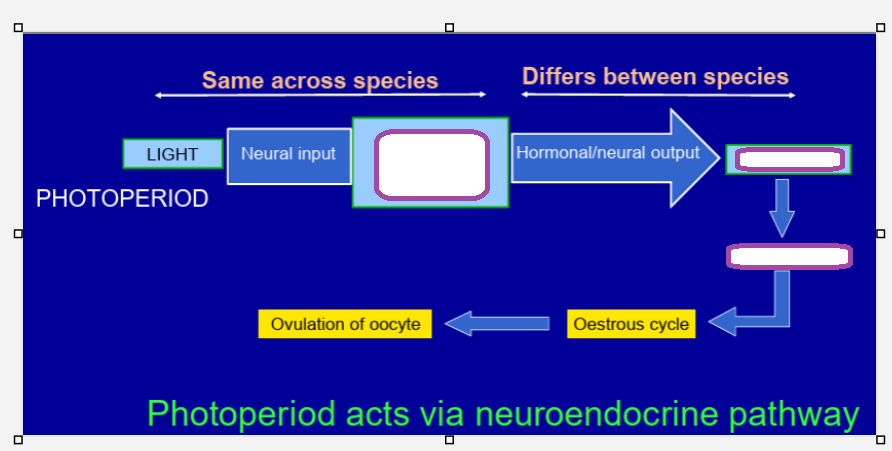
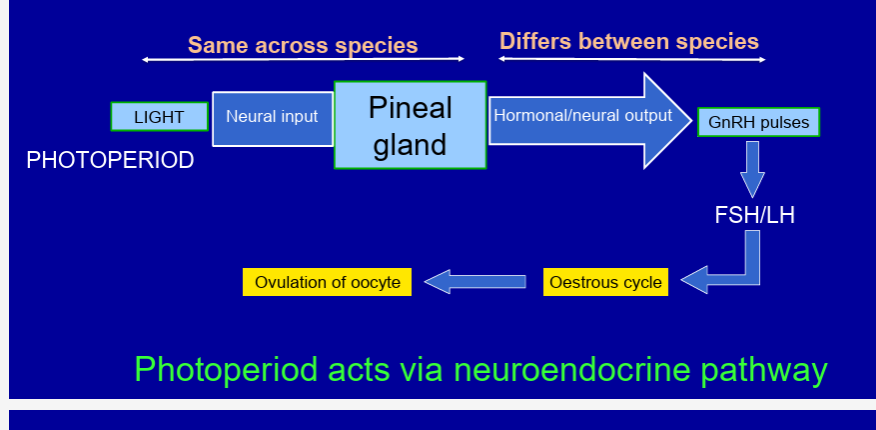
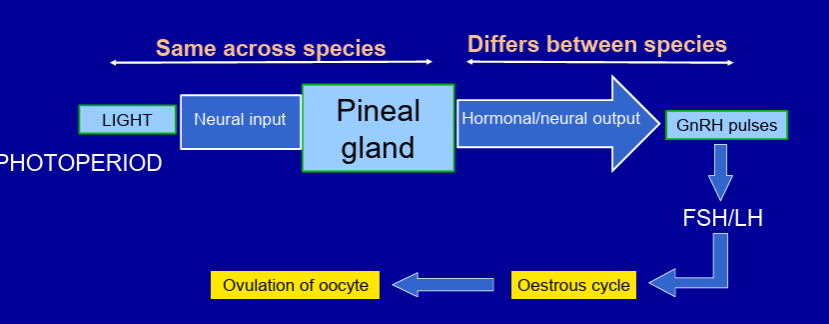
pineal gland
where is it located
what does it secrete and from what. when is the synthesis of this the greatest
what is the rate limitng enzyme
located in brain between two cerebral hemispheres
varies in size between species but not location secretes melatonin
melatonin is sytheissed in the pinela gland from tryptophan
rate limiting enzyme is N acetyl- transferase
rate of melatonin sytneiss is greatest during the hours of darkness
neural input
where is photic stimuli relayed from which cells
via which trat to which nucleus
then which neurons
then which ganglion to which gland
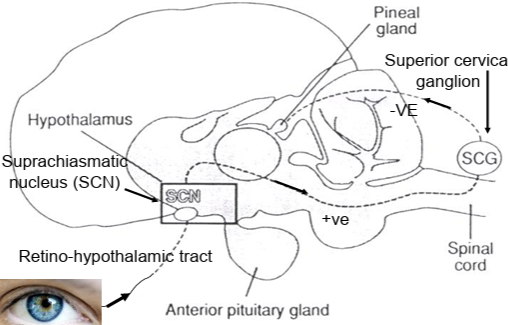
photic stimuli relayed from retinal ganglion cells via retinohypothalamic tract → supraciasmatic nucleus (anterior hypothalamus) → periphreal and central sympathetic neurons and superior cervical ganglion →pineal gland
more light equals more -ve feedback on pineal so less melatonin
what does rainfall regulate
seasonal patterns of pregnancies in macropods
influence of sex
females more strongly seasonal than the male
timing of the breeding season may not be exactly the same
male fertility is influenced by season and photoperiod
eg in sheep daily production of spermatozoa during spring is 4x lower compared autumn
influence of genotype on seasonality
interaction with genotype
sometimes out of sync with latitude
so lambs can be born outside of spring
non seasonal vs seasonal
where is nonseasonal reproduction mainly observed
when do seasonal breeders develop gonads and display reproductive behaviour
which 2 factorsdetermine the timing in mating
Nonseasonal reproduction is mainly observed in animals inhabiting tropical areas, where annual environmental changes are relatively small. Animals in these areas exhibit reproductive behaviour all year round.
• In contrast, seasonal breeders develop gonads and display reproductive behaviour during specific times of the year in order to limit the delivery of offspring between spring and early summer.
• These seasons are optimal for raising offspring because the climate is moderate and sufficient food is available.
• A critical factor in determining the timing of mating is the gestation length or incubation of fertilized eggs
seasonal species
sheep
goat
deer
horse
cat
wild pig
hamster
rabbit

non seasonal species
dog
cow
pig
guinea pig
rodent

when are reproductive behavours in LH or SD breeders observed
when the light phase lasts longer than the critical day or night length
what is same and different between species
long and short days
what does melatonin act on
what happens in long days
what happens in short days
what happens as a result of long days
light signals the hypothalamus and controls pineal gland and either melatonin increases or decreases
melatonin acts on the pars tuberalis of the pituitary
in LONG DAYS pars tuberalis cells increase TSH which activates DIO2 in tanycytes.This converts t4 (inactive) to t3.
in SHORT DAYS melatonin suppresses PT activity so low TSH, DIO2 and T3
the increased T3 in LONG DAY increases kisspeptin ( by stimulating apidocytes to produe and secrete leptin) , RFRP 3 stimulates so increased GnRH, FSH, LH
in SHORT DAYS the decreased T3 decrease kisspeptin, as kisspeptin neurones are inhibted by RFRP3
therefore RFRP-3 has different effects in short and long day breeders
the opposite effects of RFRP3
in short day what is RFRP3 and how is it inhibited
in long day, and how is it activated
in short day breeders like sheep, RFRP3 is inhibitory to GnRH production. therefore for the start of breeding season this peptide has to be inhibited.
high melatonin during short by pineal gland inhibits RFRP3.
in long day like mare RFRP3 is stimulatory
low melatonin during long days increases TSH DiO2 and T3 leading to activation of RFRP3