T1 Business HSC
 Call Kai
 Learn
Learn Practice Test
 Spaced Repetition
 Match
Match Flashcards
 Knowt Play
1/93

There's no tags or description
Looks like no tags are added yet.
94 Terms
Purpose of marketing
Profit maximisation. Generate sales, cover costs, increase return and grow.
Competitive advantage
Promote brand awareness
Increase marketshare
What is marketing
Set of interrelated activities to plan, price, promote and distribute to both current and potential customers.
Role of marketing strategies
Planning and R&D as well as the decision which go into marketing strategies market segmentation and the 7 p’s
Marketing Timeline
Develop and implement marketing plan at satisfying customer needs
Increased sales and achievement of goal
Successful marketing strats increase brand awareness and customer satisfaction
Generate sales
Profit maximalisation
How does marketing depend on other business functions
Operations - Marketing work together to ensure products are of right standards and available at the right time (Satisfies customers)
Finance - Providing marketing funds to undertake activities like promotion (Achieve profitability)
HR - Ensures staff are confident and qualified (Desirable good or service, satisfactory experience)
Production, Selling, Marketing approach
Production focuses on manufacturing the most goods and services possible.
Focused on sales, pushing the most sales possible. E.g Hiring Sales associates and expanding to advertisement in films, radio
Focus on creating products that meet customer’s wants and needs. E.g Balances customers wants and needs along with production and sales.
Marketing approach
Focuses on customer wants through market research then satisfy that need
Marketing concept must be customer orientated
Develop long term customer relationships
Prioritises indentifying/satisfying customer needs BEFORE production
Societal Marketing approach
More socially responsible, moral and ethical model of marketing
Closely related to CSR and sustainable development, used to improve brand image
Emphasises social responsibilities as well as importance of maintaining wellbeing of customer and society
APPLE CASE STUDY ON MARKETING STRATEGY
Simple marketing strategies, e.g not including price, features, special effects. Straightforward method of communicating to the customer.
Create mystery around new product launches in order to generate excitement
Advertise people having a great time with the products rather than the product detail
Effective product placement, increases brand awareness and displays features
Resource Market
Supply and purchase of raw materials from primary industry. E.g mining, agriculture, foresting and fishing
Industrial Market
Businesses that purchases materials to produce their own goods and services. E.g Bakery buys flower to make bread
Intermediate Market
Wholesalers/Retailers who purchase finished product and sell them to make a profit. e.g JB Hifi buys phone
Consumer Market
Indiviuals/Members of a household that intends to consume the product they buy.
Mass Market
Standard products with a large demand. Mass produced, distributed and promoted. Addresses a broad need and wants
Niche Market
Smaller segment, directed towards customers with specific needs Lower volume, higher quality for unique needs
Influence on marketing
These can be Internal (e.g., the ethics of the business) or External (e.g., laws and consumer choice).
Can limit the style of marketing a business uses.
Factors Influencing Customer Choice (Influences)
Buying behaviour, decisions, and actions of customers when they search for, evaluate, select, and purchase goods and services.
Businesses try to influence customer choice by modifying their marketing strategies to appeal to customer motives.
Psychological Factors (1)
Perception: An individual’s personal view or interpretation of a brand or product.
Motives: The internal reasoning that drives an individual to take an action.
Attitude: A person's overall feeling about an object or activity, which can determine the success or failure of a marketing strategy.
Psychological factors (2)
Learning: Changes in an individual’s behaviour caused by information and past experiences.
Personality: The collection of all behaviours and characteristics that make up that individual.
Economic Influences
Economic conditions affect a business’s ability to compete and customers’ willingness to spend. These conditions fluctuate between booms and recessions.
Boom: Characterised by high employment, rising income, strong consumer spending, and optimism.
Recession: Marked by low employment, decreased income, reduced spending, and consumer pessimism.
Government influences:
Laws and policies can make certain products illegal or restrict how consumers use them.
Depending on the economic state, the government may introduce policies to expand (stimulate growth) or contract (control inflation) the economy.
Regulations and laws, such as the Competition and Consumer Act 2010 (CCA), set standards for ethical business conduct and influence marketing behaviour
Sociocultural Influences
Social Class (Socioeconomic Status): Determined by education, occupation, and income. It influences the type, quality, and quantity of products purchased.
Culture: The shared values, beliefs, behaviours, and traditions of a society. It strongly shapes buying behaviour as it guides everyday lifestyle choices
Family and Roles: Individuals play different roles within families and social groups (e.g., parent, child, friend), which affect purchasing decisions.
Reference (Peer) Groups: Groups with whom individuals identify or aspire to belong. People often adopt similar attitudes, values, and buying behaviours to fit in or gain acceptance.
Government Role (Consumer law)
Both federal and state governments have introduced laws to protect consumer rights and clarify the rights and responsibilities of businesses.
Marketers must understand and stay up to date with these laws that regulate marketing activities, ignorance of the law is not an excuse.
Businesses must apply legal requirements to their marketing practices and make necessary adjustments to ensure compliance.
Australian Consumer Law (ACL, 2011)
A single, national consumer law introduced to harmonise consumer protection across Australia.
Forms Schedule 2 of the Competition and Consumer Act 2010 (CCA).
Competition and Consumer Act 2010 (CCA)
Aims to promote fair trading, competition, and consumer protection. Enforced by
ACCC / ASIC
ACCC (Australian Competition and Consumer Commission)
Protects consumers against unfair and undesirable business practices.
Regulates trade practices that restrict competition.
Can issue public warning notices to inform consumers of suspected illegal activity.
ASIC (Australian Securities and Investments Commission)
Enforces consumer protection laws for financial products and services.
ACL penalties (Consumer law)
Companies: Up to $10 million or more, depending on profit or turnover.
Individuals: Up to $500,000 per person.
Breaches also lead toLegal fees and compensation claims from consumers.
Reputational damage and loss of trust.
Unconscionable Conduct (Consumer law)
Refers to practices that are unreasonable, exploitative, or unethical — often illegal under the ACL.
Misleading and Deceptive Conduct
Illegal under the Competition and Consumer Act 2010.
Businesses must ensure all representations (direct or implied) are accurate and not likely to mislead consumers.
Common Types of Misleading Advertising (Consumer law)
Bait and Switch Advertising: Advertising a product at a low price to attract customers, then directing them to a higher-priced item once the cheaper product runs out.
Dishonest Advertising: Making false or exaggerated claims about a product’s qualities or benefits.
Fine Print / Implications: Hiding key terms or limitations in small print to mislead or confuse consumer
Price discrimination
Involves charging different prices for the same product/service based a customer is believed to be willing to pay. Based off demographics or perceived value to the customer.
Illegal if it substantially reduces competition
ACCC: Australian Competition & Consumer Commission
Introduced national consumer guarantees, giving consumers rights to remedies if goods or services fail to meet standards.
Applies to both retailers and manufacturers.
Implied conditions :
Unwritten or unspoken terms assumed to exist in a contract, even if not explicitly stated.
Automatically apply to consumer transactions under the Australian Consumer Law (ACL).
Products must also
Match description made by the salesperson, packaging + labels, and in promotions/advertising
Match any demonstration model/sample
Be fit for the purpose
Not carry any hidden debts or extra charges
Meet any promises made about performance condition, and quality
Services must be
Be provided with acceptable care, skill, and technical knowledge.
Take necessary steps to avoid loss or damage.
Be fit for the agreed purpose or deliver expected results.
Be delivered within a reasonable time if no specific timeframe is agreed.
Warranties
Promises made by a business that they will correct any defects in the goods that they produce or in service that they deliver. Promise to repair or replace faulty products
Must be clearly stated so customers understand rights. Shows a business confidence in product and can be a selling point if better competitors
Illegal under CCA to make false or misleading warranty claims, and the law protects consumers rights to refund and exchanges
Refund and exchanges (Returns)
A business is required by law to offer a refund if products are
Faulty
Do not match description or a sample
Fail to do the intended purpose
Accurate signs of refund policies must be displayed
Ethical behaviour
Conduct that goes beyond legal requirement. Some marketing strategies might be legal, they are still considered wrong/unethical
Ethical Criticism 1
Material: Individual desire to constantly acquire possessions, large business uses powerful/sophisticated marketing strategies e.g ads to persuade and manipulate customers to buy whatever the firm wants to sell.
Stereotyping: The way groups of people are portrayed in advertisements does not always fully represent reality. Common examples include gender, facial stereotypes and children
Ethical Criticism 2
Use of Sex to Sell Products
Overuse of sexual themes and connotations.
Suggests products increase attractiveness through sex appeal.
Product Placement
Advertising embedded in entertainment media.
Blurs the line between advertising and entertainment due to its concealed nature.
Invasion of Privacy
The growth of online advertising raises ethical concerns.
Trading of user data for targeted advertising.
Unethical Processes
Untruths / Concealed Facts – misleading by omitting important details, undermining consumer trust.
Exaggerated Claims (Puffery) – unreasonable exaggerations that mislead consumers.
Vague Statements (Weasel Words) – ambiguous language used to make products sound better without proof.
Invasion of Privacy – trading consumer information for targeted marketing
Case Studies Volkswagen, Puffery and KFC
Misleading Advertising: Volkswagen fined $125 million under ACL for false claims about diesel emissions standards. Promoted an “eco‑friendly” mode that was not actually used.
Puffery: Ice cream advertised as “makes you happy” criticised for linking mood to high‑fat, high‑sugar products.
KFC BAD AD: Objectifies women and sexist ideas on boys will be boys.
Ethical Business standards
Product Safety: All products must comply with mandatory standards before sale.
Consumer Guarantees (ACL): Unsafe products entitle consumers to a refund or compensation, with liability usually on the retailer.
Product Recalls: Serious injury risks must be reported within 2 days.
Government Regulation: Ban on advertising during preschool programs.
Emerging Issues: Social media platforms using unregulated methods to market junk food.
Engaging for competition
Businesses compete to attract customers and increase profits.
The Competition and Consumer Act (CCA) requires fair competition and includes provisions to prevent anti‑competitive conduct.
E.g
Monopolies: Competitors cannot agree to act together to dominate a market.
Contracts/Arrangements: Provisions that reduce competition are prohibited as they limit choice, mislead customers, and harm business reputation.
Misuse of Market Power: Businesses with significant market power cannot engage in conduct that substantially lessens competition
Resale Price Maintenance:
Illegal for suppliers to force retailers to sell at a set price.
Suppliers may recommend prices, but retailers must be free to set their own.
Illegal to set minimum or maximum prices that restrict competition.
Mergers and Acquisitions:
Prohibited if they substantially reduce competition.
Sugging:
Process of selling under a guise of a survey
Raises concerns about privacy and deception
Primary aim ios top engage in sales, promotion
Targeting customers based off behavior
Code of ethics: Aus association of national advertisement 2023 AANA more legal adv
SWOT (Processes)
Better understand Ext and Internal position
Constantly monitor external changes, look for any opportunities to exploit and avoid threats
Internal force operates from inside org within business control
Analysis indicates business position compared to competitors, and the marketing plan should be modified to reflect this info.
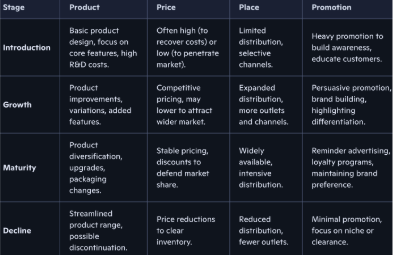
Product life cycle: Introduction (low sales, high promo costs), growth (sales and competitors rise), maturity (sales peak, market saturated), then post-maturity, where it’s either renewed or declines.
Market Research
Systematically collecting, recording and analysis concerning a specific marketing problem.
Marketing strategies perform best based on accurate, up-to-to-date, detailed and relevant info.
Well-informed about market aspects, especially buying behavior of existing and potential customers establishes a strong business position.
Benefits of market research
Market research
Reduces risk
More accurate and responsive marketing plan
Identify and outline opportunities + problems and evaluate implementation of marketing plans.
Without accurate, reliable and direct information, businesses expose themselves to market embarrassment.
3 steps of the market research
Determining information needs
Collecting data from primary and secondary research
Analysing and interpreting data
Identify the issue to investigate so businesses can design strategies that meet target market needs, achieve objectives, and increase sales and profits.
Use primary research (surveys, observation, experiments/test marketing) and secondary research (existing data from internal sources like sales reports and external sources like ABS, media, industry reports). Observation shows what happened but not why.
Analyse and interpret data – Process and examine data (e.g. averages, trends, deviations) to draw insights that guide marketing decisions.
Secondary data: Comprises info collected by some other person/organization
Internal
Collected from internal sources, inside business e.g
customer feedback, sales, management/research reports.
External
Published data from outside sources. E.g magazines, industry associations, newsletters, internet sources and ABS.
Establishing market objectives
Realistic measurable goals to be achieved through marketing plan. Should be aligned to overall goals, and concerned with products and markets.
Common objectives
Increase market share
Expand product range
Maximise customer service
Increasing Market Share
Business share is the total industry scale for a particular product
Increasing MS is an important objective for businesses that dominate the market; small market gains often translate to large profits.
E.g 7 News increases the market share of viewership as measured by the rating of a program.
Expanding product range: Range of g/s business offers.
Expand products to increase profits long term
Product adaption to TS to be competitive
Coca cola offers diet, zero, vanilla for different markets
Maximising customer service
Responding to needs of customer
High level results in improved satisfaction and positive reflection from purchases.
Investigate what competitors are offering and then expanding product mix
Customer and sales orientation
Identifying Target Markets
Primary: Major segment where majority of resources are invested
Secondary: Smaller less important
Why: Uses marketing resources efficiently = cost/time effective
Promotion material is more relevant to customers
Better understanding of buying behaviour
Different target market
Mass Marketing: Large range, assumes similar needs. E.g products with no variation and for everyone
Market segmentation: Group divided into common characteristics
Segmenting the market allows it to meet the needs of a uniform group.
Niche Marketing: Narrowly selected TS
Needs of specific consumers that are neglected
CASE STUDY: Fila changing TS from 30-40 to younger audiences
Developing Strategies (Processes)
Product, Price, Promotion, Place
Business controls 4 functions and uses them to reach its target market
Business considers which variable to emphasise
Determined by where product is positioned or stage in product lifecycle.
Product and price
Product: Deciding which product to produce
Product quality, packaging, design and guarantee
Customers buy products not just for needs and wants but to have the intangible feelings such as prestige, security and satisfaction.
Price: The amount of money the customer is prepared to offer
Consider costs, deductions and customer demand
Set price above, below or even with competitors
Promotion and Place
Promotion: Materials used to inform, persuade and remind customers about products
Advertising, personal selling, relationship selling, sales promotion, publicity, public relation
Technology is important on how to promote product
Place/Distribution: Channels of delivering products to customers.
Intermediaries e.g wholesaler or retailer.
Number of intermediaries chosen determines how wide the distribution is
E.g limited is gucci, as wide as possible is coca cola
Distribution includes retail, supermarket, vending machines
Implementation, monitoring and controlling
Definition: Process of putting strategies into operations, involves daily, weekly and monthly decision to maintain efficiency. How, where and when to be done.
Marketing plan must be carefully monitored and controlled
Monitoring
Monitoring: observing marketing plan progress
Requires the marketing department to gather info and report on important changes, problems and opportunities that arise
Establish marketing objective
Monitor performance
Evaluate performance
What to achieve
What's happening
What is good/bad - Why
Corrective action - What should be done
Monitoring and controlling
Gathering of info on performance of the marketing plan
Business uses this info to measure performance. Compare with projected performance
Controlling involves reflection and taking corrective actions to make sure objectives are achieved.
Key Performance Indicator (KPI)
Quantitave forecast performance against actual performance. E.g increasing marketing sales by 5%. KPI allows to understand evaluate effectiveness of marketing
What does business want to achieve - objectives
Are the objectives being achieved
Financial forecasting and Revising the marketing plan (I,M,C)
However not too accurate, forecasts are essential for businesses to engage sensibly in the marketplace.
A business must develop financial forecasts outlining the costs and revenues of each strategy. By comparing projected sales and revenue (benefits) with anticipated expenses (costs), the business can determine the most viable option using cost‑benefit analysis.
Financial forecast requires two steps
Cost estimate - Marketing plan expected cost. 4 major components market research, product development, promotion, packaging/distribution.
Revenue estimate - Revenue expected income. Forecasted by assessing how much customers are expected to buy and at what price, + sales and staff predictions. Compared with actual Rev to evaluate effectiveness of marketing strategy.
Marketing (Internal): In business control so easy
Revenue (External): Outside of control so harder
KPI to measure success of marketing plan
Sales analysis : Sales data to evaluate business current performance and marketing strategy effectiveness. More sales are broken down it is easier to see each performance,
Market share analysis: allows a business to compare its marketing performance with competitors. By examining changes in market share, the business can determine whether sales increases or decreases are due to its marketing strategies or external factors beyond its control.
Marketing profitability analysis: examines sales and market share by breaking total marketing costs into specific activities (e.g., advertising, transport, administration, order processing). By comparing each activity’s cost with the results achieved, managers can assess effectiveness and determine where marketing resources should be allocated in the future
Revising marketing plan
Once results of sales, market share and profitability market analysis has been calculated, businesses can assess which objectives are met. Based off this marketing plan can be revised.
3 main ways
Modify marketing mix - Adaption of elements of marketing mix. Price changes, product modification, change of promotional stratgies and distribution
New product development - Limited lifespan products, new products contribute to success of business
Product deletion - as products are developed. Eliminate outdated products to preserve the image of new products.
Market segmentation (Strategy)
Division of the market for product according to customer characteristics, can be based on demographic, psychographic, geographic or behavioural aspects.
Demographic: Primarily targets urban consumers aged 18-45 with high disposable income. Also targets emerging markets (e.g., India) with models like the iPhone SE.
Psychographic: Focuses on attitude, lifestyle, and values, positioning its products as status symbols and expressions of personal identity. Emphasizes exclusivity and premium quality, though faces competition from Android on functionality, battery life, and cost.
Geographic: Adapts designs (e.g., larger screens for Asia) and distribution regionally. Is shifting production to India to diversify from China. Faces challenges like regulatory differences, local consumer preferences, price sensitivity, and economic volatility.
Behavioural: Segments customers based on product usage, loyalty, and response to marketing. Analyzes upgrade cycles, ecosystem reliance, and spending habits (e.g., upgrade programs). Tailors products, pricing, and promotions to adapt to economic pressures and changing consumer behaviour.
Product differentiation (Strategy)
More complex, additions or features to make product seem superior or different to customers
Product/service position: How marketers try to create the image or identity of a product
Branding (Strategy)
Allows customers to easily identify the product they like, establishes the quality of a product, reduces risk when seeing a reputable/high quality brand, psychological reward that reflects prestige.
Enables repeat sales through product recognition
Encourages customer loyalty
Signifies the trademark and the brand is registered
Packaging (Strategy)
Preserves product
Attract attention
Transportation and storage functionality
Apples product
Focus on quality, design and appearance
IOS operating system
Wide range of apps on app store
Other device compatibility
Ai assistance
Tiered product mix
High visible logos on products
Apple pay/wallet
Pricing methods (Strategy)
Cost-based pricing : cost of producing a product and then adding a markup
Market based pricing : Pricing based off the supply and demand of the market
Competition based pricing : Price is compared to competitors price
Pricing Strategies (Strategy)
Price leader: Major price influence
Bundle pricing: Higher perceived value with added products
Price penetration: Lowest price possible to achieve market share
Loss leader : product sold lower or at cost price
Price point: Sold at predetermined price
Apple pricing Strategies
Price skimming - New iphone released, positioning it as leading edge, quality product
When a model is upgraded, older model is reduced to be more competitive aligned with lates samsung model
EMI (monthly payment plans) make high price of products more affordable
Buy back program and discounted price on older models
Promotion (Strategy)
Inform, persuade and remind customers of the product
Attract new customers
Increase brand loyalty
Encourage existing customers to buy the product
Promotion methods (Strategy)
Advertising - A paid, message communicated through mass media (such as television, print, online, or radio) to inform, persuade, or remind a target audience about a product/servcice.
Sales Promotion - Short-term incentives or activities designed to encourage the immediate purchase or sale of a product or service. Common examples include discounts, coupons, buy-one-get-one-free offers, contests, samples, and loyalty rewards.
Personal selling - Sales representative directed to a customer to make a sale, inform and persuade about a product, allows business to learn about customers encouraging relationship marketing Louis Vuitton has sales representative
Opinion leaders - Influences, celebrity endorsement is powerful as an opinion leader method
Place / Distrubution
Activities that make the product available to customers when and where they want to purchase them from
Allows for the product to reach consumers in number of areas
Distrubution channels
Method used by business to deliver g/s
Producer to consumer (Direct)
Produce to retailer to consumer (Indirect)
Producer to wholesaler to retailer to consumer (Indirect)
CASE STUDY APPLE
40% of apple sales are made direct through online+apple stores and 70% through indirect channels such as retailers (JB hifi and officeworks.
People (P’s)
People
Quality of interaction between the consumer and those who are within the business who deliver the service
Businesses need to recruit the right staff to leave good impressions and create positive images
CASE STUDY APPLE
Employs customer orientated, empathetic employees which lead to customer satisfaction and repeat purchases
Processes (P’s)
Flow of activities that business will follow in delivery of service
Must be specified efficiently such as communicating with customers and ensuring a sense of progress
CASE STUDY: Efficient instore and online ordering system, each of which offers free ios upgrade
Physical evidence (P’s)
Physical evidence
Refers to everything the customer sees when interacting with a business, environment, location and materials
CASE STUDY
Store visitors experience a no- pressure environment, which build relationship with the brand
E-marketing ((Strategy))
Broad form of marketing that involves use of technology to directly liaise with and communicate with customers
Caters to diverse group of customers, allows business with online operatIons to reach global audience
Adv and Dis of E-marketing
Adv
Allows wide reach to potential customers quickly
Low costs
Effective for reaching ™
Dis
Tarnish name brand if bad execution
Business must be constantly engage
Messages being misinterpreted
CASE STUDY APPLE
Growth of digital marketing in current day, product e-marketing e.g “shot on iphone” Promotion is displayed on their well developed website
Global marketing (Strategy)
Business marketing plan must be modified/adapted to suit overseas markets if they decide to go global
Global Branding (Strategy)
The worldwide use of name, term, symbol, or logo to identify the sellers product to build familiarity across markets
Global pricing (Strategy)
How business coordinate pricing policies across different countries
Customized pricing: WHenever consumer in different countries are charged different prices for smae product
Market customised pricing: Prices according to local market conditions
Standardized pricing: Practise for charging customers same price for a product anywhere in the world
Standardisation
Global marketing strategy that assumes the way the product is used and the needs it satisfies are same around the world
Customisation
Global marketing strategy that assumes the way the product is used and the needs it satisfies are different between countries
Competitive positioning
How business differentiate products in order to gain competitive advantage
Apple case sutdy on competitive positioning
APPLE
In order for competitive positioning, Apple adopted tiered pricing strategy e.g base 17 is 79.990 in India while pros are targeted at higher end consumers.
Localised production and supply chain strategies, attempt to reduce costs and tariffs. With expansion in India. Also introduced flexible ownership and financing options to address affordability challenges in diverse markets.
Promotional strategies tailored to each region while maintaining consistent brand image
India/China :Amazon, Alibaba offering cashbacks and discounts
US/Aus: Emphasise performance, camera, and AI