BIOM1001 MOD4 LEC4 - Breathng, lung volumes & diseases
 Call Kai
 Learn
Learn Practice Test
 Spaced Repetition
 Match
Match Flashcards
 Knowt Play
1/10

There's no tags or description
Looks like no tags are added yet.
Name | Mastery | Learn | Test | Matching | Spaced | Call with Kai |
|---|
No analytics yet
Send a link to your students to track their progress
11 Terms
What is Anatomical Dead Space
Space in respiratory tract where there is air, but gas exchange does not take place. (Conducting airways)
Equates to ~150ml out of 500ml normal breath.
What is tidal volume?
The volume of air breathed in and out during quiet breathing
What is the difference between Pulmonary and Alveolar Ventilation
Pulmonary ventilation:
is the volume of air breathed in and out per minute (ml/min)
Pulmonary ventilation (ml/min) = tidal volume (ml/breath) * ventilation rate (breaths/min)
Alveolar Ventilation
is the amount of air involved in gas exchange
Alveolar ventilation = (tidal volume-dead space) * ventilation rate.
What is lung volume
Lung Volume:
amount of air in lungs at different stages of breathing
Used to clinically diagnose lung pathologies, measured with spirometer.
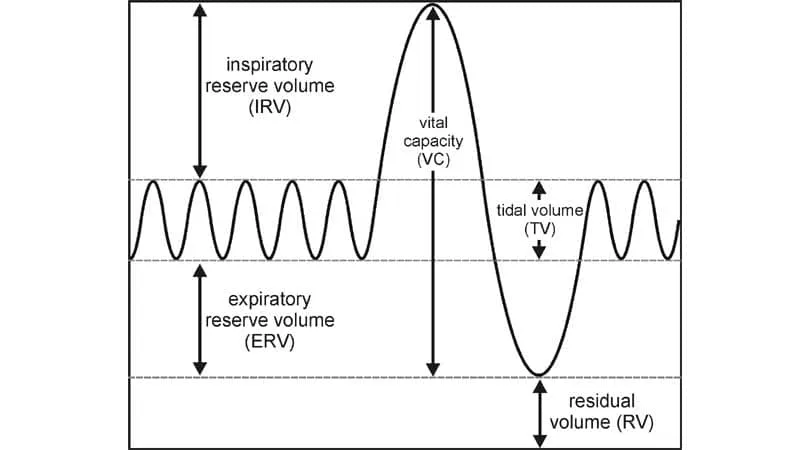
What are the lung volume terms, and what do they mean?
Tidal Volume (TV)
air inspired or expired during quiet breathing
Expiratory reserve volume (ERV)
Extra air (in addition to TV) expired during forced expiration
Inspiration reserve volume (IRV)
extra air (in addition to TV) inspired during forced inspiration
Residual Volume (RV)
air left in lungs after forced experiation
What is dynamic small airway closure?
During forced expirations, pressure in intrapleural space becomes higher than in small airways → closure of smaller airways, trapping air in lungs.
What are three Lung Capacities
Inspiratory Capacity (IC)
maximum volume of air that can be inspired
TV + IRV
Vital Capacity (VC)
maximum amount of air that can be breathed in and out
TV+IRV+ERV
Functional Residual Capacity (FRC)
Volume of air in lungs after normal expiration
ERV + RV
Total Lung Capacity (TLC)
Maximum volume of air that lungs can hod
VC + RC
What influences Lung volumes?
Physiological factors
age
Height
Anatomical build
Gender
Fitness
Pathological factors
lung diseases
What are the two classes of respiratory disease?
Obstructive Lung Disease
Difficulty with exhalation
Air gets trapped in the lungs (higher residual volume)
Examples:
asthma, Emphysema, Chronic bronchitis
Restrictive Lung Disease
difficulty with inhalation
Not enough air brought into the lungs (lower inspiratory capcity
Examples
Pulmonary Fibrosis, COVID-19, Pneumonia
How does asthma work?
Is an obstructive disease
Periods of inflammation (thickened airway walls) of small airways
inflamed small airways create greater resistance in airways
Causes early dynamic small airway closure, increasing residual volume
increased mucus production
Airway hyperresponsivenss to allergens → bronchoconstriction
Triggered by allergens
Treated with bronchodilators and anti-inflammatory drugs.
How does COVID-19 work?
Inflammation - virus infects lungs, triggering immune response causing inflammation in lung tissue + alveoli
Oedema - fluid leaks into alveoli, reducing gas exchange and making lungs harder to expand
Scarring (fibrosis) - as lung heals, fibrotic tissue can form, makes lungs stiff, reduces lung volumes
ARDS - causes very poor oxygen levels and respiratory failure