[CHEMICAL REACTIONS] Chemical Equilibria ➡️ Reaction Stoichiometry
 Call Kai
 Learn
Learn Practice Test
 Spaced Repetition
 Match
Match Flashcards
 Knowt Play
1/26

Earn XP
Description and Tags
Proverbs 16:3
Name | Mastery | Learn | Test | Matching | Spaced | Call with Kai |
|---|
No analytics yet
Send a link to your students to track their progress
27 Terms
TRUE
[CHEMICAL EQUILIBRIA]
TRUE OR FALSE:
Reversible reactions are the only one that have equilibrium
TRUE
[CHEMICAL EQUILIBRIA]
TRUE OR FALSE:
Irreversible reactions cannot have equilibrium
TRUE
[CHEMICAL EQUILIBRIA]
TRUE OR FALSE:
Once a reversible reaction is finished, there will be stagnation in the number of reactants and products (i.e. equilibrium). At this point, the rate of forward and backward reactions (which have been always changing before equilibrium) now become constant.
![<p>[CHEMICAL EQUILIBRIA]<br>TRUE OR FALSE:</p><p>Once a reversible reaction is <strong>finished</strong>, there will be stagnation in the number of reactants and products (i.e. <strong>equilibrium</strong>). At this point, the rate of forward and backward reactions (which have been always changing before equilibrium) now become constant.</p>](https://assets.knowt.com/user-attachments/38e18893-0f65-47c9-a3e2-1fc561ee196b.png)
Keq=[products]/[reactants]
[CHEMICAL EQUILIBRIA]
Equilibrium constant:
TRUE
[CHEMICAL EQUILIBRIA]
TRUE OR FALSE:
High Keq → More Product
TRUE
[CHEMICAL EQUILIBRIA]
TRUE OR FALSE:
Low Keq → More Reactant
TRUE
[CHEMICAL EQUILIBRIA]
TRUE OR FALSE:
Some factors ("stresses") may once again change the forward and backward reactions.
Stress
[CHEMICAL EQUILIBRIA]
_____ disturbs the balance the equilibrium
Le Chatelier’s principle
[CHEMICAL EQUILIBRIA]
The _______ states that a stress given to a reaction in equilibrium will be balanced by shifting the reaction away from that stress.
Concentration
Pressure
Temperature
[CHEMICAL EQUILIBRIA]
Possible Sources of Stress [3]
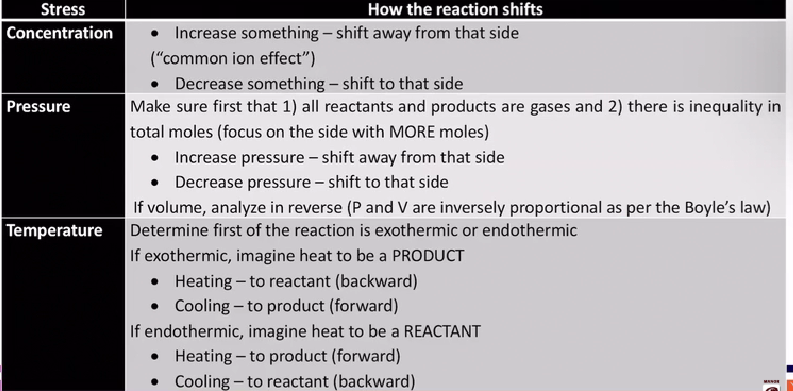
Table 20. Stresses covered by the Le Chatelier's principle
Increase something – shift away from that side ("common ion effect")
Decrease something – shift to that side
Example:
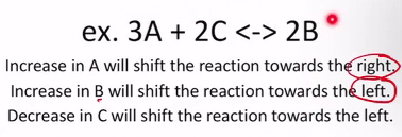
[Le Chatelier’s principle Possible Sources of Stress]
How the reaction shifts in Concentration:
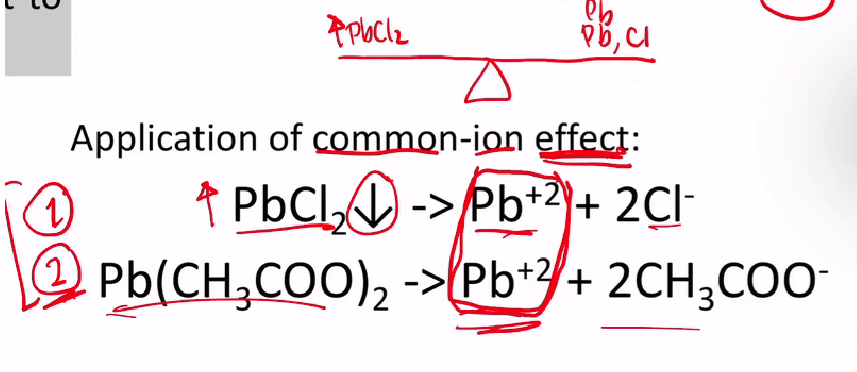
Common-ion effect
[Le Chatelier’s principle Possible Sources of Stress]
_______ was the creation of more precipitate
Make sure first that
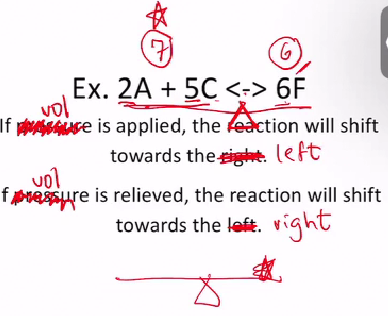
1) all reactants and products are gases
2) there is inequality in total moles (focus on the side with MORE moles)
Example: just assume that these are gases
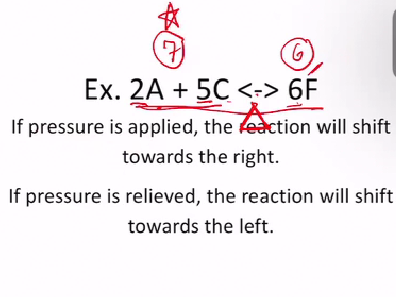
Increase pressure – shift away from that side
Decrease pressure – shift to that side
If volume, analyze in reverse (P and V are inversely proportional as per the Boyle's law)
Example [1]
Example [2]
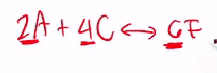
Since both side are thesame, there will be no effect (no shift will happen either forwar or backward)
[Le Chatelier’s principle Possible Sources of Stress]
How the reaction shifts in Pressure:
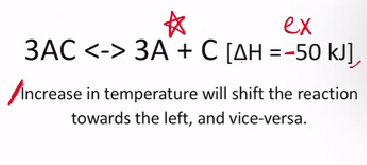
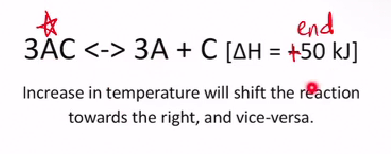
Determine first of the reaction is exothermic or endothermic
If exothermic, imagine heat to be a PRODUCT
Heating – to reactant (backward)
Cooling – to product (forward)
Example:
If endothermic, imagine heat to be a REACTANT
Heating – to product (forward)
Cooling – to reactant (backward)
Example:
[Le Chatelier’s principle Possible Sources of Stress]
How the reaction shifts in Temperature:
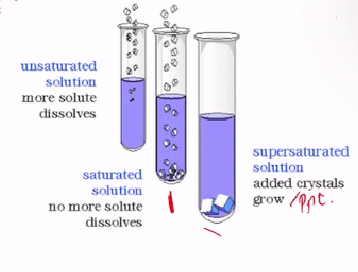
Unsaturated solution
More solute dissolves
a. Unsaturated solution
b. Saturated solution
c. Supersaturated solution
Saturated solution
No more solute dissolves
a. Unsaturated solution
b. Saturated solution
c. Supersaturated solution
Supersaturated solution
Added crystals grow
a. Unsaturated solution
b. Saturated solution
c. Supersaturated solution
Acid-base equilibria
Solubility equilibria
Ka and Kb [meaning]
Ksp [meaning]
Unsaturated solution
Saturated solution
Supersaturated solution
Specific equilibrium examples:
a) Acid-base equilibria – Ka and Kb (refer to part VI)
b) Solubility equilibria Ksp (compared with ions in sample "Q")
If Q < Ksp: _____
If Q = Ksp: _____
If Q > Ksp":_______
Stoichiometry
[REACTION STOICHIOMETRY]
______ deals with the quantity of reactants and products involved in chemical reactions
Limiting reagent
[REACTION STOICHIOMETRY]
______is a substance completely consumed in a chemical reaction. If this runs out, reaction stops.
Excess reagent
[REACTION STOICHIOMETRY]
______ is a substance present in quantities greater than needed for the limiting reagent.
Excess reagent
[REACTION STOICHIOMETRY]
If the limiting reagent runs out, the ______ is left behind.
Theoretical yield
[REACTION STOICHIOMETRY]
_______is the amount of product created based purely on calculation
Actual yield
[REACTION STOICHIOMETRY]
_______ is the amount of product created based purely on what is reflected in the actual experiment
Percent yield
[REACTION STOICHIOMETRY]
______ is the ratio of the actual yield to the theoretical yield ((AY/TY) x 100%)