USF genetics exam 1 El rady
 Call Kai
 Learn
Learn Practice Test
 Spaced Repetition
 Match
Match Flashcards
 Knowt Play
1/136

There's no tags or description
Looks like no tags are added yet.
Name | Mastery | Learn | Test | Matching | Spaced | Call with Kai |
|---|
No analytics yet
Send a link to your students to track their progress
137 Terms
Law of Segregation
During gamete formation, the alleles for each gene segregate from each other, so that each gamete carries only one allele for each gene.
hereditary
Passing of traits from parents to offspring
genes
DNA segments that serve as the key functional units in hereditary transmission.
the study of genetics is important for two main reasons:
1 it unifies the study of biology
2 it has profound impact on human affairs
when was the domestication of animals
13,000BC
When was the cultivation of plants
8,000BC
which philosophers provided the first formal explanations of hereditary and variation
Greek philosophers
Hippocrates
Democritus
Plato
Aristotle
Hippocrates statement on genetics
Of the semen, however, I assert that it is secreted by the whole body healthy by healthy parts, sick by sick parts. Hence as a rule, bald-headed begets bald-headed, blue-eyed beget blue-eyed."
Democritus statement on genetics
"More people become able by exercise than by their natural predisposition."
Plato statement on genetics
Advocated the selection of spouses to produce children who will develop into bodily and ethically eminent personalities
Aristotle statement on genetics
Developed a comprehensive theory of inheritance:
The male semen was only formed from the blood
It provides a "form"
The menstrual blood contains the "matter" for offspring The "form" controls and shapes the "matter" into the mature offspring
after the Greek philosophers when did the next ideas of genetics get presented
not until the 17th century
William henry presentation of genetics
Proposed that all living things originate from an egg
Introduced the Theory of Epigenesis All parts of the embryo are present potentially in the egg
The organism evolves by gradual building up and aggregation of these parts
Theory of Epigenesis
structures such as body organs are not initially present in the early embryo and are formed later
Antonie van Leeuwenhoek (1632-1723)
Discovered spermatozoa
Speculated that the sperm provides the essential life-giving properties, and the egg merely furnishes the proper environment for the embryo's nutrition and development
Theory of Preformationism
The organism is contained in one of the sex cells as a fully developed (albeit miniature) homunculus
With proper nourishment the homunculus unfolds into its adult proportions
The Spermists believed the homunculus was found in the sperm
The Ovists believed the homunculus resided in the egg
Caspar Wolff
Discredited the Theory of Preformationism
Jean Baptiste de Lamarck (1809)
proposed first theory of evolution
theory of inheritance of acquired characteristics
discredited theory of evolutionary change proposing that changes that occur during the lifetime of an individual, through use or disuse, can be passed on to the next generation
theory destroyed by Darwin
Provisional Hypothesis of Pangenesis
Cells of the developing organism are capable
of producing gemmules, which are exact but
minute copies of each body part. These are carried by the blood to the reproductive organs where they are assembled into gametes. With fertilization, the combined gemmules then separate out to different parts of the body during development.
August Weismann
disproved Darwin's pangenesis
What did August Weismann propose
The Germplasm theory of hereditary
The Germplasm theory of hereditary
Multicellular living organisms are made up of two types of tissue
Somatoplasm-body tissue essential for function of organism
Germplasm- hereditary material set aside for reproductive purposes
there was continuity of germplasm between generations, and it was associated with the nucleus
Who were the 2 most important plant hybridists before Mendel
Joseph Kolreuter
Karl Gaertner
recorded similar work did not realize significance
Johann Gregor Mendel (1822-1884)
priest who worked with garden peas in his garden used results to propose The Particulate Theory of Inheritance
Gregor Mendel's work
Was rediscovered by Hugo de Vries, Carl Correns, and Erich von Tschermak in 1900
William Bateson (1861-1926)
First to demonstrate experimentally the extension of Mendel's Laws to animals
Coined the term genetics to describe the science of heredity
Eugenics
Coined by Francis Galton
It refers to the improvement of a population by selecting its best specimen for breeding
Galton believed that many human traits are inherited and thus subjects to selection
Positive eugenics (Galton)
Encouraging the reproduction of those with beneficial traits
Negative eugenics (Galton)
Discouraging the reproduction of those with undesirable traits
The Eugenics movement had a strong impact on US public policy in the early 20th century
1. Compulsory sterilization of "eugenically-unfit" individuals 2. Laws invalidating marriages between "eugenically-unfit" individuals 3. Immigration Restriction Act
End of the Eugenics movement in the United States
In the 30s it floundered people made prejudiced experiments
Modern Eugenics
prenatal diagnosis, artificial insemination, cloning
Blending theory of genetics
Factors that control hereditary are malleable they can blend together generation after generation
what organism did Gregor Mendel decide to work with
Pisum sativum
cross-fertlization
pollen and egg are derived from different plants
self-fertilization
pollen and egg are derived from the same plant
monohybrid cross
A cross between individuals that involves one pair of contrasting traits
P generation
Parental generation, the first two individuals that mate in a genetic cross
F1 generation (first filial generation)
the first generation of offspring obtained from an experimental cross of two organisms
F2 generation (second filial generation)
offspring of the F1 generation
third filial generation (F3 generation)
The third generation, produced by crossing F2 organisms.
alleles
Different forms of a gene
Homozygous
An organism that has two identical alleles for a trait
Heterozygous
An organism that has two different alleles for a trait
genotype
genetic makeup of an organism
Phenotype
An organism's physical appearance, or visible traits.
Punnet Square Method
a method of predicting the genotypes and phenotypes of offspring in genetic crosses
law of independent assortment
the law that states that genes separate independently of one another in meiosis
dihybrid cross
Cross or mating between organisms involving two pairs of contrasting traits
If the genes do assort independently, what will the expected phenotypic outcome be
9:3:3:1
loss of function alleles
an allele of a gene that encodes an RNA or protein that is nonfunctional or compromised in function
commonly inherited in a recessive manner
trihybrid cross
a cross involving three traits
forked-line method
a method to solve independent assortment problems in which lines are drawn to connect particular genotypes
product rule of probability
The chance of two or more independent events occurring together is the product of their chance of occurring separately
sum rule of probability
When two events A and B are mutually exclusive the probability that A or B will occur is the sum of the probability.
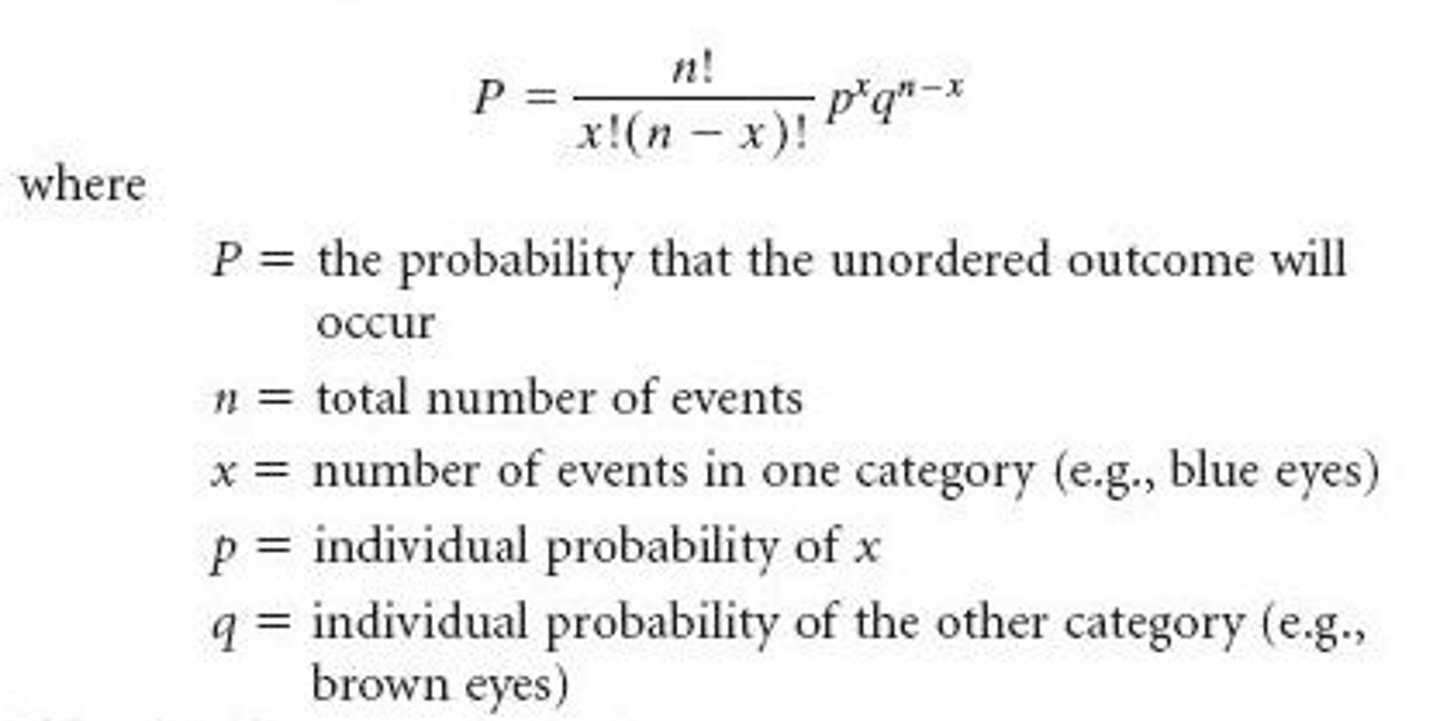
binomial expansion equation
The probability of the occurrence of unordered mutually exclusive events is defined by the binomial theorem
binomial expansion equation formula
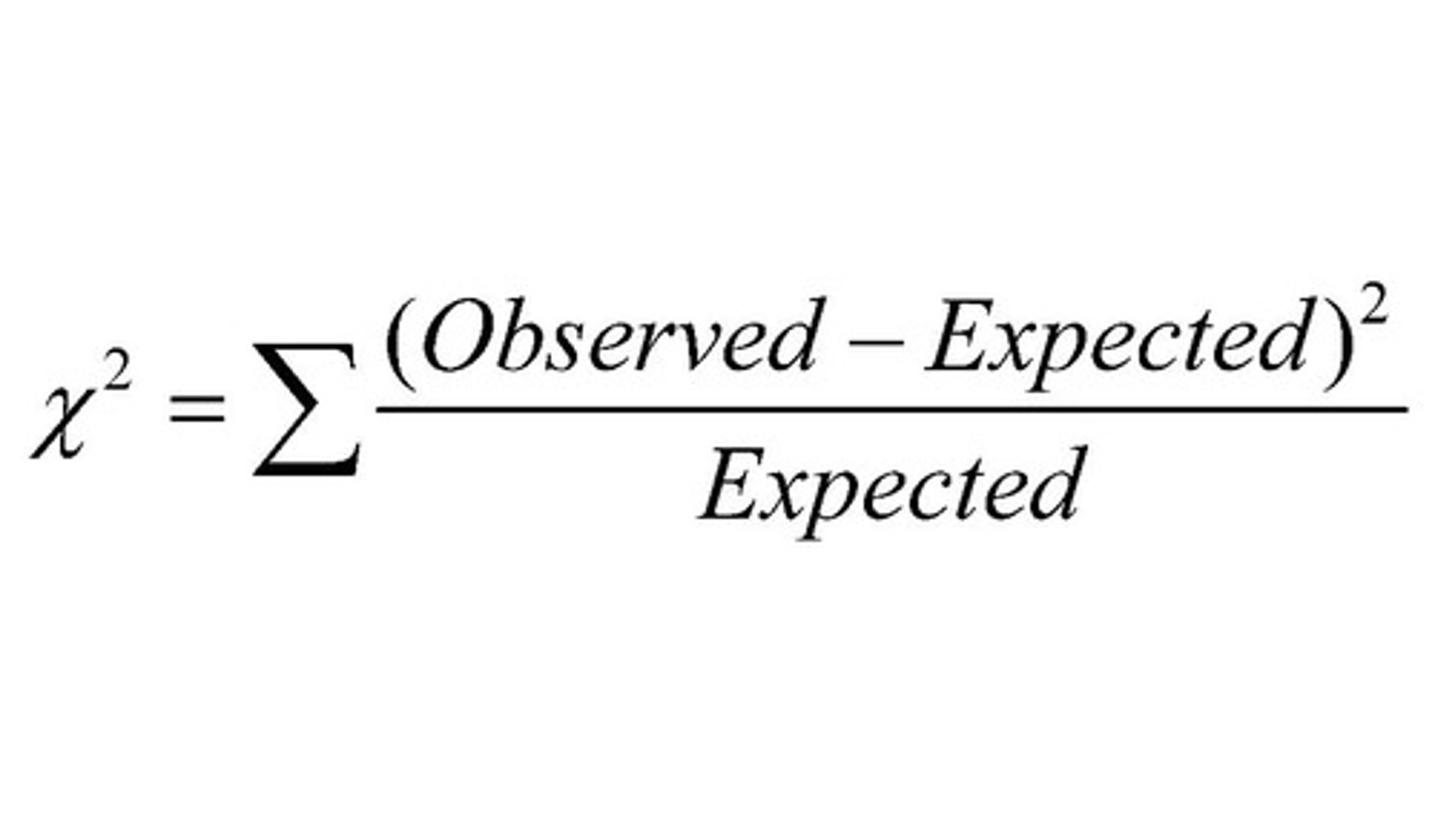
Chi-square test
a statistical test used to determine the probability of obtaining observed proportions by chance, under a specific hypothesis
chi squared formula
pedigree
A diagram that shows the occurrence of a genetic trait in several generations of a family.
autosomal dominant trait (1-3)
1 trait is usually present in every generation
2 Members of both sexes affected equally
3 unaffected parents produce unaffected offspring
autosomal dominant trait (4-6)
4 two affected parents can produce unaffected offspring
5 on average half the children of an affect parent will be affected
6 The homozygote for the disease-causing allele is generally, more severely affected than the heterozygote
autosomal dominant disorders
Huntington's disease, achondroplasia
polydactyly
brachydactyly
syndactyly
helio-Opthalmic outburst syndrome
Huntington's Disease (HD)
The major symptom of the disease is the degeneration of certain types of neurons in the brain
leads to personality changes, dementia, and earl death
what causes huntingtins disease
Result of a mutation in the gene that encodes a protein termed Huntington. The mutation adds a polyglutamine tract to the protein which causes aggregation of the protein in the neurons
autosomal dominant traits
freckles
widows peak
cleft chin
three explanations for autosomal dominant disorders
Haploinsufficiency
gain-of-function mutation
dominant negative mutations
Haploinsufficiency
The heterozygote has 50% of the normal protein
This is not sufficient for a normal phenotype
gain of function mutation
mutation changes protein so it gains a new function
dominant negative mutations
The altered gene product acts antagonistically to the normal product
autosomal recessive traits (1-3)
1 traits tend to skip generations
2 members of both sexes affected equally
3 unaffected parents can have an affected child
autosomal recessive traits (4-5)
4 two affected parents cannot have an unaffected child
5 Traits are more likely to occur in consanguineous marriages
autosomal recessive disorders explanation
disorders that involve defective enzymes typically have an autosomal recessive mode of inheritance
The heterozygote has 50% of the normal enzyme this is sufficient for a normal phenotype
examples of autosomal recessive disorders
cystic fibrosis, sickle cell anemia
albinism PKU and TSD
albinism
Absence of pigment in the skin, hair, and eyes
cystic fibrosis (CF)
inherited disorder of exocrine glands resulting in thick mucinous secretions in the respiratory tract that do not drain normally
Tay-Sachs Disease TSD
a fatal genetic disorder in which harmful quantities of a fatty substance buildup in tissues and nerve cells in the brain
patients die usually at 4
X-linked recessive traits (1-3)
1 Traits may skip generations
2 Most affected individuals are male
3 Affected males result from affected mothers or mothers who are carriers
X-Linked recessive traits (4-6)
4 Affected females come from affected fathers and affected or carrier mothers
5 affected females will have affected sons
6 the trait can never be transmitted directly from father to son
X-linked recessive disorders
Hemophilia
Hemophilia
An X-linked recessive disorder in which blood fails to clot properly, leading to excessive bleeding if injured.
X-linked dominant traits (1-3)
1 Trait does not skip generations
2 Affected males must come from affected mothers
3 Affected females come from affected mothers or fathers
X-Linked dominant traits (4-7)
4 Affected males have no normal daughters and no affected sons
5 Affected heterozygous females transmit the trait to approximately half of their children of either sex
6 Affected homozygous females transmit the trait to all their children
7 males are often more severely affected
X-linked dominant disorders
Vitamin D resistant rickets, Rett syndrome, Aicardi syndrome, Incontinentia pigmenti, faulty tooth enamel
Vitamin D resistant rickets
Rickets is a disorder involving softening and weakening of the bones of children primarily caused by lack of vitamin D
Y-linked traits
1. Trait only affects males
2. Affected males get it from their fathers and give it to their sons
incomplete penetrance
In the case of dominant traits, this pattern occurs when a dominant phenotype is not expressed even though an individual carries a dominant allele.
Incomplete dominance
This pattern occurs when the heterozygote has a phenotype that is an intermediate between either corresponding homozygote for example a cross between red and white equal pink
Overdominance (heterozygote advantage)
The pattern occurs when the heterozygote has a trait that confers a greater level of reproductive success than either homozygote
codominance
This pattern occurs when the heterozygote expresses both alleles simultaneously without forming an intermediate phenotype for example with human blood types an individual carry A and B with have an AB blood type
X-Linked
This pattern involved the inheritance of genes that are located on the X chromosome. In mammals and fruit flies males have one copy of x-linked genes where females have two copies
sex influenced
This pattern refers to the effect of sex on the phenotype of the individual some alleles are recessive in one sex and dominant in the opposite sex
sex-limited
In this pattern a trait occurs in only one of the two sexes. an example is breast development in mammals
lethal alleles
A lethal allele is one that has the potential of causing the death of an organism
Mutant alleles
alleles that have been altered by mutation
wildtype allele
most frequent allele associated with the common phenotype
genetic polymorphism
The existence of two or more distinct alleles at a given locus in a population's gene pool.
haploinsufficiency
The appearance of a mutant phenotype in an individual cell or organism that is heterozygous for a normally recessive trait
Expressivity
the degree to which a trait is expressed. For example, flowers with deep red color have a high expressivity of the red allele.