Behaviourist Approach
 Call Kai
 Learn
Learn Practice Test
 Spaced Repetition
 Match
Match Flashcards
 Knowt Play
1/16

There's no tags or description
Looks like no tags are added yet.
Name | Mastery | Learn | Test | Matching | Spaced | Call with Kai |
|---|
No analytics yet
Send a link to your students to track their progress
17 Terms
Assumptions of Behaviourist Approach
Our behaviour is shaped by learning from our environment
NURTURE side
For psych to be scientific, should focus on observable behaviour that can be objectively measured
Lab experiments best way to objectively measure observable behaviour
What do behaviourists study?
Changes in behaviour that are caused by a person’s direct experience of their environment, using the principles of classical & operant conditioning
What is classical conditioning and who discovered it?
Learning through association, discovered by Ivan Pavlov
Neutral stimulus consistently paired w. unconditioned stimulus so it eventually takes on the properties of this stimulus & is able to produce a conditioned response
Process of classical conditioning
UCS (food) elicits UCR (salivating dog)
Acquisition phase where NS (bell) presented before UCS ; no response elicited
NS (bell) + UCS (food) elicits UCR (salivating dog)
Consistent pairing of NS + UCS needs to occur for step 4.
CS (bell) now elicits CR (salivating dog)
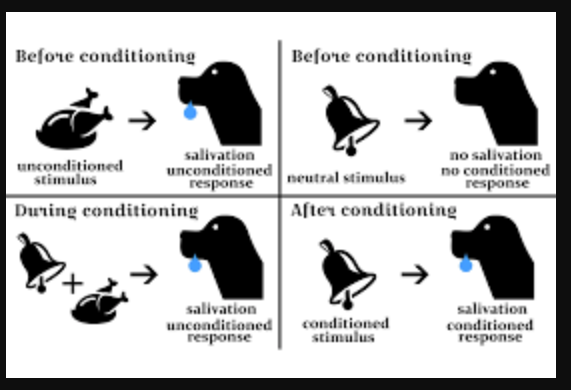
Other features of Classical Conditioning
Timing
If NS occurs after UCS or time interval too big, conditioning doesn’t occur
Extinction
CS eventually loses ability to produce CR in absence of UCS. CR not perm. established
Spontaneous Recovery
Post (2) if CS + UCS, link between them made much quicker
Stimulus generalisation
Once animal conditioned, responds to other stimuli similar to CS
What is operant conditioning and who proposed the theory?
Learning through reinforcement/ punishment or consequences. Discovered by Skinner
If a behaviour is followed by a desired consequence, then that behaviour is more likely to occur again
Skinner’s box study
Every time rat presses lever within box, was rewarded w. a food pellet
From then, animal will continue its behaviour
If food pellets stops, rat presses lever few more times before abandoning it
Extinction
Showed how rats could be conditioned to perform same behaviour to avoid unpleasant situations (hunger)
Positive Reinforcement
Adding something pleasant as a reward in order to increase behaviour
Produces satisfying / pleasant consequence for organism
Reinforces particular behaviour, so it is more likely to occur in the future
Negative reinforcement
Remove something unpleasant to increase behaviour
Positive punishment
Adding something unpleasant in order to decrease behaviour e.g. adding detention
Negative punishment
Removing something pleasant to decrease behaviour
What are the 2 types of Schedules of Reinforcement?
Continuous Reinforcement
Desired behaviour reinforced every time it occurs
Can cause behaviour to be extinct
Variable Ratio
Behaviour is reinforced part of the time
More effective at maintaining response & avoiding extinction
Prolonged conditioned behaviour
DIS1: Environmental Determinism
P: Limitation is that it sees all behaviour conditioned by past conditioning experiences
Ev: Skinner suggested everything we do is sum total of our reinforcement. When something happens, we think we made the decision to do it ; Skinner says our past conditioning history determines outcomes
Ex: This means that, it ignores any possible influence free will may have on behaviour.
L: Therefore, this is an extreme position & ignores influence of conscious decision making processes on behaviour.
AD1: Real World Application
P: Strength is its principles of conditioning have been applied to real-world behaviours & problems
Ex: O.C. is basis of token economy systems that are used successfully in institutions e.g. prisons & psychiatric wards. Appropriate behaviour is rewarded w. tokens that can be exchanged for privileges
Ex: Treating phobias via C.C.; S.D. is process of learning new association between stimulus & fear response
L: This increases value of behaviourist approach because it has widespread application
DIS2: Ethical Issue
P: Limitation is ethical issues associated w. how experiments were carried out
Ev: Skinner locked his participants & tactically teased them w. concept of food. Lack of consent, lack of ability to withdraw, and no protection from harm
Ex: This means that the ways in which the experiments were carried out were unethical
L: Therefore, this highlights the ethical dilemma in psych between gaining knowledge & ensuring humane treatment of respect
AD2: Well-Controlled Research
P: Strength is this approach is based on well-controlled research
Ex: They focused on measuring observable behaviour within highly controlled lab settings. As behaviour was broken down into basic stimulus response units, extraneous variables were removed, so cause-&-effect relationships could be established
Ev: Skinner able to demonstrate clearly how reinforcement influenced animals’ behaviour
L: Suggests that behaviourist experiments have scientific credibility
CA to AD2: Too simple
Behaviourists may have oversimplified learning by overlooking role of human thought.
SLT & Cognitive approaches highlight importance of mental processes. suggesting learning is more complex than just observable behaviour