probability (chapter 5)
 Call Kai
 Learn
Learn Practice Test
 Spaced Repetition
 Match
Match Flashcards
 Knowt Play
1/11

There's no tags or description
Looks like no tags are added yet.
Name | Mastery | Learn | Test | Matching | Spaced | Call with Kai |
|---|
No analytics yet
Send a link to your students to track their progress
12 Terms
empirical vs classical probabilities
empirical: determined by making observations and gathering data; experiments
classical: determined by reasoning mathematically
law of large numbers
as the number of repetitions of a probability experiment increase, the proportion with which a certain outcome is observed gets closer to the probability of the outcome; empirical probability with begin to match up with classical probability
sample space (S)
collection of all possible outcomes; an event is any collection of outcomes from a probability experiment
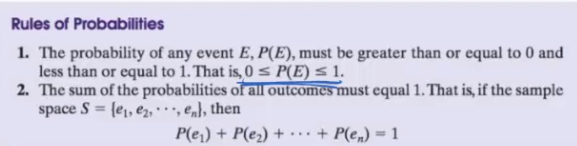
rules of probability
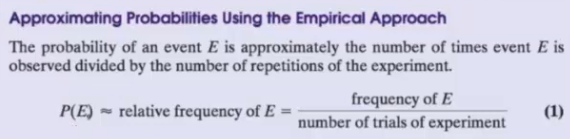
approximating probability using empirical method
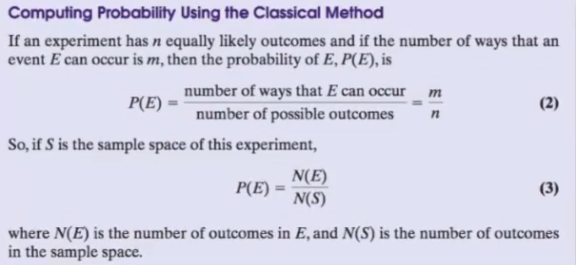
computing probability using the classical method
disjoint
events that cannot happen at the same time, or have no outcomes in a common
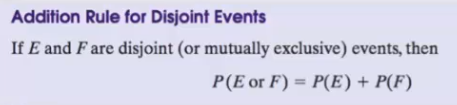
addition rule for disjoint events
general additional rule for non-disjoint events
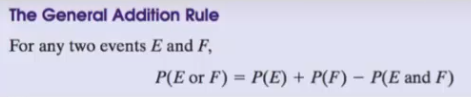
subtract off double counting
complement of an event
denoted EC is all outcomes in the sample space S that are not outcomes in the event E
ex: 1 - some number/total things
multiplication rule for independent events
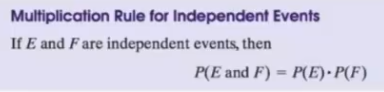
or probability vs and probability
or implies addition; and implies multiplication