Obsessive Disorders Ch. 21
 Call Kai
 Learn
Learn Practice Test
 Spaced Repetition
 Match
Match Flashcards
 Knowt Play
1/10

Earn XP
Description and Tags
Week 3
Name | Mastery | Learn | Test | Matching | Spaced | Call with Kai |
|---|
No analytics yet
Send a link to your students to track their progress
11 Terms
Obsessive Compulsive Disorder
Involuntary and unwanted obsessions and compulsions that are distressing, consume more than 1 hr a day, and impair functioning
Common Themes: contamination, symmetry, forbidden thoughts, harm
May result in avoidant behaviors and/or habits and routines that interfere with daily functioning
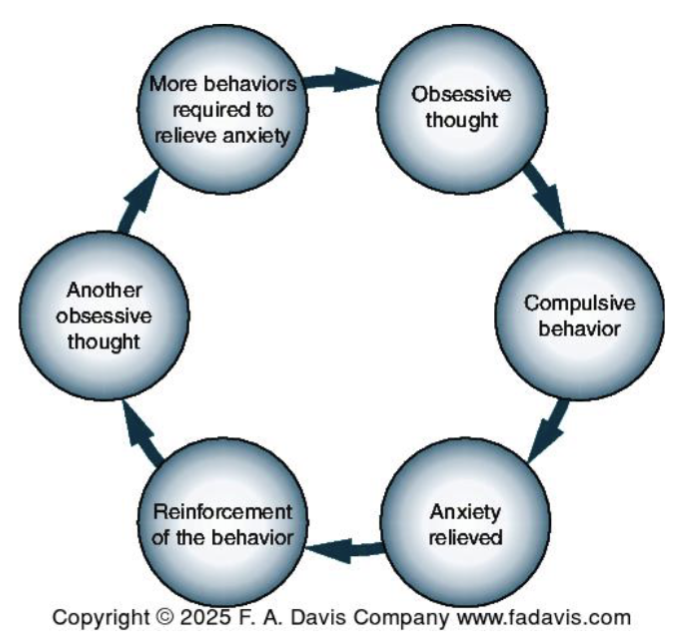
Cycle of Obsessive Thoughts and Compulsive Behaviors in OCD
Obsessive thought → compulsive behavior → anxiety relieved → reinforcement of the behavior → another obsessive thought → more behaviors required to relieve anxiety
Body Dysmorphic Disorder
Preoccupation with perceived flaws or defects in one’s physical appearance that are not apparent or significant to others
o Consumes 3-8 hours per day
Excessive, repetitive behaviors including seeking reassurance about appearance, compulsive skin picking, excessive lifting weights, using anabolic steroids, and having cosmetic surgical procedures
Can impact social participation
Hoarding Disorder
Persistent difficulty discarding or parting with possessions regardless of value resulting in an accumulation of clutter that interferes with functionality of the environment
o Collecting = systematic and organized
o Hoarding = disorganized, excessive clutter that interferes with ability to use living spaces
Trichotillomania
Repetitive pulling out of one’s own hair
Bald spots, thinning hair, skin issues
GI issues if ingested
Excoriation Disorder
Recurrent skin picking
Usually associated with anxiety or boredom, causes distress and/or embarrassment
Frequently co-occurs with anxiety and/or depression
More common in women
Etiology
Genetics:
Strong familial links
Close relatives of a person with OCD have a 5x higher chance of having OCD
Neuroanatomy:
Frontal cortex involvement
Brain differences in OCD can change over time
Neurochemical:
Involves multiple neurotransmitter systems (serotonin, dopamine, and glutamate)
Cognitive and Psychological:
Self perpetuating cycel of obsessions and compulsions
Environmental: NO specific environmental causes, BUT infections and stressful or traumatic life events may increase the risk
Prevalence: Obsessive Disorders
OCD has prevalence rate of 2-3%
Average age onset: 19-20 → almost always before 35
Females more commonly affected
Cultural beliefs, religious practices, and family roles should be considered when assessing/treating
Impact on Occupational Performance: Obsessive Disorders
Cognitive: executive functioning impairments
Psychosocial: decreased social and community participation, disrupted relationships due to → time spent engaged in obsessive thinking, compulsive acts interfering w task completion, avoiding situations that may trigger symptoms
Medication and Medical Treatment: Obsessive Disorders
SSRIs
ECT most effective for people w comorbid depressions
Repetitive transcranial electromagnetic stimulation (rTMS)
Deep Brain Stimulation (DBS)
OT Intervention Approaches: Obsessive Disorders
Cognitive Adaptation
Cognitive Behavioral
Community Clutter and Hoarding Toolkit
Motivational Interviewing