Systems Neuro SI Practice Exam(s) - ANSWER KEYs 1-3
 Note
Note Call Kai
 Learn
Learn Practice Test
 Spaced Repetition
 Match
Match Flashcards
 Knowt Play
1/131

There's no tags or description
Looks like no tags are added yet.
Name | Mastery | Learn | Test | Matching | Spaced | Call with Kai | Chat |
|---|
No analytics yet
Send a link to your students to track their progress
132 Terms
Wernicke-Korsakoff Syndrome is due to palsy of the abducens nerve: T/F?
True
The Sensory Association Cortex is involved in nondeclarative memory. This brain region can be impacted by Huntington’s and/or Parkinson’s Disease, leading to impairments of its function. T/F?
False
External ear sensation is part of which functional component of the glossopharyngeal nerve?
GVA
SVA
GVE
SVE
GSA
GSA
Which of the spinocerebellar tracts decussates twice to still transmit ipsilateral information?
Posterior Spinocerebellar
Anterior Spinocerebellar
Cuneocerebellar
Rostral Spinocerebellar
Anterior Spinocerebellar
Which of the following cranial nerves is NOT involved in eye movement?
CN III
CN IV
CN V
CN VI
Cranial Nerve (V)
Together, the superior and inferior colliculus make up the _________
while the substantia nigra and red nucleus are part of the __________.
Tectum
Tegmentum
What are the two primary functions of the reticular activating system?
Manages arousal levels
Initiates/manages threat response
Muscles closer to your midline are controlled by motor neurons with somas farther from the midline. T/F?
False
Which of the following generate the greatest amount of force?
Slow motor units
Fast-fatigable motor units
Fatigue-resistant motor units
Fast-fatigable motor units
When Usaian Bolt runs his 100m dash, which of the following are recruited for his use?
Slow motor units
Fast-fatigable motor units
Fatigue-resistant motor units
Fast-fatigable motor units
After beating the world record, Bolt decides to walk a few miles to decompress. Now which of the following are recruited for his use?
Slow motor units
Fast-fatigable motor units
Fatigue-resistant motor units
Fatigue-resistant motor units
Where can you find Betz cells?
Layer 4 of the primary motor cortex
Layer 5 of the primary motor cortex
Layer 4 of the premotor cortex
Layer 5 of the premotor cortex
A and C
B and D
Layer 5 of the primary motor cortex
Which area of the cortex cares more about people entering my personal space?
Which area cares more about people farther away?
Close: Primary Motor Cortex
Further: Premotor Cortex
Which of the following is NOT a stabilizing eye movement?
Vergence
Optokinetics
Vestibulo-ocular
Saccades
Smooth pursuit
Vergence
Which of the following is important for foveation and used to shift your gaze?
Vergence
Optokinetics
Vestibulo-ocular
Saccades
Smooth pursuit
Vergence
Optokinetics =
stabilize a moving image on the retina
Vestibulo-ocular =
ensures best vision during head motion (by moving the eyes contrary to the head to stabilize the line of sight in space).
Saccades =
rapid, ballistic movements of the eyes that abruptly change the point of fixation
** range in amplitude
Smooth pursuit =
slower tracking movements of the eyes that — keep a moving stimulus on the fovea.
What are the names of the two gaze centers? Label whether they are the horizontal or vertical gaze center.
PPRF = horizontal
Mesencephalic Reticular Formation (MRF)= vertical
The _____ corticospinal tract is essential for innervation of trunk and shoulder musculature while the _____ corticospinal tract is essential for limb musculature innervation.
Anterior
Lateral
I go to stick my tongue out at you and it deviates to the right. What cranial nerve is likely impacted?
Glossopharyngeal
Vagus
Hypoglossal
Facial
Hypoglossal
The ____ nerve is technically part of the CNS because it is derived from an out-pocket of the diencephalon during embryonic development.
Optic
Which spinocerebellar tract(s) communicate with the lower limbs? Select all that apply.
Posterior Spinocerebellar
Anterior Spinocerebellar
Cuneocerebellar
Rostral Spinocerebellar
Posterior Spinocerebellar
Anterior Spinocerebellar
Which spinocerebellar tract communicate with the upper limbs?
Cuneocerebellar
Describe the major difference between declarative and nondeclarative memory?
Declarative = available consciousness
Nondeclarative = not available to consciousness (inc: priming)
I go sit down in my Systems Neuroscience lecture at 9:30. Professor Clark starts talking about the brain, and after the lecture I realize that I was unable to retain any information. I visit the doctor and they tell me I am suffering from amnesia. What type of amnesia am I suffering from?
Anterograde Amnesia
( = cannot remember new information)
Retrograde amnesia:
A person can remember new info but CAN NOT remember events from before the onset of amnesia.
Dissociative amnesia:
A person may forget specific events or time periods.
The basal ganglia and cerebellum directly influence lower motor neurons? T/F
False
What structures make up the striatum? (2)
Caudate and putamen
What structures make up the pallidum? (2)
Globus pallidus and substantia nigra
Which three structures are generally believed to be a part of the basal ganglia?
Caudate
putamen
globus pallidus
Nearly all cortical regions have direct projections to the striatum via the _______ pathway.
Corticostriatal
Which thalamic nuclei are involved in outflow of the basal ganglia? Select all that apply/
Dorsal Anterior Nucleus
Ventral Anterior Nucleus
Dorsal Lateral Nucleus
Ventral Lateral Nucleus
Ventral Anterior Nucleus
Ventral Lateral Nucleus
The ventral anterior nucleus is primarily involved in the learning of movements. T/F?
False
Which disease is characterized by degeneration of dopaminergic neurons of the substantia nigra?
Huntington’s Disease
Alzheimer’s Disease
Parkinson’s Disease
ALS
Parkinson’s Disease
Huntington’s Disease =
inherited disorder that causes nerve cells (neurons) in parts of the brain to gradually break down and die.
Alzheimer’s Disease =
slowly destroys memory and thinking skills — eventually, not able to do simple tasks.
ALS =
Affects motor neurons
(the nerve cells in the brain and spinal cord that control voluntary muscle movement and breathing).
Which cerebellar peduncle primarily receives afferent fibers from the medulla?
Superior Cerebellar Peduncle
Inferior Cerebellar Peduncle
Middle Cerebellar Peduncle
Inferior Cerebellar Peduncle
Which cerebellar peduncle(s) convey outputs from the cerebellum? Select all that apply.
Superior Cerebellar Peduncle
Inferior Cerebellar Peduncle
Middle Cerebellar Peduncle
Superior Cerebellar Peduncle
Which cerebellar peduncle is Efferent?
Which cerebellar peduncle is Afferent?
superior cerebellar peduncle
Middle Cerebellar Peduncle
Which cerebellar peduncle primarily conveys afferent fibers from the pontine nuclei to the cerebellum?
Middle Cerebellar Peduncle
The cerebellum is composed of Purkinje cells. Purkinje cells are ______ (think of the neurotransmitter released).
GABAergic
Which region of the ventral horn primarily contains lower motor neurons that govern posture?
Medial Ventral Horn
Lateral Ventral Horn
Superior Ventral Horn
Inferior Ventral Horn
Medial Ventral Horn
Types of ventral horns and their functions:
Lateral Ventral Horn
Superior Ventral Horn
Inferior Ventral Horn
Lateral = regulate autonomic functions and visceral activities
Superior = coordinating motor functions related to the upper limbs
Inferior = ontrolling motor functions related to the lower limbs
Where do you find mirror motor neurons?
Ventrolateral premotor cortex
(more important to know they are in the premotor cortex)
Extra Credit: in what century was the first drawing of the hippocampus made? Who made it?
1500s; Eustachi
Extra Credit: what brain region is arguably the easiest to identify in a neuroanatomy lab?
Pons
Complete the following table using information about eye movement:
Muscle | Direction of Movement | Cranial Nerve Involved |
Lateral Rectus | ||
Medial Rectus | ||
Superior Rectus | ||
Inferior Rectus | ||
Superior Oblique | ||
Inferior Oblique |
Muscle | Direction of Movement | Cranial Nerve Involved |
Lateral Rectus | Abduction | Abducens |
Medial Rectus | Adduction | Oculomotor |
Superior Rectus | Elevation | Oculomotor |
Inferior Rectus | Depression | Oculomotor |
Superior Oblique | Depression | Trochlear |
Inferior Oblique | Elevation | Oculomotor |
list all of the cranial nerves and whether they are sensory, motor, or both:
1 | Olfactory | S |
2 | Optic | S |
3 | Oculomotor | M |
4 | Trochlear | M |
5 | Trigeminal | B |
6 | Abducens | M |
7 | Facial | B |
8 | Vestibulocochlear | S |
9 | Glossopharyngeal | B |
10 | Vagus | B |
11 | Spinal Accessory | M |
12 | Hypoglossal | M |
Identify the parts of the Basal Ganglia

Which cranial nerves are involved in the sensory transduction of tastant information?
Facial, Glossopharyngeal, Vagus
What cells are the direct synaptic connection of ORNs?
Tufted Cells
Mitral Cells
Glomerular Cells
Granule Cells
Mitral Cells
True or False: a glomerulus contains the dendritic bush of many mitral cells and many ORNs
False
What is the association cortex for taste and olfactory information?
Pyriform Cortex
Entorhinal Cortex
Orbitofrontal Cortex
Insular Cortex
Orbitofrontal Cortex
Which brain region is involved in smell aversion?
Pyriform Cortex
Amygdala
Entorhinal Cortex
Insular Cortex
Amygdala
Which brain region is involved in odor discrimination?
Pyriform Cortex
Amygdala
Entorhinal Cortex
Insular Cortex
Entorhinal Cortex
Which brain region does all olfactory information converge on?
Olfactory bulb
True or False: all sensory information synapses on the thalamus before being conveyed to their primary sensory cortical area
False
Select which tastant receptors are GPCRs:
Sweet
Salt
Sour
Bitter
Umami
Sweet
Bitter
Umami
Which taste is carried by the movement of hydronium ions?
Sweet
Salt
Sour
Bitter
Umami
Sour
Which nucleus is the primary source of convergence for all three cranial nerves involved in the transduction of taste?
Solitary Tract Nucleus/Solitary Nucleus/Nucleus Solitarius
Which thalamic nuclei receives taste information?
Ventral posterior medial
Ventral posterior lateral
Dorsal posterior medial
Dorsal posterior lateral
Ventral posterior medial
The following fibers carry which type of touch information?
Aβ Fiber →
Aδ Fiber →
C Fiber →
Aβ Fiber → touch
Aδ Fiber → fast pain
C Fiber → slow pain
Which of the following are slow-adapting?
Merkel
Ruffini
Paccinian
Meissner’s
Merkel
Ruffini
Which of the following are rapidly-adapting?
Merkel
Ruffini
Pacinian
Meissner’s
Pacinian
Meissner’s
Where does the tactile pathway cross the midline?
Brainstem
Where does the pain pathway cross the midline?
Dorsal horn of the spinal cord
What structure allows for the detection of muscle tension?
Muscle spindles
Joint capsule receptors
Golgi tendon organs
Golgi tendon organs
Which thalamic nuclei relays tactile information from the body’s extremities?
Ventral posterior medial
Ventral posterior lateral
Dorsal posterior medial
Dorsal posterior lateral
Ventral posterior lateral
Which thalamic nuclei relays tactile information from the face?
Ventral posterior medial
Ventral posterior lateral
Dorsal posterior medial
Dorsal posterior lateral
Ventral posterior medial
Through what pathway is tactile information from the face carried by the thalamus by?
Mammillotegental pathway
Anterior thalamic pathway
Trigeminothalamic pathway
Medial lemniscus pathway
Trigeminothalamic pathway
Where do the cell bodies of the previously mentioned pathway lie?
Trigeminal ganglia
Where do the cell bodies of proprioceptors of the face lie?
Mesencephalic trigeminal nucleus
What fiber is involved in sharp pain?
Aβ Fiber
Aδ Fiber
C Fiber
??????
_______ acts as the neurotransmitter of the pain system while ______ acts as the neuromodulator of pain
Glutamate
Substance P
Where are enkephalins produced?
PAG
Name the two regions that enkephalins can act upon to suppress pain?
PAG
Spinal cord
Which region(s) of the cochlea have the highest sodium levels?
Scala media
Scala vestibuli
Scala tympani
Scala vestibuli
Scala tympani
What nucleus of the brainstem retrieves all auditory information?
Cochlear nucleus
After synapsing on the previously mentioned nucleus, projections to the ____ measures interaural time differences while projections to the _____ measure sound intensity differences
MSO
LSO
Which nucleus is important for sound localization?
Medial nucleus of the trapezoid body (MNTB)
A photoreceptor ______ (IPSP or EPSP) in response to light
Hyperpolarizes (IPSP)
The part of the thalamus that relays visual information to the occipital lobe:
Lateral geniculate nucleus (LGN)
The part of the thalamus that relays auditory information to the temporal lobe:
Medial geniculate nucleus (MGN)
Name the three ossicles:
Stapes, Incus, Malleus
Myopia is characterized by:
Corneal surface that is too curved which results in an inability to see close objects
Corneal surface that is too curved that results in an inability to see far objects
Corneal surface that is too flat which results in an inability to see close objects
Corneal surface that is too flat which results in an inability to see far objects
Corneal surface that is too curved that results in an inability to see far objects
Presbyopia is characterized by:
Corneal surface that is too curved which results in an inability to see close objects
Corneal surface that is too curved that results in an inability to see far objects
Corneal surface that is too flat which results in an inability to see close objects
Corneal surface that is too flat which results in an inability to see far objects
Corneal surface that is too flat which results in an inability to see close objects
The peripheral portion of your visual field is detected by the…
Temporal hemiretina
Nasal hemiretina
All of the above
None of the above
Nasal hemiretina
Which cells are responsible for giving rise to new ORNs?
Basal cells
Ensheathing cells
Mitral cells
Periglomerular cells
Basal cells
Which of the following are direct targets of the olfactory bulb?
Orbitofrontal cortex
Thalamus
Pyriform cortex
Olfactory tubercle
Hypothalamus
Amygdala
Hippocampus
Entorhinal cortex
Pyriform cortex
Olfactory tubercle
Amygdala
Entorhinal cortex
Which mechanoreceptor of the body detects pressure, tension, and joint movement?
Muscle spindle
Joint capsule receptor
Golgi tendon organs
Joint capsule receptor
I reached under my desk and accidentally touched a piece of gum stuck to the bottom of it. Which nucleus conveys the sticky information that my hand just felt?
Gracile nucleus
Cuneate nucleus
Cuneate nucleus
Which subdivision of the anterolateral pathway conveys temperature?
Lateral spinothalamic tract
Anterior spinothalamic tract
Lateral spinothalamic tract
What allows for the peripheral sensitization of pain?
Sensitizing soup
Name the major purpose of peripheral sensitization:
Protect the damaged area until it is fully healed
Extra credit: what is different about the pyriform cortex in reference to other cortical areas?
It is composed of three layers rather than six!
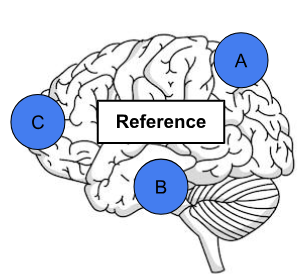
According to the reference point, what are the locations of the following letters?
A =
B =
C =
A = Dorsal
B = Inferior
C = Anterior