oat orgo unit 8

0.0(0)
Studied by 0 people
call kaiCall Kai
learnLearn
examPractice Test
spaced repetitionSpaced Repetition
heart puzzleMatch
flashcardsFlashcards
GameKnowt Play
Card Sorting

1/23

flashcard set

Earn XP

Description and Tags

the cows came home and i welcomed them dearly. as a smile began to adorn my face, i knew i would never feel the same again. a tear fell to the floor.

Last updated 7:21 AM on 6/16/26
Name
Mastery
Learn
Test
Matching
Spaced
Call with Kai

No analytics yet

Send a link to your students to track their progress

24 Terms

1
New cards

Synthesis of carboxylic acid via primary alcohol

reagents: strong oxidizing agents
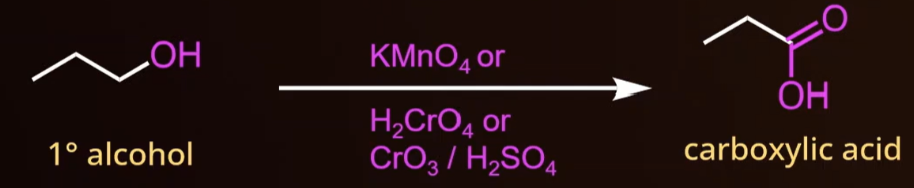
<p>reagents: strong oxidizing agents</p>
2
New cards

Synthesis of carboxylic acid via alkyl halide

  • Add Mg to get Grignard reagent, then CO2 + H2O to get carboxylic acid.

  • The CO2 adds an extra carbon.

<ul><li><p><span style="background-color: transparent;">Add Mg to get Grignard reagent, then CO<sub>2</sub> + H<sub>2</sub>O to get carboxylic acid.</span></p></li><li><p><span style="background-color: transparent;">The CO<sub>2</sub> adds an extra carbon.</span></p></li></ul><p></p>
3
New cards

carboxylic acid derivatives

  • OH on carboxylic acid is replaced with other.

  • Used in nucleophilic acyl substitution

  • Reactivity ranking: Amide < Ester < Acid anhydride < Acid halide
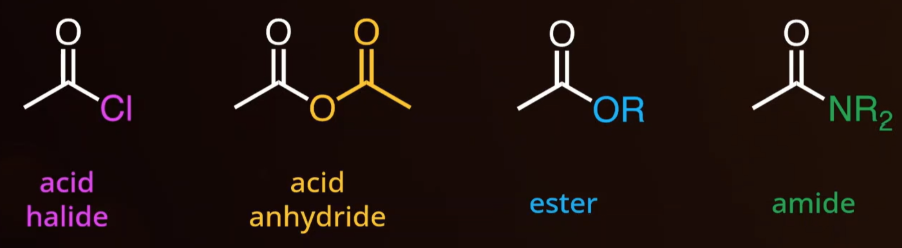
<ul><li><p><span style="background-color: transparent;">OH on carboxylic acid is replaced with other.</span></p></li><li><p><span style="background-color: transparent;">Used in nucleophilic acyl substitution</span></p></li><li><p><span style="background-color: transparent;">Reactivity ranking: Amide &lt; Ester &lt; Acid anhydride &lt; Acid halide</span></p></li></ul><p></p>
4
New cards

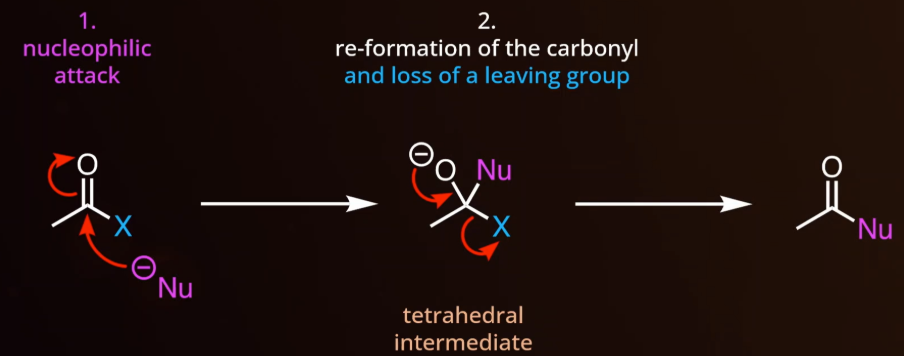
nucleophilic acyl substitution

knowt flashcard image
5
New cards

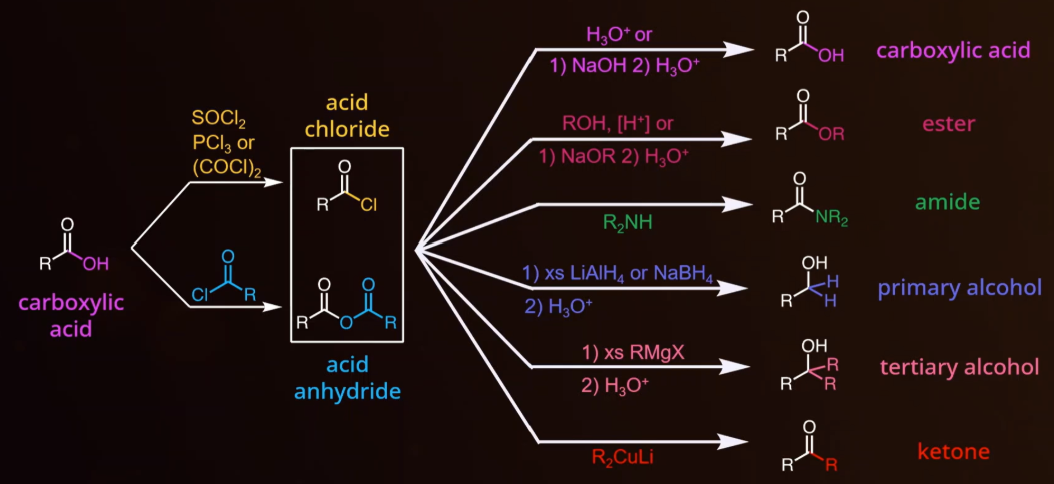
synthesis of acid chloride/anhydride

  • Reagents for acid chloride: SOCl2, PCl3, or (COCl)2

  • Reagent for anhydride: use an acid chloride.
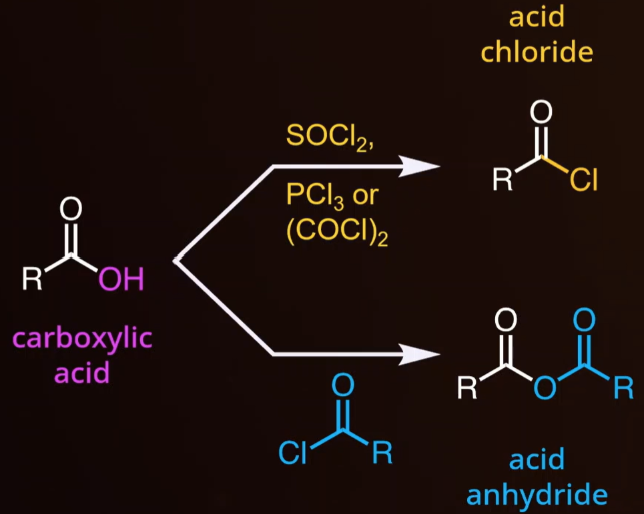
<ul><li><p><span style="background-color: transparent;">Reagents for acid chloride: SOCl<sub>2</sub>, PCl<sub>3</sub>, or (COCl)<sub>2</sub></span></p></li><li><p><span style="background-color: transparent;">Reagent for anhydride: use an acid chloride.</span></p></li></ul><p></p>
6
New cards

hydrolysis of acid chloride/anhydride

  • Reagents: H3O+ or NaOH + H3O+

  • Both make carboxylic acid. Anhydride makes two kinds because of the different R groups.
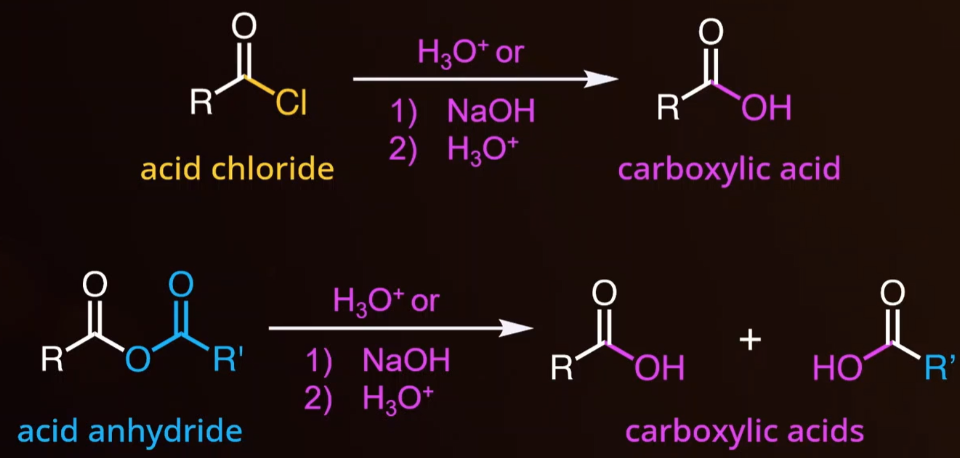
<ul><li><p><span style="background-color: transparent;">Reagents: H<sub>3</sub>O<sup>+</sup> or NaOH + H<sub>3</sub>O<sup>+</sup></span></p></li><li><p><span style="background-color: transparent;">Both make carboxylic acid. Anhydride makes two kinds because of the different R groups.</span></p></li></ul><p></p>
7
New cards

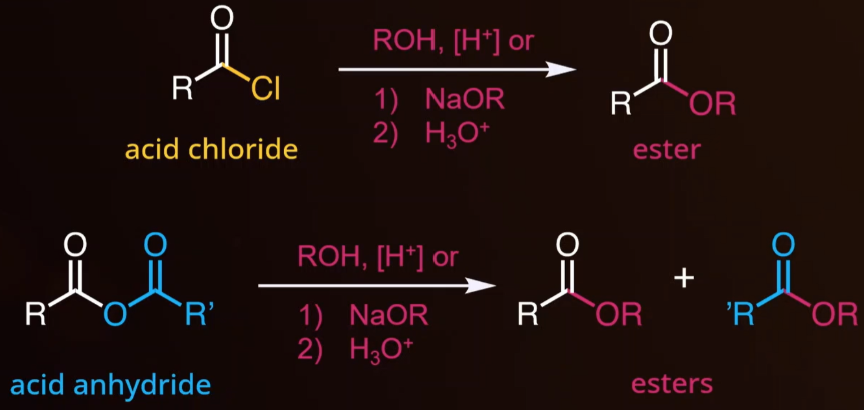
ester formation using acid chloride/anhydride

  • Reagents: ROH + H+ or NaOR + H3O+

  • Anhydride makes two esters.

<ul><li><p><span style="background-color: transparent;">Reagents: ROH + H<sup>+</sup> or NaOR + H<sub>3</sub>O<sup>+</sup></span></p></li><li><p><span style="background-color: transparent;">Anhydride makes two esters.</span></p></li></ul><p></p>
8
New cards

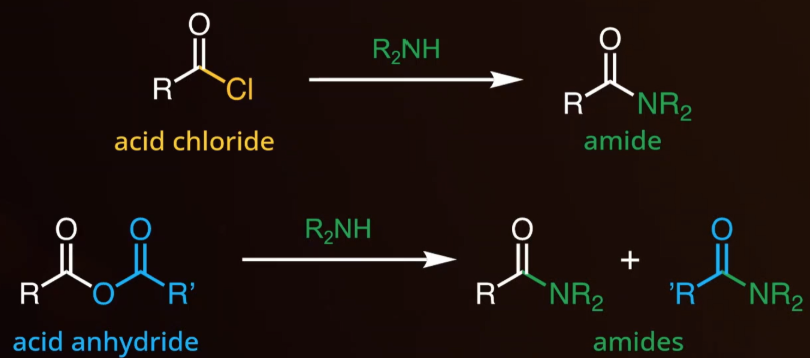
amide formation using acid chloride/anhydride

  • Reagent: R2NH

  • Anhydride makes two amides.

<ul><li><p><span style="background-color: transparent;">Reagent: R<sub>2</sub>NH</span></p></li><li><p><span style="background-color: transparent;">Anhydride makes two amides.</span></p></li></ul><p></p>
9
New cards

hydride reduction using acid chloride/anhydride

  • Reagents: LiAlH4 + H3O+ or NaBH4 + H3O+

  • Makes a primary alcohol (anhydride makes 2)
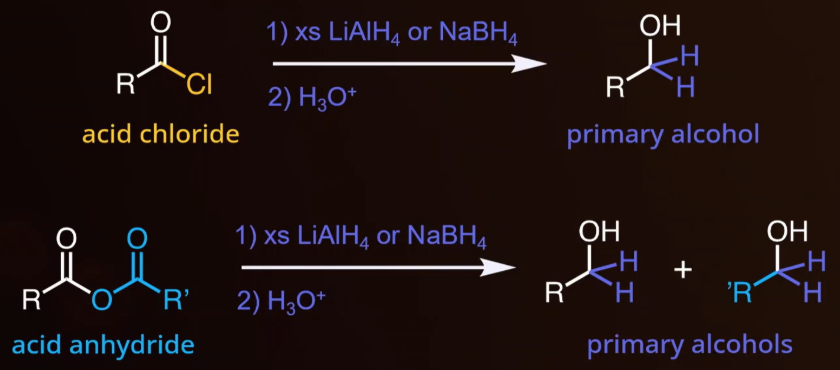
<ul><li><p><span style="background-color: transparent;">Reagents: LiAlH<sub>4</sub> + H<sub>3</sub>O<sup>+</sup> or NaBH<sub>4</sub> + H<sub>3</sub>O<sup>+</sup></span></p></li><li><p><span style="background-color: transparent;">Makes a primary alcohol (anhydride makes 2)</span></p></li></ul><p></p>
10
New cards

grignard reaction using acid chloride/anhydride

  • Reagents: RMgX + H3O+

  • Makes a tertiary alcohol (anhydride makes 2)
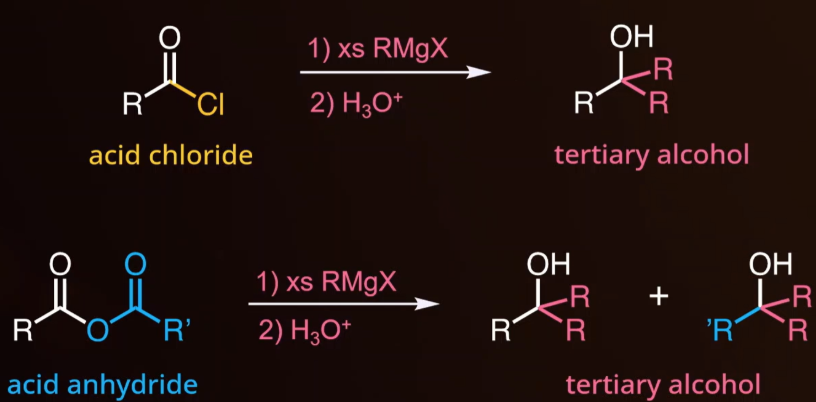
<ul><li><p><span style="background-color: transparent;">Reagents: RMgX + H<sub>3</sub>O<sup>+</sup></span></p></li><li><p><span style="background-color: transparent;">Makes a tertiary alcohol (anhydride makes 2)</span></p></li></ul><p></p>
11
New cards

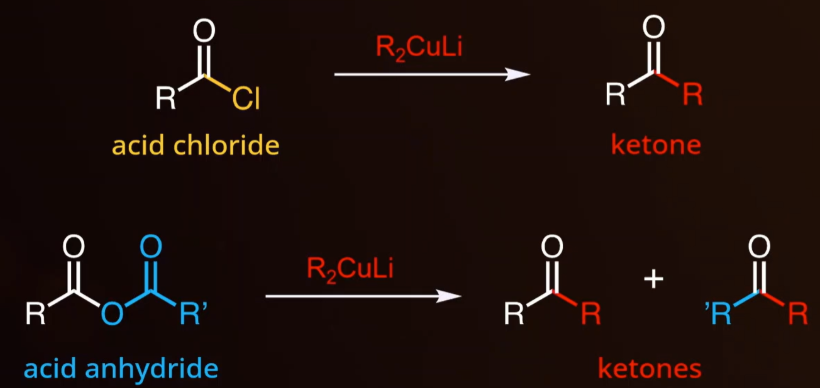
organocuprate reaction using acid chloride/anhydride

  • Reagent: R2CuLi

  • Makes a ketone, anhydride makes 2

<ul><li><p><span style="background-color: transparent;">Reagent: R<sub>2</sub>CuLi</span></p></li><li><p><span style="background-color: transparent;">Makes a ketone, anhydride makes 2</span></p></li></ul><p></p>
12
New cards

carboxylic acid reaction summary

knowt flashcard image
13
New cards

fischer esterification

  • Reagent: ROH + H+

  • Converts carboxylic acid to ester

  • The opposite direction is called hydrolysis, and it uses H2O + H+ to go from ester to carboxylic acid (acidic conditions).
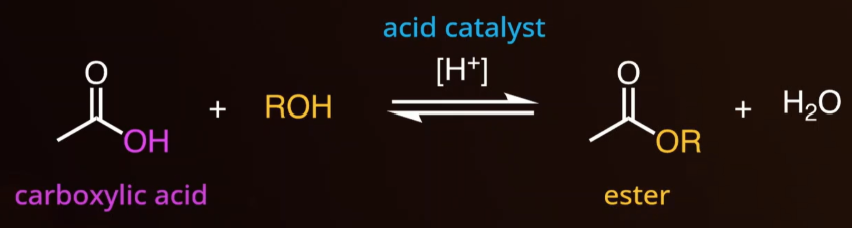
<ul><li><p><span style="background-color: transparent;">Reagent: ROH + H<sup>+</sup></span></p></li><li><p><span style="background-color: transparent;">Converts carboxylic acid to ester</span></p></li><li><p><span style="background-color: transparent;">The opposite direction is called hydrolysis, and it uses H<sub>2</sub>O + H<sup>+</sup> to go from ester to carboxylic acid (acidic conditions).</span></p></li></ul><p></p>
14
New cards

saponification

  • Converts ester to carboxylic acid under basic conditions

  • Reagents: NaOH + ROH + H+

<ul><li><p><span style="background-color: transparent;">Converts ester to carboxylic acid under basic conditions</span></p></li><li><p><span style="background-color: transparent;">Reagents: NaOH + ROH + H<sup>+</sup></span></p></li></ul><p></p>
15
New cards

transesterification

Converts one ester to another.
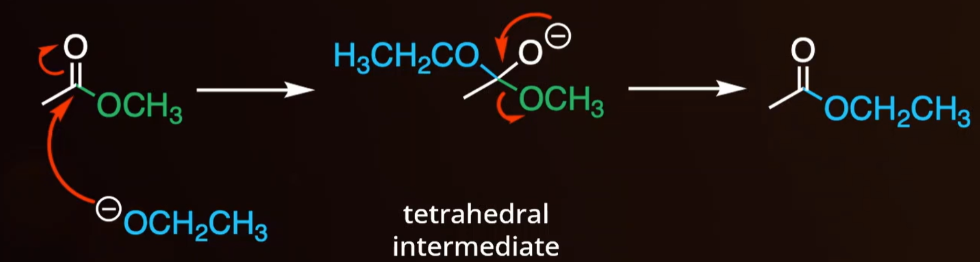
<p><span style="background-color: transparent;">Converts one ester to another.</span></p>
16
New cards

grignard reactants summary

  • Acid chlorides, acid anhydrides, and esters make tertiary alcohols.

  • Carboxylic acids and amides don’t work.

  • The mechanism involves nucleophilic acyl substitution and the nucleophilic addition.

17
New cards

reducing ester to aldehyde

Reagents: DIBAL-H, -70o C + H2O
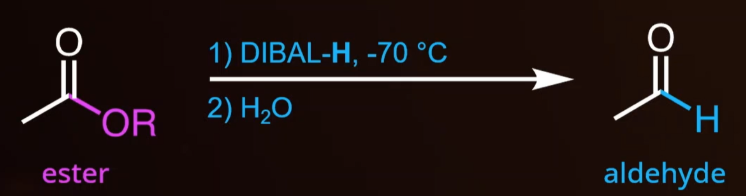
<p><span style="background-color: transparent;">Reagents: DIBAL-H, -70<sup>o</sup> C + H<sub>2</sub>O</span></p>
18
New cards

reducing acid chloride to aldehyde

Reagents: LTBA + H2O
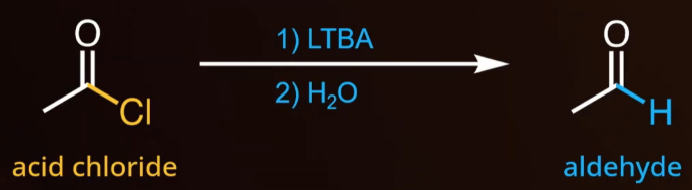
<p><span style="background-color: transparent;">Reagents: LTBA + H<sub>2</sub>O</span></p>
19
New cards

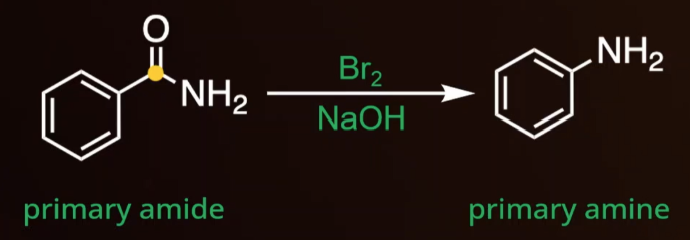
Hofmann rearrangement

  • Happens when converting primary amide to primary amine.

  • Reagents: Br2 + NaOH

  • Removes a carbon in the process

<ul><li><p><span style="background-color: transparent;">Happens when converting primary amide to primary amine.</span></p></li><li><p><span style="background-color: transparent;">Reagents: Br<sub>2</sub> + NaOH</span></p></li><li><p><span style="background-color: transparent;">Removes a carbon in the process</span></p></li></ul><p></p>
20
New cards

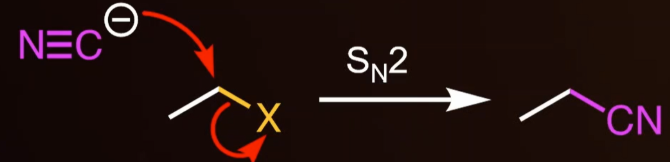
nitrile formation

  • Alkyl halide can be converted to nitrile through an SN2 mechanism

  • Reagent: CN-

<ul><li><p><span style="background-color: transparent;">Alkyl halide can be converted to nitrile through an SN2 mechanism</span></p></li><li><p><span style="background-color: transparent;">Reagent: CN<sup>-</sup></span></p></li></ul><p></p>
21
New cards

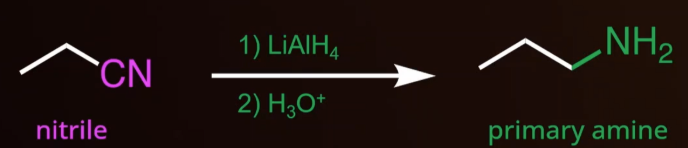
nitrile reduction

  • Converts nitrile to primary amine

  • Reagents: LiAlH4 + H3O+

<ul><li><p><span style="background-color: transparent;">Converts nitrile to primary amine</span></p></li><li><p><span style="background-color: transparent;">Reagents: LiAlH<sub>4</sub> + H<sub>3</sub>O<sup>+</sup></span></p></li></ul><p></p>
22
New cards

nitrile hydrolysis

  • Converts a nitrile to a carboxylic acid

  • Reagents: NaOH + heat + H3O+ or H3O+ + heat
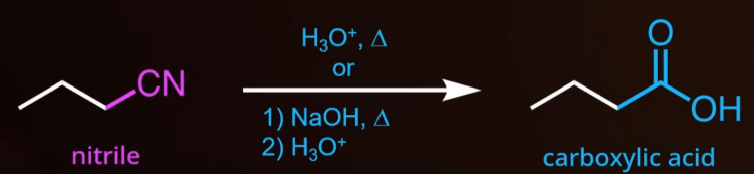
<ul><li><p><span style="background-color: transparent;">Converts a nitrile to a carboxylic acid</span></p></li><li><p><span style="background-color: transparent;">Reagents: NaOH + heat + H<sub>3</sub>O<sup>+</sup> or H<sub>3</sub>O<sup>+</sup> + heat</span></p></li></ul><p></p>
23
New cards

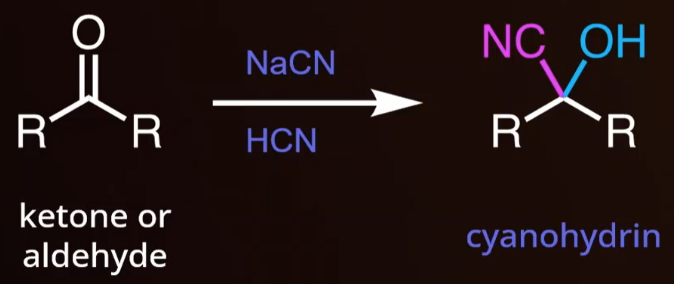
cyanohydrin formation

  • Converts a ketone or aldehyde to a cyanohydrin

  • Reagents: NaCN + HCN

<ul><li><p><span style="background-color: transparent;">Converts a ketone or aldehyde to a cyanohydrin</span></p></li><li><p><span style="background-color: transparent;">Reagents: NaCN + HCN</span></p></li></ul><p></p>
24
New cards

21

9+1