Intro to Contemporary Art Exam 4
 Call Kai
 Learn
Learn Practice Test
 Spaced Repetition
 Match
Match Flashcards
 Knowt Play
1/27

Earn XP
Description and Tags
immersive
Name | Mastery | Learn | Test | Matching | Spaced | Call with Kai |
|---|
No analytics yet
Send a link to your students to track their progress
28 Terms
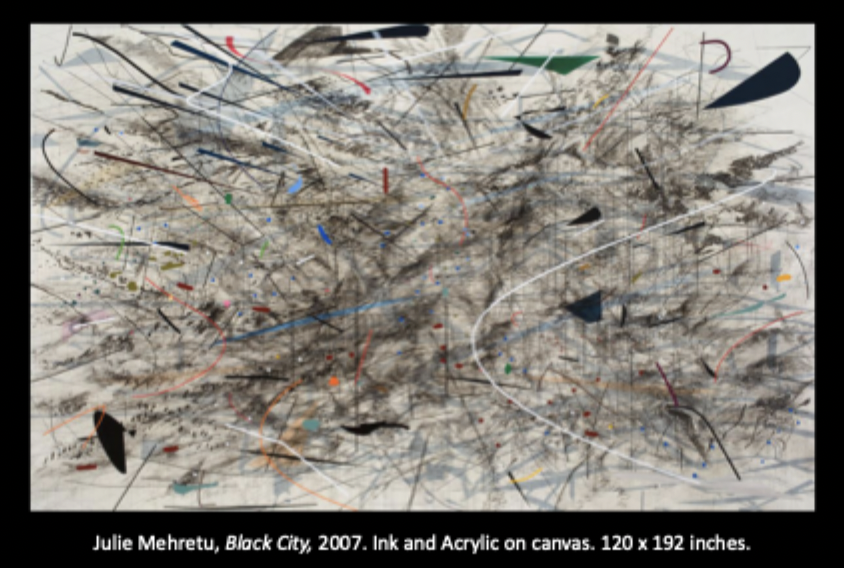
Abstract Spatial Representation
the depiction of space using non-realistic, layered, or fragmented forms, suggesting space through lines, shapes, movement, and overlapping elements
Julie Mehretu, Black City, 2007: uses layered, fragmented structural forms and dynamic marks with ink and acrylic on canvas. the artist creates abstract spatial representation by resembling city plans or a shifting urban environment.
Wayne Thiebaud, Palm Street, 2006–2007
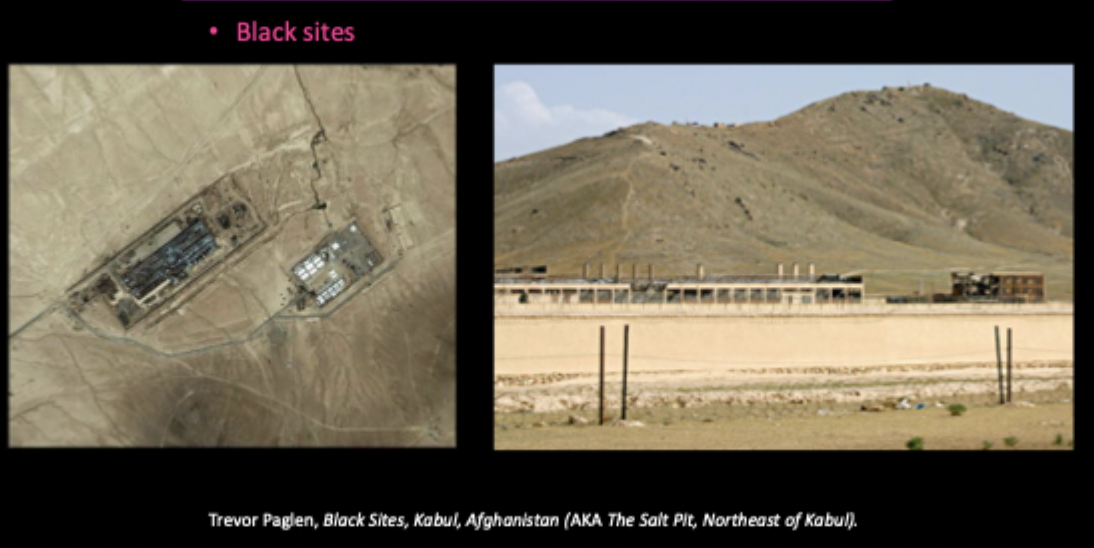
Black site
are secret, undisclosed locations—often run by governments—used for activities like detention, interrogation, or surveillance that operate outside public oversight and legal transparency.
Trevor Paglen, Black Sites, Kabul, Afghanistan (AKA The Salt Pit, Northeast of Kabul), 2004: documentation of a secret CIA detention facility, revealing the hidden spaces used for prisoners. the photo is a direct example/evidence of black sites
Conceptual art
art where the idea is more important than the physical object.
John Baldessari, I Will Not Make Any More Boring Art, 1971.: The work is not about a traditional visual artwork, but about an idea and a process. Baldessari has students repeatedly write the phrase “I will not make any more boring art,” making the concept (instruction + repetition + discipline) the artwork itself.
Lawrence Weiner, Taken From Here To Where It Came From And Taken To A Place And Used In Such A Manner That It Can Only Remain As A Representation Of What It Was Where It Came From, 1980.: n this work, there is no need for a traditional visual object—the language itself is the artwork. The piece exists as an idea communicated through text rather than a physical form.
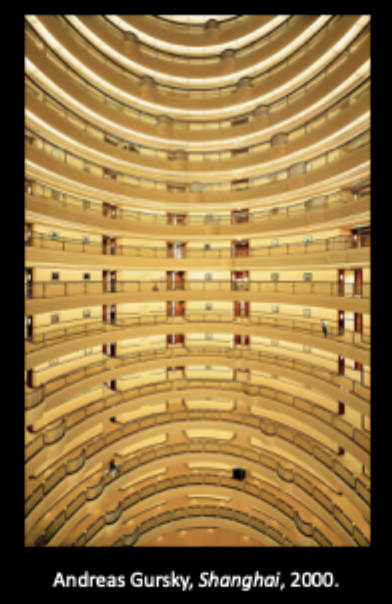
Contemporary Sublime
a feeling of awe mixed with unease or disorientation
Andreas Gursky, Shanghai, 2000: photograph of a massive urban interior, filled with repeating architectural patterns, bright colors, and tiny human figures. it demonstrated contemporary sublime because it is repetitive and overwhelms the viewer, emphasizing the scale and anonymity of modern globalized life.
Deconstruction
taking apart familiar structures or ideas (like language, institutions, or knowledge system
Mali Wu, The Library, 1995: installation where viewers are invited to enter a space filled with books that are often altered, fragmented, or recontextualized, encouraging them to rethink what a “library” normally represents. it is an example of deconstruction because it takes the usual idea of a library and reconstructs it to have new meaning.
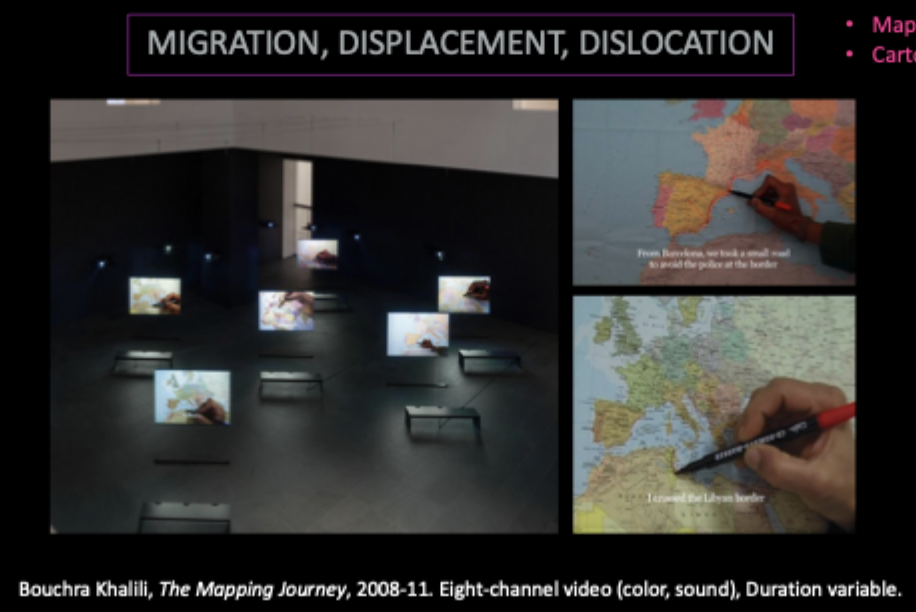
Dislocation
the physical and psychological experience of being separated or “out of place” from one’s home, often resulting in feelings of alienation, instability, or not belonging.
Bouchra Khalili, The Mapping Journey, 2008-11: a video series in which migrants trace their own travel routes across maps while narrating their experiences. example of dislocation by showing migrants’ journeys and emphasizing their experience being “out of place”.
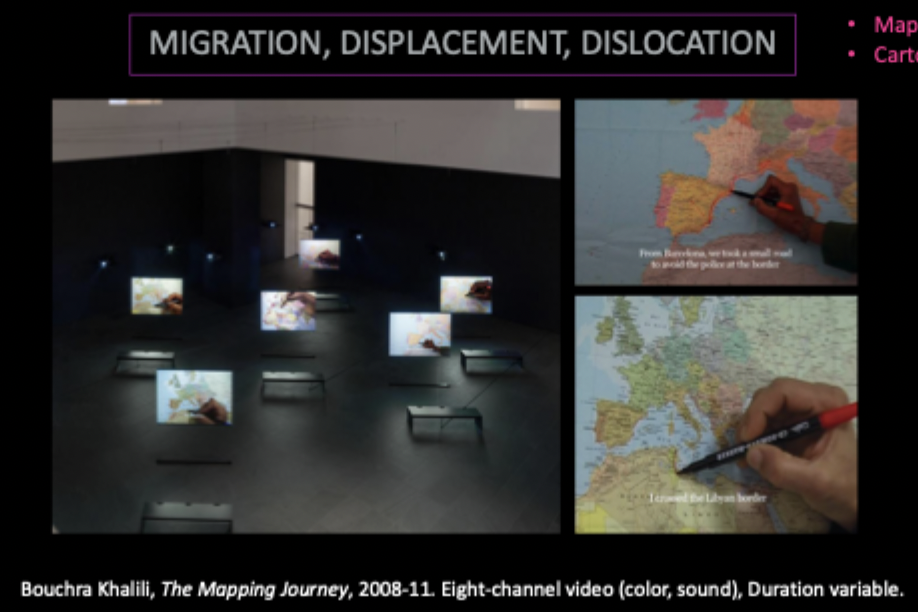
Displacement
the forced or unwilling removal of people from their homes or native places due to factors such as political conflict, environmental disaster, or economic pressure.
Bouchra Khalili, The Mapping Journey, 2008-11: a video series in which migrants trace their own travel routes across maps while narrating their experiences. example of displacement by showing the exact journey people were forced to endure.
Disputed place
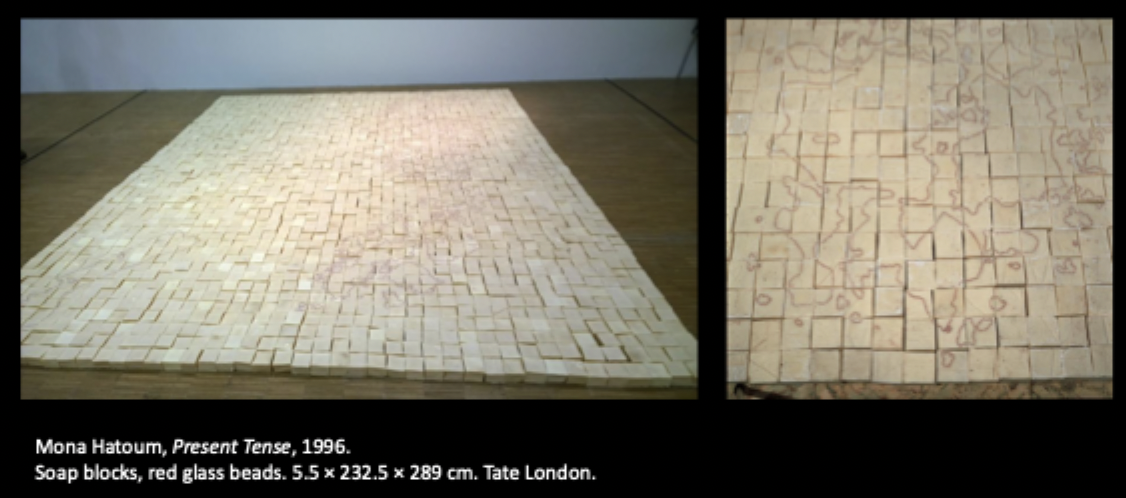
geographic locations that are contested by different groups, often due to political, historical, or cultural conflicts over land, borders, identity, or control.
Mona Hatoum, Present Tense, 1996: artist exemplifies Palestinian territories using soap and beds. This is symbolic and relating to disputed place because soap changes shape when it is used, changing the territories and limits of the places put on them.
Earth Art
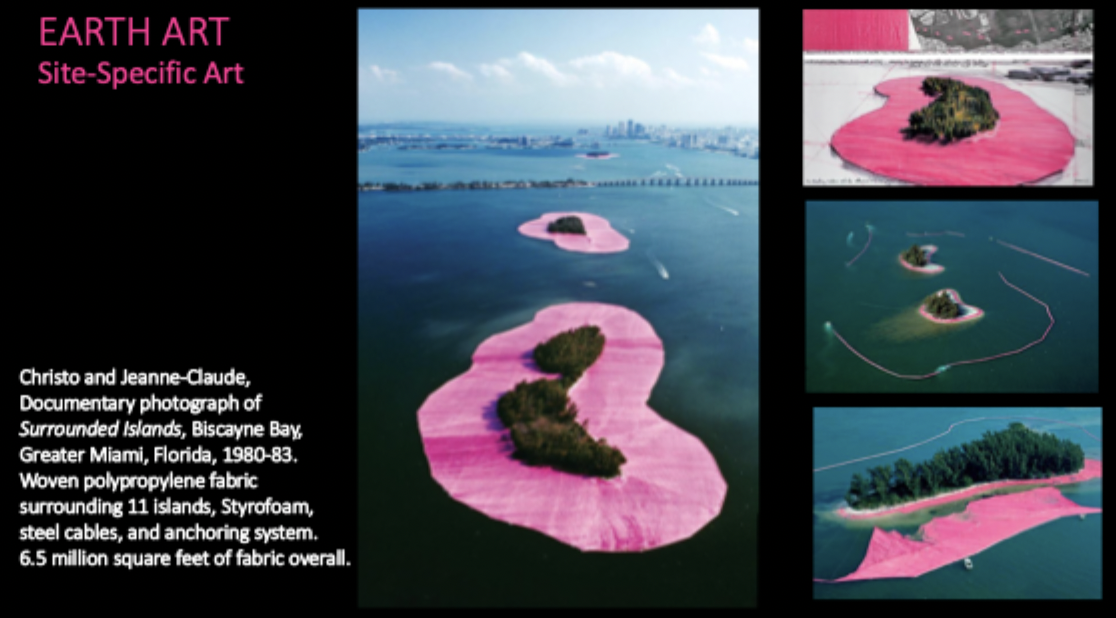
an art movement in which artists create works directly in the natural landscape using materials like soil, rocks, sand, and water.
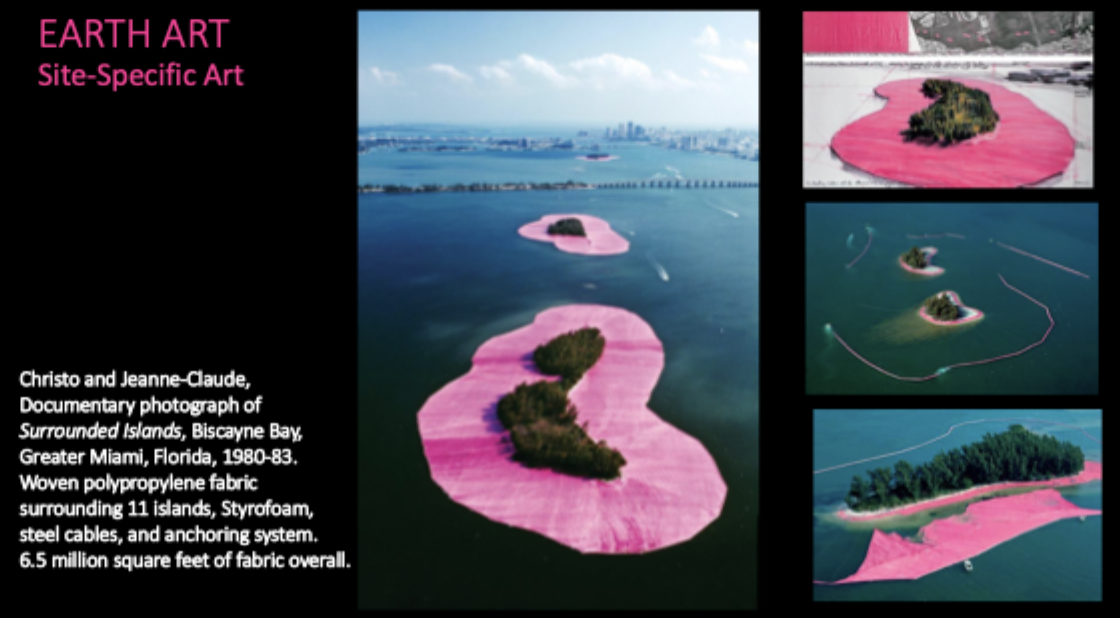
Christo and Jeanne-Claude, Surrounded Islands, Biscayne Bay, Greater Miami, Florida, 1980-83: piece involved wrapping islands in bright pink floating fabric, making the landmark itself art. The installation created directly in the natural environment that transforms and interacts with the landmarks
Truman Lowe, Red Banks, 1992.
Entropic System
a system that moves toward decay, disorder, unpredictability, or loss of structure over time
Richard Long, Planes of Vision, 1983.
Experimental Geography
An approach that explores space and place through artistic, critical, or unconventional methods rather than traditional mapping
Yael Bartana, Wild Seeds, 2005.: Bartana uses film/art to explore space and place in an unconventional way, turning geography into something constructed, performative, and socially examined rather than just mapped.
Icon
a sign that resembles or visually imitates what it represents
Joseph Kosuth, One and Three Chairs, 1965: The photograph of the chair is also an icon because it looks like the chair.
Immersive artwork
art that surrounds or fully engages the viewer, making them feel physically and spatially part of the work rather than just observing it from a distance.
Olafur Eliasson, The Weather Project, 2003.
Mark Hansen and Ben Rubin, Listening Post, 2001-2.:The installation surrounds the viewer with constantly changing visual text and audio from real-time internet chat rooms. It creates an environment you enter, rather than simply observe
Index
a sign that has a direct physical or causal connection to what it represents (a trace or evidence)
Joseph Kosuth, One and Three Chairs, 1965: The photograph of the chair is an index because it is directly produced from the real chair (it’s a trace of it).
Richard Long, Planes of Vision, 1983.: Long often uses text, maps, and descriptions as records of his walks and interventions. The written documentation functions as an index—pointing directly to real actions that occurred in specific places.
Linguistics
the scientific study of language
Rachel Berwick, may-por-é, 1997-present: an installation featuring two live parrots that are taught to speak an extinct or endangered language. it is an example of linguistics because it explores language through live parrots speaking an endangered language, emphasizing speech, preservation, and the relationship between language and cultural identity.
iKen Aptekar, Dad is Showing Me How to Develop, 1998.: It is an image/painting with words over top of the image. it is an example of linguistics because it uses written language within the artwork to create meaning, showing how words and context shape interpretation and understanding.
Duane Michals, Necessary Things for Writing Fairy Tunes, 1989: Michals integrates handwritten text with photographs, showing how language shapes meaning, storytelling, and imagination. The “instructions” or written elements are central to how we understand the work.
Tauba Auerbach, How to Spell the Alphabet, 2005: The work directly engages language systems—specifically the structure of the alphabet. It breaks down how written language works and makes the viewer think about spelling, sequence, and the mechanics of language itself.
Migration
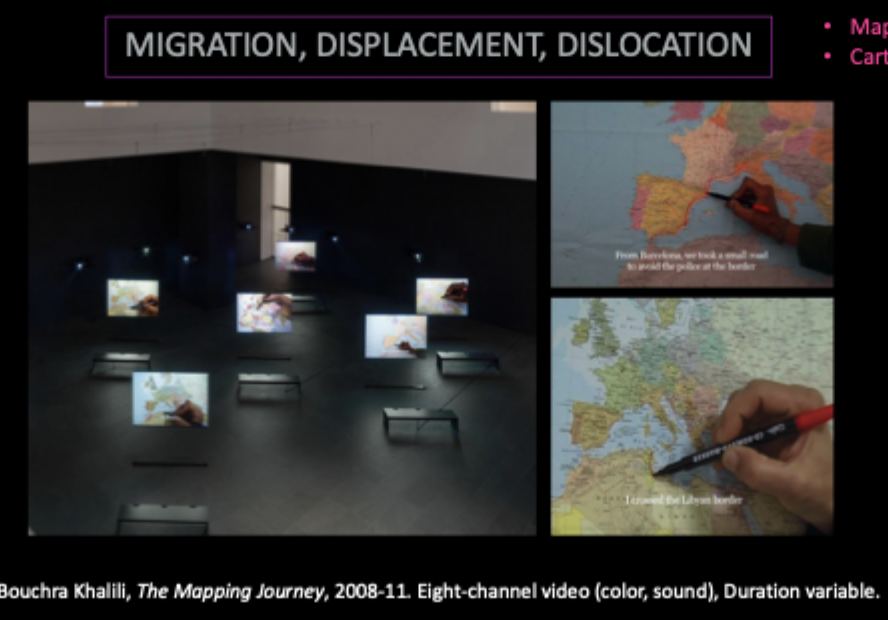
the movement of people from one place to another, often across borders, for reasons such as economic opportunity, conflict, persecution, or survival.
Bouchra Khalili, The Mapping Journey, 2008-11: a video series in which migrants trace their own travel routes across maps while narrating their experiences. example of migration because it highlights individuals’ journey across borders
Multisensorial
an experience that engages multiple senses at once, such as sight, sound, touch, and even atmosphere (temperature, humidity, etc.).
Olafur Eliasson, The Weather Project, 2003.:
Non-place
A space that lacks identity, history, or emotional connection (e.g., airports, highways, chain hotels).
Trevor Paglen, Orbital Reflector, 2018.: The satellite exists in orbital space, which is not a traditional lived environment. It becomes a location without identity, history, or human habitation, similar to Marc Augé’s idea of non-places (like airports or highways, but extended into space).
Post-structuralism
A theoretical approach that challenges fixed meanings and emphasizes that knowledge, language, and identity are unstable and constructed.
Gillian Wearing, Signs That Say What You Want Them To Say And Not Signs That Say What Someone Else Wants You To Say, 1992-1993.: The piece challenges the idea that identity is fixed or knowable. Instead, it shows that identity is constructed, unstable, and dependent on language and context.
Relational Aesthetics
an approach in contemporary art where the focus is on human interaction and social experience rather than on a static object.
Carsten Höller, Test Site, 2006: installation of aluminum and glass slides. it creates a participatory environment where the artwork emerges through the shared physical and social interactions of viewers using the slides.
Semiotics
study of signs, how meaning is created and communicated.
Joseph Kosuth, One and Three Chairs, 1965. it shows how meaning comes from objects (chair), images (photo), language (definition)
Lorna Simpson, Easy to Remember, 2001: The work combines images and text in a way that shows how meaning is constructed through sign systems. The relationship between what you see and what you read is not fixed, so meaning is produced through interpretation.
Rima Gerlovina and Valeriy Gerlovin, Be-Le-Ve, 1990: The work is built around fragmented language (“Be-Le-Ve”), which forces the viewer to interpret meaning through signs and broken linguistic structure rather than clear representation. Meaning is unstable and created through reading.
Glenn Ligon, Untitled (I am not Tragically Colored), 1990.: The work is built from repeated text (“I am not tragically colored”), so meaning comes through language as a system of signs, not imagery. The repetition changes how the phrase is interpreted over time.
Edgar Heap of Birds, Building Minnesota, 1990
Sign
A sign is anything that communicates meaning; it is made up of a signifier (form) and a signified (concept).
Joseph Kosuth, One and Three Chairs, 1965.: The chair, the photograph, and the dictionary definition are all signs—each represents the idea of a “chair” in a different way.
Gillian Wearing, Signs That Say What You Want Them To Say And Not Signs That Say What Someone Else Wants You To Say, 1992-1993.
Signified
the mental concept or idea that the sign refers to
Joseph Kosuth, One and Three Chairs, 1965.: All three elements point to the same signified: the idea or concept of a chair in your mind.
Signifier
dictionary’s definition, the physical form of the sign (what you see, read, or hear).
Joseph Kosuth, One and Three Chairs, 1965.: the actual objects in the piece are the signifiers
Site-specific
artwork created for a particular location and designed to respond to the physical, cultural, or environmental conditions of that place.
Christo and Jeanne-Claude, Surrounded Islands, Biscayne Bay, Greater Miami, Florida, 1980-83: piece involved wrapping islands in bright pink floating fabric, making the landmark itself art. This is an example of site-specific because the installation was made for these islands and it would not be the same if it were in a different location.
Magdalena Jetelová, Atlantic Wall, Area of Violence, 1994-95.
Structuralism
a theory that says meaning is created through underlying systems or structures (especially language, signs, and relationships between elements), rather than from individual objects themselves. It focuses on how things are organized into systems that produce meaning.
Joseph Kosuth, One and Three Chairs, 1965.
Symbol
meaning
Turbine Hall Tate Modern
The Turbine Hall is a massive, central exhibition space inside the Tate Modern in London. It holds many large pieces of art installations that are all site-specific.
Doris Salcedo, Shibboleth, 2007. - a site-specific installation in the Tate Modern’s Turbine Hall that that consisted of a long crack running through the floor. it represents division.