B6 : Inheritance, Variation + Inheritance
 Call Kai
 Learn
Learn Practice Test
 Spaced Repetition
 Match
Match Flashcards
 Knowt Play
1/152

Earn XP
Description and Tags
Name | Mastery | Learn | Test | Matching | Spaced | Call with Kai |
|---|
No analytics yet
Send a link to your students to track their progress
153 Terms
What is DNA?
The genetic material in the nucleus of a cell
Where is DNA found?
In chromosomes
What is a chromosome?
Really long molecule of DNA
What is the structure of DNA?
DNA is a polymer made up of 2 strands forming a double helix (a double stranded helix)
What does your DNA determine?
Inherited characteristics
What proteins the cell produces, which determines what type of cell it is
What is a gene?
A small section of DNA on a chromosome
What does a gene code for?
Each gene codes for a particular sequence of amino acids, to make a specific protein
How many amino acids are used in shaping DNA?
20
What is a genome?
The entire genetic material of an organism
Why is it important to understand the importance of the human genome? (3)
Allows scientists to identify genes in the genome that are linked to different types of diseases
Knowing what genes are linked to inherited diseases could help understand them + help develop effective treatments
Scientists can look at genomes to trace human migrating patterns from the past
What are DNA polymers made up of?
Repeating units called nucleotides
What does a nucleotide consist of? (3)
A sugar
A phosphate group
A base
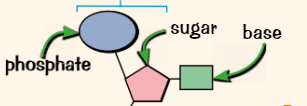
What forms the backbone of DNA + how are the positioned?
Sugar + phosphate groups
Which alternate
What is attached to the sugars + name them + which ones they pair with?
Bases are attached to sugars
The 4 bases are
A
T
C
G
The pairs for the bases are
A + T
C + G
What does the order of bases in a gene decide?
The order of amino acids in a protein
How are amino acids coded for?
By a sequence of 3 bases in the gene (triplets)
What do the non-coding parts of DNA that don’t code for proteins do?
They switch genes on + off, so they control whether a gene is expressed (used to make a protein)
Where does protein synthesis take place?
In the cytoplasm (sometimes)
In the ribosomes
How do ribosomes make protein + what is the problem faced during this + what 2 molecules are used to solve this?
They use the code in DNA
The DNA is in the nucleus + can’t move out of it ,so the cell needs to get the code from the DNA to the ribosome
This is done using a molecule called mRNA + tRNA
What happens when the amino acids have assembled to from a complete protein chain? (2)
When the protein chain is complete it folds up to form a unique shape
This unique shape enables the proteins to do their job
What are the 3 types of jobs of proteins in the body?
Enzymes → they act as biological catalysts to speed up chemical reactions
Hormones → they are used to carry messages around the body
Structural proteins → they form structures which are very strong such as collagen (which is a structural protein that strengthens connective tissues)
What are the 2 stages in protein synthesis called + explain how they work (5)
Transcription → takes place in the nucleus → the base sequence is copied into a complementary mRNA which is only a single strand
The mRNA then passes out of the nucleus + into the cytoplasm
Translation → takes place in the cytoplasm → the mRNA molecule attached to a ribosome + then amino acids are brought to the ribosome on carrier molecules called tRNA
The ribosome then reads the triplets of bases on the mRNA + uses this to join together the correct amino acids in the correct order
Then when the protein chain is complete it folds in a unique shape which enables it do its job
What is a mutation in terms of DNA?
A random change in an organisms DNA
When do mutations occur?
Continuously + spontaneously
What do mutations do?
They change the sequence of DNA base in a gene, which produces a genetic variant (a form of a different gene), which can lead to changes in the protein that it codes for
What increases the chance of mutations?
Exposure to certain substances or some types of radiation
What does an unharmful mutation cause?
A unharmful mutation causes a small change which leads the proteins function + appearance to be unaffected
What does a harmful mutation cause + give 2 examples
A harmful mutation causes a code to be generated for an alternate protein with a change in its shape, which could effect its ability to function
E.g.
If an enzymes active site is changed, its substrate can no longer fit
Structural proteins like collagen lose their strength
What happens if non-coding parts of DNA are mutated?
It may effect how the genes are expressed
Explain the 3 types of mutations
Insertions → when a new base is inserted in a DNA base sequence
Deletions→ when a base is deleted from a DNA base sequence
Substitution → when a random base is changed into a different base
How many chromosomes does a normal human cell have?
46 chromosomes
23 pairs
What are the 2 types of reproduction + processes happen via?
Sexual → Meiosis
Asexual → Mitosis
What is the difference between the product of meiosis compared to the product of mitosis?
Meiosis → non-identical cells
Mitosis → identical cells
What happens during sexual reproduction?
Genetic information from two organism (a mother + father) is combined to produce offspring which are genetically different to either parent
What are the produced via meiosis?
Gametes
What is the name of the gamete produced by a female human + a male human?
Female → egg cell
Male → sperm cell
How many chromosomes does a gamete have?
23
What happens with the gametes during sexual reproduction?
The egg + the sperm fuse together to form a cell with a full number of chromosomes (half from the mother + half from the father)
What does the offspring of sexual reproduction contain?
A mixture of their parents genes
Why does the offspring of sexual reproduction inherit features from both parents?
Because it has received a mixture of chromosomes from its mum + dad (and the chromosomes decide your characteristics)
The mixture of genetic information produces what in the offspring?
Variation
What are the gametes in flowering plants?
Male → pollen
Female → egg cells
What happens during asexual reproduction?
A parent cell (only one) divides to produce identical offspring (clones), as there is no mixing of genetic material + therefore no genetic variation
What is the process called when gametes fuse?
Fertilisation
Explain the stages for meiosis (6)
The cell duplicates its genetic information, forming 2 armed chromosomes + then the chromosomes arrange themselves into pairs (92 chromosomes)
In the first division, the chromosome pairs line up in the centre of the cell
The pairs are pulled apart so each new cell only has one copy of each chromosome (some of the mothers + some of the fathers go into both of the cells) (46 chromosomes in each cell)
Then in the second division, the chromosomes line up again in the centre of the cell
The arms of the chromosomes are then pulled apart (23 chromosomes in each cell)
The products is 4 gametes, each with only a single set of chromosomes in it + they are all genetically different
What happens after two gametes have fused together (fertilisation)? (3)
The fertilised egg divides itself by mitosis to make a copy of itself
Mitosis repeats many times to produce lots of new cells in an embryo
As the embryo develops, these cells then start to differentiate into different types of specialised cells that make up a whole organism
What are the advantages of sexual reproduction? (3)
Produces variation in the offspring (as genetically different cells are produced)
Variation gives a survival advantage if the environment changes (as because they are different some will survive + some won’t)
Natural selection can be sped up by humans in selective breeding (which allows desirable animals to be produces leading to an increase in food production)
What are the advantages of asexual reproduction? (4)
Only one parent is needed
More time + energy efficient as there is no need to find a mate
Faster that sexual reproduction
Many identical offspring can be produced in favourable conditions
Give 3 examples of animals that can reproduce both sexually + asexually
Malarial parasites reproduce asexually in the human host, but sexually in the mosquito
Many fungi reproduce asexually by releasing spores but also reproduce sexually to give variation
Many plants produce seeds sexually, but also reproduce asexually such as runners in strawberry plants, or bulb division such as daffodils
How many pairs of chromosomes control characteristics?
22 pairs of chromosomes
What is the 23rd pair of chromosomes + what does it control?
23rd pair of chromosomes can either be
XX → female
XY → male
This control sex (gender)
What is the chance of having either a girl or a body?
50%
What do genetic diagrams determine?
The probability of offspring as a result of 2 parents’ genes
What are the 2 types of genetic diagrams?
Punnett square diagram
Genetic cross diagram
Draw a punnett square diagram for a male chromosome (XX) + a female chromosome (XY)
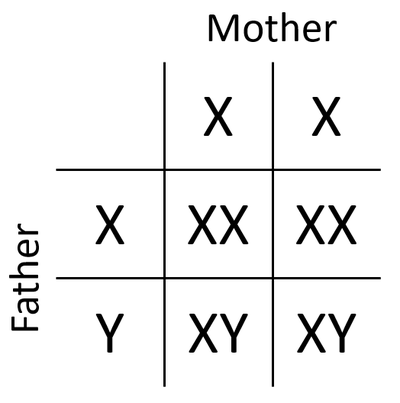
Draw a genetic cross diagram for a male chromosome (XX) + a female chromosome (XY)
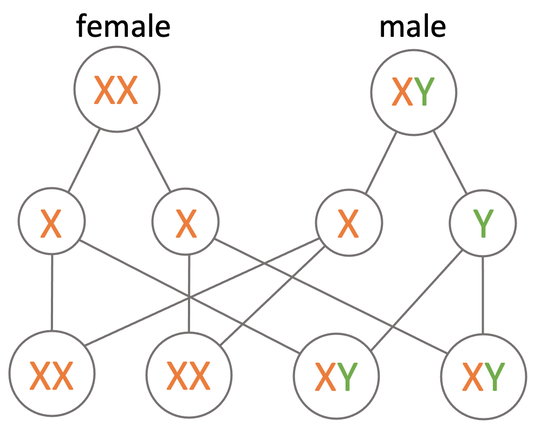
What do genes control?
Characteristics
What is an allele?
A gene that has different forms
What is a genotype?
The combination of alleles you have
What is a phenotype?
Your characteristics
What is a homozygous trait?
When your alleles are both identical for the same characteristic
What is a heterozygous trait?
When your alleles are different for the same characteristic
What determines what characteristic is present?
The allele for the characteristic that’s shown is called the dominant allele
How is a dominant allele expressed?
Using a capital letter e.g. A
How is a recessive allele expressed?
Using a lowercase letter e.g. a
How can a dominant characteristic be displayed + a recessive characteristic? (give example with the letter A + a)
Dominant | Recessive |
|---|---|
AA | aa |
Aa |
Why is Aa seen as a dominant characteristic even though it has ‘a’ in it?
Because the dominant allele ‘A’ overrules the recessive allele ‘a’
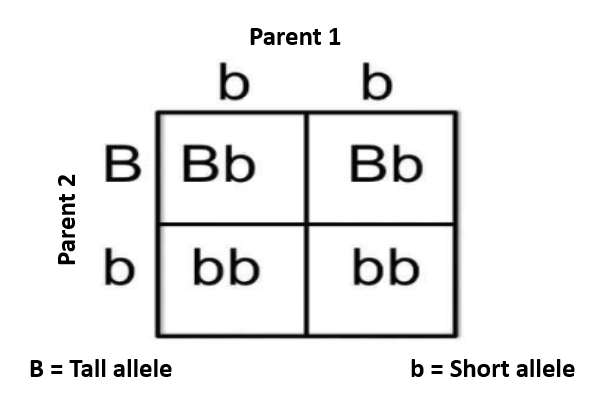
Label both parents with either heterozygous or homozygous + state the probability the offspring will be tall + short
Parent 1 → Homozygous
Parent 2 → Heterozygous
Probability
Tall → 2/4 or 2:2 or 50%
Short → 2/4 or 2:2 or 50%
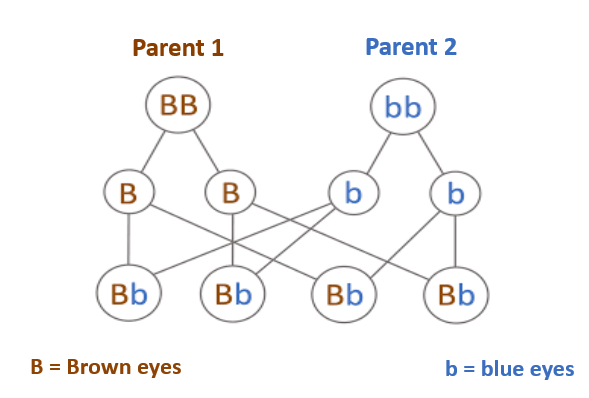
Label both parents with either heterozygous or homozygous + state the probability the offspring will have brown eyes + blue eyes
Parent 1 → Homozygous
Parent 2 → Homozygous
Probability
Brown eyes → 4/4 or 100%
Blue eyes → 0/0 or 0%
What is cystic fibrosis caused by?
A recessive allele
What is cystic fibrosis?
A disorder of cell membranes
What is polydactyly caused by?
A dominant allele
What is polydactyly?
Having extra fingers or toes
What does a family tree show which is different to other genetic diagrams?
It shows phenotypes + not genotypes
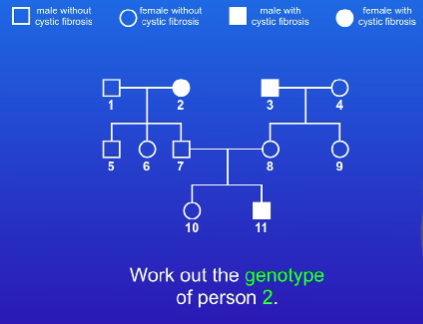
cc
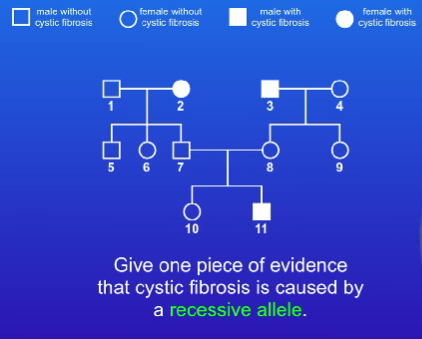
Person 11 has cystic fibrosis but their parents do not which means person 7 + 8 must be carriers
This means it is caused by a recessive allele
If cystic fibrosis was dominant, then at least one of the parents would have to have cystic fibrosis in order to pass it onto person 11
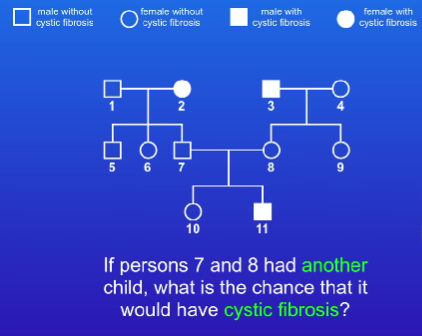
Person 7 + 8 are carriers which means they are heterozygous
This means they have a carrier allele and an allele which causes cystic fibrosis
By drawing a punnet square, it would lead to the probability of their next child having cystic fibrosis as 25% or ¼ or 1:3
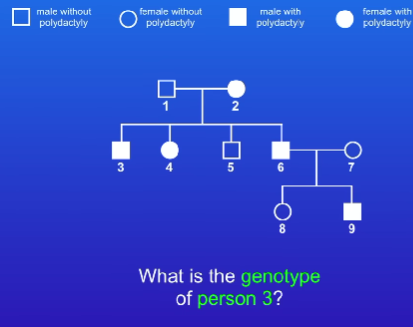
Pp
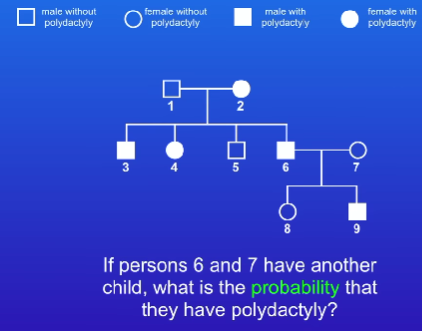
Person 6 is a heterozygous + person 7 is a homozygous
By drawing a punnet square, it would lead to the probability of their next child having cystic fibrosis as 50% or ½ or 1:1
What is embryonic screening + what does it detect?
Analysation of an embryos + its genes
Which detects genetic disorders
What are the arguments for + against embryonic screening?
For | Against |
|---|---|
It will help people suffering | It implies that people with genetic problems are undesirable |
Treating disorders costs money for the government (healthcare) | There may come a point where everyone wants to pick desirable characteristics for their children |
There are laws to stop it from going to far e.g. parents can’t select the gender of their baby | Screening is expensive |
Who was Gregor Mendel + what was his theory about?
Mendel was a austrian monk
He noted down how characteristics in plants were passed on from one generation to the next
What experiment did Mendel carry out + what were his results?
Experiment:
He mated a tall pea plant with a dwarf pea plant (experiment part 1) + he mated a tall pea plant with a tall pea plant (experiment part 2)
Conclusion:
Experiment part 1 → 4 offspring all of which were tall pea plants
Experiment part 2 → 4 offspring of which 3 were tall pea plants + one was a dwarf pea plant
What conclusion did Mendel come to after his pea plant experiment?
The inheritance of each characteristic is determined by ‘units’ that are passed on to descendants unchanged + these ‘units’ can be either dominant or recessive
Why was Mendel’s discovery only recognised after his death?
Before Mendel’s death, there was no knowledge about genes, chromosomes or DNA + so what he had figured out was not understood
What did Mendel’s discovery lead to? (3)
In the late 19th century behaviour of chromosomes during cell division was observed.
In the early 20th century it was observed that chromosomes and Mendel’s ‘units’ behaved in similar ways. This led to the idea that the ‘units’, now called genes, were located on chromosomes
In the mid-20th century the structure of DNA was determined and the mechanism of gene function was worked out
What is variation?
Differences in the same species
What are the 2 types of variaton?
Genetic variation
Environmental variation
Explain genetic variation
Because of meiosis, gametes are genetically different + so there is variation is a species
Explain environmental variation
Because of the conditions organisms live + grown in, there are differences between members of the same species
Can characteristics be affected by both environment + genetics?
Yes
Put these characteristics in either genetic, environmental or both
Body weight
Eye colour
Height
Scars
Blood group
Skin colour
Shape of earlobe
Tattoos
Hair length
Natural hair colour
Language
Sporting achievements
Environmental | Both | Genetic |
|---|---|---|
Scars | Body weight | Eye colour |
Tattoos | Height | Blood group |
Hair length | Skin colour | Natural hair colour |
Language | Sporting achievements | Shape of earlobe |
What can rarely happen when a mutation occurs in terms of variation?
A new phenotype can be seen in a species
If a new phenotype is suited to an environmental change, what will happen to the species?
A relatively rapid change in the species via natural selection
What was the theory proposed by Charles Darwin?
Evolution by natural selection
What does the theory of evolution by natural selection state? (in terms of the past)
That all species of living things have evolved from simple life forms that first developed more than three billion years ago
What does the theory of evolution by natural selection state? (in terms of the present)
A change in the inherited characteristics of a population over time through a process of natural selection may result in the formation of a new species
Explain ‘survival of the fittest’
Organisms with the most suitable characteristics for the environment would be more successful competitors + more likely to survive
How would desirable characteristics influence future generations + what would happen overtime?
The organisms that would survive would reproduce + pass on the genes for the desirable characteristics to their offspring
Overtime beneficial characteristics would become more common in the population + the species would change → evolution
Why was the theory of natural selection gradually accepted + not immediately? (3)
The theory challenged the idea that God made all the animals and plants that live on Earth
There was insufficient evidence at the time the theory was published to convince many scientists
The mechanism of inheritance and variation was not known until 50 years after the theory was published