BIOL 1202: Chp. 40
 Call Kai
 Learn
Learn Practice Test
 Spaced Repetition
 Match
Match Flashcards
 Knowt Play
1/68

Earn XP
Name | Mastery | Learn | Test | Matching | Spaced | Call with Kai | Chat |
|---|
No analytics yet
Send a link to your students to track their progress
69 Terms
Anatomy
Is the biological form of an organism.
Physiology
Is the biological functions an organism performs.
What programs an animal’s body plan?
The genome, which is the product of millions of years of evolution.
Answer the following questions about animal size and shape.
Physical laws govern what four things?
The properties of water _______ for swimming animals.
How does a skeleton of a larger animal compare to a smaller animal?
How does convergent evolution relation to different animal adaptations?
Strength, diffusion, movement and heat exchange
shapes
larger animals have larger skeletons to support their bodies
Convergent evolution causes similar adaptations in diverse animals who face the same challenges
What three things must be exchanged across the cell membranes of animal cells?
Nutrients
Waste product
Gases
Rate of exchange is proportional to a cell’s surface area, while amount of exchange material is _______ to a cell’s volume (DA in 2nd, 3D is vo.).
proportional
How does a multicellular organisms with a saclike body plan vary in their cell wall?
Multicellular organisms with a saclike body plan heavy body walls that are only two cell walls thick and facilitating in diffusion of materials.
A single-celled organism living in water has _______ surface area to carry out all necessary discharge.
sufficient
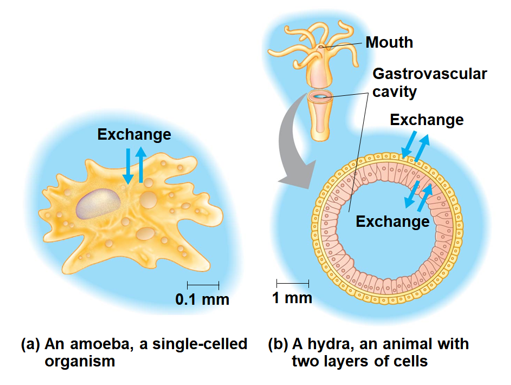
Answer the following questions about cells in different animals.
How do cells in flatworms interact with the environment?
How are complex organisms’ cells developed?
How have evolutionary adaptations caused cells to change?
How does a complex body plan help the animal survive?
There cells are in direct contact with their environment
The cells are in complex mass with complex internal organizations
Specialized, extensively branched or folded structures enable sufficient exchange with the environment
Complex body plans help maintain a relatively stable internal environment for an animal.
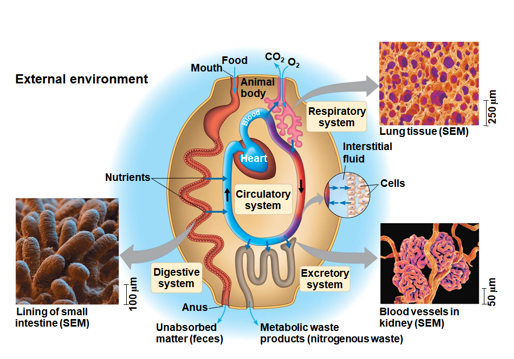
Intestinal fluid
Fluid that fills the space between cells, which linked exchange surfaces to body cells.
Tissues
Cells that up organs and together to make up organ systems.
Name one organ that belongs to more than one organ system.
The pancreas
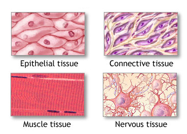
List the four main types of animal tissues.
Epithelial
Connective
Muscle
Nervous
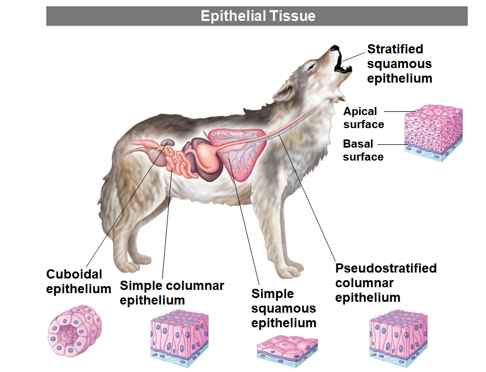
Answer the following questions about epithelial tissue.
How are its cells connected?
What are the three shapes of epithelial tissues and what do they resemble?
What are the three types of epithelial cell arrangements?
Closely joined
Cuboidal (like dice), Columnar (like bricks on end) or Squamous (like floor tiles)
Simple (single cell layer), Stratified (multiple tiers of cells), or Pseudostratified (a single layer of cells varying length)
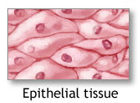
Epithelial tissue
Tissue that covers the outside of the body and lines the organs and cavities within the body.
Connective tissue
Tissue mainly binds and supports other tissues.
Answer the following questions about connective tissue.
How are its cells arranged?
What are the three textures this matrix fiber consists of?
What are three types of connective tissue fibers?
Sparsely packed cells scattered throughout an extracellular matrix
Fibers in a liquid, jelly-like, or solid foundation
Collagenous fiber (provide strength and flexibility), reticular fibers (join connective tissue to adjacent ones), elastic fibers (stretch and revert back to original length)
What two things does connective tissue contain? Define them.
Fibroblasts: Secrete the protein of extracellular fibers.
Macrophages: Involved in the immune system.
List the six types of connective tissue present in vertebrates.
Loose
Fibrous
Bone
Adipose
Blood
Cartilage
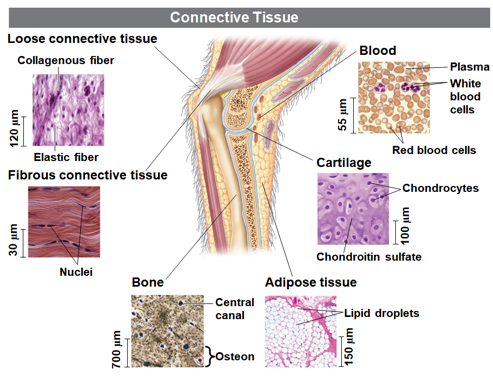
Loose tissue
Binds epithelia to underlying tissues and hold organs in place.
Fibrous tissue
Is found in tendons (attach muscles to bones) and ligaments (connect bones at joints).
Bone tissue
Is mineralized and forms the skeleton.
Adipose tissue
Stores fat for insulation and fuel.
Blood
Is composed of blood cells and cell fragments in blood plasma.
Cartilage tissue
Is a strong and flexible support material.
Muscle tissue
Is responsible for all types of body movement.
Answer the following questions about muscle tissue.
What two proteins do the filaments have?
What do they proteins in the filaments allow the muscle to do?
Name the three types of muscle tissue?
Actin and myosin
Together the allow muscles to contract
Skeletal, smooth, and cardiac
Define the three types of muscle tissue.
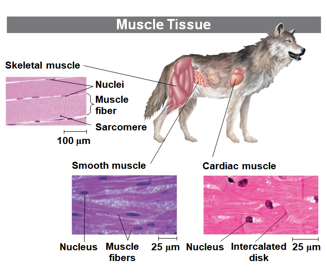
Skeletal: Is responsible for voluntary movement, also called striated muscle.
Smooth: Is responsible for involuntary body activities.
Cardiac: Is responsible for the contraction of the heart.
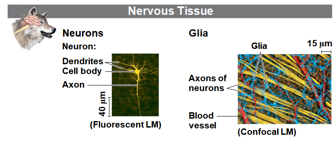
Nervous tissue
Functions in the receipt, processing, and transmission of information.
What two things do nervous tissues contain? Define them.
Neurons: They transmit nerve impulses, also known as nerve cells.
Glial cells: They support cells, also known as glia.
Answer the following questions regarding coordination and control.
What two bodily systems do coordination and control use?
Can hormones affect multiple regions of the body?
What is the speed at which hormones act?
Are nerve signal transmission fast?
The nervous and endocrine system
Yes
They’re slow acting, but have long lasting affects on the body
Yes
The endocrine system
It releases signaling molecules called hormones.
The nervous system
Transmits information between specific locations.
Answer the following questions about feedback control and animals.
How do animals manger their internal environment to adapt to environmental fluctuations?
Animals may regulate some environmental variables while _______ to others.
Animals manage their internal environment by either regulating or conforming
conforming
Regulator
Uses internal control mechanisms to control internal change in the face of external fluctuation.
Conformer
Allows its internal condition to vary with certain external changes.
Answer the following questions regarding homeostasis.
What process do animals use to maintain a steady state?
In humans, what three things must be maintained at a constant level?
How are fluctuations monitored?
A control center then generates _______ that triggers a response.
The response returns the variable back to its _______ _______.
Homeostasis
body temperature blood pH, and glucose concentration
Fluctuations above or below a set point serve as a stimulus that are detected by a sensor.
output
set point
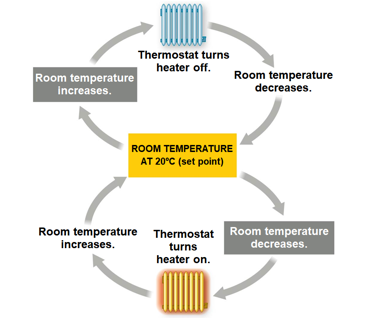
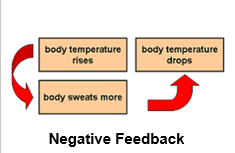
Does homeostasis rely heavily on negative or positive feedback? Why?
Homeostasis in animals relies largely on negative feedback, which helps to return a variable to a normal range.
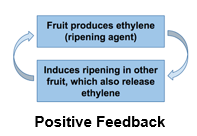
Positive feedback
Amplifies a stimulus and does not usually contribute to homeostasis in animals.
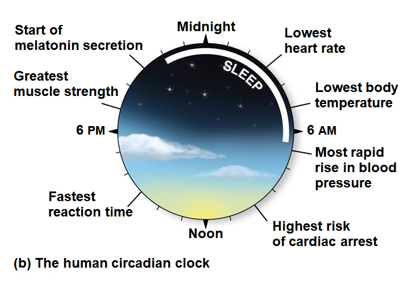
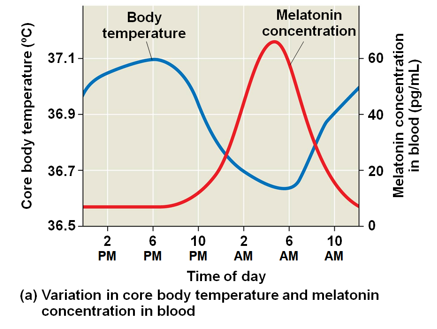
Circadian rhythm
In animals and plants, this governs physiological changes that occur roughly every 24 hours.
Acclimatization
This is where homeostasis can adjust to changes in external environment temporarily.
Set points and normal ranges can change with _______ or show cyclic variation.
age
Thermoregulation
Is the process by which animals maintain an internal temperature in a normal range.
Endothermic vs. Ectothermic
Endothermic: Animals generate heat by metabolism; birds and mammals are endotherms (walruses and humans).
Ectothermic animals gain heat from external sources (fish, amphibians, and non-avian reptiles).
Endotherms can maintain a stable body temperature even with large _______ fluctuations; Ectotherms tolerate greater variation in _______ temperature.
environmental; internal
Answer the following questions regarding variation in body temperature.
An organism that has a body temperature which varies in its environment is called what?
What is the name of an organism whose body temperature is relatively constant?
Are all poikilotherms ectotherms?
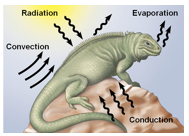
What are the four methods that organisms can exchange heat by?
poikilotherm
homotherm
No
radiation, evaporation, convection, and conduction
Integumentary system
The body's outer layer that consists of your skin, hair, and nails.
List the five adaptations that help animals thermoregulate.
insulation
circulatory adaptations
cooling by evaporative heat loss
behavioral responses
adjusting metabolic heat production
Answer the following questions about insulation.
What two types of animals is insulation a major thermoregulatory adaptation?
What three things on an organism can help reduce heat flow to the environment?
What other two marine animals is insulation also helpful for?
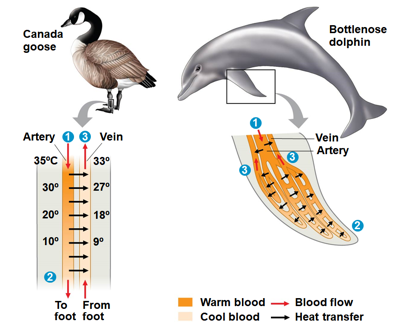
The arrangement of blood vessels in many marine mammals and birds allows for _______ exchange.
What does countercurrent heat exchanges do?
mammals and birds
feathers, fur, and blubber
whales and walruses
countercurrent
transfer heat between fluids flowing in opposite directions and thus reduce heat loss
Answer the following questions about circulatory adaptations below.
What affects thermoregulation significantly?
What can many endotherms and some ectotherms do with their blood flow?
What happens in vasodilation?
What happens in vasoconstriction?
Name three other animals that also use vasoconstriction.
Why do many insects have countercurrent heat exchanges?
regulation of blood flow near the body surface
they can ectotherms can alter the amount of blood flow between the body core and skin
blood flow in the skin increases, facilitating heat loss
blood flow in the skin decreases, lowering heat loss
Sharks, fishes, and insects
to help main high temperature in the thorax
Answer the following questions about cooling by evaporative heat loss.
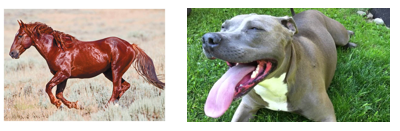
How does water on skin help cool down animals?
How does panting help cool down birds and mammals?
It moistens the skin, helping the animal to cool down
Panting increases the cooling affect
Answer the following questions regarding behavioral responses below.
How do ectotherms and endoderms behave if they want to cool off?
How do ectotherms and ectotherms behave if they want to warm up?
They bathe, move to cooler areas, or change orientation to minimize heat absorption
They may seek warm places when cold and orient themselves towards heat sources
Thermogenesis
Is the adjustment of metabolic heat production to maintain body temperature’ increased by muscle activity.
Non-shivering thermogenesis
Is when hormones cause mitochondria to increase metabolic activity.
Brown fat
Tissue that is specialized for rapid heat production in some animals.
Birds and some non-avian reptiles can also raise body temperature through traditional _______ processes.
shivering
What organisms are brown fat found in? How does the amount of fat vary per animal?
It’s found in mammal infants and hibernating animals; the amount of brown fat varies depending on the temperature of the surrounding environment.
Answer the following questions about acclimatization in thermoregulation below.
Birds and mammals can vary their _______ to acclimatize to seasonal temperature changes.
What in cell membranes change with temperature?
What do some ectotherms produce when temperatures are subzero?
Why do they produce this?
insulation
lipid composition
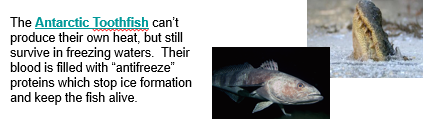
“anit-freeze” compound
to prevent ice conformation in their cells
Answer the following questions about physiological thermostats and fever.
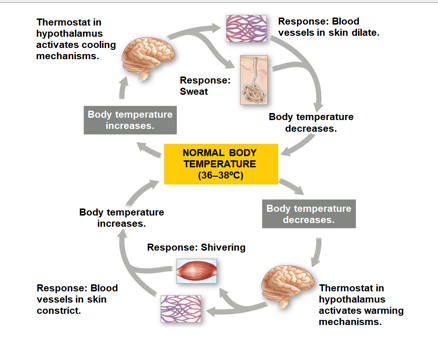
What controls thermoregulation in mammals?
How does fever affect he biological thermostat?
How do some ectothermic organisms increase their body temperature for infections?
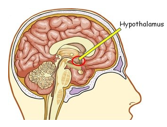
the hypothalamus
Its an infection response, which increases the normal range for the biological thermostat to cope
They seek warmer environments to increase their body temperature in response to certain infections
Bioenergetics vs. Biosynthesis
Bioenergetics: Is the overall flow and transformation of energy in an animal and It determines an animal’s nutritional needs, and it relates to an animal’s size, activity, and environment
Biosynthesis: Includes body growth and repair, synthesizing storage material such as fat, and production of gametes; this occurs after the need of staying alive is met in bioenergetics, such as
Metabolic rate
is the sum of all the energy an animal uses in a unit of time.
List the three things that metabolic rate can be determined by.
An animals heat loss
The amount of animal’s heat loss
Measuring energy content of oxygen consumed or carbon dioxide produced
BMR VS. SMR
Basal metabolic rate (BMR): is metabolic rate of an ectotherm at rest at a “comfortable” temperature.
Standard metabolic rate (SMR): Is the metabolic rate of an ectotherm at rest at a specific temperature.
Ectotherms have much lower metabolic rates than _______ of comparable size.
ectotherms
Answer the following questions regarding size and metabolic rate below.
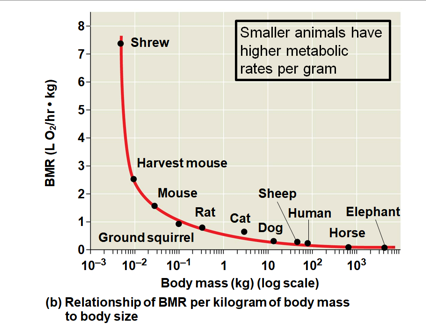
How much is metabolic rate proportional to body mass?
Do smaller or larger animals have higher metabolic rates?
What causes smaller animals to have higher oxygen delivery rate, breathing rate, heart rate, and greater blood volume?
Metabolic rate is proportional to body mass to the power of three-quarters (m^3/4)
Higher
Because they have higher metabolic rates
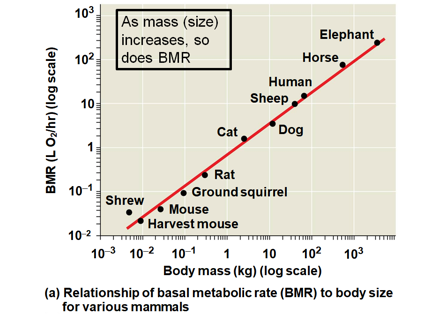
Answer the following questions about activity and metabolic rate below.
_______ greatly affects metabolic rate for both endotherms and ectotherms
What is the relationship between duration of activity and metabolic rate of an animal?
What is the average daily rate of energy consumption for terrestrial animals?
How much of an animal’s budget is devoted to their activity?
Why does this vary?
Activity
inverse
2 to 4 times BMR (endotherms) or SMR (ectotherms)
a fraction of it
it depends on factors such as environment, behavior, size, and thermoregulation
Torpor
State of decreased activity and metabolism.
Hibernation
Long-term torpor that is an adaptation to winter cold and good scarcity.
Answer the following questions regarding torpor and energy conservation.
Torpor enables animals to do what?
Metabolic rates during hibernation can be _______ times lower than normal rates
What does summer torpor or estivation enable animals to do?
Do larger or smaller animals exhibit torpor?
Save energy while avoiding difficult and dangerous conditions
20
To survive long periods of high temperatures and scare water
smaller