SPP 520 COG: Working Memory (copy)
 Call Kai
 Learn
Learn Practice Test
 Spaced Repetition
 Match
Match Flashcards
 Knowt Play
1/28

There's no tags or description
Looks like no tags are added yet.
Name | Mastery | Learn | Test | Matching | Spaced | Call with Kai |
|---|
No analytics yet
Send a link to your students to track their progress
29 Terms
“_____ Memory” and “_____ Memory” refer to:
Short-term memory and working memory
Same cognitive processes
working memory represents an updated view of short term memory
Short Term memory (example)
You’re given a phone number
You didn’t practice or rehearse it so you forget it
Long term memory (example)
Rehearsed
Cannot really damage LTM unless physical brain part is extracted
Declarative and Nondeclarative Memory
Declarative - can declare, aware
Ex. What did I do yesterday? I ate lunch at Monte
Episodic - time, place, person (hippocampus pulls out the memory, medial temporal lobe)
Semantic - facts (amnesia, cortex)
Nondeclarative - not declarative, unconscious
Ex. skills, behavioral conditioning, habituation reflex, priming, procedural
Magic Number 7
george miller
suggested people can remember ~7 items (± 2)
compact info into chunks to retain info
proposed that people engage in internal mental processes in order to convert stimuli into a manageable number of chunks
Chunk
memory unit consisting of strongly associated components
Early research on Short term Capacity: The brown/peterson & peterson technique
material held in memory for less than minute is frequently forgotten
present some items to be remembered; count backwards by 3’s (distractor task); attempt recall
rehearsal
Early research on Short term Capacity: Serial Position Effect
recency effect - last on list
primacy effect - 1st on list
person with amnesia learning new stuff
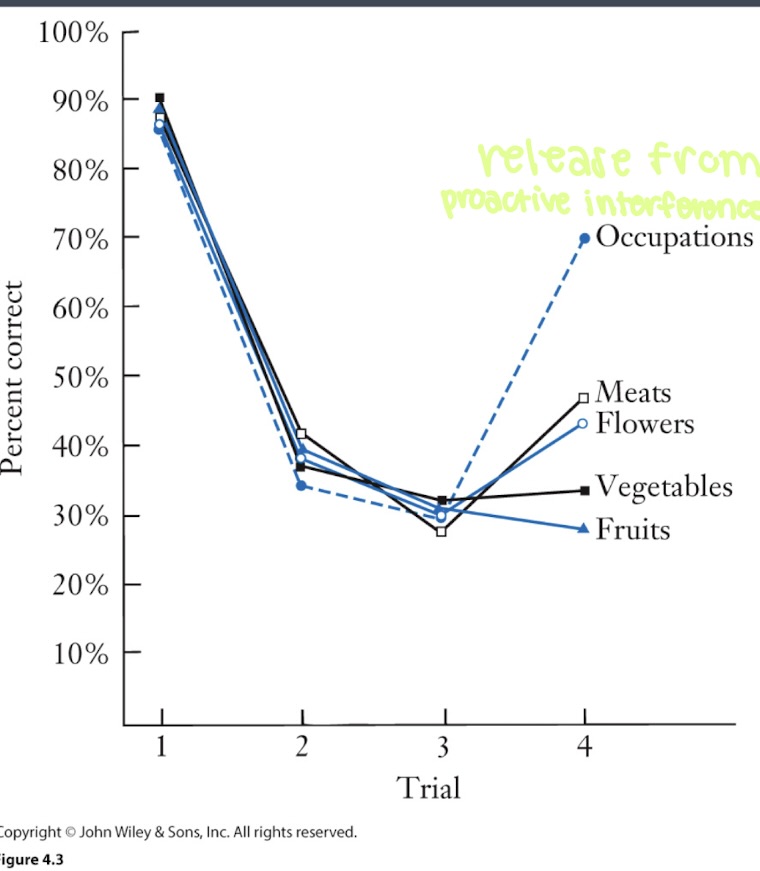
Semantic similarity of the items in short term memory: Wickens and colleagues (1976)
proactive interference (PI)
Ex. Multiple classes with similar info so info interferes when trying to recall
Brown/Peterson & Peterson task varying semantic similarity on tail 4
release from proactive interface
retroactive - new info interfering with old info
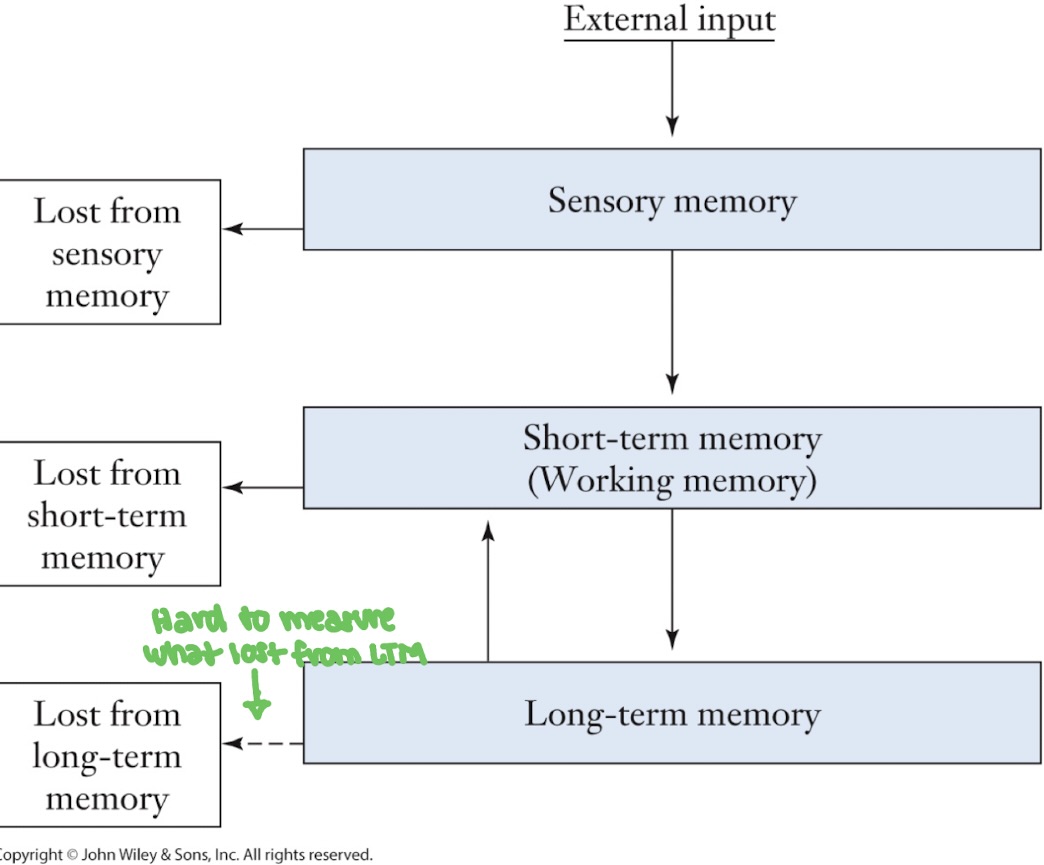
Atkison and Shiffrins model of information processing
a) mental processes are similar to the operations of a computer
b) information progresses through a series of stages, 1 step at a time
Atkinson-Shiffrin model
sensory memory
short-term memory (working)
long term memory
control processes
Diminished Influence
most cognitive psychologists now consider sensory memory to be part of perception rather than memory
researchers question the clear-cut distinction between short-term and long-term memory
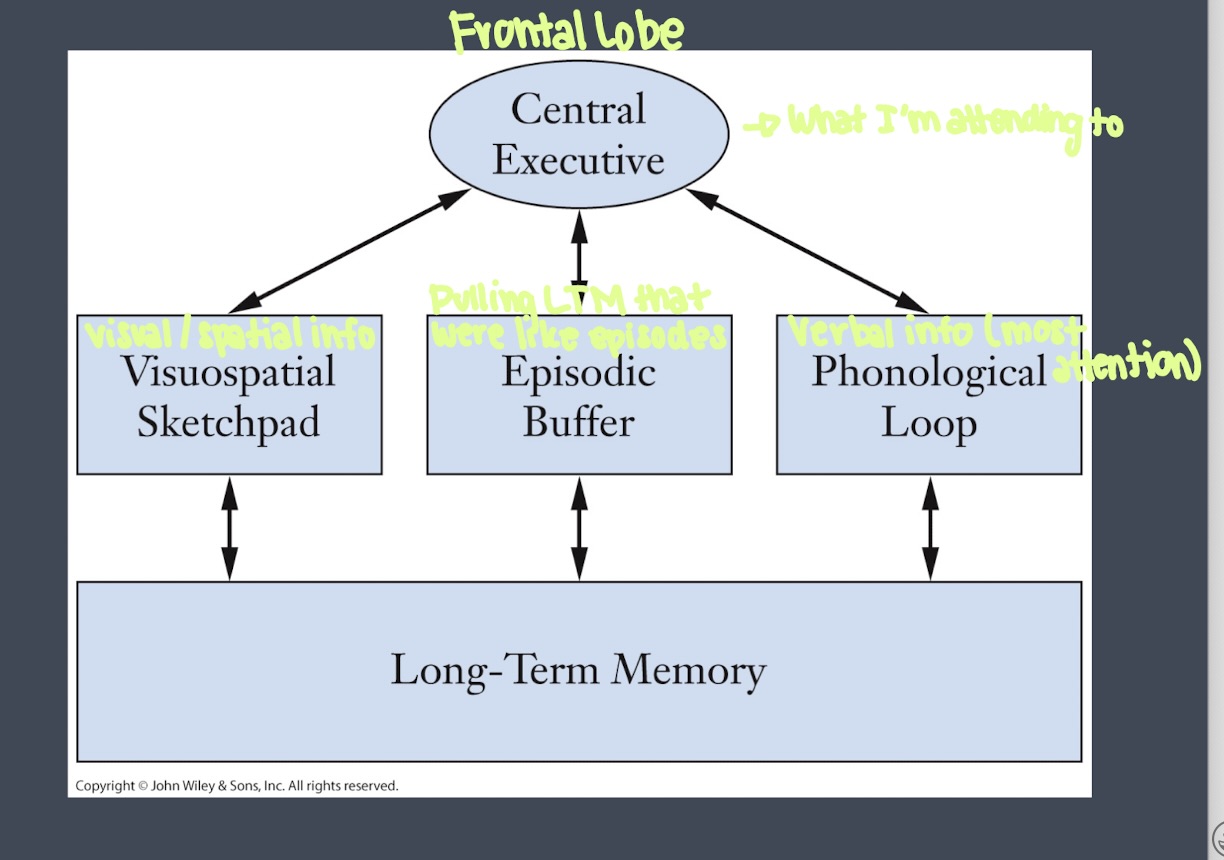
Working memory approach
our immediate memory is a multipart system that temporarily holds and manipulates info while we perform cognitive tasks
central executive
visuospatial sketchpad
episodic buffer
phonological loop
long term memory
Evidence for components with independent capacities
working memory is NOT unitary
baddeley and hitch (1974)
random numbers and spatial reasoning task
people performed remarkably quickly and accurately on both of these 2 simultaneous tasks (bc they were different modalities)
Ex. Same modalities interfere
Viseospatial task + Visuospatial task = interference
Visuospation task + Phonological task = only small interference
phonological loop
processes a limited number of sounds for a short period of time
we tend to turn to this modality more often
Subvocalization
because as humans we tend to think about things in words → it is a go-to method to remember things
Acoustic Confusions
list of letters, presented visually
make fewer errors when letters do not sound similar (this is bc they were processing sounds AND visual input, aka the letters)
brain had to convert visual letters to a sound-based code
examples of how the phonological loop plays a central role in other cognitive processes
this is our main processing unit (as humans)
working memory as the “gateway” to long term memory
using the phonological loop during self-instruction
learning new words in your first language
producing new language
mathematical calculations and problem solving tasks
the loop is also used to articulate things
frontal lobe and left temporal lobe
Visuospatial sketchpad
aka visuospatial working memory, short-term visual memory
processes both visual and spatial info
Allows you to:
store visual appearance and relative position
store visual info encoded from verbal stimuli
limited capacity
cognitive map - hippocampus
certain neurons fire depending on where you’re at in space and the direction you’re going
research on the visuospatial sketchpad
performing 2 visuospatial tasks simultaneously
no standardized set of visual stimuli
tendency to provide names for visual stimuli, thus using phonological loop instead
brandimote et al 1992: say “lalala” while looking at a complex visual stimulus
saying lalala occupies the phonological loop, which prevents you from labeling the visual stimuli with words, so you can actually remember the visual stimuli (bc we automatically think about things in words)
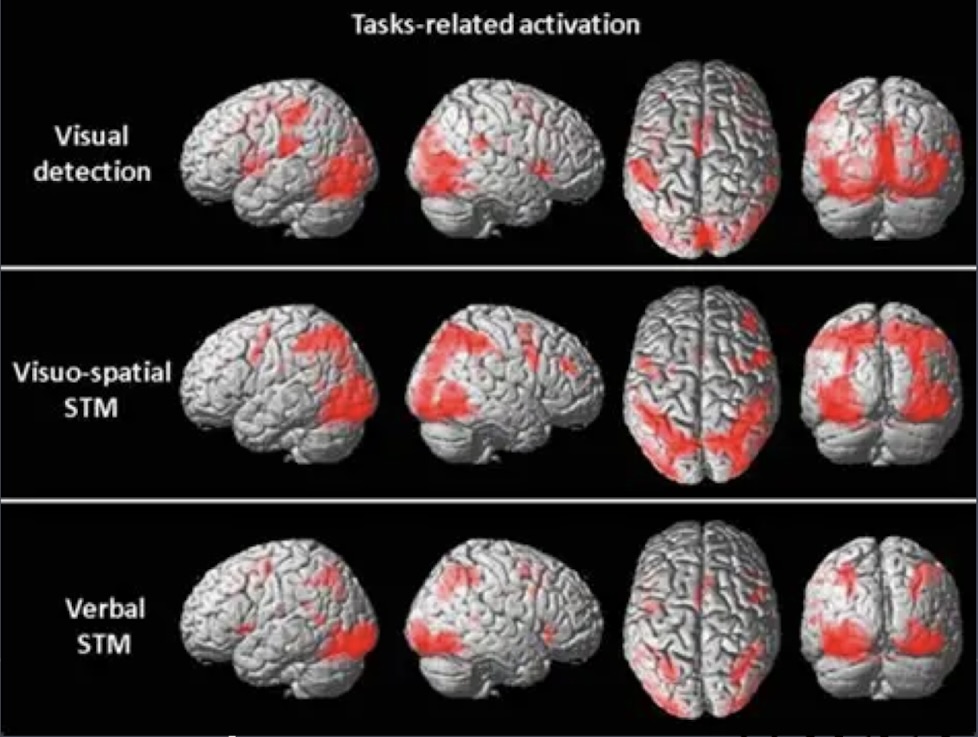
neuroscience research on the visuospatial sketchpad
lot of areas involved:
right hemisphere
occipital lobe
frontal cortex
frontal and parietal lobes
noticeably not the front left cortex
central executive
Strategizer and gear switcher
integrates info from the phonological loop, visuospatial sketchpad, episodic buffer and long term memory
plays role in: focusing attention, selecting strategies, transforming info and coordinating behavior
suppresses irrelevant info
plans/coordinates, does NOT store info
executive supervisor
decides which issues deserve attention
selects a strategy
decides how to tackle the problem
limited ability to perform simultaneous tasks
Neuroscience research: central executive
limited to the frontal region of cortex
recent views of central executive
the executive attention network seems to have a lot in common with the central executive
strong correlation between working memory tasks and tasks used by cognitive neuroscientists to study the prefrontal executive attention network
Episodic Buffer
holding cell for memories
temporary storehouse that can hold and combine info from the phonological loop, visuospatial sketchpad, and LTM
integrates info from different modalities
manipulates info for interpretation
make connections between concepts
limited capacity
temporary memory systems
ex. pulls things to solve problems
Working memory and Academic performance
Varies by individual
can depend on intelligence
scores on working memory tasks are correlated with overall intelligence and grades in school
scores on tests of working memory(especially the phonological loop) are usually corretlated with reading ability
scores on central-executive tasks are correlated with verbal fluency, reading cophresenion, reseoning ability and note taking skills
Ex. Someone who has attentional issues —> different working memory
Ex. Larger working capacity —> buffer distractions
working memory abilities in clinical populations: Major Depression
Christopher and MacDonald (2005)
phonological loop
visuospatial sketchpad
central executive
difficulty concentrating
ruminative style
Many internal and external distractions
the executive worrying so indicative of GAD may very well cause reductions in working memory resources, thus reducing one’s ability to perform other cognitive and perceptual tasks
Ex. Worrying about something (rumination) takes up space in our brain
less space for other info
highlights importance of giving your brain a break
cannot attend as well and hurts performance
People with ADHD often have _____ than others on central-executive tasks
more difficulty
adhd & ASD → lower experience of flow
working memory: anxiety
excessive worrying indicative of GAD may very well cause reductions in working memory resources, thus reducing ability to perform other cognitive and perceptual tasks