NHA CCMA 2nd Practice Test
 Call Kai
 Learn
Learn Practice Test
 Spaced Repetition
 Match
Match Flashcards
 Knowt Play
1/149

There's no tags or description
Looks like no tags are added yet.
Name | Mastery | Learn | Test | Matching | Spaced | Call with Kai |
|---|
No analytics yet
Send a link to your students to track their progress
150 Terms
Which of the following supplies are required for proper handwashing technique?
A. An oil-based lotion
B. Cold water
C. Bar soap
D. Paper towels
D. Paper Towels
Paper towels that are thrown away after each use should be used when handwashing.
When performing venipuncture, which of the following is the correct order of draw?
A. Lavender, green, gray
B. Gray, green, lavender
C. Green, gray, lavender
D. Green, lavender, gray
D. Green, lavender, gray
The proper order of draw for multiple tube collection is the green top tube, followed by the lavender top tube, and then the gray top tube.
Which of the following cell structures provides energy for cells?
A. Nucleus
B. Cytoplasm
C. Lysosomes
D. Mitochondria
D. Mitochondria
Mitochondria are considered the power plant of cells, providing energy to them.
Which of the following does a Snellen chart measure?
A. Visual acuity
B. Hearing acuity
C. Color vision
D. Bone conduction
A. Visual acuity
A Snellen chart measures visual acuity.
Which of the following aseptic techniques can be achieved using dry heat, moist heat, ultraviolet light, gas, chemicals, or ionizing radiation?
A. Sterilization
B. Disinfection
C. Sanitization
D. Hand hygiene
A. Sterilization
Sterilization is an aseptic technique that can be achieved using dry heat, moist heat, ultraviolet light, gas, chemicals, or ionizing radiation.
Which of the following elements is a component of the standard precautions use of personal protective equipment (PPE)?
A. Personal lab jacket
B. Sharps containers
C. Masks
D. Safety needle guard
C. Masks
PPE is one of the five elements of the standard precautions and includes gloves, masks, gowns, and eye protection.
Which of the following is the recommended age for children to receive their first human papillomavirus (HPV) vaccine?
A. At birth
B. 6 to 7 years of age
C. 11 to 12 years of age
D. 15 to 16 years of age
C. 11 to 12 year of age
The first dose of the HPV vaccine is recommended at 11 to 12 years old, with a second dose 1 to 2 months later, and a third dose approximately 16 weeks after the second dose.
A patient informs a medical assistant that they get headaches when they read from a computer monitor. The assistant should enter this information into which of the following locations when using the SOAP approach to organizing medical records?
A. Subjective
B. Objective
C. Assessment
D. Plan
A. Subjective
Subjective data includes patient symptoms, non-measurable data, and patient statements. Therefore, the assistant should document the patient's report of headaches when reading from a computer screen in the subjective section of the record.
A medical assistant is weighing a patient that is 72 kg. Which of the following values is the patient's weight converted to points?
A. 72
B. 158.4
C. 98.2
D. 185.9
B. 158.4
Kilograms are converted to pounds by multiplying the kilogram value by 2.2 (72 kg x 2.2 = 158.4).
When a procedure requires informed consent, which of the following steps should occur prior to the patient signing the form?
A. The medical assistant should explain the procedure to the patient
B. The medical assistant should describe the risks of the procedure to the patient
C. The provider should include information about alternative procedures before informed consent is obtained from the patient
D. The provider should review the patient's insurance coverage for the procedure
C. The provider should include information about alternative procedures before informed consent is obtained from the patient
When a medical assistant is performing a venipuncture procedure, which of the following is a preanalytical error that can affect the test results?
A. Identification of the patient
B. Adjusting the order of draw
C. Reading the requisition order
D. Applying the tourniquet 3 inches above the elbow
B. Adjusting the order of draw
Adjusting the order of draw may cause a preanalytical error and affect the test results.
Overwhelming experiences often cause which of the following conditions?
A. Attention-Deficit/Hyperactivity Disorder (ADHD)
B. Posttraumatic stress disorder (PTSD)
C. Bipolar Disorder
D. Oppositional defiant disorder
B. Posttraumatic stress disorder (PTSD)
Traumatic experiences often cause PTSD.
Which of the following classes of fire extinguisher should be used on flammable liquids?
A. Class A
B. Class B
C. Class C
D. Class D
B. Class B
Class B extinguishers contain carbon dioxide and can be used on flammable liquids, such as grease.
The abbreviation PRN stands for which of the following?
A. Twice per day
B. Nothing by mouth
C. As needed
D. Before eating
C. As needed
The abbreviation PRN, which is short for the Latin phrase pro re nata, stands for as needed.
A medical assistant is scheduling a procedure at a local facility for a patient. Which of the following steps should the assistant take first?
A. Review preadmission instructions with the patient
B. Send the patient's medical records to the facility
C. Call and schedule the procedure
D. Verify insurance will cover the procedure
D. Verify insurance will cover the procedure
A medical assistant is talking with a patient who sustained a foot fracture in a fall. They report managing most tasks at home well, but they have difficulty navigating with their crutches and are currently homebound. To which of the following resources should the assistant refer the patient?
A. Hospice services
B. Legal Aid Society
C. Meals on Wheels
D. American Red Cross
C. Meals on Wheels
Meals on Wheels is a program designed to support homebound patients by delivering meals daily. This is an appropriate resource for the assistant to recommend to this patient due to their homebound status.
A medical assistant is performing a scratch allergy test on a patient's back. Which of the following distances describes the correct spacing for the small amounts of allergen scratched onto the skin?
A. 1 to 1.5 inches
B. 1.5 to 2 inches
C. 2.5 to 3 inches
D. 3.5 to 4 inches
B. 1.5 to 2 inches
Which of the following is the correct placement for lead V4?
A. Fourth intercostal space at the left of the sternum
B. Fifth intercostal space at the midclavicular line
C. Fifth intercostal space at the midaxillary line
D. Fourth intercostal space at the right of the sternum
B. Fifth intercostal space at the midclavicular line
A medical assistant is reviewing the medical history of a patient who regularly comes into contact with coal and wood dust. The assistant should recognize that this patient is at an increased risk for developing which of the following disorders?
A. Obstructive sleep apnea
B. Emphysema
C. Mesothelioma
D. Carcinoma of the larynx
B. Emphysema
Contact with coal and wood dust, which causes damage to the alveoli in the lungs, can cause emphysema.
A medical assistant is preparing the exam room for a patient's general physical examination. Which of the following instruments should be available to the provider for the examination?
A. Forceps
B. Otoscope
C. Curette
D. Endoscope
B. Otoscope
The provider uses an otoscope to examine the tympanic membrane and the external auditory canal. This instrument should be available for a general physical examination.
A medical assistant is performing an EKG on a patient. Which of the following describes the appropriate placement of the electrodes?
A. Tabs downward on the arms
B. Tabs downward on the knee
C. Tabs upward on the chest
D. Tabs downward on the lower leg
A. Tabs downward on the arms
The assistant should place the tabs downward to reduce tension and pulling on the electrodes.
A medical assistant is providing instructions to a patient who is hard of hearing. Which of the following positions should the assistant choose when speaking to the patient?
A. Face the patient when speaking
B. Turn away from the patient
C. Speak very low when talking to the patient
D. Face the patient, speaking toward their bad ear.
A. Face the patient when speaking
Which of the following techniques should a medical assistant use when bandaging a wound with a roller bandage?
A. Wrap the wound from distal to proximal
B. Bandage fingers and toes to prevent further injury
C. Extend the wound dressing 3 to 5 inches beyond the bandage
D. Moisten and apply ointment before bandaging
A. Wrap the wound from distal to proximal
Which of the following can result from the use of outdated or incorrect codes on a billing claim?
A. Delay of laboratory results
B. Reduction of payer reimbursement
C. Incomplete discharge summary
D. Misfiled progress notes
B. Reduction of payer reimbursement
A patient's insurance company calls the office to obtain additional information regarding a recently submitted claim. Which of the following regulations allows the office to release this information to an insurance company without a written authorization?
A. The HIPAA Privacy Rule
B. The HIPAA Security Rule
C. The Good Samaritan Act
D. The Health Information Technology for Economic and Clinical Health Act
A. The HIPAA Privacy Rule
When performing surgical asepsis, which of the following steps should a medical assistant take to prevent contamination of the sterile field?
A. Place all sterile items in the center of the sterile field
B. Reach across the sterile field to pick up a specimen container
C. Hold all sterile items below waist level
D. Place all soiled dressings on the corner of the sterile field
A. Place all sterile items in the center of the sterile field
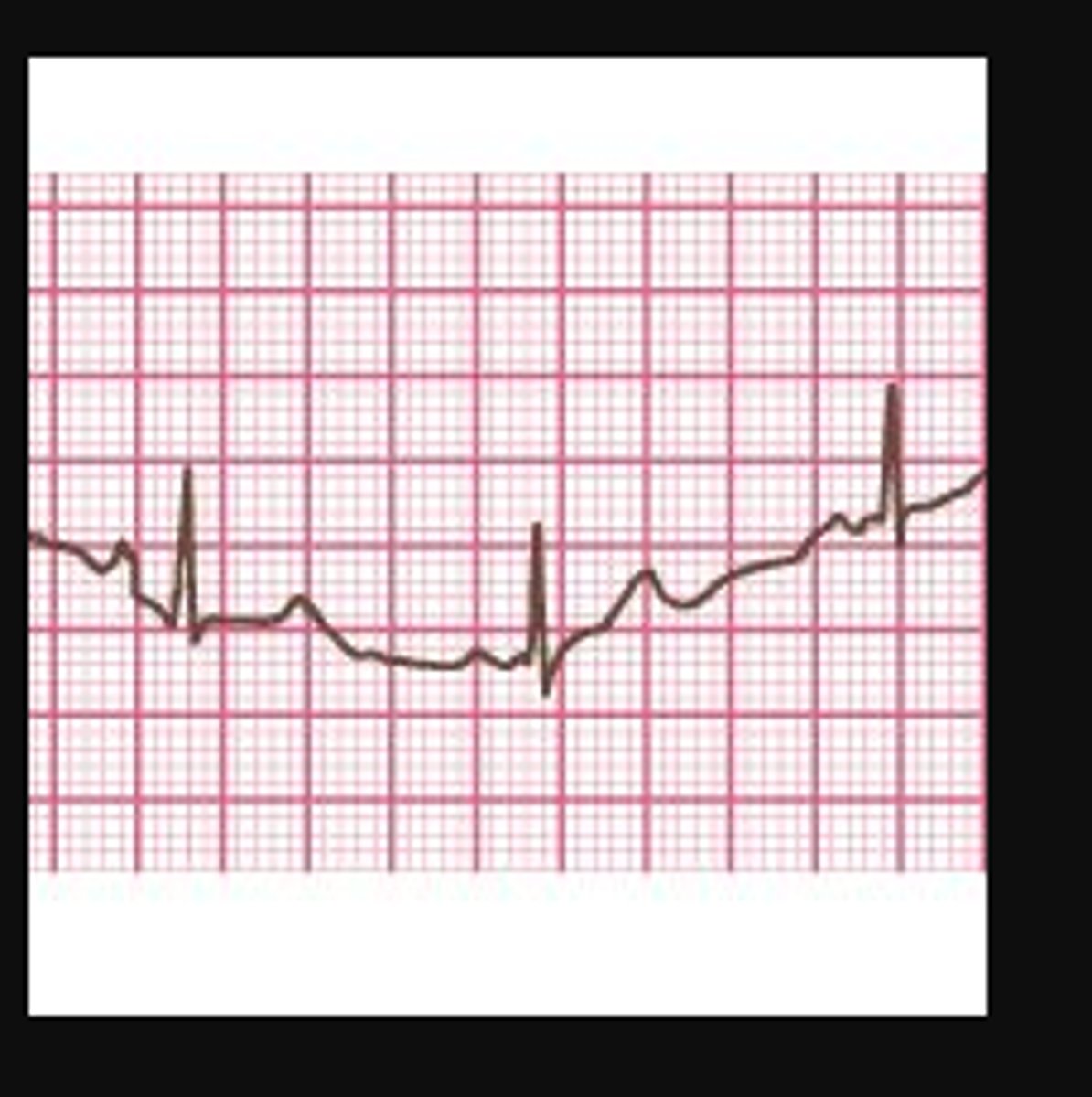
Which of the following types of artifacts does the tracing above contain?
A. Wandering baseline
B. Somatic tremor
C. Alternating current (AC) interference
D. Interrupted baseline
A. Wandering baseline
A wandering baseline occurs when the stylus moves from the center of an EKG. This can be the result of too much lotion or sweat on the skin or an inadequate attachment to the skin, among other reasons.
Which of the following do team members take into consideration within a patient-centered medical home (PCMH)?
A. Administering gynecologic and prenatal labor and birth care
B. Providing a network of contracted providers
C. Respecting a patient's culture with their health care needs
D. Allowing the inclusion of preexisting condition coverage
C. Respecting a patient's culture with their health care needs
A medical assistant is preparing to perform a capillary collection from a patient who has poor circulation in their hands. Which of the following techniques should the assistant use to increase circulation at the collection site?
A. Hold the patient's hand above their heart.
B. Squeeze the patient's finger.
C. Warm the patient's hand.
D. Apply a tourniquet above the patient's wrist.
C. Warm the patient's hand.
Warming the hand can help increase circulation and bring capillaries to the surface of the hand.
Which of the following is the appropriate instrument for removing stitches?
A. A probe
B. Suture scissors
C. A retractor
D. A dilator
B. Suture Scissors
A medical assistant has a provider order to draw blood for a lead level on an 18-month-old toddler. Which of the following sites should the assistant choose for the venipuncture?
A. Deep brachial veins
B. Superficial dorsal hand veins
C. Scalp vein
D. Femoral vein
B. Superficial dorsal hand veins
A medical assistant is speaking with a patient about their social history and the assistant notices the patient is fidgeting and appears anxious. Which of the following nonverbal communication styles is the patient exhibiting?
A. Passive-aggressive communication
B. Assertive communication
C. Passive communication
D. Manipulative communication
C. Passive communication
Which of the following is a root word?
A. Anti
B. Col
C. Hyper
D. Poly
B. Col
Col is a common root word meaning large intestine/colon.
Which of the following diagnostic statements is appropriate in the outpatient setting?
A. Fever of unknown origin
B. Suspected strep throat
C. Knee pain and arthritis
D. Probably urinary tract infection
A. Fever of unknown origin
Coding signs and symptoms are acceptable when a definitive diagnosis has not been determined.
Which of the following aseptic techniques involves using sound waves to vibrate and cleanse surgical instruments?
A. Sterilization
B. Chemical disinfection
C. Ultrasonic sanitization
D. Autoclave
C. Ultrasonic sanitization
A medical assistant calls a patient from the waiting area to obtain a specimen. Which of the following actions should the assistant do first?
A. Identify the patient
B. Proceed with obtaining the specimen
C. Educate the patient about correct specimen collection technique
D. Provide the patient with the lab requisition form
A. Identify the patient
The assistant should identify the patient by verifying their full name and date of birth before obtaining the specimen.
Which of the following is a positive nonverbal behavior?
A. Turning your back towards the other person
B. Leaning away from the other person
C. Displaying stiff posture towards the other person
D. Leaning towards the other person
D. Leaning towards the other person
A medical assistant is working with a patient who has cognitive impairment that causes them to display short-term memory loss. In which of the following ways should the assistant adapt to this barrier?
A. Have the patient perform a return demonstration
B. Provide easy-to-read handouts
C. Distribute analgesics as prescribed by the provider
D. Offer adaptive equipment for home use
B. Provide easy-to-read handouts
Which of the following types of advance directives provide information about the person that a patient delegated to make health care decisions on their behalf if they are unable to do so?
A. Living will
B. Organ donation
C. Do not resuscitate (DNR)
D. Health care proxy
D. Health care proxy
A medical assistant must provide which of the following community resources to a patient who states their partner bent their arm backwards until it broke?
A. Women, Infant, and Children (WIC)
B. Domestic violence shelter
C. Hospice agency
D. Grief support group
B. Domestic violence shelter
Domestic violence shelters provide temporary living arrangements for people dealing with domestic abuse.
A patient's ability to walk, groom themselves, bathe, and eat is evaluated by which of the following screenings?
A. Depression screening
B. Functional status screening
C. Substance use screening
D. Elderly safety screening
B. Functional status screening
A medical assistant fails to document a patient's preference for not using any blood products during their procedure. This error falls under which of the following legal principles?
A. Breach of contract
B. Implied consent
C. Negligent torts
D. Intentional torts
C. Negligent torts
Negligent torts are unintentional and the person's failure causes harm to the patient.
A medical assistant is replacing a sharps disposal container in an examination room and receives a small laceration on their arm from a plastic lid. Which of the following types of documentation should the assistant complete as a result of this incident?
A. Advance Beneficiary Notice (ABN)
B. Incident report
C. 837P/CMS-1500 claim form
D. Quality control log
B. Incident report
An incident report is a form used to document details about a work-related injury or illness.
When performing routine follow-up calls to patients, which of the following actions should a medical assistant take first to notify the provider if the patient provides an unsatisfactory progress report?
A. Notify the provider immediately
B. Notify the provider on the next business day
C. Add a note to the patient's appointment file
D. Document the phone call
A. Notify the provider immediately
Which of the following formulas is used to convert a patient's weight from kilograms to pounds?
A. Multiply the number of kilograms by 2.2
B. Divide the number of kilograms by 2.2
C. Multiply the number of kilograms by 1.2
D. Divide the number of kilograms by 1.2
A. Multiply the number of kilograms by 2.2
Which of the following statements describes the doctrine of professional discretion?
A. A patient can read their own chart without completing a release of information form.
B. A medical office may turn over unpaid bills to a collection agency only after obtaining written permission from the patient.
C. Law enforcement can request protected health information only after the patient has signed a release of information form.
D. When a patient requests a copy of their medical records, the provider may choose not to disclose all of the patient information.
D. When a patient requests a copy of their medical records, the provider may choose not to disclose all of the patient information.
The provider may use their professional judgement when giving a patient information about mental or emotional conditions if they believe the information may harm the patient.
A medical assistant is helping a provider who is caring for a patient with a laceration. Which of the following should the assistant recognize is the first step of first aid administration in this situation?
A. Ensure bleeding of the laceration is under control.
B. Suture the laceration.
C. Pour saline on the laceration.
D. Apply a bandage on the laceration.
A. Ensure bleeding of the laceration is under control.
The assistant should recognize that the first step of first aid involves stopping the bleeding by applying pressure to control the bleeding, and then elevating the affected body part if necessary.
A medical assistant is collecting a forensic specimen at the request of an employer. Which of the following people should sign the documentation for the specimen, according to the chain of custody protocol?
A. The patient who gives the specimen
B. The employer who requested the specimen
C. All personnel that come in contact with the specimen
D. The front office staff who checked in the patient
C. All personnel that come in contact with the specimen
According to the chain of custody protocol, all personnel that come in contact with the forensic specimen should sign the documentation.
In which of the following positions should a medical assistant place an 18-month-old patient when administering ear drops to the right ear?
A. Right ear facing down with the earlobe pulled down and back
B. Right ear facing up with the pinna pulled up and back
C. Right ear facing up with the earlobe pulled down and back
D. Right ear facing down with the pinna pulled up and back
C. Right ear facing up with the earlobe pulled down and back
When administering ear drops to a child under the age of 3 years, the patient should be positioned with the ear facing up and the earlobe pulled down and back to allow medication to flow into the canal and reach the affected area.
Which of the following sections of the clinical medical record includes a collection of the patient's subjective data obtains by a medical assistant during the clinical intake process?
A. Health history
B. Vital signs
C. Anthropometric measurements
D. Radiology reports
A. Health history
The health history section includes a collection of subjective data obtained by a medical assistant during the clinical intake process.
Which of the following is a medical assistant required to document in the electronic health record (EHR) when administering immunizations to a patient?
A. Lot number
B. Immunization purchase date
C. Patient's home address
D. Cost of immunization
A. Lot number
The assistant is required to document the names and lot numbers of the immunizations, and the name of the ordering provider in the EHR.
In which of the following positions should a medical assistant place a patient when preparing to perform a 12-lead EKG in the office?
A. Supine
B. Prone
C. Lithotomy
D. Lateral semi-prone recumbent position
A. Supine
Which of the following fasting blood sugar laboratory results should the medical assistant recognize as abnormal?
A. 70 to 99 mg/dL for a nondiabetic
B. Greater than 126 mg/dL for a diabetic
C. 101 mg/dL for a nondiabetic
D. 100 to 125 mg/dL for a prediabetic
C. 101 mg/dL for a nondiabetic
The assistant should recognize that a fasting blood sugar laboratory result from 70 to 99 mg/dL for a nondiabetic is considered normal, thus a fasting blood sugar laboratory result of 101 mg/dL is considered abnormal.
A medical assistant is processing blood samples obtained for a DNA analysis and paternity testing. Which of the following information must they include on the document in order to maintain chain of custody?
A. Initials of the patient and their DOB
B. Ordering provider's initials
C. Initials of the person transporting the specimen
D. Office manager's initials
C. Initials of the person transporting the specimen
A medical assistant is aiding a provider with a colposcopy procedure. In which of the following positions should the assistant place the patient?
A. Supine position
B. Dorsal recumbent position
C. Lithotomy position
D. Lateral semi-prone recubment position
C. Lithotomy position
A lithotomy position involves the patient lying on their back with knees bent and arms down at the sides. This is the position used for colposcopy procedures.
A medical assistant is preparing hemostats for sterilization after an invasive procedure. Which of the following techniques should the assistant use?
A. Autoclave
B. Gas
C. Dry heat
D. Chemical
A. Autoclave
The assistant should use an autoclave to sterilize the hemostats. Instruments that penetrate skin or tissue should be sterilized by an autoclave, which uses wet heat and is effective against spores.
A medical assistant is preparing an 837P/CMS-1500 claim form for a patient treated for a burn injury. Which of the following information is required?
A. Physical address where the injury occurred
B. Patient's health savings account number
C. Current procedural terminology code
D. Patient's preexisting conditions
C. Current procedural terminology code
A medical assistant is administering an intradermal injection for allergy testing. Which of the following actions should the assistant take?
A. Locate the middle portion of the anterior forearm.
B. Pinch the skin between the thumb and forefinger.
C. Insert the needle with the bevel pointed down.
D. Inject the solution rapidly with the needle positioned at a 30° angle to the skin.
A. Locate the middle portion of the anterior forearm.
The assistant should locate the middle portion of the patient's forearm for the intradermal injection. The assistant should avoid discolored, pigmented, or scarred areas of skin.
Which of the following is the normal setting for the standardization mark on an EKG?
A. 5 mm/mV
B. 10 mm/mV
C. 20 mm/mV
D. 25 mm/mV
B. 10 mm/mV
A medical assistant is sorting mail and is not sure where a particular piece of mail should go. Which of the following steps should the assistant take?
A. Ask the office manager or provider how to distribute the item.
B. Open the item and review it to determine who should receive it.
C. Return the item to the mail carrier.
D. Dispose of the item in the office trash.
A. Ask the office manager or provider how to distribute the item.
If the medical assistant is unsure how to handle a piece of mail, the best course of action is to ask the manager or provider what to do with the item.
Which of the following is used to collect the specimen during a Pap test?
A. Cervical spatula
B. Vaginal speculum
C. Uterine dilator
D. Uterine sound(s)
A. Cervical spatula
A cervical spatula is an instrument used to collect a specimen during a Pap test.
A medical assistant is collecting data from a patient who is experiencing heatstroke. Which of the following manifestations should the assistant expect to find?
A. Hot skin
B. Bradycardia
C. Hypothermia
D. Slow breathing
A. Hot skin
The assistant should expect a patient who is experiencing heatstroke to have flushed, hot, and dry skin.
A medical assistant has a blood pressure cuff inflated and partially opens the valve to deflate as they listen with a stethoscope. When should they read the diastolic pressure?
A. When the sound disappears
B. When repetitive sounds begin
C. When the sounds change from strong to muffled
D. When the sounds change from swishing to sharp
A. When the sound disappears
The assistant should measure the patient's diastolic pressure when the sound disappears, also known as the Korotkoff V sound.
A medical assistant is using a butterfly needle set to obtain a blood sample from a vein in a patient's hand. Which of the following actions should the assistant take?
A. Hold the needle by its wings.
B. Insert the needle into the skin at a 45° angle.
C. Release the tourniquet after 2 min.
D. Activate the safety device before removing the needle.
A. Hold the needle by its wings.
Which of the following conditions requires a patient to avoid gluten?
A. Pyloric stenosis
B. Peptic ulcers
C. Celiac disease
D. Appendicitis
C. Celiac disease
Celiac disease is a digestive and immune disorder that does require gluten restrictions.
A medical assistant is preparing a patient for a flexible sigmoidoscopy examination. In which of the following positions should the assistant place the patient?
A. Prone position
B. Fowler's position
C. Lithotomy position
D. Left lateral position
D. Left lateral position
In left lateral position, the patient lies on their left side with their right leg sharply flexed. This position is used for rectal examinations.
Which of the following actions should a medical assistant take when dealing with an angry patient?
A. Match the patient's energy.
B. Stand closer to the patient so that they will lower their voice.
C. Allow the patient to talk through their anger.
D. Tell the patient the provider will not see them if they continue to act out their anger.
C. Allow the patient to talk through their anger.
The assistant should demonstrate empathy by using active listening skills.
Prior to running an EKG tracing, which of the following is the final step a medical assistant should take to ensure the tracing will be clear with a horizontal baseline?
A. Remove artifacts
B. Enter patient information into the EKG machine
C. Cover the patient with a blanket
D. Double-check the electrodes' attachment
D. Double-check the electrodes' attachment
Double-checking the electrodes' attachment and placement is the final step an assistant should take to ensure the tracing will be clear with a horizontal baseline.
Which of the following is considered an adverse reaction?
A. Nausea
B. Vomiting
C. Diarrhea
D. Anaphylaxis
D. Anaphylaxis
Anaphylaxis is an adverse reaction due to extreme sensitivity to a specific drug.
During which of the following activities is it necessary for a medical assistant to use personal protective equipment (PPE)?
A. Performing an EKG
B. Assisting a patient with gowning
C. Performing vital signs
D. Administering injections
D. Administering injections
A medical assistant is collecting a health history from a patient who exhibits moderate hearing loss. Which of the following actions should the assistant take?
A. The assistant should keep their hands still to avoid distracting the patient.
B. The assistant should speak in a raised pitch when clarifying information.
C. The assistant should use longer sentences to keep the patient's attention.
D. The assistant should face the patient and speak clearly.
D. The assistant should face the patient and speak clearly.
By facing the patient and speaking clearly, the assistant is promoting successful communication techniques with a patient who is exhibiting moderate hearing loss.
Which of the following methods aids in gathering additional details from the patient regarding their chief complaint?
A. Asking open-ended questions
B. Using visual diagrams
C. Asking closed-ended questions
D. Using an audio tool
A. Asking open-ended questions
Open-ended questions aid in gathering more details from a patient regarding their chief complaint.
Which of the following is a safeguard for all health care employees and patients who may be at risk of exposure to potentially infectious materials?
A. Afforable Care Act (ACA)
B. Standard precautions
C. Patient's Bill of Rights
D. Health Insurance Portability and Accountability Act (HIPAA)
B. Standard precautions
Standard precautions are a safeguard for all health care employees and patients who may be at risk of exposure to potentially infectious materials.
Which of the following cell structures is instrumental in helping the body mobilize and secrete mucus from the respiratory tract?
A. Centrioles
B. Ribosomes
C. Cilia
D. Mitochondria
C. Cilia
Cilia are hairlike projections found in the lungs that are capable of movement and are instrumental in helping mobilize and secrete mucus from the respiratory tract.
Which of the following tasks should a medical assistant have a patient complete prior to gowning for a physical examination to ensure that the patient is more comfortable and to make the examination easier for the provider?
A. Finish reading educational materials
B. Listen to soothing music while waiting
C. Drink a full glass of water
D. Have the patient empty their bladder
D. Have the patient empty their bladder
If a medical assistant experiences an exposure to an infectious disease via a human bite, which of the following steps should they take first?
A. Report the exposure incident to the supervisor within 48 to 72 hr.
B. Utilize an alcohol-based hand sanitizer to cleanse the exposed area.
C. Immediately flush the exposed area following the exposure.
D. Write an incident report to be included in the employee's personal file.
C. Immediately flush the exposed area following the exposure.
A medical assistant needs to draw a blood glucose level on a patient. Which of the following tubes should they use?
A. Lavender top tube
B. Red top tube
C. Light blue top tube
D. Gray top tube
D. Gray top tube
Which of the following can prevent a patient from comprehending an informed consent?
A. Active listening
B. Cultural competence
C. Acceptance
D. Language barrier
D. Language barrier
Language barriers can prevent a patient from comprehending an informed consent. A medical practice must ensure they have a medically-trained interpreter.
Which of the following is a component of medical terminology used to ensure the ease of pronunciation?
A. Combining vowel
B. Prefix
C. Suffix
D. Word root
A. Combining vowel
Which of the following instructions should a medical assistant give a patient when administering an enteric-coated tablet?
A. "Swallow the tablet whole with a glass of water."
B. "Chew the tablet thoroughly before swallowing."
C. "Dissolve the tablet in a glass of water before drinking."
D. "Crush the tablet and mix it with applesauce."
A. "Swallow the tablet whole with a glass of water."
Enteric-coated tablets should not be crushed, chewed, or dissolved. The tablets need to arrive in the small intestine whole.
Which of the following dictates the operations of physician office clinical laboratories?
A. American Medical Technologists (AMT)
B. National Institutes of Health (NIH)
C. Occupational Safety and Health Administration (OSHA)
D. Centers for Medicare and Medicaid Services (CMS)
D. Centers for Medicare and Medicaid Services (CMS)
The CMS regulates laboratory testing through the Clinical Laboratory Improvement Amendments.
In addition to receiving a paper copy of their prescription, a patient has requested that the prescription be called in to their pharmacy. After calling the pharmacy, which of the following actions should the medical assistant take to complete this request?
A. Provide the patient with an unaltered copy of the prescription.
B. Provide the patient with a copy of the prescription with "Copy only" written on it.
C. Provide the patient with a copy of the prescription that reads "Dispense as written."
D. Inform the patient that a copy of the prescription cannot legally be made.
B. Provide the patient with a copy of the prescription with "Copy only" written on it.
In which of the following quadrants is the gallbladder located?
A. Left upper quadrant
B. Right lower quadrant
C. Left lower quadrant
D. Right upper quadrant
D. Right upper quadrant
Which of the following should the medical assistant verify with the patient prior to the patient receiving. a prescription for their acute ear infection?
A. The last time the patient had a prescription filled
B. Medication allergies
C. Other chronic medical conditions
D. The patient's insurance company
B. Medication allergies
Checking the patient's allergies is vital to writing any prescriptions for a patient.
When obtaining a blood pressure reading, which of the following describes how high a medical assistant should inflate the cuff?
A. To at least 200 mmHg to obtain an accurate systolic reading
B. To approximately 30 mmHg above the previously measured radial pulse reading
C. To approximately 60 mmHg above the previously measured brachial pulse reading
D. To no more than 190 mmHg to get an accurate systolic pressure
B. To approximately 30 mmHg above the previously measured radial pulse reading
The assistant should inflate the blood pressure cuff as they palpate the radial pulse. When they can no longer feel the patient's pulse, the assistant should add 30 mmHg to that number. This is the number to which the assistant should inflate the cuff
As the body processes medications, which of the following terms best represents absorption, distribution, metabolism, and excretion?
A. Pharmacodynamics
B. Pharmacokinetics
C. Pharmacotherapeutics
D. Toxicology
B. Pharmacokinetics
Pharmacokinetics is the study of how the body absorbs, distributes, metabolizes, and excretes drugs
A medical assistant is examining a patient who has a third-degree burn on their hands. Which of the following is a first aid procedure the medical assistant can perform?
A. Remove burned clothing stuck to the patient's skin
B. Lower the patient's hands below their waist
C. Separate the patient's burned fingers
D. Have the patient increase their breathing
C. Separate the patient's burned fingers
For a third-degree burn, the medical assistant should cover the affected skin with sterile dressings and separate the patient's fingers with a dry and sterile dressing
Which of the following examples of patient coaching addresses disease prevention?
A. Explaining how to correctly take prescribed medication
B. Supplying a patient with information about self-exams
C. Showing an instructional video based on the patient's treatment plan
D. Providing information on the importance of recommended vaccines
D. Providing information on the importance of recommended vaccines
Recommended vaccines are in important part of disease prevention
When taking a patient's blood pressure, which of the following is the highest pressure level that occurs, as indicated by the first sound heard?
A. Diastolic pressure
B. Pulse pressure
C. Blood volume
D. Systolic pressure
D. Systolic pressure
Systolic pressure is the highest pressure level, and the first sound heard
When a medical assistant is performing a patient interview, ti is important they understand the patient's message so that they can relay it accurately to the provider. Which of the following techniques is the assistant using when they state, "I hear that you are saying..."
A. Clarification
B. Paraphrasing
C. Reflection
D. Summarizing
B. Paraphrasing
Paraphrasing is when the assistant tells the patient what they think the patient is saying
When assisting a patient from a different culture, which of the following should the medical assistant do to help the patient feel more comfortable in the medical office setting?
A. Try to understand their beliefs about disease
B. Tell the patient, "Your English is very good."
C. Speak very slowly and use medical terms
D. Tell the patient, "Your home remedies will not help as much as the medication that the doctor prescribes."
A. Try to understand their beliefs about disease
The assistant can help a patient from a different culture feel more comfortable in the medical office setting by trying to understand their beliefs about disease processes.
A medical assistant is billing a patient's third-party payer for today's office visit. Which of the following documents does those require?
A. An explanation of benefits (EOB)
B. A release of information form
C. An 837P/CMS-1500 claim form
D. Notice of privacy practices (NPP)
C. An 837P/CMS-1500 claim form
Billing a third-party payer requires a completed 837P/CMS-1500
A medical assistant is using an alcohol-based hand sanitizer after patient contact. the hand sanitizer should contain at least what percentage of alcohol?
A. 30%
B. 50%
C. 60%
D. 40%
C. 60%
An alcohol-based hand sanitizer should have at least 60% alcohol to effectively prevent cross-contamination among patients and staff
Which of the following pulmonary function tests involves measuring the oxygen saturation of a patient's blood by placing a probe on their finger?
A. Pulse oximetry
B. Peak-flow monitor
C. Spirometry test
D. Lung volume test
A. Pulse oximetry
Pulse oximetry is a noninvasive procedure for measuring the oxygen saturation of a patient's blood by placing a probe on their finger
Which of the following stages described by the Kübler-Ross grieving process indicates that a patient may attempt to give something up to gain more time?
A. The denial stage
B. The anger stage
C. The acceptance stage
D. The bargaining stage
D. The bargaining stage
In the bargaining stage, the patient may attempt to bargain with the provider or a higher power regarding lifestyle changes they will make in the hopes of gaining more time
A medical assistant has orders to collect blood cultures, a CBC, and prothrombin time (PT), and an iron panel. They forget to draw for the PT. Which of the following actions should the assistant take?
A. Discard the collected specimens and redraw all of them
B. Keep the specimens previously collected and draw the PT
C. Call another assistant and notify the supervisor of the situation
D. Draw a discard tube, then redraw the blood cultures and a blue top tube
B. Keep the specimens previously collected and draw the PT
The other specimens are acceptable for testing. The assistant needs to draw the PT
A pulse oximeter can register an artificially low oxygen saturation measurement for a patient with which of the following conditions?
A. Cold fingers
B. Hyperventilation syndrome
C. Carbon monoxide poisoning
D. Anemia
A. Cold fingers
Cold fingers indicate low perfusion and might result in an artificially low pulse oximetry reading
A medical assistant is preparing to administer buccal medication to a patient. The assistant should instruct the patient to place. themedication in which of the following places?
A. On the patient's skin
B. Under the patient's tongue
C. Between the cheek and gums
D. Sprayed into the patient's nose
C. Between the cheek and gums
Placing medication between the cheek and gums is the buccal route of medication administration
According to the stages of hypertension, which of the following blood pressure readings is considered to be in the elevated stage?
A. 116/74 mmHg
B. 128/78 mmHg
C. 182/124 mmHg
D. 140/90 mmHg
B. 128/78 mmHg
A systolic pressure between 120 and 129 mmHg and a diastolic pressure less than 80 mmHg in an adult patient is classified as elevated
A patient has been diagnosed with a communicable disease. Which of the following is true regarding the reporting of the disease?
A. The disease is reported directly to the Centers for Disease Control
B. The disease is reported directly to the specific state's public health department
C. The disease is reported directly to the Centers for Medicare and Medicaid Services
D. The disease is reported directly to the Occupational Health and Safety Administration Office
B. The disease is reported directly to the specific state's public health department
Reportable diseases are reported directly to the specific state's public health department