32 - Eyelid Diseases
 Call Kai
 Learn
Learn Practice Test
 Spaced Repetition
 Match
Match Flashcards
 Knowt Play
1/28

There's no tags or description
Looks like no tags are added yet.
Name | Mastery | Learn | Test | Matching | Spaced | Call with Kai |
|---|
No analytics yet
Send a link to your students to track their progress
29 Terms
Meibomian
What glands in the eyeids are also called tarsal glands and secrete the lipid fraction of the tear film to prevent premature evaporation?
Orbicularis oculi
Which eyelid muscle closes the palpebral fissure and is controlled by CN 7?
III
The levator palpebrae superioris muscle raises the upper eyelid and is controlled by which cranial nerve?
Muller’s
What muscle of the eyelids raises the upper eyelid and is controlled by the sympathetic system?
Lateral
The retractor anguli oculi muscle supports and keeps which canthus of the eye extended?
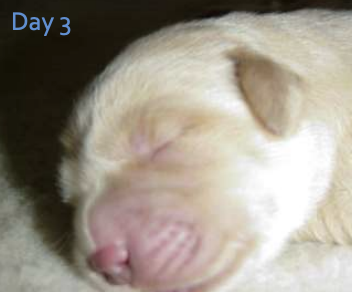
Ankyloblepharon
What eyelid disorder is physiologically normal in puppies and kittens until 10-14 days old? After this point this should not occur and it is not present in precocious neonates. This refers to the eyelids remaining closed at all times.
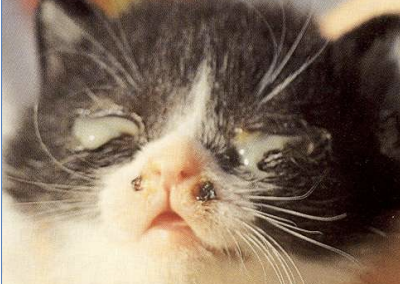
Ophthalmia
Neonatal what condition is when an infection develops beneath fused eyelids? This requires them to be prematurely opened and the infection treated, otherwise blindness and scarring will occur. The lids should be manually separated, not cut. The fornix is flushed and topical antibiotics and lubricants are applied.
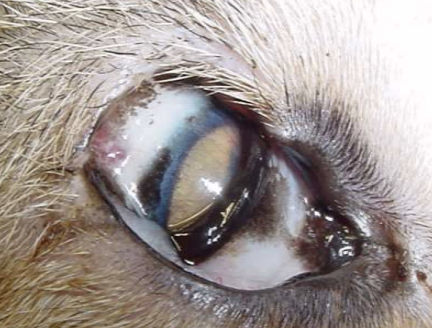
Agenesis
Eyelid what condition refers to absence of part of the eyelid, and is also called an eyelid coloboma? It can lead to exposure keratitis, and can be associated with cataracts, retinal dysplasia, posterior segment colobomas, and KCS. It is treated with lubricants, surgical correction if severe, and techniques to improve corneal protection, decrease globe exposure, and correct trichiasis. Roberts-Bistner and Lip-to-lid suture methods can be done.
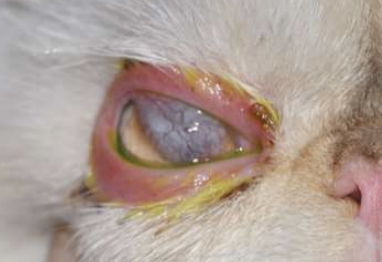
Blepharitis
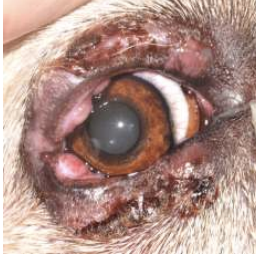
What condition refers to inflammation of the eyelid skin or glands, and presents with swelling, erythema, and chemosis? This can lead to ulcerations, excoriations, and discharge. The inside and outside of the lids should be examined including the skin, palpebral conjunctiva, and Meibomian glands. It can be due to trauma (self-inflicted or external), infection (secondary, parasites, Staphylococcus), allergies (environment, drug reaction), or immune-mediated causes. Infection should be ruled out first, and deep biopsy may be needed for histo and culture. Once infection is ruled out, consider allergy or immune response based on history and if there are any other lesions.
Meibomianitis
What condition refers to swelling of the glands or ductal openings of the meibomian glands? It is treated with tetracycline antibiotics and corticosteroids, and there may result in a qualitative tear deficiency.
Strangles
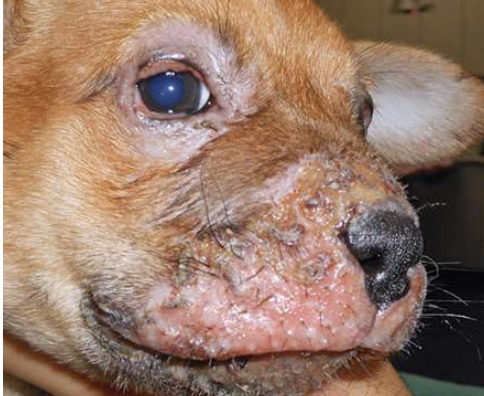
Puppy what condition refers to an immune mediated reaction to normal Staphylococci flora? It is treated with systemic antibiotics and corticosteroids.
Depigmentation
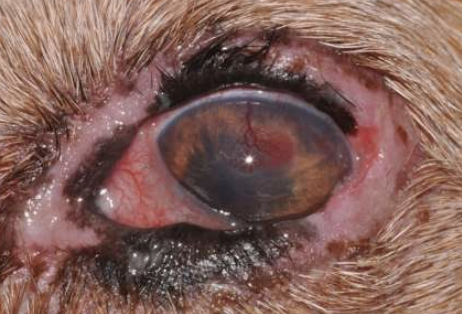
What clinical sign is often seen with drug reaction blepharitis? This can be due to preservatives in topical medications, plus neomycin and dorzolamide generally.
Sharp
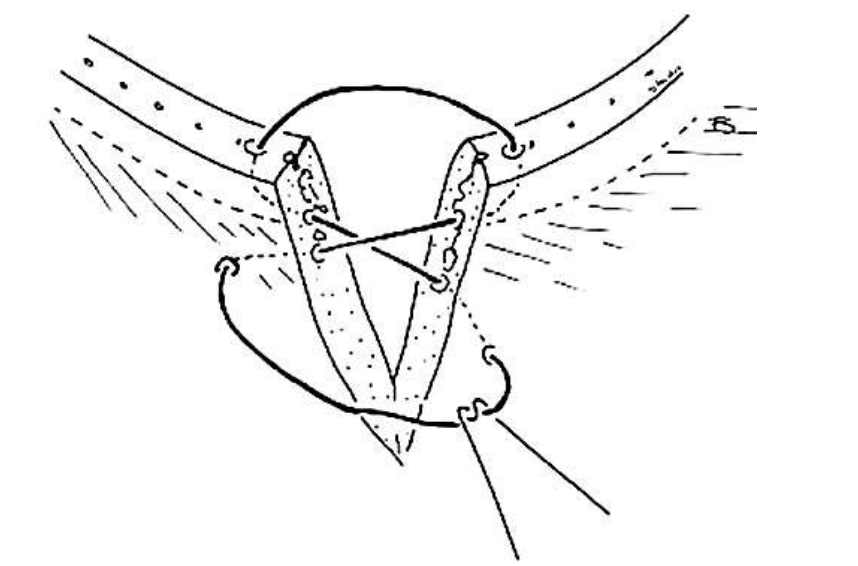
Which type of trauma (sharp or blunt) will require surgical repair if affecting the eyelids? Lacerations must be repaired immediately with minimal debridement, two-layer closure if extensive, and alignment of the lid margin with a figure eight pattern.
Entropion
What condition refers to inversion of the eyelid margins, and can be two types anatomic (breed disposition) and spastic (pain)? It causes corneal pain, keratitis, and ulcers. Treatment will be surgical depending on age and extent and should not be done on animals under 6 months old. Before surgery you should treat pre-existing problems, evaluate the extent, and apply topical anesthetic to differentiate the type.
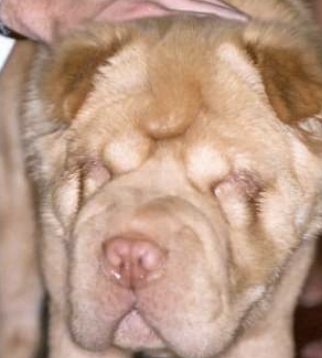
Tacking
Temporary what procedure is an option to treat entropion in puppies and spastic entropion? It uses vertical mattress sutures and non-absorbable suture or staples.
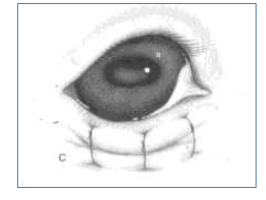
Holtz-Celsus
A modification of what procedure is the main permanent surgical treatment for entropion? It is often combined with wedge resection and lateral canthal closure.
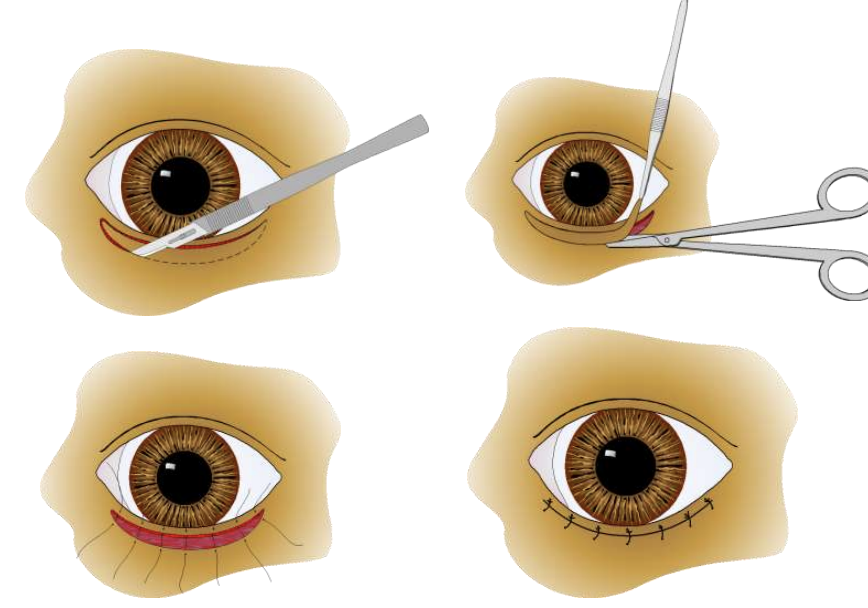
Macroblepharon
What condition refers to large palpebral fissures relative to the globe? It is part of the brachycephalic complex and can involve medial lower lid entropion, nasal trichiasis, nasal fold trichiasis, decreased corneal sensitivity, rapid tear evaporation, keratitis, and greater risk of proptosis. Lubrication is necessary to avoid keratitis, and they usually benefit from an eyelid shortening procedure such as medial canthoplasty or partial permanent tarsorrhaphy.
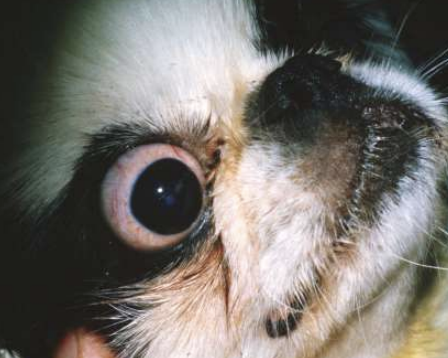
Canthoplasty
A medial what procedure is done to treat macroblepharon in small breeds, and corrects medial trichiasis, entropion, and euryblepharon? It is done to shorten the palpebral fissures and can prevent proptosis. It involves two-layer closure, with the deep layer (6-0, vicryl, simple continuous) and skin (figure eight at margin, simple interrupted, 5-0, nylon/silk).
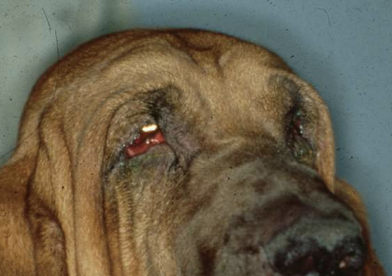
Ectropion
What condition refers to eversion of the eyelid margin, and is standard in basset hounds, saint bernards, bloodhounds, and many spaniels? It is only treated surgically if there is keratitis and conjunctivitis.
Canine
In which species are eyelid neoplasias usually benign, irritating to the globe, and can include meibomian adenomas, epitheliomas, papillomas, and melanomas?
Feline
In which species are eyelid neoplasias usually malignant, and can involve SCC, basal cell carcinoma, fibrosarcoma, and mast cell tumors?
Neoplasia
Surgical techniques for an eyelid what condition depends on whether there is less than 1/3-1/4 lid involvement (V or house excision) or more (sliding skin graft, H-plasty)? Two layer closure is done for all but the smallest defects, with deep (6-0, absorbable, simple continuous/mattress, no suture through conjunctiva), and skin (5-0, non-absorbable, figure eight at margin, simple interrupted after) layers.
Cryotherapy
What type of treatment can be done for eyelid neoplasis to debulk the mass without complete excision, using a double freeze-thaw cycle? It has a slightly higher risk of recurrence than full removal and risk of post-op depigmentation.
VII
Facial paralysis is a condition which occurs due to injury or inflammation of which cranial nerve? It can lead to exposure keratitis and decreased tear production, and can be due to otitis, hypothyroidism, trauma, or idiopathic causes.
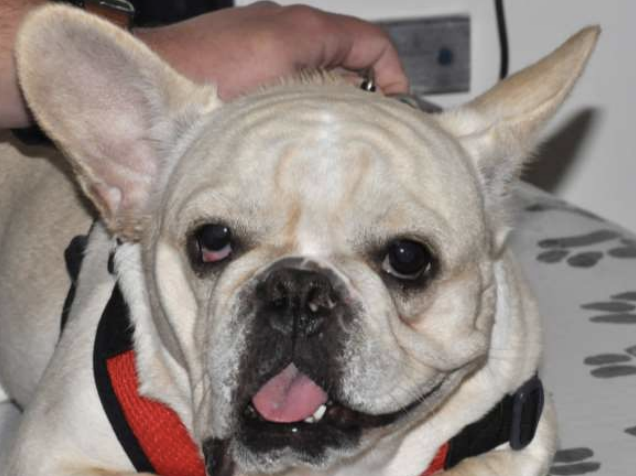
Tarsorrhaphy
A temporary what procedure can be done in facial paralysis patients to protect the globe? It uses horizontal mattress and non-absorbable suture, and can also be done in cases of proptosis and trigeminal neuropathy.
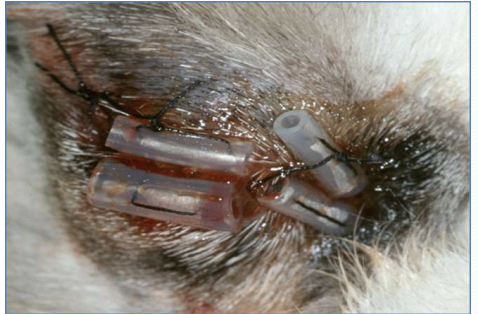
Trichiasis
What condition refers to lashes or facial hair pointing toward the cornea, and involves a normal follicle in the normal location but oriented in the wrong direction? This is often at the medial canthus or facial fold, and is common in cocker spaniels. It is not always significant.
Distichiasis
What condition refers to lashes arising from the meibomian gland openings on the lid margin? This can be insignificant, but can also cause irritation and is treated with epilation, cryotherapy, lid splitting, or electrolysis. Recurrence is common.
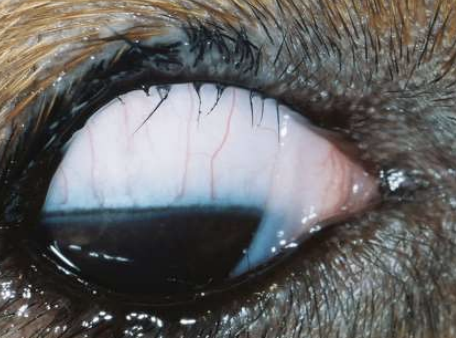
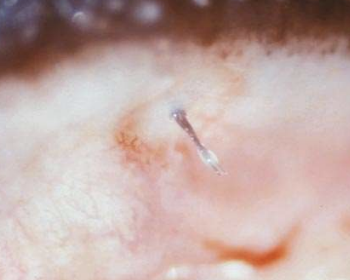
Ectopic
What type of cilia refers to cilia exiting through the palpebral conjunctiva, causing discomfort and corneal erosions or ulcers? It is most common in dogs 1-2 years old and often at the dorsal lid, near the 12 o’clock position. Surgical excision of the follicle is needed.
Fillers
The use of what substances, such as hyaluronic acid, is a non-surgical approach to surgical eyelid disease? This requires sedation and topical anesthesia, 27-30 gauge needle, slow injection while withdrawing, and using the lowest effective volume.