ch 10-3 mars perseverance rover
 Call Kai
 Learn
Learn Practice Test
 Spaced Repetition
 Match
Match Flashcards
 Knowt Play
1/32

There's no tags or description
Looks like no tags are added yet.
Name | Mastery | Learn | Test | Matching | Spaced | Call with Kai |
|---|
No analytics yet
Send a link to your students to track their progress
33 Terms
Mission statistics of Perseverance Rover
Type: Rover
Launch: July 30, 2020 (carefully planned to minimize launch time)
Landed: February 18, 2021
Target: Jezero Crater
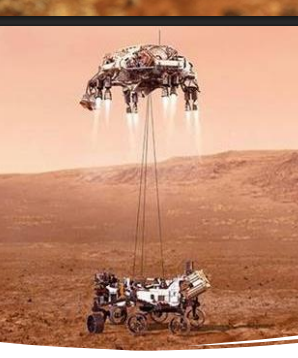
what was the perseverance rover designed for?
to photograph mars
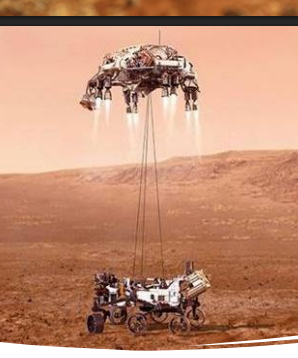
Why was Jezero Crater chosen as a Mars landing site?
Because it is believed to have once contained a lake and river delta, making it a promising location to search for signs of past life.
What evidence suggests Jezero Crater once contained water?
Ancient river channels flowed into the crater and created a lake about 3.5 billion years ago.
Why are clay minerals in Jezero Crater important?
Clay minerals form in the presence of water and may preserve evidence of ancient microbial life.
Why do scientists think Jezero Crater is a good place to search for ancient microbial life?
Because it once contained a lake, river delta, and water-deposited clay minerals, all of which could preserve signs of past life
characteristics of Jezero Crater
45km wide
western edge North of equator
wet past of mars
river channels spilled over crater wall and created a lake
What is the primary scientific goal of the Perseverance rover?
To study Mars's past environment and search for evidence of ancient life.
Why does Perseverance collect rock cores and samples?
To preserve them for possible retrieval and return to Earth by a future mission.
What future mission may use the samples collected by Perseverance?
A Mars Sample Return mission could retrieve the samples and bring them to Earth for detailed analysis.
What technology goal does the Perseverance mission have?
To test technologies needed for future robotic and human exploration of Mars.
what did Preservice Rover discover?
several types of igneous rocks
lava flows
intrusive igneous rocks (slow-cooling magma)
show interaction with water
what does igneous rocks tell us?
they’re time capsules that contains crystals telling when and how created
evidence of interaction with water and habitable condition
What do the sediments in Jezero Crater suggest about its past?
They were likely deposited in an ancient lake, indicating that standing water once existed there.
What does it mean that the sediments interacted with water long after formation?
Water continued to alter the sediments after they were deposited, showing that water was present for an extended period.
Why are ancient lakebed sediments important in the search for life on Mars?
They indicate environments that may have been habitable for ancient microbial life.
Why is Jezero Crater considered a promising location to search for ancient life?
It contains ancient lakebed sediments that were deposited and altered by water, creating potentially habitable conditions for microbes.
What does the delta in Jezero Crater indicate?
A river once flowed into a lake and deposited sediments.
What is a delta?
A deposit of sediment formed where a river enters a lake, sea, or ocean.
What evidence suggests high-energy flooding occurred in Jezero Crater?
Large boulders that were likely transported by powerful floodwaters.
What does Jezero Crater reveal about the history of water on Mars?
It shows evidence of long-term lake and river activity followed by later high-energy flooding events. (boulders into craters)
What was the purpose of the MOXIE experiment on Mars?
To produce oxygen from carbon dioxide in the Martian atmosphere.
What gas did MOXIE use to make oxygen?
Carbon dioxide (CO₂).
Why is MOXIE important for future Mars exploration
It demonstrates that oxygen can be produced on Mars for future astronauts and missions.
How much oxygen did MOXIE produce?
Enough oxygen to support an astronaut for about four hours.
ran 16 times
sounds on Mars
lead scientists to discover speed of sound is slower compared to Earth
what causes the speed of sound to be lower on Mars than on Earth
due to the CO2 in the atmosphere and pressure contributes to volumes of sound that vary during seasons
Why does sound travel poorly on Mars?
Because Mars has a very thin atmosphere with fewer air molecules to carry sound waves.
How does low atmospheric pressure affect sound on Mars?
Low pressure means fewer air molecules, so sounds are weaker and do not travel as far.
How does higher atmospheric pressure affect sound on Mars?
Higher pressure means more air molecules, allowing sound to travel more effectively.
Why does atmospheric pressure on Mars change with the seasons?
Carbon dioxide freezes onto the polar caps in winter and sublimates back into the atmosphere in spring and summer.
What happens to Mars's atmosphere when carbon dioxide freezes at the poles?
Atmospheric pressure decreases because CO₂ is removed from the atmosphere and stored as ice.
What happens to Mars's atmosphere when carbon dioxide sublimates from the polar caps?
Atmospheric pressure increases because CO₂ returns to the atmosphere as a gas.