Chapt 4: Survery of Prokaryotic cells and microorganisms
 Call Kai
 Learn
Learn Practice Test
 Spaced Repetition
 Match
Match Flashcards
 Knowt Play
1/60

There's no tags or description
Looks like no tags are added yet.
Name | Mastery | Learn | Test | Matching | Spaced | Call with Kai | Chat |
|---|
No analytics yet
Send a link to your students to track their progress
61 Terms
what kind of cells are found only in bacteria and archaea?
prokaryotic cells
what are the major life-defining properties?
heredity
reproduction
growth
development
metabolism
responsiveness
transport
What is the S layer?
Monolayer of protein used for protection and/or attachment
what is flagellum? What are the 3 parts of it?
responsible for bacterial motility or self-propulsion
filament, the hook (sheath) and basal body
hook and filament are free to rotate 360 degrees like a propellor
what is the filament?
helical structure composed of a protein called flagellin.
approximately 20nm
what is the hook?
curved tubular hook, anchored to the cell by the basal body
What is the basal body?
stack of rings firmly anchored through the cell wall to the cell membrane.
What are the 2 general patterns based of arrangement numbers a patterns for flagella?
Polar arrangement: flagella are attached at one or both ends of the cell
peritrichous: flagella are dispersed over the surface of the cell.
What are the three subtypes of polar arrangment?
monotrichous: only group with single flagellum
lophotrichous: posessing small bunches or tufts of flagella emerging from the same site
amphitrichous: posessing flagella at both poles of the cell.
what is chemotaxis?
Flagella are sensory appendages that can detect chemical environmental signals.
Positive→ move in direction to favorable chemical stimulus
negative→ movement away from repellant compound
What happens when flagellum rotates counterclockwise? What about clockwise?
cell swims in smooth, linear direction toward stimulus “run”
reverse direction→ “tumble”
what is phototaxis?
type of movement in response to light
What do few pathogenic bacteria use their flagella for? What are they?
Invade surface of mucous membrane during infections
Helicobacer pylori (gastric ulcers, bores through stomach lining)
Vibrio cholerae (cholera, penetrates small intestine)
what are spirochetes?
corkscrew shaped bacteria
worm-like locol=motion bt periplasmic flagella or axial filament
what are nonflagellar appendages?
fimbriae and pili
what are frimbriae?
small, bristlelike fibers emerging from the surface of many types of bacterial cells.
most contain protein
inherent tendency to stick to eachother and surfaces→ biofilms and other thick aggregates
what are type IV pili?
-only found in gram-neg bacteria
-made from flexible tube of protein pilin
-mating process conjugation (uses pilus as a connector for transferring DNA from donor cell to recipient)
-twitching motility
What is the fist coating to protect bacterial surface? What is it make out of?
S layer→ thousands of copies of single protein linked together to form a strong, tight, covering surrounding cell.
only produced when bacterium is in hostile environment
allows for attachment of cells to underlying substrate
What is the second layer of the bacterial surface?
glycocalyx→ repeating polysaccharide units, may include protein
help adhere to surfaces in environment, differ among bacteria on thickness, organization and chemical composition.
Slime layer?
loose shield from glycocalyces
protects from dehydration and loss of nutrients and serves in adhesion.
Capsules?
Bound more tightly to cell than slime layer and have a thick gummy consistency that gives prominently mucoid character to colonies of most encapsulated bacteria.
What is a biofilm?
microbes cling together in complex masses.
favorable environment: moist, thin layer of organic material like polysaccharides or glycoproteins deposited on their exposed surface.
what is quorum sensing?
phenomenon occurring among microbes in biofilm in which the members signal each other and coordinate their functions. Ie one can synthesize growth factor while the other can make antibiotic
what is the cell envelope?
chemically complex external covering
composed of cell wall and cell membrane
what is a gram stain?
differential stain for bacteria useful in identification and taxonomy.
Gram-positive: appear purple from crystal violet-mordant retention.
Gram-negative: appear red after loss of crystal violet and absorbance of safranin counterstain
Gram positive?
microscopic section reveals 2 layers: thick cell wall, composed primarily of peptidoglycan and cell membrane
Gram negative?
cell envelope shows 3 layers: outer membrane, thin peptidoglycan ;ayer and cell membrane.
What gives cell walls of bacteria their relative strength and stability?
Peptidoglycan
-repeating network of long glycan chains cross-linked by short peptide fragments
what is a gram-postitive cell wall?
thick homogenous, sheath (20-80 nm)
tughtly bound polysaccharides
teichoic acid attached to peptidoglycan and lipoteichoic acid→ polymer of ribitol or glycerol and phosphate embedded in the peptidoglycansheath.
lipoteichoic acid→ similar in strcutre but attached to lipids in plasma membrane
what is a gram-negative cell wall?
outer membrane → contains lipopolysaccharides and lipoproteins
thin shell of peptidoglycan
what are the two types of proteins are located in the OM?
porins: inserted in upper layer of the outer membrane→ control over molecules entering/leaving cell
phospholipid and lipoproteins
Atypical cell walls
no cell wall
acid-fast stain: hot carbol fuchsin dye becomes tenciously attached to these cells so that an acid-alcohol solution will not remove the dye.
mycoplasmas?
bacteria that naturally lack a cell wall
membranes contain sterols that increase its strength
0.1-0.5 micrometer in size
L forms bacteria
L-phase variants; wall-less forms of some bacteria that are induced by drugs or chemicals. These forms can be involved in infections.
protoplast?
A bacterial cell whose cell wall is completely lacking and that is vulnerable to osmotic lysis.
spheroplast?
A gram-negative cell whose peptidoglycan, when digested by lysozyme, remains intact but is osmotically vulnerable.
bacterial chromosome
A circular body in bacteria that contains the primary genetic material; also called nucleoid.
plasmid
Extrachromosomal genetic unit characterized by several features. A plasmid is a double-stranded DNA that is smaller than and replicates independently of the cell chromosome; it bears genes that are not essential for cell growth; it can bear genes that code for adaptive traits; and it is transmissible to other bacteria.
inclusions? types?
A relatively inert body in the cytoplasm such as storage granules, glycogen, fat, or some other aggregated metabolic product; also called inclusion body.
glycogen and pholy-beta-hydroxybutyrate: condensed, energy ruch organic substances in single-layered membranes
gas molecules
granules: contain crystals of inorganic compounds and not enclosed by membranes
bacterial endospores?
A small, dormant, resistant derivative of a bacterial cell that germinates under favorable growth conditions into a vegetative cell. The bacterial genera Bacillus and Clostridium are typical spore-formers.
sporulation→ act of making spores
sporangium
A fungal cell in which asexual spores are formed by multiple cell cleavage. This division results in sporangiospores.
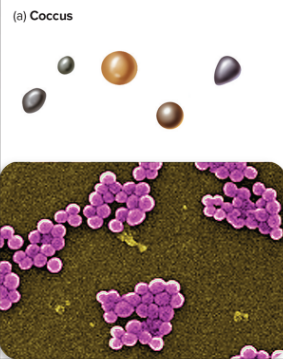
what type?
coccus
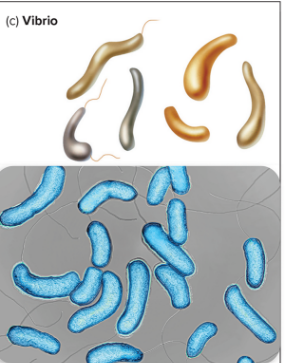
what type?
Vibrio
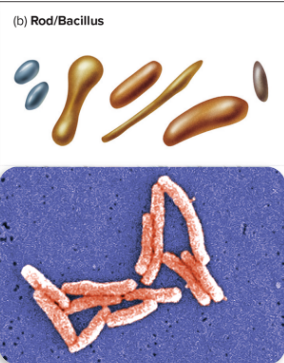
what type?
rod/bacillus
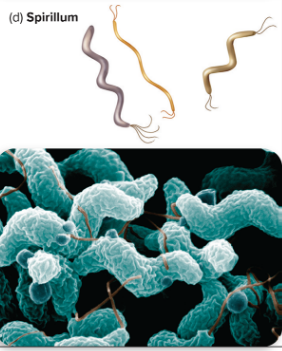
what type?
spirillum
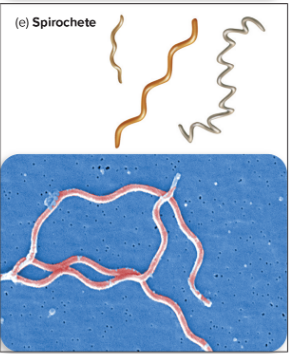
what type?
spirochete
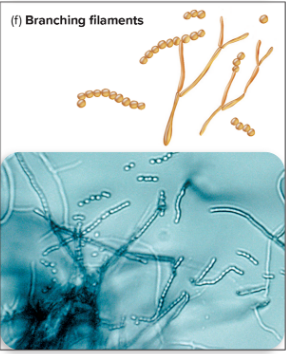
what type?
branchin filaments
How are bacterial categorized? what are the types?
-arrangement
-single
-diplococci (pairs)
-tetrads (groups of four)
-irregular clusters (staphylococci and mircrococci)
-chains of few to hundreds of cells (streptococci)
Prokaryotes in domain archae?
phylum crenarchaeota: sulfur for growth and may inhabit hot and acidic sulfur pools and vents
phylum nanoarchaeota: extremely small archaea found in salt mines and caves
phylum euryarchaeota: methanogens, halobacteria or halophiles, thermophiles and reduction of sulfur compounds
Types of bacteria in domain bacteria?
phylum aqulflcae: small thermophillic rods that inhabit underwater volcanoes
phylum thermotogae: includes thermophilic halophiles
phylum chlorobi: green sulfur bacteria→ anaerobic bacteria that live in muddy layers of lakes and ponds
phylum deinococcus-thermus A: extremophiles radiation and deseccation resistant cocci
phylum cyanobacteria: ubiquitous photosynthetic bacteria in aquatic habitats, soil, and often associated with plants, fungi, and other organisms
What are Domain Bacteria II?
medicinal impact
phylum pseudomonadota: gram negative cell wall
What is Phylum bacillota?
gram positive bacteria with low G+C content
endospore forming genera include bacillus and clostridium
pathogens staphylococcus and streptococcus
mycoplasma
Phylum Actinomycetota?
high g+c content (50%)
gram positive bacteria
branching filamentous actinomycetes
what are volume 5 category?
mixed assemblage of nine phyla are gram negative
phylum chlamydiae
phylum spirochetes
phylum planctomycetes
phylum bacteroidota: gram negative anaerobic rods
cyanobacteria?
Widespread and ecologically important photosynthetic bacteria; evidence indicates their role in the evolution of chloroplasts in eukaryotic cells.
gram-negative phototropic
Green and purple sulfur bacteria?
photosynthetic and contain pigments
use bacteriochlorophyll
phylum proteobacteria
gram-negative
gliding/fruiting bacteria
glide over moist surfaces w/filaments or fibers
Richettsias
distinctive, tiny, gram negative bacteria
chlamydias?
Tiny gram–negative bacteria that are obligate parasites inside the vacuoles of host cells; members cause a type of STD and pneumonia.