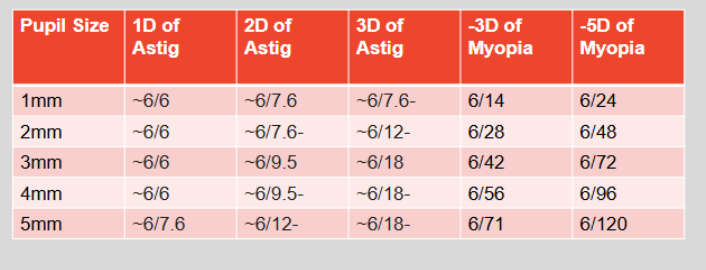
4: impact of uncorrected refractive error on vision intermediate and near viewing distances ;impact of pupil size
 Call Kai
 Learn
Learn Practice Test
 Spaced Repetition
 Match
Match Flashcards
 Knowt Play
1/14

There's no tags or description
Looks like no tags are added yet.
Name | Mastery | Learn | Test | Matching | Spaced | Call with Kai |
|---|
No analytics yet
Send a link to your students to track their progress
15 Terms
unaided vision at near, intermediate and distance
range of clear vision; from far point ( no accom in use) to the near ppint ( accom max exterted)
far point and near point in an uncorrected myopic eye
-4.00DS myopic eye with 10D of accom
the far point at 25cm is where there is no accomodation
at the near point of 7.14cm all 10D of accomodation is being used
clear vision is between the far point and the near point
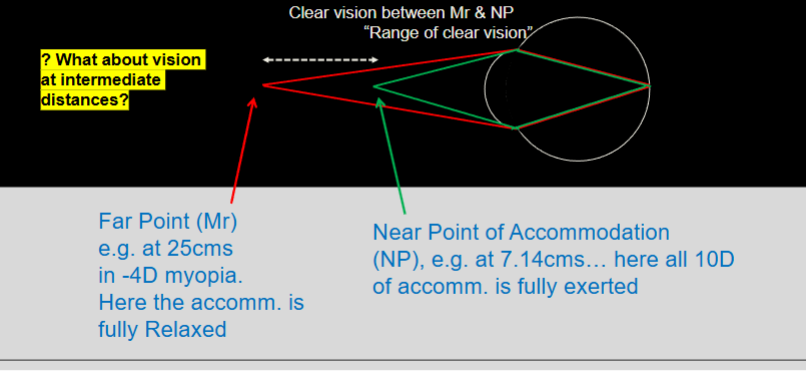
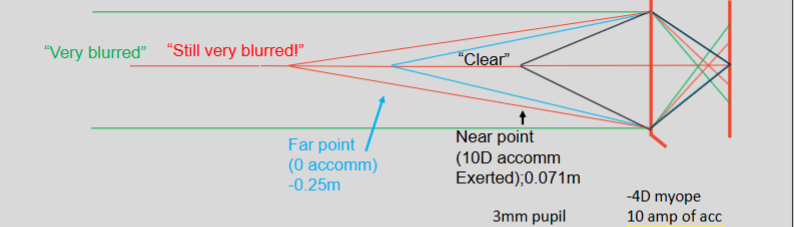
myopia of -4.00 with 10D accom
unaided vision remains poor until object is very close to the far point
inside the far point, the eye retains clear vision up to the near point
gap between near and far dictates the range of clear vision and depends on the amplitude of accom
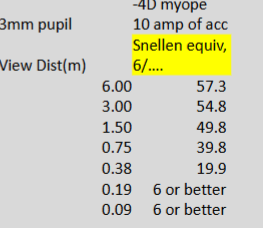
MAR= kDE
MAR = 0.83 × 3mm pupil x 4
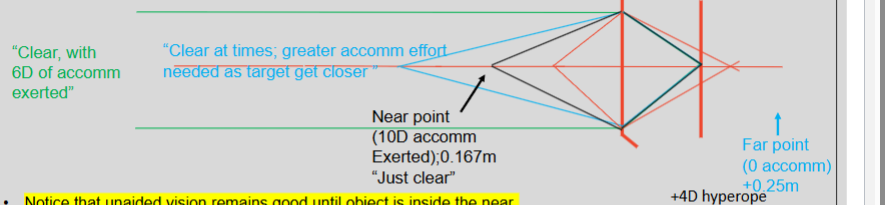
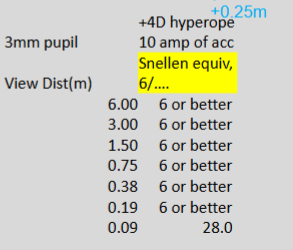
hyperopia with +4.00DS accom amplitude 10D
unaided vision remains good until the object is insed the near point
the eye is capable of achieving clear vision up to the near point but it requires lots of effort ; more effort needed for nearer target
range of clear vision for this eye would be from infinity to the near point
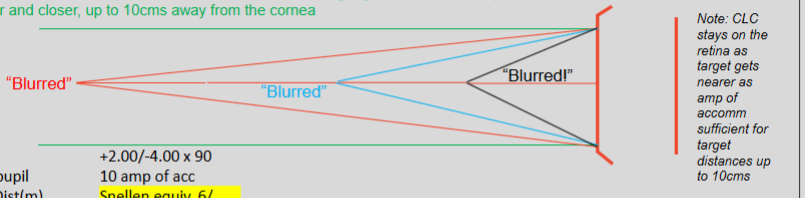
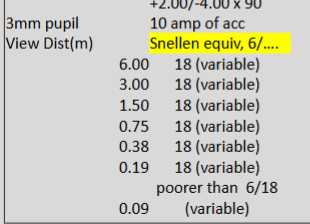
4D of mixed astigmatism with an eye with 10D accom
+2.00/-4.00 × 90
there is no far or near point because, unaided, there is no viewing distance for which a point image is formed on the retina, until the astig is corrected vision is blurred at all distances
for this eye the CLC on the retina and the eye has enough accom to keep the CLC on the retina as the target gets closer and closer , up to 10cms away from cornea
variability comes from the eye altering its accom to place diff parts of the interval of sturm on the retina
as target gets closer vision remains poor, doesnt improve or fall dramatically
if there is myopia alonside astig them unaided worse at distance, if hyperopia alogside astig then near worse
impact of astigmatism
evn 1D of uncorrected astigmatis causes a reduction in distance vision
more astig means more impact on unaided vision
near and reading also decrease with increasing astig
impact of with/against /oblique
impact of with and against the rule astigmatism on unaided distance vision is similar
eyes with oblique astig have significantly lower visual performance than eyes with WTR or ATR astig
impact of uncorrected ast depends on what
depends on the amount and axis of astigmatism but is also curcially dependent on the pupil size
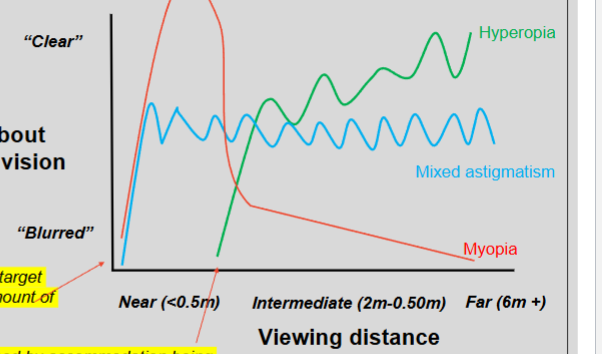
blue and red at the start where most blurry, the sharp drop is due to finite amount of accomodation
green drop at the near where blurred is caused by accomodation being used up to see clearly in the distance , gives incorrect impression that the eye has insufficient accom
variable vision is signalled by the bumpy lines
what happens as the object being viewed gets closer
light leaving the object becomes increasingly divergent, this improves vision in uncorrected myopic eyes, but it places a bigger demand on accom in uncorrected hyperopic eyes and in uncorrected astigmatic eyes
the angular subtense of the object increases so the unaided vision of the eye does not need to be s good to see the target
hence if unaided vision at near/intermediate distance is only 6/12 at that distance, this is easily enough to perform that task
what happens when object gets closer for near and intermediate viewing
prediction vision in eyes with various types and amounts of uncorrected refractive error is complicated becase it depends on the balance between accom demand , the accom availability
the acuity required for a given task is less when viewing from an intermed or near distance
impact on pupil size
whenever vision is reduced by uncorrected refractive error, vision will be better when the pupil is smaller, and poorer when the pupil size is larger
myopic unaided
eyes remains blurred until the object of interest gets close to the far point
vision becomes clear when object is at the far point where no accom is needed for clear vision
inside the far point vision in myopic eyes remains clear provided the eye has accom and it remains clear as the object gets closer still until the eye runs out of accom
hence uncorrected myopes complain that at intermed and far distance vision is blurry but near is clear
hyperopia unaided
goof at distance dependind on size of amplitudue of accom
closer the object the more likely vision is to e variable or blurred or clear but uncomfortable
just ecause the eye has 6D of accom doesnt mean the 6D is continously available
how to distnguish between hyperopia and presbyopia
presbyopia is a problem for insufficient accomodation
hyperopia is a problem of an underpowered eye