Lecture 06: Neuro Examination
 Call Kai
 Learn
Learn Practice Test
 Spaced Repetition
 Match
Match Flashcards
 Knowt Play
1/54

There's no tags or description
Looks like no tags are added yet.
Name | Mastery | Learn | Test | Matching | Spaced | Call with Kai |
|---|
No analytics yet
Send a link to your students to track their progress
55 Terms
Voluntary movements in UMN
Movements in synergistic pattern
Voluntary movements in LMN
Weak or absent
A PT is examining a 55-year-old patient who presents with weakness and tingling in his arm for 2 weeks. Which of the following examination findings would MOST likely confirm diagnosis of peripheral nerve lesion ?
A. Diminished tendon reflexes
B. Hypertonicity in the affected muscles
C. Positive Babinski sign
D. Presence of clonus with rapid passive foot dorsiflexion
A. Diminished tendon reflexes
Frontal lobe lesion
- Apraxia and Broca's aphasia
- Controls plans, programming, movement
- Emotional, behavioral control, personality
- Olfaction
Temporal lobe lesion
- Hearing
- Language comprehension
- Wernickes aphasia
Broca's aphasia
- Frontal lobe affected
- Slow, hesitant speech
- Cannot speak properly
Wernickes aphasia
- Temporal lobe affected
- Speech is good, but does not make sense
- Have trouble receiving speech
Broca's aphasia is also known as
- Expressive aphasia
- Non fluent aphasia
Wernickes aphasia is also known as
- Receptive aphasia
Broca's treatment
Yes/no questions
Wernickes treatment
Gestures and demonstrations
A PT is assessing a 65-year-old patient and asks thepatient how he is doing. The patient's response is, "the sun is yellow, and the water is cold". Which of thefollowing is the MOST appropriate diagnosis of this finding?
A. Wernicke's aphasia
B. Broca'saphasia
C. Non-fluentaphasia
D. Lesion to CN VII
A. Wernicke’s aphasia
Will have difficulty with reading and writing as well
Parietal lobe lesion
- Perceptual disorders
- Sensory loss
Occipital lobe lesion
- Visual loss
- Contralateral homonymous hemianopsia
- Inability to identify previously known objects
CNs in the cerebrum
- 1: olfactory
- 2: optic
CNs in the midbrain
- 3: oculomotor
- 4: trochlear
CNs in the pons
- 5: trigeminal
- 6: abducens
- 7: facial
- 8: vestibulocochlear
CNs in the medulla
- 9: glossopharyngeal
- 10: vagus
- 11: accessory
- 12: hypoglossal
CN 1
- Sensory
- Sense of smell
- Affected = anosmia
CN 2
- Sensory
- Vision = color, acuity, peripheral vision
- Pupillary light reflex
- Affected = blindness, myopia, presbyopia
A therapist is assessing cranial nerve integrity in apatient. On shining light in the patient's left eye none ofthe pupils constrict, however on shining the light inpatient's right eye both pupils constrict. Which of thefollowing is MOST appropriate about this finding?
A. Left oculomotor nerve is not affected
B. Right oculomotor nerve is intact
C. Left optic nerve is affected
D. Right optic nerve is intact
C. Left optic nerve is affected
CN 3
- Motor
- Function = moves eyeballs, open eyelids, constricts pupils
- Affected = strabismus, ptosis, dilation of pupils
CN 4
- Motor
- Function = moves eye down and in (towards the nose)
CN 6
- Motor
- Moves eyeball out/ abducts eyeball
Muscles of the eye
- Superior rectus
- Inferior rectus
- Lateral rectus
- Medial rectus
- Inferior oblique
- Superior oblique
Function of superior rectus
Looking up and out
Function of inferior rectus
Looking down and out
Function of lateral rectus
Lateral movement (abduction)
Function of medial rectus
Medial movement (adduction)
Function of inferior oblique
Looking up and in
Function of superior oblique
Looking down and in
CN 8
- Sensory
- Balance and hearing
Conductive hearing loss
- Hearing loss caused by damage to the mechanical system that conducts sound waves to the cochlea
- Less common
Sensory neural hearing loss
Hearing loss caused by damage to the inner ear, cochlea, or auditory nerve
Rinne test
- Hearing test using a tuning fork on mastoid bone
- Patient indicates when sound is no longer heard
- When no longer heard, move fork to by ear and ask if heard
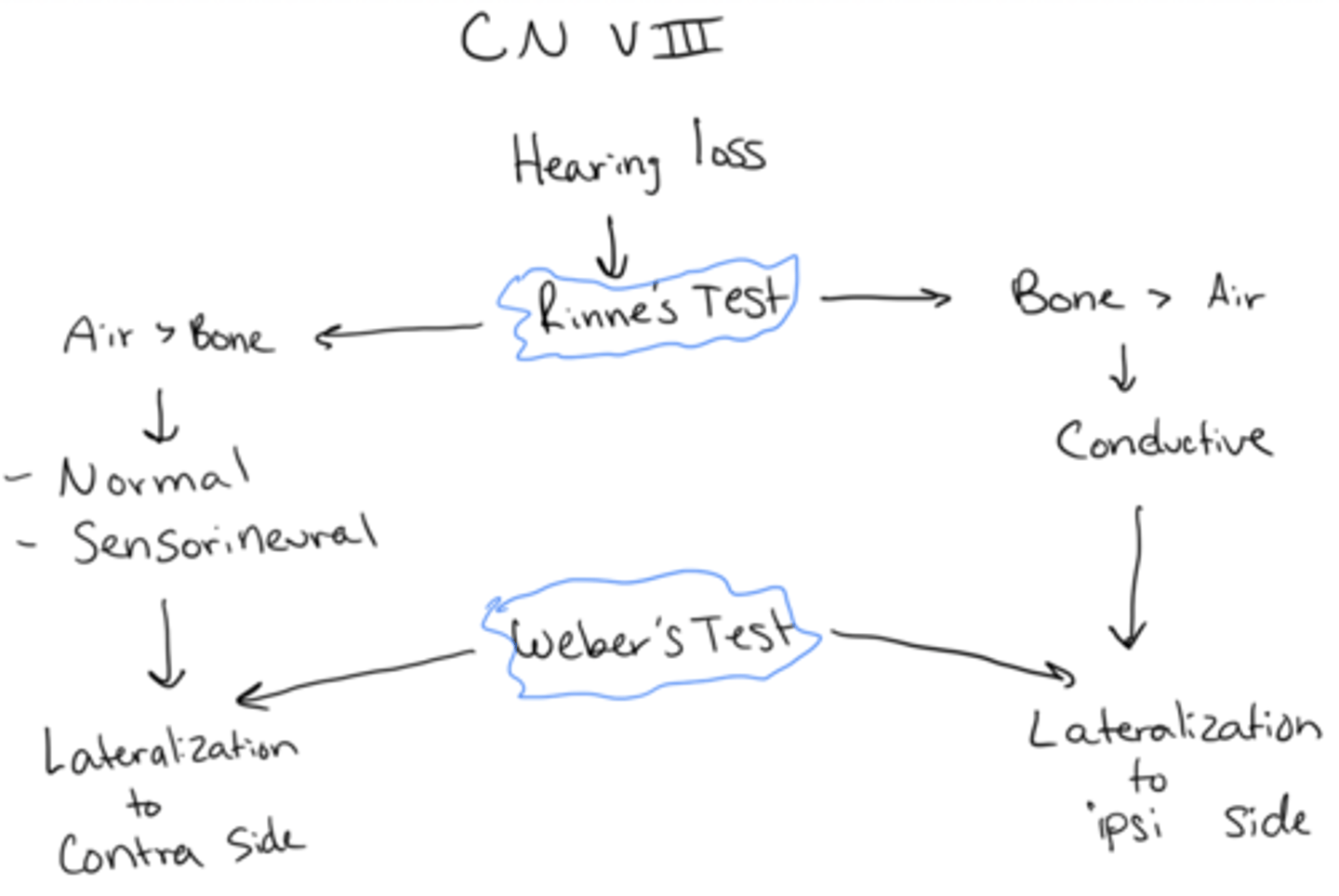
Rinne test results
- Normal: AC > BC
- Sensorineural loss: AC > BC
- Conductive loss: BC > AC
Weber test
- Test for sensorineural hearing loss
- Place base of struck tuning fork on bridge of forehead, nose, or teeth
Weber test results
Normal: no lateralization
Sensorineural loss: lateralization to contra side
Conductive loss: lateralization to ipsi side
Determining hearing loss:
- Perform Rinnes test to determine if conductive or sensorineural
- Performs Webers test to determine which side is affected
- CANS = conduction (sound louder on affected side)
- CANS = sensorineural (sound louder on normal side)
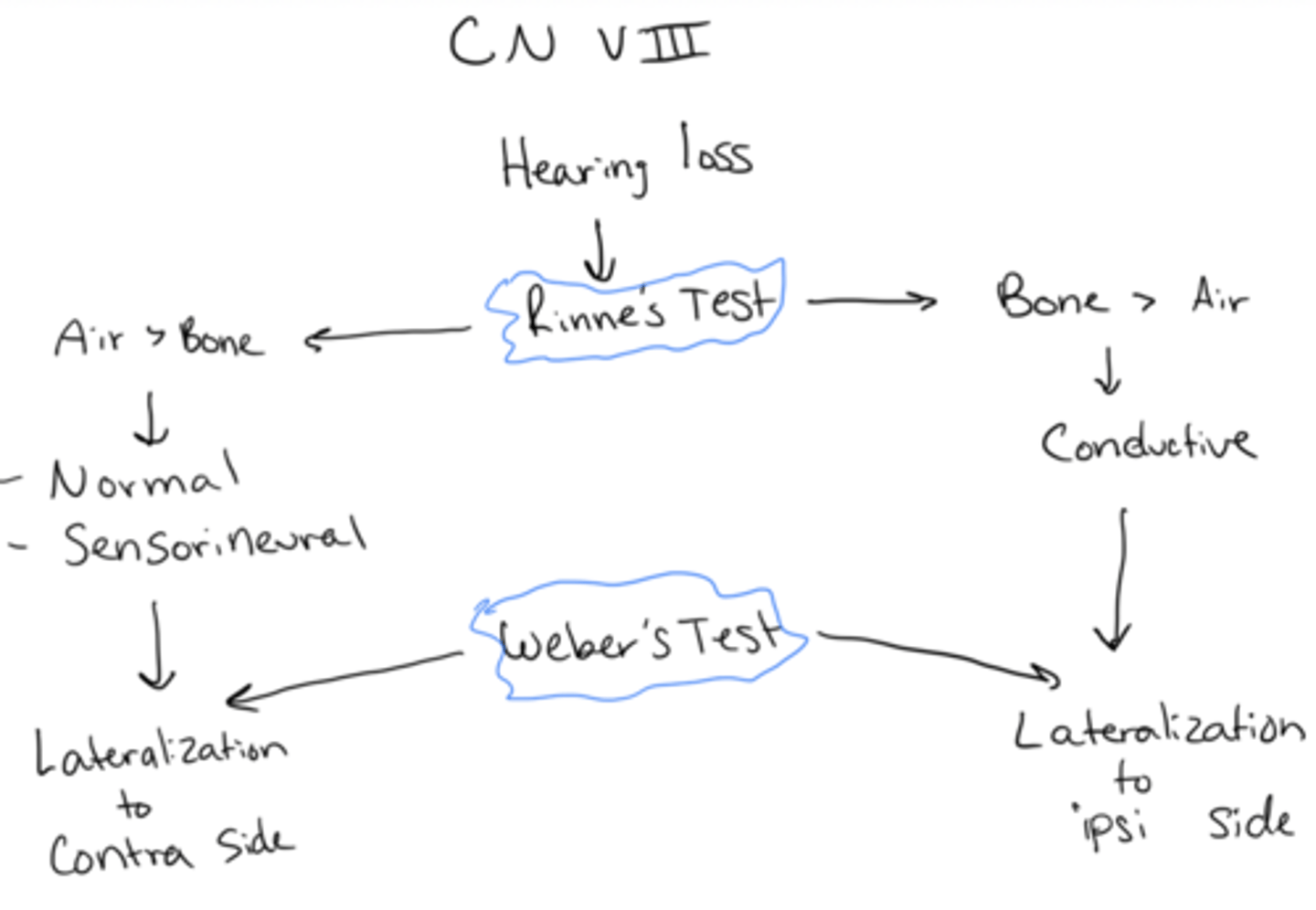
A patient complains of sudden onset of mild hearing loss on the right side. Rinne test was consistent with air conduction greater than bone conduction on both sides. Weber's test findings show sound lateralized to the left ear. Which of the following is the MOST likely?
A. Right side sensorineural hearing loss
B. Left side conduction hearing loss
C. Right side conduction hearing loss
D. Left side sensorineural hearing loss
A. Right side sensorineural hearing loss
- Rinne’s: AC >> BC = sensorineural
- Weber’s: sound louder in L ear (normal ear because sensorineural) —> other ear affected
- Sensorineural HL; R ear
CN 5
- Mixed
- Muscles of mastication
- Sensation to face
- Corneal reflex- afferent
- Sensation to anterior tongue
- Dampens sound
CN 7
- Mixed
- Salivation
- Muscles of the face
- Corneal reflex-efferent
- Taste to anterior tongue
- Dampens sound
A PT suspects a patient to have lesion of the trigeminal nerve. During assessment, a positive finding of which of the following signs and symptoms will confirm thetherapist's suspicion?
A. Loss of pain and temperature of face
B. Loss of ability to taste food on the anterior part of tongue
C. Loss of ability to raise eyebrows
D. Loss of sensation on posterior 1/3rd of tongue
A. Loss of pain and temperature of face
A PT administers a series of cranial nerve tests to a patient with a confirmed lower motor neuron disease. Assuming the patient has a lesion impacting the right hypoglossal nerve, which clinical presentation would be most likely?
A. Right-sided tongue atrophy and deviation toward the left with tongue protrusion
B. Right-sided tongue atrophy and deviation toward the right with tongue protrusion
C. Left-sided tongue atrophy and deviation toward the left with tongue protrusion
D. Left-sided tongue atrophy and deviation toward the right with tongue protrusion
B. Right-sided tongue atrophy and deviation toward the right with tongue protrusion
CN 9
- Mixed
- Posterior tongue sensation and taste
- Gag reflex- afferent
CN 10
- Mixed
- Muscles of uvula
- Control of HR
- Gag reflex- efferent
A patient presents with neurological symptoms so the PT decides to do cranial nerve assessment. When PT asksthe patient to say "Ahh", the PT finds the patient's uvula deviated as shown in the image. Which cranial nerve is MOST likely affected?
A. Left vagus nerve
B. Right vagus nerve
C. Left hypoglossal nerve
D. Right glossopharyngeal nerve
B. Right vagus nerve
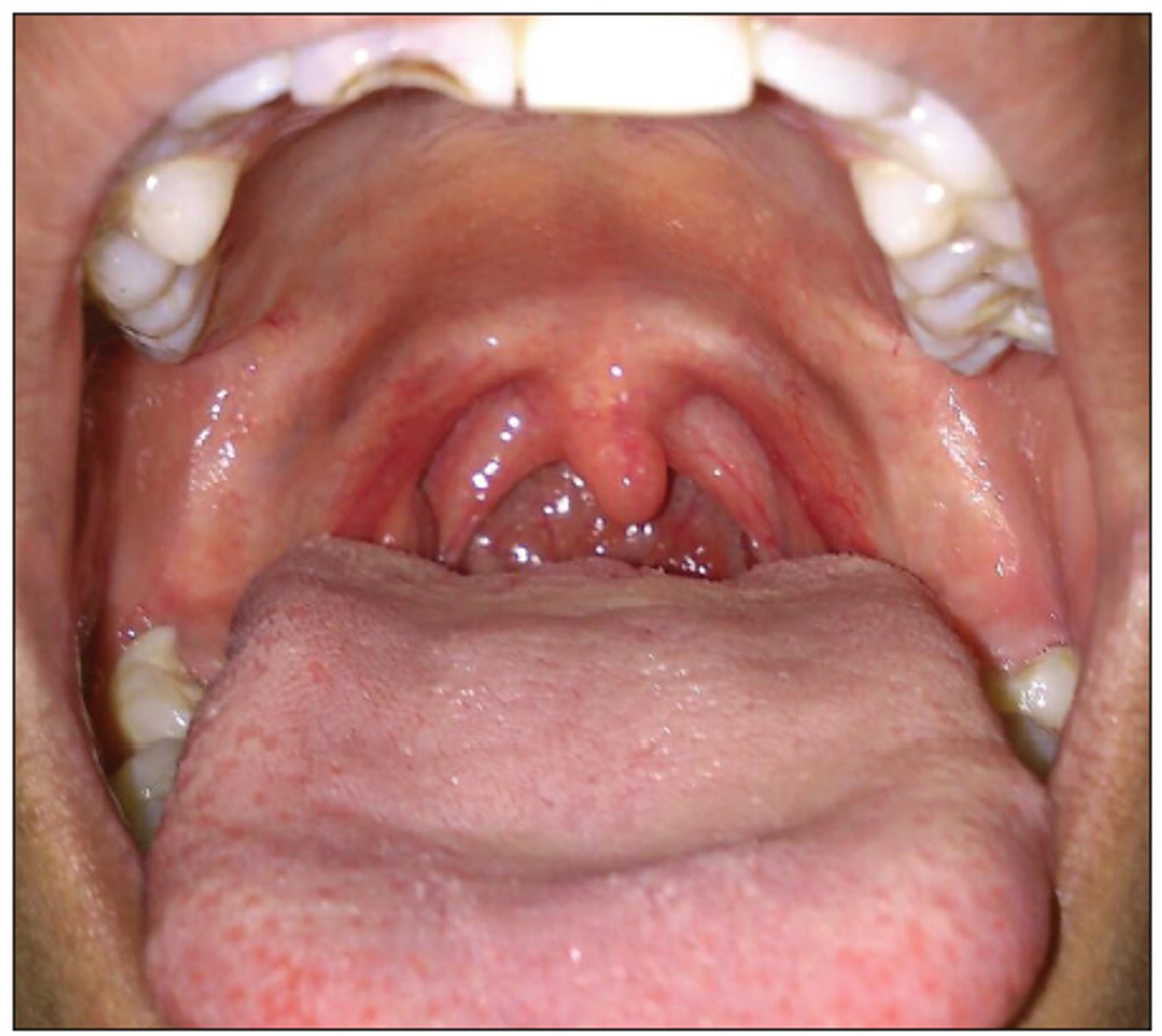
CN 10- vagus nerve injury results in the uvula deviated to which side?
Contralateral
CN 12- hypoglossal injury results in tongue deviation to which side?
Ipsilateral
Frontal lobe function
- Motor control (premotor)
- Problem solving (prefrontal)
- Speech production (Broca's)
Temporal lobe function
- Auditory processing (hearing)
- Language comprehension (Wernicke's)
- Memory/information retrieval
Brainstem function
Involuntary responses
Parietal lobe function
- Touch perception (somatosensory cortex)
- Body orientation and sensory discrimination
Occipital lobe function
- Sight (visual)
- Visual reception and visual interpretation
Cerebellum function
Balance and coordination