Econ Test 3
 Call Kai
 Learn
Learn Practice Test
 Spaced Repetition
 Match
Match Flashcards
 Knowt Play
1/97

There's no tags or description
Looks like no tags are added yet.
Name | Mastery | Learn | Test | Matching | Spaced | Call with Kai |
|---|
No analytics yet
Send a link to your students to track their progress
98 Terms
What fiscal policy tools are used to shift the aggregate demand curve?
government spending and interest rates
taxes and interest rates
government spending and taxes
taxes and employment rates
government spending and taxes
Explanation
Fiscal policy is the use of government taxes and spending to alter macroeconomic outcomes.
Which of the following could cause a recession?
a decline in aggregate demand
a decline in unemployment
An increase in aggregate supply
An increase in government spending
a decline in aggregate demand
Explanation
Recessions occur when aggregate demand declines and persist when aggregate demand remains below the economy's capacity to produce.
Inflation occurs when
aggregate demand increases faster than unemployment.
unemployment increases faster than the labor force.
aggregate demand increases faster than output.
output increases faster than unemployment.
aggregate demand increases faster than output.
Explanation
If aggregate demand increases faster than output, average prices tend to rise.
The four components of aggregate demand are
net exports, income, interest, and investment.
consumption, investment, government spending, and net exports.
consumption, interest, and government spending.
net exports, government spending, investment, and foreign trade.
consumption, investment, government spending, and net exports.
Explanation
The four major components of aggregate demand are consumption, investment, government spending, and net exports.
An improvement in consumer confidence will cause
a movement down the aggregate demand curve.
the aggregate supply curve to shift to the right.
the aggregate demand curve to shift to the right.
the aggregate demand curve to shift to the left.
the aggregate demand curve to shift to the right.
Explanation
When consumers have more confidence, they will buy more output at all price levels.
Ceteris paribus, _______ in consumer confidence will cause _______ in aggregate demand.
a decrease; a decrease
a decrease; no change
an increase; a decrease
an increase; no change
a decrease; a decrease
Explanation
Because consumption is a component of aggregate demand, if consumption falls due to lower confidence, aggregate demand will decrease as well.
Which of the following is NOT an example of investment spending?
construction of a new factory
the purchase of stock in the stock market
inventory expenditures
new equipment
the purchase of stock in the stock market
Explanation
The purchase of stock is not an economic investment. In fact, stock purchases by investors are often used to finance investment spending.
In a graph of the aggregate demand curve, an increase in investment by businesses is represented by a
movement down the curve.
movement up the curve.
rightward shift of the curve.
leftward shift of the curve.
rightward shift of the curve.
Explanation
Because investment is a component of aggregate demand, increases to investment will cause aggregate demand to rise as well.
All of the following represent government spending as a part of aggregate demand except for
flood control
national parks
police and fire protection
Social Security checks
Social Security checks
Explanation
Social Security is a transfer payment and is not classified as government spending.
Ceteris paribus, a decrease in exports will generate which of the following changes for aggregate demand?
a rightward shift of the curve
a leftward shift of the curve
an upward movement along the curve
a downward movement along the curve
a leftward shift of the curve
Explanation
A leftward shift demonstrates the effect of a decline in exports as this would mean less spending on domestically-produced goods and services.
Which of the following will occur if aggregate demand is below full employment GDP?
recession
excessive aggregate demand
inflation
a stable economy
recession
Explanation
Less spending is generated when the economy is below full employment.
Which of the following will occur if aggregate demand is above full employment GDP?
recession
high unemployment
inflation
a stable economy
inflation
Explanation
The scramble for available goods and services pushes prices up as demand will rise faster than output.
Between 1921 and 1927, the stock market's value more than doubled, adding billions of dollars to the wealth of U.S. households and businesses. Which of the following indicates the appropriate change in the U.S. economy as a result of this stock market boom?
The economy moved up along the aggregate demand curve.
The economy moved down along the aggregate demand curve.
Aggregate demand shifted to the left.
Aggregate demand shifted to the right.
Aggregate demand shifted to the right.
Explanation
With more money to spend and general feeling of being wealthier, aggregate demand increased and shifted to the right.
Most of the countries in the world suffered long and deep losses of output and employment between 1930 and 1935, which meant fewer purchases of U.S. goods and services. Which of the following indicates the appropriate change in the U.S. economy as foreigners purchased fewer U.S. goods and services?
Aggregate demand shifted to the left.
Aggregate demand shifted to the right.
The economy moved up along the aggregate demand curve.
The economy moved down along the aggregate demand curve.
Aggregate demand shifted to the left.
Explanation
With fewer purchases of U.S. goods, aggregate demand shifted to the left as exports fell.
If the value of the dollar plummets in international currency markets, initially this causes foreigners to buy more American goods. Which of the following indicates the appropriate change in the U.S. economy from the dollar become less valuable?
The economy moves up along the aggregate demand curve.
The economy moves down along the aggregate demand curve.
Aggregate demand shifts to the left.
Aggregate demand shifts to the right.
Aggregate demand shifts to the right.
Explanation
If the value of the dollar falls, foreigners are able to purchase more American imports at lower prices than they could in their countries. This will increase exports. At the same time, if the dollar decreases in value, American consumers will be less able to buy foreign goods which will decrease imports. Both of these effects generate an increase in the aggregate demand curve.
The terrorist attacks in September 2001 reduced consumer confidence. Which of the following indicates the resulting change in the U.S. economy after 9/11?
The economy moved up along the aggregate demand curve.
The economy moved down along the aggregate demand curve.
Aggregate demand shifted to the left.
Aggregate demand shifted to the right.
Aggregate demand shifted to the left.
Explanation
When consumer confidence decreases, consumers will demand fewer goods and services, shifting the aggregate demand curve to the left.
The purpose of fiscal stimulus is to shift aggregate
demand to the left.
demand to the right.
supply to the left.
supply to the right.
demand to the right.
Explanation
Tax cuts or spending hikes intended to increase aggregate demand (shift to the right). Increased government spending would add directly to aggregate demand while tax cuts add indirectly to aggregate demand as consumers and firms have more disposable income to spend.
Which of the following is an example of fiscal stimulus?
an increase in government spending on new military jet fighters
an increase in consumption because of improved consumer confidence
an increase in personal income taxes for families with children
an increase in the purchase of office buildings by foreign investors
an increase in government spending on new military jet fighters
Explanation
Fiscal stimulus is an increase to government spending (or decrease to government taxes) specifically.
If an economy has a GDP gap such that equilibrium output is less than full employment output, which of the following is a correct fiscal policy action?
a reduction in Social Security payments
an increase in the money supply
an increase in government expenditures
an increase in the tax rate
an increase in government expenditures
Explanation
The simplest solution to the demand shortfall would be to increase government spending through fiscal stimulus.
Which of the following is a fiscal policy prescription for ending a recession?
Raise taxes to pay for greater transfer payments to stimulate the economy.
Increase government expenditures to let the multiplier work.
Raise interest rates to stimulate saving.
Restrict exports to increase injections in the domestic economy.
Increase government expenditures to let the multiplier work.
Explanation
When the government increases its spending, it creates additional income for market participants.
Which of the following is the correct formula for the marginal propensity to consume?
1 ÷ (1 − Marginal Propensity to Save)
(Total Consumption) ÷ (Total Disposable Income)
1 − Marginal Propensity to Save
(Change in Consumption) + (Change in Disposable Income)
1 − Marginal Propensity to Save
Explanation
The marginal propensity to consume tells us what portion of an extra dollar of income will be spent. The remaining portion will be saved. If each dollar is either spent or saved, then the marginal propensity to save and marginal propensity to consume must sum to one.
If consumers spend 79 cents out of every extra dollar received, the
multiplier is 0.79.
marginal propensity to consume is 0.79.
marginal propensity to save is 0.79.
marginal propensity to consume is 0.21.
marginal propensity to consume is 0.79.
Explanation
The marginal propensity to consume is 0.79 of every dollar.
Ceteris paribus, if the government transfers income from individuals with a high marginal propensity to consume to those with a low marginal propensity to consume, in the short run, spending and output will
increase.
decrease.
stay the same.
increase or decrease depending on the level of saving.
decrease.
Explanation
Those with low propensity to consume may save more thus decreasing spending and output.
Which of the following helps explain the multiplier effect?
Income is spent and re-spent in the circular flow model.
People buy a lot of luxury items.
Incomes tend to increase with inflation.
Banks only hold a fraction of their deposits on reserve.
Income is spent and re-spent in the circular flow model.
Explanation
As a result of this multiplier process, aggregate demand increases by much more than the initial increase in government spending.
If the current level of spending falls short of full employment, the government can close the GDP gap by
increasing government spending by an amount less than the GDP gap.
increasing government spending by an amount greater than the GDP gap.
decreasing government spending by an amount less than the GDP gap.
decreasing government spending by an amount greater than the GDP gap.
increasing government spending by an amount less than the GDP gap.
Explanation
This will shift aggregate demand to the right.
The multiplier is equal to
1 − Marginal propensity to save.
Marginal propensity to save ÷ Marginal propensity to consume.
1 ÷ Marginal propensity to save.
1 ÷ Marginal propensity to consume.
1 ÷ Marginal propensity to save.Correct
Explanation
The multiple by which an initial change in aggregate spending will alter total expenditure after an infinite number of spending cycles is given by 1 / (marginal propensity to save).
If consumers spend 75 cents out of every extra dollar received, the
marginal propensity to save is 0.75.
marginal propensity to consume is 0.25.
multiplier is 4.
multiplier is 7.5.
multiplier is 4.
Explanation
The multiplier is 1÷ (1 − 0.75) = 4.
Which of the following economies has the largest multiplier?
Economy A with a marginal propensity to save of 0.5
Economy B with a marginal propensity to save of 0.1
Economy C with a marginal propensity to consume of 0.8
Economy D with a marginal propensity to consume of 0.6
Economy B with a marginal propensity to save of 0.1
Explanation
The marginal propensity to save is 0.1, therefore economy B has the greatest propensity to consume with a multiplier of 10 (1 / 0.1).
If the marginal propensity to save is 0.1 and government spending is raised by $5 billion, then total aggregate spending will rise by
$500 million.
$5 billion.
$10 billion.
$50 billion.
$50 billion.Correct
Explanation
Total aggregate spending change = Multiplier × Initial injection = (1 / 0.1) × $5 billion = $50 billion.
Assume a marginal propensity to consume of 0.6. The change in total spending for the economy as a result of a $10 billion new government spending injection would be
$6 billion.
$25 billion.
$60 billion.
$600 billion.
$25 billion.
Explanation
Total aggregate spending change = Multiplier × Initial injection = (1 / (1 − 0.6) × $10 billion = $25 billion.
With respect to the aggregate demand curve, a tax cut will
move the economy down along the curve.
move the economy up along the curve.
shift the curve leftward.
shift the curve rightward.
shift the curve rightward.
Explanation
Aggregate demand will increase as consumers have more money to spend and so it will shift to the right.
A tax cut of $8 billion with a marginal propensity to consume of 0.90 will cause a cumulative change in spending equal to
an increase of $720 million.
an increase of $72 billion.
an increase of $80 billion.
a decrease of $720 billion.
an increase of $72 billion.
Explanation
Total aggregate spending change = Multiplier * Initial injection. Because consumers will save a portion of the tax cut, not all $8 billion enters the economy as an injection, only $7.2 billion will ($8 billion × 0.9). Therefore: Total aggregate spending change = (1 / (1 − 0.9) × $7.2 billion = $72 billion.
If aggregate supply is upward sloping, fiscal stimulus causes _______ in aggregate demand and _______ in prices.
a decrease; a decrease
a decrease; an increase
an increase; a decrease
an increase; an increase
an increase; an increaseCorrect
Explanation
Whenever the aggregate supply curve is upward sloping, an increase in aggregate demand increases prices as well as output
During an inflationary period, it is appropriate for the government to pursue policies that
stimulate aggregate demand.
reduce aggregate demand.
make budget deficits larger.
eliminate the public debt.
reduce aggregate demand.
Explanation
If excessive aggregate demand is causing prices to rise, the goal of fiscal policy will be to reduce aggregate demand, not stimulate it.
If the economy is experiencing inflation, which of the following is most likely to decrease aggregate demand?
increasing spending and cutting taxes
increasing spending and raising taxes
decreasing spending and cutting taxes
decreasing spending and raising taxes
decreasing spending and raising taxesCorrect
Explanation
People will pay higher taxes and reduce their consumption while the government also spends less money directly. Both of these would generate a decrease in aggregate demand.
If the multiplier is 5 and defense expenditures decrease by $40 million, aggregate demand decreases by a total of
$8 million.
$20 million.
$40 million.
$200 million.
$200 million.Correct
Explanation
Total aggregate spending change = Multiplier × Initial injection = 5 × $40 million = $200 million.
Which of the following is the appropriate fiscal policy during a recession?
a budget surplus
a budget deficit
a balanced budget
no change to the budget
a budget deficit
Explanation
Whenever government expenditures exceed tax revenues a budget deficit exists. If the government cuts taxes and raises spending appropriately during a recession, it will generate a budget deficit. Balancing a budget or trying to generate a budget surplus would make the situation worse.
According to Keynes,
an unbalanced budget was very appropriate at certain times.
an unbalanced budget was appropriate during a full-employment equilibrium.
a budget deficit was appropriate most of the time.
tax cuts were always appropriate because of their political appeal.
an unbalanced budget was very appropriate at certain times.
Explanation
An unbalanced budget is perfectly appropriate if macro conditions call for a deficit or surplus.
Income and Consumption Data
Disposable Income ($ billions/year) 100 // 200
Total Consumption ($ billions/year) 80 // 155
Savings ($ billions/year)
According to the table, what is the marginal propensity to consume?
0.60
0.75
0.80
0.85
0.75
Explanation
The marginal propensity to consume is the fraction of additional income people spend. If consumption increases from $80 billion per year to $155 billion per year while disposable income rises from $100 billion per year to $200 billion per year, then the marginal propensity to consume is 0.75 ($75 billion / $100 billion).
Income and Consumption Data
Disposable Income ($ billions/year) 100 // 200
Total Consumption ($ billions/year) 80 // 155
Savings ($ billions/year)
According to the table, what is the multiplier?
0.75
0.80
4.00
5.00
4.00
Explanation
The marginal propensity to consume is 0.75 ($75 billion / $100 billion), and so the multiplier is 4 (1/ (1 − 0.75)).
Refer to the figure. Assuming aggregate demand is represented by AD1 and full employment output is $5.6 trillion per year, the economy confronts a real GDP gap of
$0 per year.
$400 billion per year.
$800 billion per year.
$560 billion per year.
$400 billion per year.
Explanation
Current output is $6.0 trillion per year while full employment output is $5.6 trillion per year. The difference between the two represents the real GDP gap.
Refer to the figure. Assuming aggregate demand is represented by AD1 and full employment output is $5.6 trillion per year, the equilibrium level of income is
$800 billion per year.
$5.2 trillion per year.
$5.6 trillion per year.
$6.0 trillion per year.
$6.0 trillion per year.Correct
Explanation
Full employment is irrelevant here as the question asks for the current equilibrium. Current equilibrium is found at the intersection of AD1 and AS, or $6.0 trillion per year.
Refer to the figure. Assume aggregate demand is represented by AD2. Which of the following could cause a shift to AD3?
an increase in government spending on goods and services
an increase in consumer spending
an increase in taxes
an increase in investment spending
an increase in taxesCorrect
Explanation
An increase in taxes reduces consumer disposable income and so aggregate demand will fall as consumer spending declines.
Refer to the figure. Which fiscal policy action would increase aggregate demand from AD1 to AD2, ceteris paribus?
a decrease in transfer payments
a decrease in taxes
a decrease in government spending
an increase in saving
a decrease in taxes
Explanation
A decrease in taxes would provide more disposable income to consumers, which would increase aggregate demand as consumer spending rose.
All of the following represent government spending as a part of aggregate demand except for
federal government spending on roads.
state and local government spending on schools.
income transfers.
national defense.
income transfers.
Explanation
Government spending only accounts for money the government spends on goods and services since aggregate demand captures spending on output. Income transfers are payments to individuals for which no services are exchanged and so are not included in either government spending or aggregate demand.
According to Keynes, which of the following is always true at macro equilibrium?
The economy achieves full employment.
Aggregate demand is inadequate.
Prices are at the appropriate level.
Aggregate demand equals aggregate supply.
Aggregate demand equals aggregate supply.Correct
Explanation
Macroeconomic goals are fulfilled only if we get the right amount of aggregate demand.
Which of the following is true about Keynes?
He focused primarily on reducing inflation by shifting aggregate supply.
He was a classical economist and prescribed a policy of laissez faire.
He believed aggregate demand could be inadequate to ensure full employment.
He was opposed to government intervention in the economy.
He believed aggregate demand could be inadequate to ensure full employment.
Explanation
Aggregate demand is typically at the wrong level to ensure full employment.
Which of the following is consistent with what Keynes believed?
Markets automatically self-adjust to full employment very quickly.
The economy is inherently stable.
Monetary policy should be used to shift the aggregate supply curve.
Fiscal policy should be used to shift the aggregate demand curve when aggregate demand is not at the appropriate level.
Fiscal policy should be used to shift the aggregate demand curve when aggregate demand is not at the appropriate level.
Explanation
The use of government spending and taxes to adjust aggregate demand is the essence of fiscal policy.
When the economy overheats, the government sometimes cools it down with higher taxes, spending reductions, and less money. Which of the following indicates the appropriate change in the U.S. economy after these types of government interventions?
Aggregate demand shifts to the left.
Aggregate demand shifts to the right.
The economy moves up along the aggregate demand curve.
The economy moves down along the aggregate demand curve.
Aggregate demand shifts to the left.
Explanation
With these policies, people become cautious about spending and/or have less money to spend. Aggregate demand will then decrease as a result.
The GDP gap is
the difference between equilibrium output and full employment output.
the amount of output at the ideal price level
equal to the difference between imports and exports
equal to the multiplier
the difference between equilibrium output and full employment output.
Explanation
A GDP gap is the difference between full employment output and the current equilibrium level of output.
The marginal propensity to consume is
total consumption in a given period divided by total disposable income.
the percentage of total disposable income spent on consumption.
that part of the average consumer dollar that goes to the purchase of final goods.
the fraction of each additional dollar of disposable income spent on consumption.
the fraction of each additional dollar of disposable income spent on consumption.
Explanation
The marginal propensity to consume is the fraction of each dollar of disposable income spent on consumption.
The after-tax income of consumers is defined as
consumption.
disposable income.
personal income.
savings.
disposable income.
Explanation
The money left after taxes is disposable income.
Fiscal stimulus is most effective in changing the level of real output without causing inflation when the aggregate supply curve is
horizontal.
vertical.
upward sloping to the right.
downward sloping to the right.
horizontal.
Explanation
Only if the aggregate supply curve were horizontal would there be no risk of inflation.
When aggregate demand exceeds the full employment level of output, the result is
significant unemployment.
higher inventory levels.
a higher average price level.
a recession.
a higher average price level.
Explanation
Prices will rise due to shortages of output relative to demand increases.
A budget deficit occurs if government spending
equals tax revenues.
is greater than tax revenues.
is less than tax revenues.
causes tax revenues to increase.
is greater than tax revenues.
Explanation
If the government spends more than it collects in taxes, a budget deficit occurs.
Which of the following will definitely reduce a budget deficit and provide fiscal restraint?
greater government spending and lower taxes
greater government spending and higher taxes
lower government spending and lower taxes
lower government spending and higher taxes
lower government spending and higher taxes
Explanation
The government must reduce spending and increase taxes to make the budget balance more positive.
If the federal government uses its budget to shift aggregate demand in an attempt to manage the macroeconomy, it is likely that the budget will
always be balanced.
always be in a deficit.
always be in a surplus.
often be unbalanced.
often be unbalanced
Explanation
By reducing/increasing tax revenues and increasing/decreasing expenditures simultaneously, the federal government will likely throw its budget out of balance.
Disposable Income ($ billions/year) 100 // 200
Total Consumption ($ billions/year) 80 // 155
Savings ($ billions/year)
According to the table, what is saving at a disposable income of $200 billion per year?
$0 per year
$20 billion per year
$22 billion per year
$45 billion per year
$45 billion per year
Explanation
Disposable income of $200 billion minus total consumption of $155 billion equals $45 billion, or all disposable income that is not spent.
Fiscal policy is the use of government _______ and _______ to alter macroeconomic outcomes.
spending; taxes
Which of the following defines the composition of aggregate demand?
C+ I + G
C+ I + G + X
C + I + G + (X-IM)
C + I + G + IM
C + I + G + (X-IM)
_______ is expenditures by consumers on final goods and services.
Consumption
The component of aggregate demand that contributes most to total spending is _______ spending.
consumption
In economics, investment refers to:
the sale of stocks and bonds in the secondary market
improvements to the public infrastructure
purchases of stocks and bonds
business spending on plant and equipment
business spending on plant and equipment
The production possibilities curve will definitely shift outward if
the labor force increases and, at the same time, technology improves
which of the following is true during the expansionary phase of the business cycle?
real GDP increases
As economy-wide output falls from the peak to the trough of the business cycle
cyclical unemployment should increase and real GDP should decline
Nominal GDP is defined as the
value of output in current dollars
Which of the following is likely if an economy is headed for a recession?
an increase in consumer confidence
an increase in the rate of inflation
an increase in unemployment
an increase in the rate of output
an increase in unemployment
All persons over age 16 who are either working for pay or actively seeking paid employment refers to
the labor force
The unemployment rate is calculated by dividing
the number of unemployed by the size of the labor force and multiplying by 100
Who among the following would be counted as unemployed?
Amy, who is on vacation but will soon return to the same job
Bob, a college student looking for summer work
Carol, who is on welfare and not actively looking for a job
Dave, who is on strike
Bob, a college student looking for summer work
Suppose that in a population of 100 million people, 50 million are in the labor force and 47 million are employed. The unemployment rate is
6.0 percent
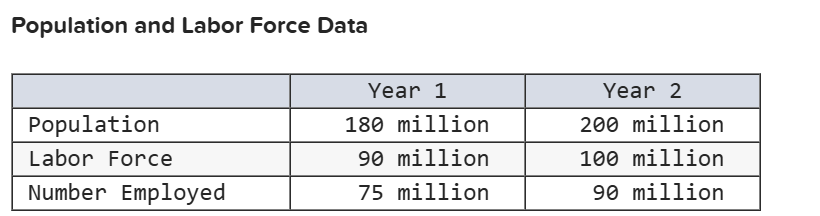
According to the Population and Labor Force Data table, what is the unemployment rate in Year 1?
16.7 percent
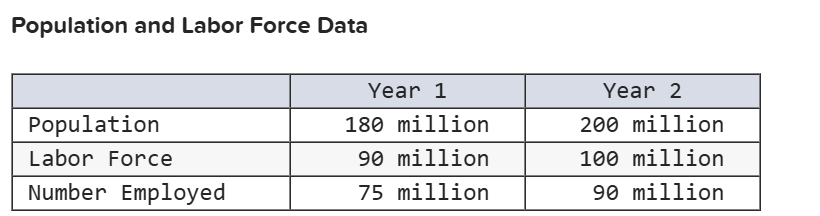
According to the Population and Labor Force Data table, what is the number of unemployed in Year 2?
10 million
Which of the following types of unemployment would best characterize a swimming instructor’s unemployment during the winter months?
seasonal unemployment
After quitting one job, some people with marketable skills find that it takes several months to find a new job that best matches their skill set. This is an example of which type of unemployment?
frictional unemployment
Frictional unemployment goes up when
a worker quits one job in order to search for another
An office worker who loses their job because they do not have the necessary computer skills is likely
structurally unemployed
Automobile workers in Detroit are unemployed because robots are now being used on assembly lines but, at the same time, job vacancies exist for computer programmers. In this case, the automobile workers are an example of
structural unemployment
A stock person who is laid off by a department store because retail sales across the country have decreased is _____ unemployed
cyclically
Which of the following government policies or programs is most likely to reduce cyclical unemployment?
tax incentives to invest in more capital that will contribute to higher production levels
increased job training for computer programmers
additional job-placement services for seasonal workers
additional health services for disabled veterans
tax incentives to invest in more capital that will contribute to higher production levels
According to macroeconomists, a goal for the economy is
zero cyclical unemployment
One reason our full employment goal is not zero percent is because
frictional unemployment will always exist
when the unemployment rate falls to the full employment level
there is increased concern about inflation
deflation occurs when the
price level decreases
Which of the following is an essential part of the market mechanism?
changing relative prices
constant prices
falling average prices
rising average prices
changing relative prices
During a period of inflation
people who have borrowed money may be better off
If the number of dollars you receive every year is the same, but prices are rising, then your nominal income
stays the same, but your real income falls
Patricia’s nominal annual income in 2024 was $60,000. If the rate of inflation is constant at 10 percent, in order to keep Patricia’s real income constant, their nominal income in the year 2025 should be
$66,000
Suppose that at the start of this year you got a salary increase of 10 percent from your employer. The price of goods and services you typically purchase increase 10 percent during the year. At the end of the year, you have experienced
no change in real income
which of the following is an example of the wealth effect during a period of inflation?
A firm receives a fixed price for the services it sells while the price level is rising
You hold money in a savings account that earns 5 percent interest while the price level rises 2 percent
Your income stays constant while the price level doubles
You pay for utilities that are becoming more expensive as the price level is rising
You hold money in a savings account that earns 5 percent interest while the price level rises 2 percent
The value of an original painting, held as an asset, increased in value by 100 percent from 1980 to 2025. Suppose that during the same period, average prices in the economy rose by 150 percent. The owner of the painting, relative to those who do not own paintings, experienced a
lower real wealth, as a result of the wealth effect
If the Consumer Price Index (CPI) had a value of 128 in the year 2025, this means that during the period between the base year and 2025
price of goods and services that typical consumer buys increased by an average of 28 percent
If the CPI is 137 in the year 2025, then it costs ____ in 2025 to buy the same market basket that cost ____ in the base period
$137; $100
If the market basket of goods cost $100 in the base year and $125 in a later year, then average prices have increased by
25 percent
If a market basket of goods cost $100 in the base year and $143 in a later year, then average prices have increased by
43 percent
The CPI tends to overestimate the rate of inflation because
some price increases are an indication of higher quality products
GDP is defined as
the market value of all final goods and services produced in a country in a year