Lipids
 Call Kai
 Learn
Learn Practice Test
 Spaced Repetition
 Match
Match Flashcards
 Knowt Play
1/12

There's no tags or description
Looks like no tags are added yet.
Name | Mastery | Learn | Test | Matching | Spaced | Call with Kai |
|---|
No analytics yet
Send a link to your students to track their progress
13 Terms
What do the functions of lipids include
Energy storage- Fat stored in adipose tissue and can be broken down to be used in respiration
Provide insulation and protection
Key component of cell membranes
Some hormones are lipids
Water storage
What are the three types of lipids you need to be aware of
Triglycerides
Phospholipids
Cholesterol
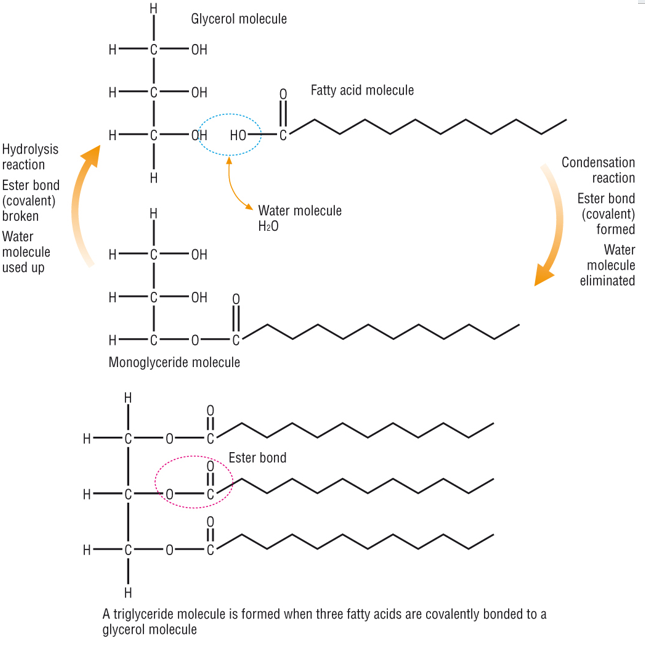
Describe the structure of triglycerides
They have ester bonds between 3 fatty acids+ glycerol. Condensation reactions occur when fatty acid is added can have saturated and unsaturated fats.
Where are triglycerides stored and why
They are stored in adipose tissue as an energy store and for an insulation/ protection. As they are non polar and insoluble they can be stored in compact ways without affecting water potential of cells.
What is triglycerides main function and what makes it suitable for this
Used as an energy store as long fatty acids chains contains lots of chemical energy, meaning triglycerides are good a long-term energy store and when oxidised in respiration they release lots of energy.
What is a saturated fatty acid
A saturated fatty acid only has C-C single bonds, this makes the molecule straight, so the molecules can pack closely meaning they are solid at room temperature, as they have more London forces, due to higher surface contact, so more energy is required to overcome them.
What is an unsaturated fatty acid
They contain one or more C=C double bonds, this creates a kink in the chain of the molecules, so they are liquid at room temperature as molecules cannot pack as closely together.
Describe the structure of phospholipids
They are modified triglycerides, they have one glycerol which forms ester bonds with two fatty acids as one fatty acid is replaced with a phosphate group. So a phospholipid has a phosphate group.
How do phospholipids interact with water
Due to the phosphate ions having extra electrons so are negatively charged, this makes them soluble in water. However, as the fatty acid tails are hydrophobic, when phospholipids interact with water their fatty acid tails stick out whilst the phosphate head is in water, forming a layer and they are called surfactants for this.
What is the two-layered sheet formation that phospholipids can form called. Why is it useful
It is called a bilayer, where the hydrophobic fatty acid tails point towards the centre of the sheet protected from the water by the hydrophilic heads.
The bilayer is important in forming cell membranes, as the hydrophobic core allows small non-polar molecules to diffuse through, whilst ions and polar molecules are restricted making transport controlled.
Note:
Describe the structure of cholesterol
It is not formed from glycerol and fatty acids, they are small molecules made from 4 carbon based rings, with a hydroxyl group on periphery of the membrane. The hydroxyl group is polar so is hydrophilic whilst the rest of the molecule is hydrophobic.
What is the role of cholesterol
As it is a small molecules it fits into the bi-layer of phospholipids providing strength and stability. This is because they restrain movement, stopping them from becoming too fluid at higher temperatures, they also limit excessive permeability
Note:
Cholesterol is used to form steroid hormones such as testosterone, lipid nature of these hormones mean they can pass directly through the bilayer of cells.
How are lipids structure and properties make them suitable for energy storage
Fats have many carbon-carbon and carbon-hydrogen bonds so high proportion of energy rich bonds
Fats contain more energy per molecule and more energy stored in less space
Fats are insoluble so do not affect water potential of cell
Animal fats saturated for insulation as well as energy storage