Genetics chapter 1 and 2
 Call Kai
 Learn
Learn Practice Test
 Spaced Repetition
 Match
Match Flashcards
 Knowt Play
1/55

There's no tags or description
Looks like no tags are added yet.
Name | Mastery | Learn | Test | Matching | Spaced | Call with Kai |
|---|
No analytics yet
Send a link to your students to track their progress
56 Terms
gene
a ‘unit’ of heredit
is a segment of DNA that produces a functional product such as a polypeptide
Genes provide
the blueprint that determines the traits of an organism
Traits
are the observable characteristics of an organismMost
Most human cells contain
46 human chromosomes, 23 pairs
22,000 coding genes
3 billion dna base pairs per set of chromosomes ( containing A,T,G, and C)
Diploid
refers to a cell or organism that contains two sets of chromosomes (i.e. somatic cells)
denoted as "2n" and represents the total number of chromosomes present in most cells
Haploid
refers to a cell or organism that contains a single set of chromosomes. In humans, this refers to cells such as gametes (sperm and egg cells)
carry half the genetic information necessary for a new individual. (n)
Somatic cells
Body cells, other than gametes
Blood cells, for example
Germ cells
Gametes
Sperm and egg cells
Cytogenetics
The field of genetics that involves the microscopic examination of chromosomes
•Centromeres
Constricted regions on chromosomes
Location of centromere establishes appearance of chromosome
Centromere: Long arm =
q arm
Centromere: short arm =
p arm
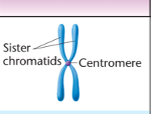
Centromere: Metacentric
middle
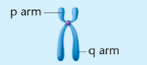
Submetacentric
between the middle and end

Acrocentric
close to end

At end
at end
cell division purpose
asexual reproduction
achieving multicellularity
G0 phase
A cell may remain for here long periods
in this phase is all cell decides to ither progress through the cell cycle or divide again
Terminally differentiated cells (for example adult nerve cells)
G1 phase
Cell commits and prepares to divide
period where cell increases its supply of proteins and number of organelles
DNA is checked for errors
S phase - interphase - DNA replication
Cell chromosomes are replicated → chromatids (2 copies) → form sister chromatids
cell now has twice as many chromosomes as the G1 phase (46 chromosomes in G1 → 46 sister chromatids in S phase)
G2 phase - protein synthesis
cell grows and increases the number of proteins necessary for cell division
M phase - miotic phase - cell diviosion
Cell is subdivided through prophase, metaphase, anaphase, telophase, and cytokinesis resulting in to identical daughter cells
Mitosis: 46 pairs of sister chromatids are separated and sorted Thus, each daughter cell receives
46 chromosomes
In a cell preparing for mitosis, you see two identical copies of a chromosome held together by a centromere. HC or SC?
sister chromatids
A person inherits a chromosome carrying the gene for blue eyes from their mother and a chromosome carrying the gene for brown eyes from their father. HC or SC?
Homologous chromosomes
A cell contains four chromosomes in total, with two pairs that look similar but may have different alleles of genes for specific traits. HC or SC?
Homologus chromosomes
There are 100% identical and generated during S-phase. HC or SC?
sister chromatids
Consider an original mother cell that is diploid (2n).
It contains a total of?
4 chromosomes
Two chromosomes per set (n= 2)
Interphase
Chromosomes decondense forming chromatids (6 pairs not seen until prophase)
centrosome, the attachment point of the mitotic spindle, divides
Spindle Apparatus- Needed for M phase
Microtubules
are formed by rapid polymerization of tubulin proteins
There are three types of spindle microtubules
Aster microtubules
Polar microtubules
Kinetochore microtubules
Aster microtubules
Important for positioning of the spindle apparatus
Polar microtubules
Help to “push” the poles away from each other
Kinetochore microtubules
Attach to the kinetochore, which is bound to the centromere of each individual chromosome
Prophase
Chromatids coil up and condense
centrioles divide and move apart
Prometaphase
centrioles reach the opposite poles, spindle fiber from
Kinetochore microtubules grow
Prometaphase: Kinetochore microtubules grow from the two poles
If they make contact with a kinetochore, the sister chromatid is “captured”
If not, the microtubule depolymerizes and retracts to the centrosome
Prometaphase two kinetochores on a pair of sister chromatids are attached to
kinetochore MT on opposite poles
Metaphase
Pairs of sister chromatids align themselves the metaphase plate
Each pair of chromatids (dyad) is attached to both poles by kinetochore microtubules
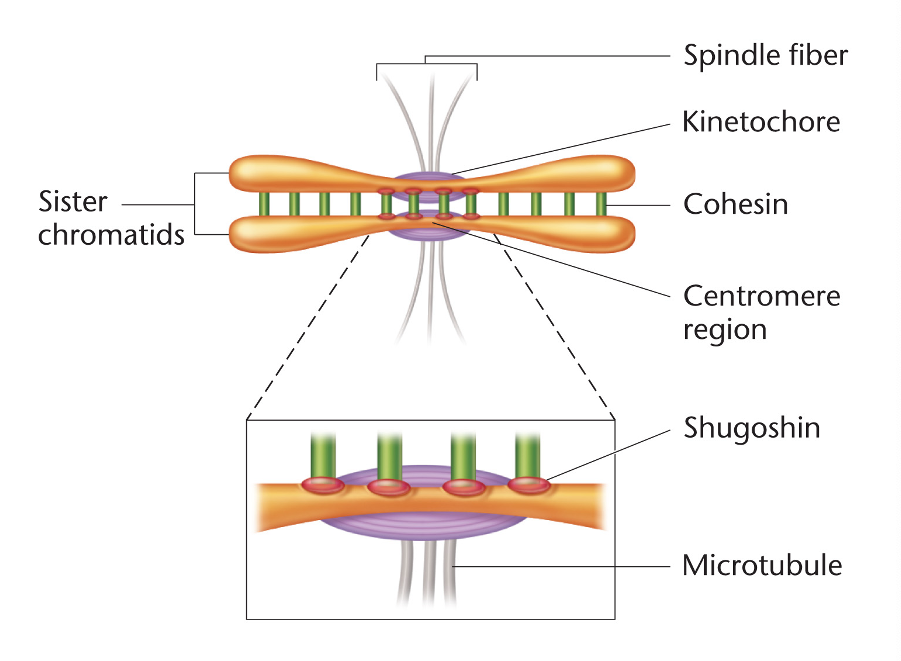
Cohesin
protein complex that holds sister chromatids together
Separase
Enzyme that degrades cohesin
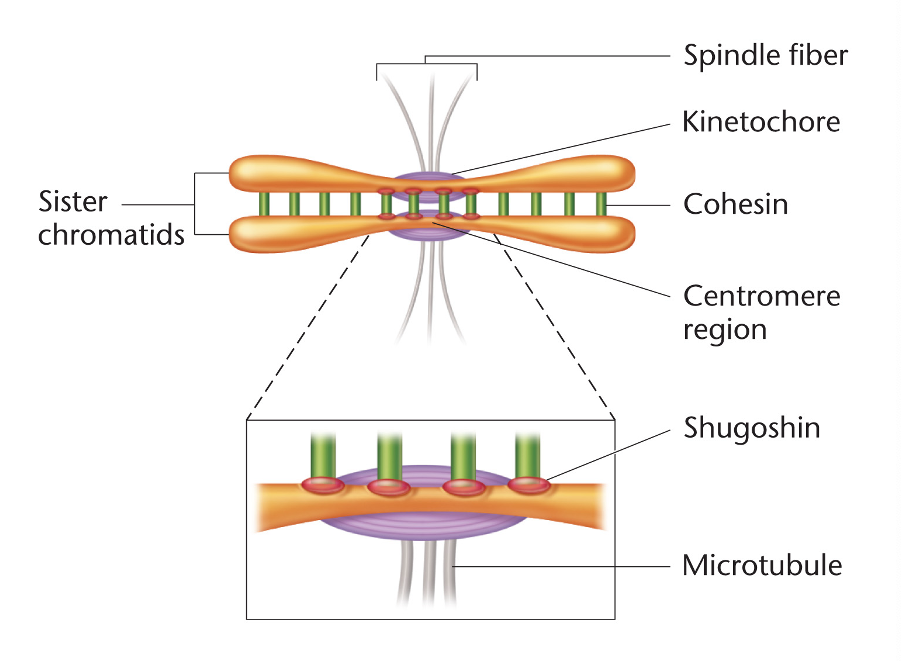
Shugoshin
Protein that protects cohesin from being degraded by separase
Anaphase
centromeres split and daughter chromosomes migrate to opposite poles
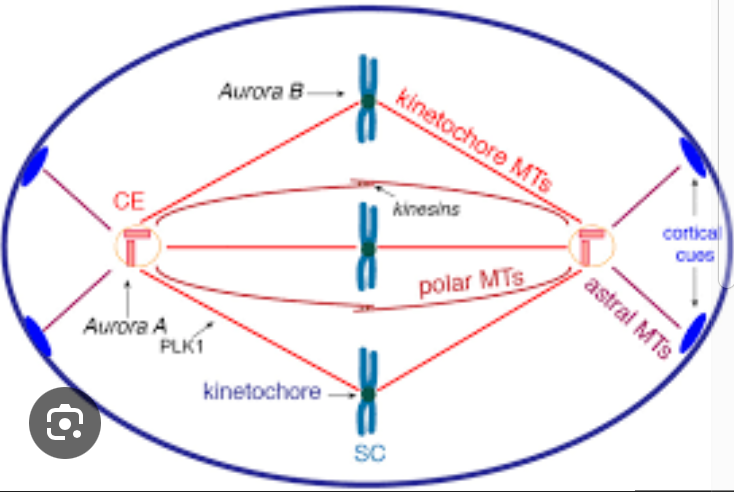
As anaphase proceeds
Kinetochore MTs-
shorten
Chromosomes move to opposite poles
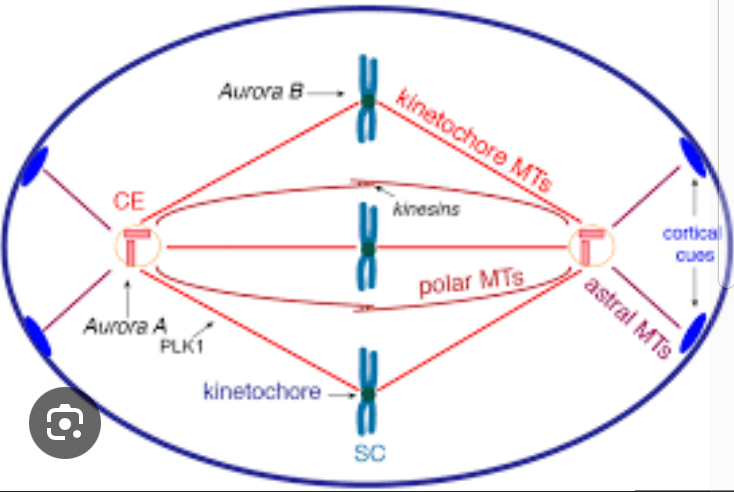
As anaphase proceeds
Polar MTs lengthen
Poles themselves move further away from each other
elongating the cell
Telophase
Daughter chromosomes arrive at thr poles
cytokensis commences
nucleus membrane froms two separate nuclie
Outcome of Mitotic Cell Division
produces two daughter cells are genetically identical to each other
ensures genetic consistency from one cell to the next
development of multicellularity relies on
the repeated process of mitosis and cytokinesis
Meiosis
Parents (diploid) make gametes with half the amount of genetic material (haploid)
These gametes fuse with each other during fertilization to create a new diploid individual
Gametes
1n
contains only 23 chromosomes
Unlike mitosis, meiosis involves
two successive divisions to reduce the chromosome content (termed meiosis 1 and 2). Each meiotic division is subdivided into:
Prophase
Prometaphase
Metaphase
Anaphase
Telophase
Meiosis: Prophase 1 is further subdivided into five stages known as
Leptonema
Zygonema
Pachynema
Diplonema
Diakinesis
meiosis beging with _____ and ends with _____.
one cell with 4 diploid chromosomes (2n = 4)
4 genetically differentiated haploid cells, each with two chromosomes (n = 2)
Meiosis significantly increases the
level of genetic variation due to crossing over
Mitosis vs meiosis II
For a diploid organism with six chromosomes
Mitosis begins with 12 chromatids joined as six pairs of sister chromatids
Meiosis 2 begins with 6 chromatids joined as three pairs of sister chromatids
Sexual Reproduction
Parents (diploid) make gametes through the process of gametogenesis with half the amount of genetic material (haploid)