Biology 1D Environment
 Call Kai
 Learn
Learn Practice Test
 Spaced Repetition
 Match
Match Flashcards
 Knowt Play
1/215

There's no tags or description
Looks like no tags are added yet.
Name | Mastery | Learn | Test | Matching | Spaced | Call with Kai |
|---|
No analytics yet
Send a link to your students to track their progress
216 Terms
snowball earth hypothesis
earth’s surface entirely frozen and oceans covered by ice
snowball earth competing theories
rocks formed near equator and deformed + dropstones NEAR EQUATOR vs. rock formed and deformed EVERYWHERE
creator of snowball earth hypothesis
Paul hoffman
skeptic of snowball earth
nick christie-blick (slushball)
how did earth get out of snowball earth
volcanoes, greenhouse effect, geothermal vents, gaps in melted ice, cap carbonates
modular organism
plants - build indefinitely
indeterminate
unspecialised
determinate
specialised
inflorescence
group of flowers on stem
cladode
leaf-like structure, formed from a stem
geranium lucidum
different color leaves - sun exposure and stress
cheese plant/monstera
holes - to appear previously eaten
rheum nobile
white leaves - high uv radiation/conserve warmth
how many cells in a human
~7- trillion —> 55% (31 trillion contain DNA)
microbiome
community of microorganisms that live in specific environment
bioaugmentation
adding microorganisms to contaminated environments to degrade pollutants
microbiome interactions
competition for space, parasitism, predator/prey engulfing, social signal
quorum sensing
bacterial communication, exploiting new niches (biofilm formation)
succession
communities age over time in response to environment - abiotic and biotic agents
birth mode and microbiome
influence on gut - c section vs birth canal can have short term effects on matching maternal microbiome
how to change microbiome
diet (probiotics), health/treatment, hormones, fecal transplants, antibiotics/chemo
rewilding the gut
fecal microbiome transplant, does not usually work, high possibility of mismatch; adding a climax community to a bare environment so it doesn’t work
why are human microbiomes different from each other
different parts of the world have different dominant types, nature vs. nurture
human microbiome project
trying to characterize a health microbiome - difficult to define
lactobacillus
lactic acid producing bacteria - marker of health
4 proven climate change facts + 2 causal relationships
CO2 traps heat, humans emit CO2, increasing CO2 in atmosphere, global temperatures rising —> CO2 increase due to humans and causing climate change
current consensus for climate change
less heat escaping atmosphere than before and reduction matches CO2 plus CH4 absorption wavelengths
niche
summary of organisms’s tolerances and requirements - first defined by grinnell in 1914 - how not where an organism lives
competitive exclusion principle
gauses 1934 theory - complete competitors cannot exist, species use different parts of a habitat - 2 species using same limiting resource in some way cannot coexist indefinitely, the greater the difference the more likely to coexist (avoid by keeping species at low density and intra>inter)
n dimensional hypervolume
defines boundaries of life and multidimensional - defined by GE Hutchinson 1957 - addresses ways in which tolerances and requirements interact to define conditions and resources needed (temp, humidity, pH, windspeed, water flow, daylight, precipitation, etc)
resource partitioning
ecologically similar species living in same habitat utilize different resources
spatial/temporal/morphological/conditional partitioning
similar species use same resource but are separated in space, time, morphology, or ability to use resource
niche construction
organism modifies own niche to increase fitness important for natural selection
extended phenotype
not limited to biological processes but extended to all effects gene has on environment
fundamental niche
overall potential niche of a species, allowing it to have viable population
realised niche
more limited spectrum of conditions and resources that allow a species to persist - role species fills in reality - restricted by interspecific competition that reduces survival
carrying capacity (K)
how many individuals a niche can support - species can be limited by others occupying same space therefore lowering K
how do competing species coexist
one wins and higher K more competitive, another wins, either could win and then one goes extinct (higher inter low intra), both coexist (low inter high intra)
two ways to prevent competitive exclusion
species at low density + species inhibits own population growth more than its competitor
two mechanisms of competitive coexistence
equalizing (keep density of strongest competitors low - predation) + stabilizing (cause intraspecific competition > interspecific —> species increases when rare - niche differentiation)
evolution and niches
evolution → ecology (related species inherit similar ecological traits, phylogenetic niche conservation) vs. ecology → evolution (competitive exclusion principle. adaptation to new niches and reproductive isolation, speciation and extinction)
community
assemblage of species populations that occur together at same place and time; defined arbitrarily based on interests of ecologists studying them using physical or biological characteristics
ecological community
collection of organisms found inhabiting a defined area - understand origin, maintenance, and consequences of diversity, measures of diversity and relative species abundance
how to define communities
taxonomic affinity, guild (group of species using same resources), functional groups (subset of community includes species that function in similar ways but dont use same resources, defined based on sets of species traits useful to explain ecosystem properties)
ecosystem service
something functional group does for community to aid other species
trophic levels
position organism occupies in a food chain; energy flows up
national vegetation classification
1975 book to classify plant structure
functional feeding groups
predator, omnivore, collector, grazer, shredder, piercer
community structure
set of characteristics that shape a community; descriptive in nature but provides necessary quantitative basis for generating hypotheses and experiments to better understand communities
species richness
number of species - measured by species accumulation curve, influenced by degree and length of isolation, size of island, habitat suitability, location relative to ocean currents, serendipity, human activity
species evenness
abundance of species (common and rare)
species diversity
measure of both richness and evenness
Shannon Diversity index
estimate of species diversity (H= - ∑(Pi*(lnPi) ) - higher H value indicates more diversity (usually between 1-3)
biodiversity
richness and diversity of species; measured at all scales
biogeography
study of variation in species competition and diversity among geographic locations
latitudinal diversity gradient
more diversity in low latitudes - higher productivity and rate of diversification
species area curves
as size of habitat increases the number of species increases
Equilibrium Theory of Island Biogeography
McArthur and Wilson 1967 - number of species on an island depends on balance between immigration, dispersal rates, and extinction balance in dynamic; rates vary by size and isolation
disharmony
relative proportions of different taxa are not the same on islands as mainland
assembly rules
patterns in developing and establishing communities (predators cannot invade new community without prey; only certain combinations exist in nature; different rules for different areas)
incidence functions
relationship between species and island size
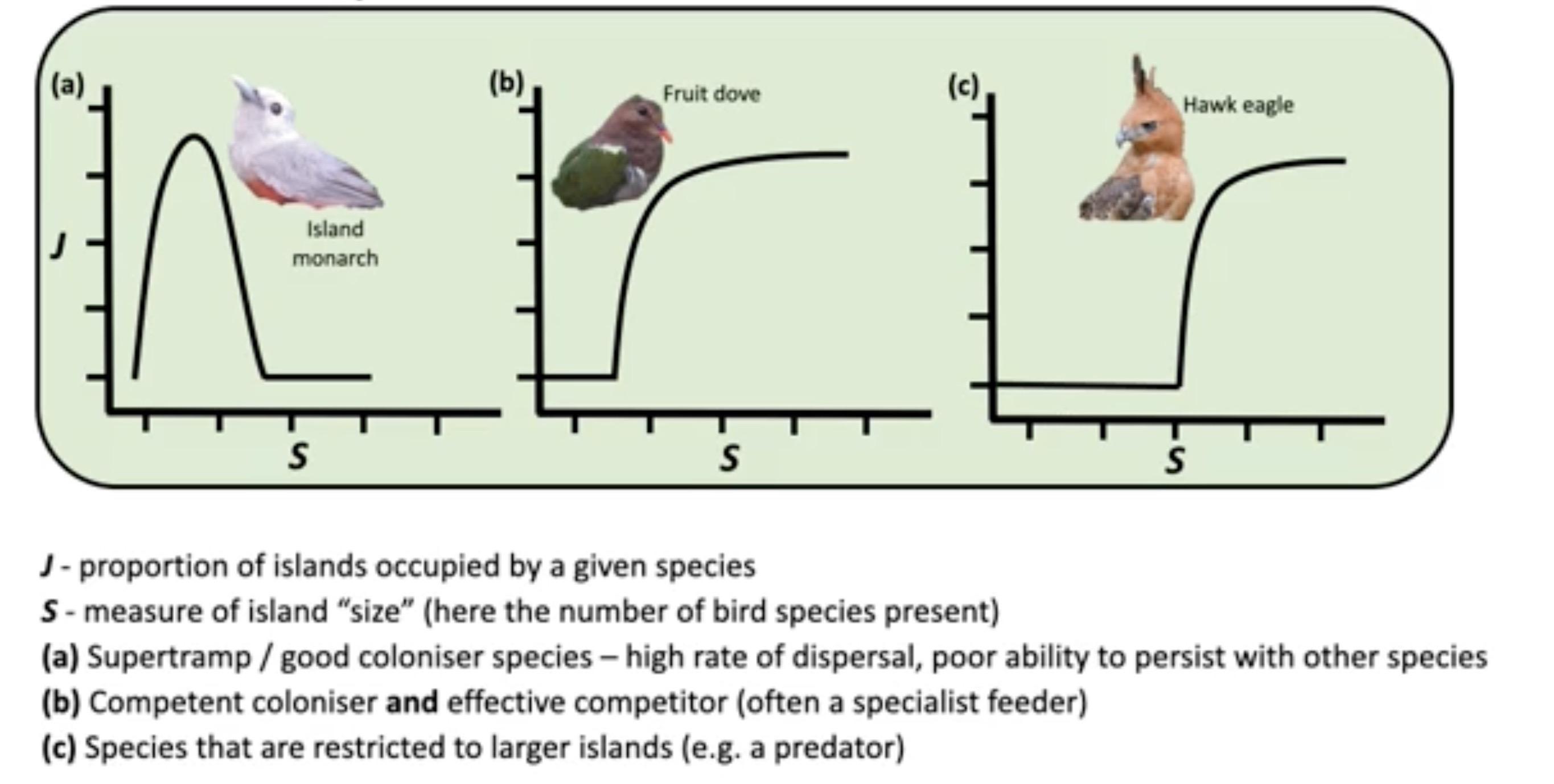
island biogeography
small island: high extinction, low immigration, low diversity
large island: low extinction, high immigration, high diversity
neighbor island: low extinction, high immigration, high diversity
far islands: high extinction, low immigration, low diversity
food chains
animals linked together by food, and all dependent in the long run upon plants
food webs
describes feeding relations among organisms in all or part of a community/ecosystem
trophic levels in food chain
primary producer (autotroph, detritivore, decomposer) → primary consumer (herbivore)→ secondary consumer (primary carnivore) → tertiary consumer (apex predator, secondary carnivore) - measure by number of lines + 1 between basal species and species of interest
links
lines between nodes that indicate predator/prey relationship and competition
nodes
single species/group
trophic position
nodes distinguished as basal, intermediate, or top predators
source webs
feeding relations among species from single food source
sink webs
linked by one top predator and what they eat
community webs
describe entire set of feeding relations
cycles and loops
species have reciprocal feeding relations
energy flow
energy created by autotrophs and flows through chain, passes up through each feeding link, energy lost with each transfer due to entropy, net energy will decrease with each level
trophic efficiency
how much energy is transferred up the foodchain (CE*AE*PE)
consumption energy
proportion of available energy ingested by consumers (In/Pn-1 ×100)
assimilation efficiency
proportion of ingested food that is assimilated by consumer via digestion (An/In *100)
production efficiency
proportion of assimilated food that goes into producing new consumer biomass (Pn/An *100)
Interaction strength
measure of the effect of one species’ population on the size of anothers
apparent competition
presence of multiple noncompeting prey species elevates predator abundance and increased predation pressure
trophic cascade
how effects at one trophic level can influence abundance of species at another (bottom up or top down), required to happen over minimum of three levels to fit description
keystone species
species tightly connected within food web
indirect effects
influence of one species, donor is transmitted through second species (transmitter) and third species (receiver)
direct observation
+: direct evidence, -: time, nature interference, bias, affected behavior, lose contact
scat analysis
+: direct evidence, repeatable, -: sick animals, contaminated, limited, digestion and decay rate, bias
gut content analysis
+: direct evidence, not biased towards large size, -: repeatability, killing animal, requires capture, invasive, only shows last meal
stable isotope analysis
+: direct evidence, not biased towards large size, repeatable, accumulate in flesh/bones, -: tissues needed, resource demanding, can be misleading
10% Rule
loss of energy at each step
individual efficiency
efficiency with which a typical individual turns its consumption into somatic growth
abiotic changes
waves, currents, wind, water supply, chemical composition, temperature, volcanic activity, disturbance: physically harms some individual and creates opportunities for others to grow and reproduce, unpredictable and one off event, stress: occurs when abiotic factor reduces growth or reproduction of individuals and creates opportunities for others, impede performance
biotic changes
negative interactions between species; competition, predation, herbivory, disease, parasitic, trampling
basics of succession
involves colonization and extinction of species in a community due to agents of change; influenced by: site conditions, events initiating succession, interactions of species, availability of colonists, seeds, weather conditions
pioneer stage
after a catastrophic disturbance
climax stage
an equilibrium stage with little change
primary succession
involves colonization of habitats that are devoid of life; slow with first arrivals, basic resources lacking; capable of withstanding stress
secondary succession
reestablishment of community in which most organisms have been destroyed; occurs after agents of change; surviving species very important
intensity
amount of damage and death caused
frequency
how often the change occurs
intermediate disturbance hypothesis
disturbance as a prevalent feature that influences community diversity; high and low levels disturbance reduce diversity and intermediate levels promote diversity
Facilitation Model
only pioneer species established, modification for later; dominant replace them
tolerance model
any species in succession could establish in present conditions; early modification has no effect; dominant will eventually replace