Mechanics
 Call Kai
 Learn
Learn Practice Test
 Spaced Repetition
 Match
Match Flashcards
 Knowt Play
1/31

There's no tags or description
Looks like no tags are added yet.
Name | Mastery | Learn | Test | Matching | Spaced | Call with Kai |
|---|
No analytics yet
Send a link to your students to track their progress
32 Terms
Is velocity always 0 when it strikes the ground?
No
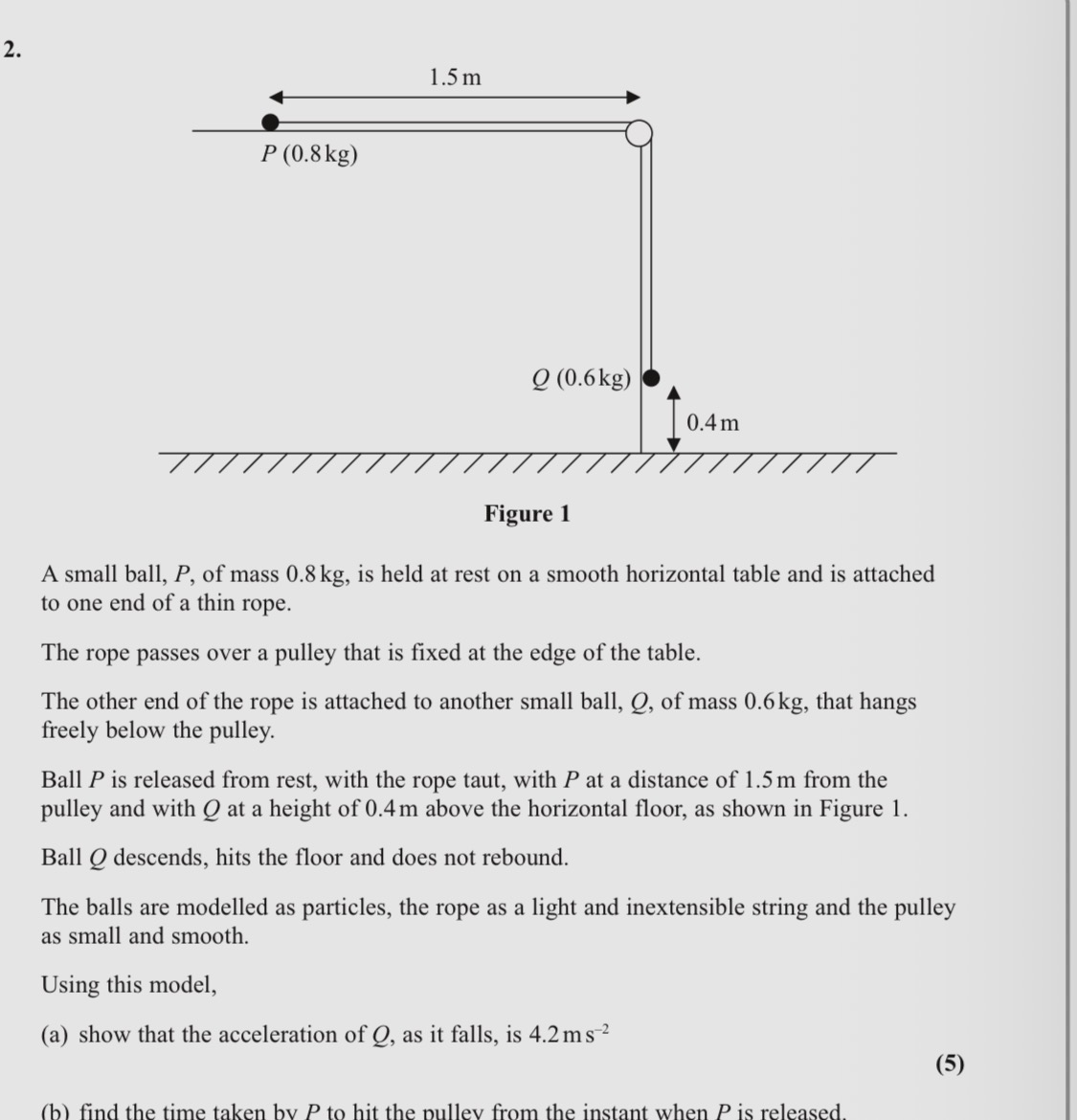
Steps of this question
Distance in 0.4m
Velocity of Q
Distance in 1.1m-by speed=distance/time
Add times together

Velocity time graph tips
W
State one limitation of the model apart from ignoring air resistance that will affect the accuracy of tension
Pulley system
Include weight of rope
Suggest one refinement that would make the model more realistic
Vertical motion
Use a more accurate value of g-only if g is originally 10
Allow for wind effects
In reality the stone will not move freely under gravity and will be subject to air resistance How would this affect the initial velocity
Vertical motion
Greater
State one limitation of the model which could affect the acceleration and speed
Train moving-uniform acceleration
Horizontal motion
Train wont move with constant acceleration
Draw increasing distance on a distance time graph

Draw constant speed on a distance time graph

Draw decreasing speed on a distance time graph
Give 2 reasons why distance is likely to be different
Horizontal motion
Bumps in the road affect the trailer
Resistance differs
Refinement to model of stone in air
Vertical motion
Include the dimensions of the stone
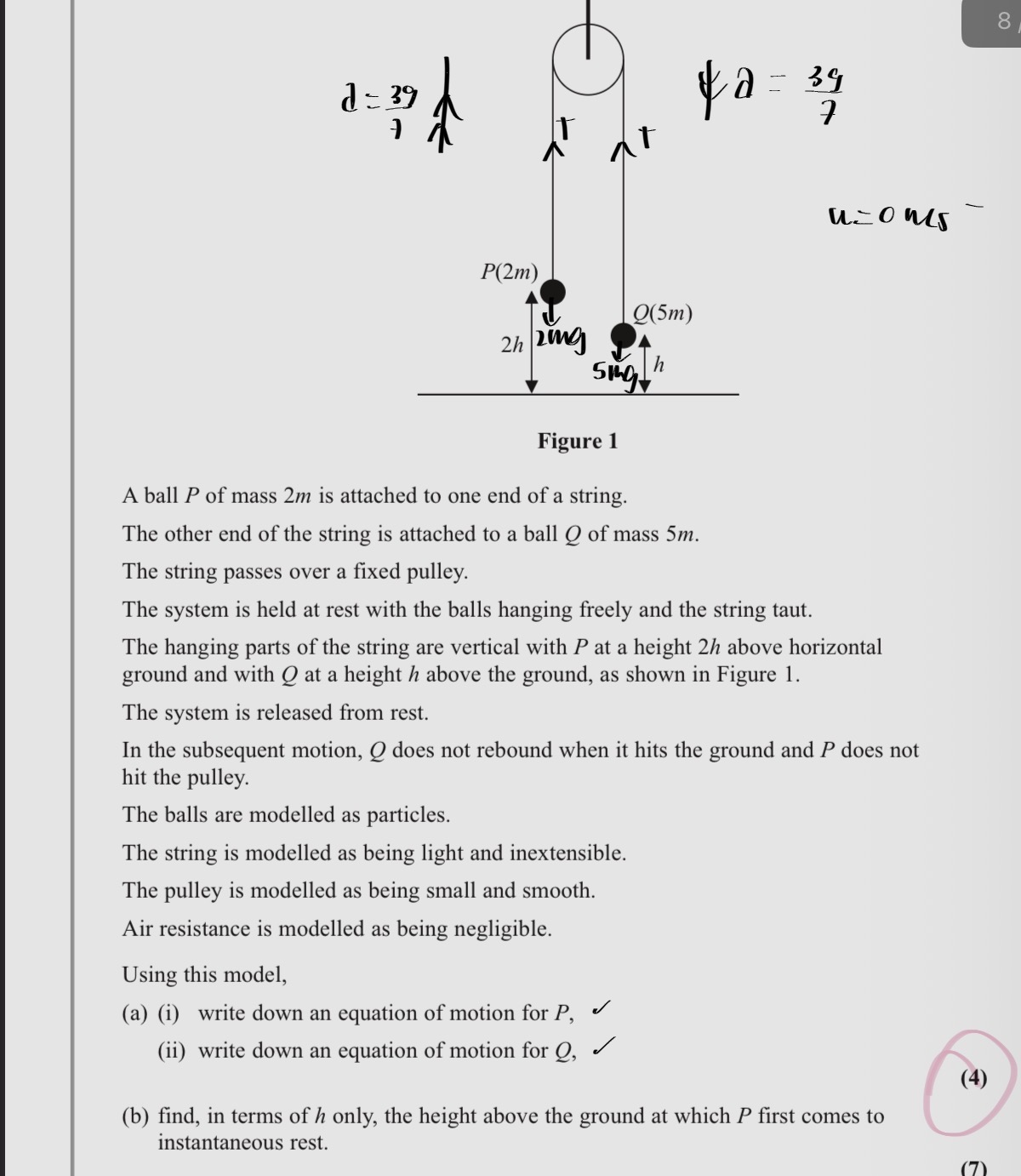
Steph for part b only
Find final velocity of Q-which is the initial velocity of P
Find the distance P moves With this velocity-BUT WITH G AS ACCELERATION AS Q doesn’t rebound so tension is non existent or GOES TO INSTANTANEOUS rest and with that velocity u found as initial velocity now bc it was final for Q-
Add the 2h and the h-for the distance Q moves bc P moves the exact same amount- and add the distance you calculated for P as well-the one u used the initial velocity for-
When is there no tension?
No tension when not connected
What does a light system mean?
Tension is equal
What does inextensible suggest?
Equal acceleration
What does a smooth pulley suggest?
Acceleration is equal
When the string breaks what changes?
Acceleration
As system is now in free fall
Limitation of using resistance for motion of a car
Air resistance can vary depending on speed so wont be constant
Normal reaction what do you do
Multiply the number by g
Improvements to pulley system
Doesn’t take into account mass of string
What affects acceleration in terms of rope
Rope being light
What affects the tension in a pulley system
Pulley not being smooth
Limitation of modelling balls as particles
Distance in terms of h
Distance it falls would not be exactly h
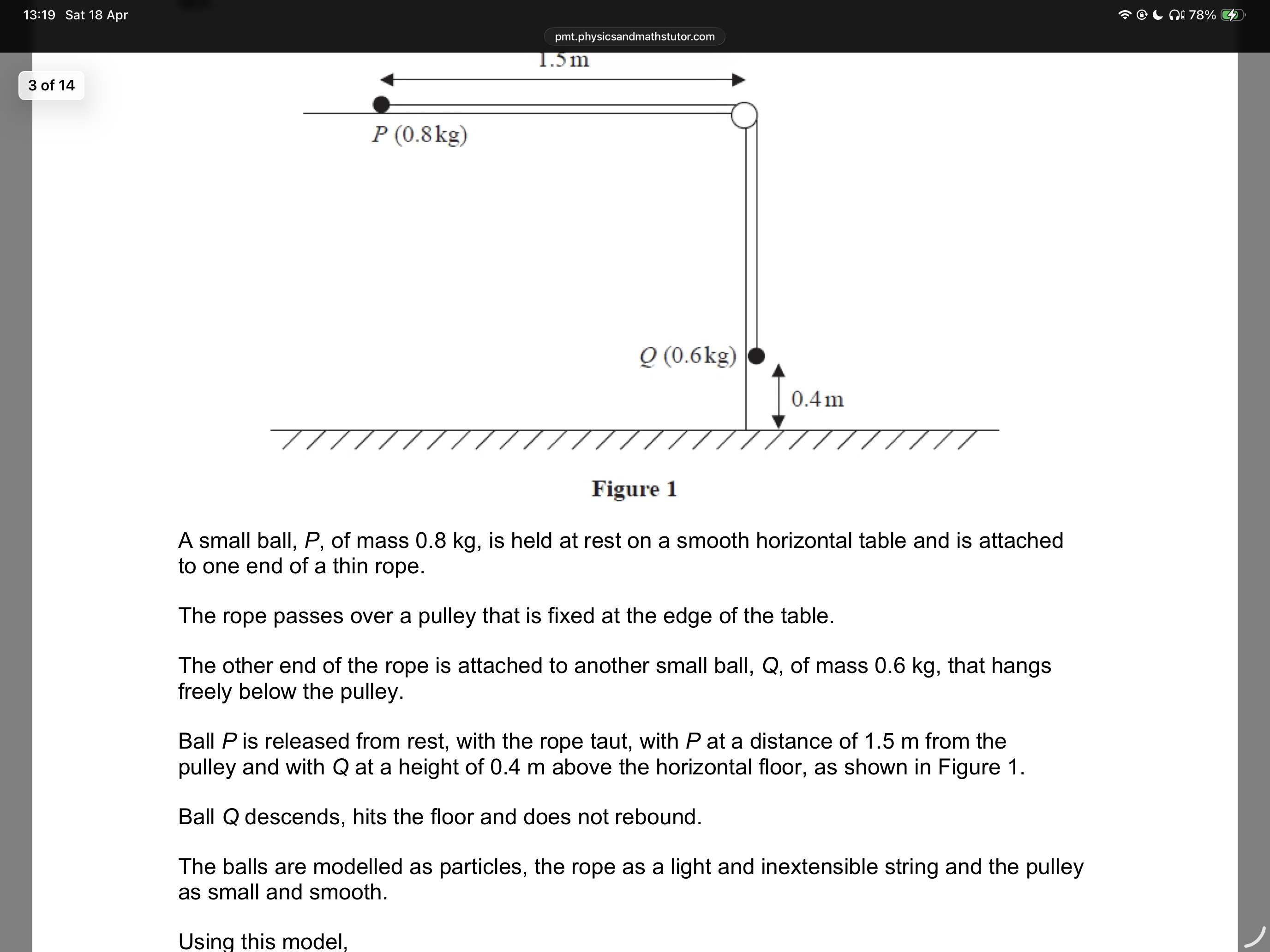
Steps of this question;
find the time taken by P to hit the pulley from the instant when P is released.
Time Q to hit floOr
Speed for Q to hit floor
Time for P to hit the pulley-after Q hits the floor- speed= distance divided by time
Add times together
Use coordinates for a velocity time graph shape might be easier
What does a negative velocity mean?
Opposite direction
When can you not use g for acceleration
If the question doesnt say freely under gravity
3
Refinement to suvat model
Remember all
Include air resistance
Use a more accurate value for g
Take into account wind effects
In reality the stone will not move freely under gravity and will be subject to air resistance.
(d) Explain how this would affect your answer to the initial velocity and give a reason
U would be greater.
As air resistance would slow the object in motion down
In a displacement SUVAT equation What do you take the initial velocity as positive or negative?
If upwards is taken as positive
Positive