Exam 3 Carruth The Knee
0.0(0)
Studied by 3 people Call Kai
 Learn
Learn Practice Test
 Spaced Repetition
 Match
Match Flashcards
 Knowt Play
Card Sorting
1/51

Earn XP
Description and Tags
Last updated 2:33 AM on 11/10/22
Name | Mastery | Learn | Test | Matching | Spaced | Call with Kai |
|---|
No analytics yet
Send a link to your students to track their progress
52 Terms
1
New cards
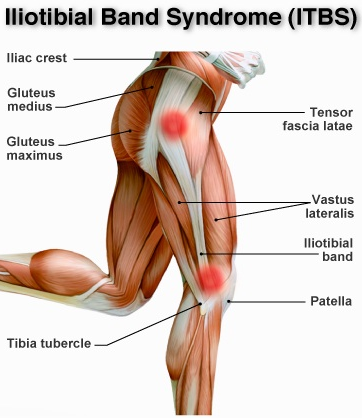
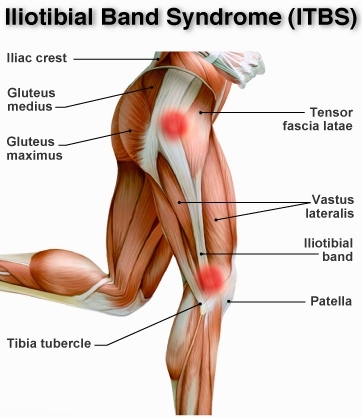
ILIOTIBIAL BAND FRICTION SYNDROME
- Common occurs with
- Common occurs with
distance runners and cyclist
- constantly moving knee from flexion to extension. Running injuries occurs mostly on the right hand side. (running at a slight angle putting additional pressure on the right side). The force exerted on you during run. causes pressure on the outside leg.
•Mostly due to abnormal alignment in the lower extremity
- constantly moving knee from flexion to extension. Running injuries occurs mostly on the right hand side. (running at a slight angle putting additional pressure on the right side). The force exerted on you during run. causes pressure on the outside leg.
•Mostly due to abnormal alignment in the lower extremity
2
New cards
TFL and gluteus maximus
pulls on the IT BAND. general direction up IT BAND is up. These are the muscles we're concerned about. Can pull the IT Band to stretch these, because they stretch the IT BAND.
3
New cards
IT BAND ON Lateral condyle and Medial condyle
4
New cards
Rubbing of the IT BAND on outside of femur causes
irritation and swelling which will constantly catch until we get it to cool down.
5
New cards
IT BAND
Runs from the hip to the fibula. Band of connective tissue (silver skin). which is non flexible (cannot be stretched). excessive tightness here: muscles at the hip are pulling up on this muscle. IT band causes problem in the knee that originate in the hip.
6
New cards
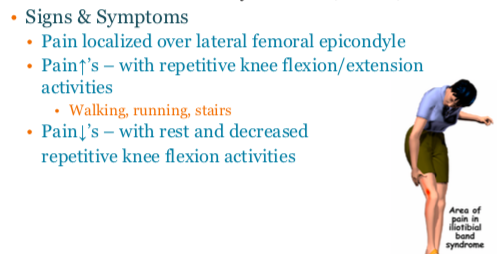
ILIOTIBIAL BAND Friction Syndrome
- Signs and Symptoms
- Signs and Symptoms
•Pain usually in the distal portion of IT band
•Maybe point tender - lateral femoral epicondyle
•Pain increase with flexion and extension of the knee.
- overused injury.
•Maybe point tender - lateral femoral epicondyle
•Pain increase with flexion and extension of the knee.
- overused injury.
7
New cards
non of the lower leg muscles crosses the knee
however, they still interact with the foot.
8
New cards
Iliotibial Band Friction Syndrome
- Treatment
- Treatment
•Investigate causes
•Muscle tightness
•Correct abnormalities
•Activity Level
•Running surfaces
•Stretching of IT band and hip musculature
•Ice
•Anti-inflammatory medications
•Muscle tightness
•Correct abnormalities
•Activity Level
•Running surfaces
•Stretching of IT band and hip musculature
•Ice
•Anti-inflammatory medications
9
New cards
ILIOTIBIAL BAND FRICTION SYNDROME on general population:
Supinators: bowleg making it tighter on the inside leg. Vice Versa for pronators.
10
New cards
ILIOTIBIAL STRETCHING
Cross leg sitting up and laying down (gluteus), Straight TFL stretching, Rolling out (the best).
11
New cards
Knee
four bones: femur tibia, fibula, patella. (are held together by four ligaments except the patella).
Four ligament: MCL, PCL, ACL, LCL. Two Meniscus.
Four ligament: MCL, PCL, ACL, LCL. Two Meniscus.
12
New cards
Collateral
on the side.
13
New cards
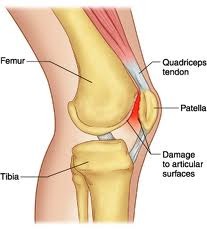
CHRONDROMALACIA OF THE PATELLA
a painful degenerative condition that results in the irritation and softening of the articular cartilage on the posterior patella
14
New cards
medial and lateral menisci
fibrocartilage pads, at femur-tibia articulations, cushion and stabilize joint, give lateral support
15
New cards
The patella is the
the tendon, the quads is ligament.
16
New cards
CHRONDROMALACIA
affects:
affects:
the underside of the patella
17
New cards
CHRONDROMALACIA is the
•Softening and deterioration of the cartilage
•Abnormal movement = friction between the underside of the patella and femur
•Vastus Medialis
•Q-angle:
- listed because they are the reason for the problem.
•Abnormal movement = friction between the underside of the patella and femur
•Vastus Medialis
•Q-angle:
- listed because they are the reason for the problem.
18
New cards
CHONDROMALACIA
Signs and Symptoms:
Signs and Symptoms:
•Pain when extending the knee and terminal degrees of flexion
•May experience a grinding sensation
•May experience a grinding sensation
19
New cards
CHONDROMALACIA
Treatment:
Treatment:
•Modify activity level
•Stretching and Strengthen of quadriceps muscles (Vatus Literalis, Vastus Medialalis, Vastus Femoris).
•Bracing (suppose to act like mcconnell tape).
•If conservative measure fail, surgery may be considered
•Stretching and Strengthen of quadriceps muscles (Vatus Literalis, Vastus Medialalis, Vastus Femoris).
•Bracing (suppose to act like mcconnell tape).
•If conservative measure fail, surgery may be considered
20
New cards
PATELLAR TENDINITIS
•Due to repetitive forceful contraction of the quadriceps muscle group
•Force produced in the quadriceps translated thru patella tendon
- inflammation caused by overuse.
•Force produced in the quadriceps translated thru patella tendon
- inflammation caused by overuse.
21
New cards
PATELLAR TENDINITIS
- Signs & Symptoms
- Signs & Symptoms
•Pain at inferior pole of patella
•Moderately point tender
•Tightness within the tendon
•Can eventually lead to rupture
•Moderately point tender
•Tightness within the tendon
•Can eventually lead to rupture
22
New cards
PATELLAR TENDINITIS
- Treatment
- Treatment
•Modify activity level
•Stretching of quadriceps
•Massage
•Patella tendon strap
•Stretching of quadriceps
•Massage
•Patella tendon strap
23
New cards
OSGOOD-SCHLATTER DISEASE
•Due repetitive pull of patellar tendon on its attachment side at the tibial tuberosity
•Small attachment site for a large and powerful muscle group
•Repetitive forces
•Inflammation
•Irritation of bone
•Leads to formation of callus - enlarged tibial tuberosity
•Small attachment site for a large and powerful muscle group
•Repetitive forces
•Inflammation
•Irritation of bone
•Leads to formation of callus - enlarged tibial tuberosity
24
New cards
OSGOOD-SCHLATTER DISEASE
- Signs & Symptoms
- Signs & Symptoms
•Pain at tibial tuberosity
•Usually occurs in adolescents and teenagers
•Usually occurs in adolescents and teenagers
25
New cards
OSGOOD-SCHLATTER DISEASE
- Treatment:
- Treatment:
•Modify activity
•Stretching and Treat inflammation
•Padding if point tender
•Stretching and Treat inflammation
•Padding if point tender
26
New cards
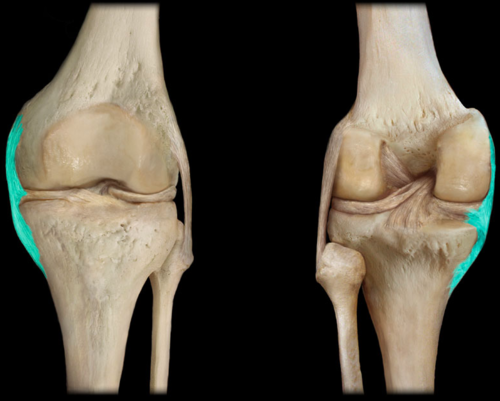
MEDIAL COLLATERAL LIGAMENT SPRAINS
- Causes =
- Causes =
- Valgus Force at the knee and/or external rotation of the tibia. force that comes from the outside to inside.
•Foot planted
•Direct blow
- ligament on the inside. mcl runs from femur to fibula.
•Foot planted
•Direct blow
- ligament on the inside. mcl runs from femur to fibula.
27
New cards
if it hurts on the side you got hit on
not worried about that ligament. now if it was the opposite you'd be worried.
28
New cards
MEDIAL COLLATERAL LIGAMENT SPRAINS
- Can BE
- Can BE
accompanied with damage to other structures
29
New cards
MCL SPRAINS
•Valgus Force
30
New cards
MCL SPRAINS
- Signs & Symptoms
- Signs & Symptoms
•Mild to Moderate Pain is generally over the medial joint line
•Mild to moderate swelling located over entire medial knee
•Remember Degrees of Sprains
•With Grade II and III there will be instability
•Buckle or give way
•Mild to moderate swelling located over entire medial knee
•Remember Degrees of Sprains
•With Grade II and III there will be instability
•Buckle or give way
31
New cards
MCL SPRAINS
- Treatment: Grade I:
- Treatment: Grade I:
•Depends on the severity
(no instability or laxity)
•Ability to walk w/o compensation
•Presence of swelling and pain
•Maintain strength and ROM
•FOCUS
•Limit Activities
(no instability or laxity)
•Ability to walk w/o compensation
•Presence of swelling and pain
•Maintain strength and ROM
•FOCUS
•Limit Activities
32
New cards
MCL SPRAINS
- Treatment: Grade II
- Treatment: Grade II
•Has Laxity and instability
•Ability to walk?
•Amount of swelling/pain
•PROTECTION (immobilization Period)
•RE-GAIN ROM AND STRENGTH
•FOCUS
•Isometrics to Isotonics
•Gradual return to activities
•Ability to walk?
•Amount of swelling/pain
•PROTECTION (immobilization Period)
•RE-GAIN ROM AND STRENGTH
•FOCUS
•Isometrics to Isotonics
•Gradual return to activities
33
New cards
MCL SPRAINS
- Treatment: Grade III
- Treatment: Grade III
•Rule out other ligaments and meniscus
Damage
Same Tx protocol as Grade II, just longer. Has Laxity and instability•Ability to walk?•Amount of swelling/pain•PROTECTION (immobilization Period)•RE-GAIN ROM AND STRENGTH•FOCUS•Isometrics to Isotonics•Gradual return to activities
Damage
Same Tx protocol as Grade II, just longer. Has Laxity and instability•Ability to walk?•Amount of swelling/pain•PROTECTION (immobilization Period)•RE-GAIN ROM AND STRENGTH•FOCUS•Isometrics to Isotonics•Gradual return to activities
34
New cards
LATERAL COLLATERAL LIGAMENT SPRAINS Causes
•Varus Force and/or Internal Rotation of the tibia
35
New cards
LATERAL COLLATERAL LIGAMENT SPRAINS
- Signs & Symptoms
- Signs & Symptoms
•Pain and Swelling over lateral joint line
•Depends on Grade of Sprain
•Depends on Grade of Sprain
36
New cards
LATERAL COLLATERAL LIGAMENT SPRAINS
Treatment Grade I
Treatment Grade I
•Depends on the severity
•Grade I (no instability or laxity)
•Ability to walk w/o compensation
•Presence of swelling and pain
•Maintain strength and ROM
•FOCUS
•Limit Activities
- Same as MCL Sprains.
•Grade I (no instability or laxity)
•Ability to walk w/o compensation
•Presence of swelling and pain
•Maintain strength and ROM
•FOCUS
•Limit Activities
- Same as MCL Sprains.
37
New cards
LATERAL COLLATERAL LIGAMENT SPRAINS
Treatment Grade II & III
Treatment Grade II & III
•Initially Protect
•Efforts to decrease pain and swelling
•Rehab focus: regaining ROM and Strengthing lateral structures of knee.
•Longer period of healing
•Efforts to decrease pain and swelling
•Rehab focus: regaining ROM and Strengthing lateral structures of knee.
•Longer period of healing
38
New cards
MENISCUS INJURIES
- Cause:
- Cause:
•Weight-bearing position + rotational force at the knee + some degree of knee flexion
39
New cards
MENISCAL INJURIES
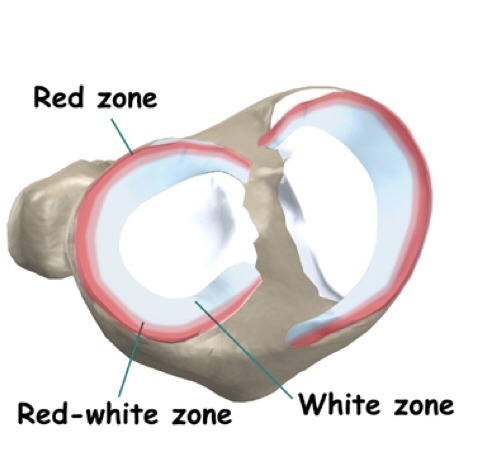
•Vascular Zone vs. Avascular zone
•Vascular Zone vs. Avascular zone
if cut and do not bleed meaning they would potentially not heal. would want bleeding to get blood to the area.
40
New cards
MENISCAL INJURIES
Signs & Symptoms
Signs & Symptoms
•Mild to moderate pain (everywhere)
- generally hurt in the morning, at night, moving up and down stairs.
Varying locations (front, back, sides).
With terminal degrees of ROM
•Diffuse swelling
•Loss of Range of motion (because of swelling or mechanical blockage).
•Feeling of instability or weakness
•Locking
Bilitibal Patellar = can tell it's swollen.
- generally hurt in the morning, at night, moving up and down stairs.
Varying locations (front, back, sides).
With terminal degrees of ROM
•Diffuse swelling
•Loss of Range of motion (because of swelling or mechanical blockage).
•Feeling of instability or weakness
•Locking
Bilitibal Patellar = can tell it's swollen.
41
New cards
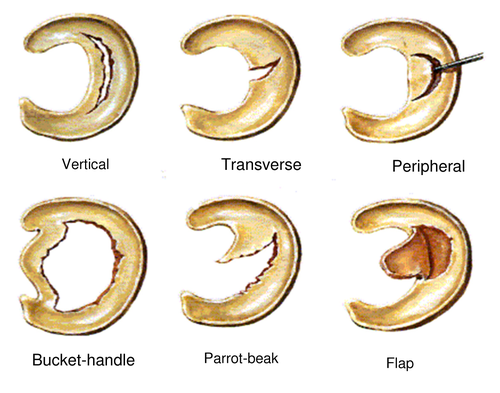
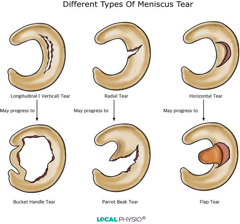
three different types of meniscus tears
bucket handle tear (most common).
42
New cards
pain will cause the
muscles to stop working. if you stop moving this will make it worse.
43
New cards
MENISCAL INJURIES
•Treatment
•Treatment
•Referral to confirm diagnosis
•Cease activity
•Surgery
Menisectomy vs. suture repair Vs. allograft
•Consequences of repeated
surgeries.
•Cease activity
•Surgery
Menisectomy vs. suture repair Vs. allograft
•Consequences of repeated
surgeries.
44
New cards
ANTERIOR CRUCIATE LIGAMENT SPRAINS
•Causes (MOI/Extrinsic Factors)
•Causes (MOI/Extrinsic Factors)
•Deceleration force
•Internal Rotation (most common) of the femur + external rotation of the tibia + external rotation of a planted foot
•Knee Hyperextension
•Direct blow vs. non-contact
•Internal Rotation (most common) of the femur + external rotation of the tibia + external rotation of a planted foot
•Knee Hyperextension
•Direct blow vs. non-contact
45
New cards
ANTERIOR CRUCIATE LIGAMENT SPRAINS
- •Secondary Causes (Intrinsic Factors)
- •Secondary Causes (Intrinsic Factors)
•Male vs. Female Characteristics
•Q-angle
•Hormonal
•Q-angle
•Hormonal
46
New cards
ANTERIOR CRUCIATE LIGAMENT SPRAINS
Dominance
Dominance
Leg Dominance
•Muscle Dominance
•Ligament Dominance
•Muscle Dominance
•Ligament Dominance
47
New cards
ACL SPRAINS
Signs & Symptoms
Signs & Symptoms
•Remember S &S of associated with each Grade of Sprain
•Grade III - Audible pop
•Instability
•Intense pain -
•Grade III - Audible pop
•Instability
•Intense pain -
48
New cards
ACL SPRAINS
- •Treatment Grade I & II
- •Treatment Grade I & II
•Refer to a physician to confirm diagnosis
•Treat as any other sprain
•Protection, control pain and swelling, rehab, brace
•Chances of Rupture? if so, we'll have surgery.
•Treat as any other sprain
•Protection, control pain and swelling, rehab, brace
•Chances of Rupture? if so, we'll have surgery.
49
New cards
ACL SPRAINS
- •Treatment Grade III
- •Treatment Grade III
•Moderate Instability
•Surgery
•Prior to surgery, minimal swelling, full ROM, and good strength
•Considerations
•Hamstring (semitendinosis) Graft vs Patellar Tendon Graft
•Pros vs Cons
•Autogenous tissue vs. Allograft
•Pro vs Cons
•Physicians Experience vs Patients wants
•Quality Rehabilitation is Paramount
•4 - 9 months
Bracing
•Surgery
•Prior to surgery, minimal swelling, full ROM, and good strength
•Considerations
•Hamstring (semitendinosis) Graft vs Patellar Tendon Graft
•Pros vs Cons
•Autogenous tissue vs. Allograft
•Pro vs Cons
•Physicians Experience vs Patients wants
•Quality Rehabilitation is Paramount
•4 - 9 months
Bracing
50
New cards
POSTERIOR CRUCIATE LIGAMENT SPRAINS
Causes
Causes
•Falling on a bent knee = posterior translation of tibia
Blow to anterior knee (Most common mechanism is a car injury).
Blow to anterior knee (Most common mechanism is a car injury).
51
New cards
POSTERIOR CRUCIATE LIGAMENT SPRAINS
Signs & Symptoms
Signs & Symptoms
Grade I & II: can't find it •Grade III - Audible Pop, felt in back of the knee
•Pain and tenderness in the back of the knee
•Instability in back of knee
•Pain and tenderness in the back of the knee
•Instability in back of knee
52
New cards
POSTERIOR CRUCIATE LIGAMENT SPRAINS
•Treatment
•Treatment
•Initially PRICE
•Surgery? - Patient and Physician
•Immobilize for 6 wks in extended position
•At6 wks, Begin ROM exercises
•3-4 mos., begin strengthening
•Surgery, Depends on amt of instability and
Patients activity level
•Surgery? - Patient and Physician
•Immobilize for 6 wks in extended position
•At6 wks, Begin ROM exercises
•3-4 mos., begin strengthening
•Surgery, Depends on amt of instability and
Patients activity level