Lateral Geniculate Nucleus & Functional Testing - Visual Neurophysiology and Perception Spring 2026
 Call Kai
 Learn
Learn Practice Test
 Spaced Repetition
 Match
Match Flashcards
 Knowt Play
1/166

There's no tags or description
Looks like no tags are added yet.
Name | Mastery | Learn | Test | Matching | Spaced | Call with Kai |
|---|
No analytics yet
Send a link to your students to track their progress
167 Terms
The action potentials generated in RPCs are carried where?
along their axons and out of the optic nerve
In primates, 90% of the RGCs project to where?
to the dorsal lateral geniculus (LGN) of the thalamus
RGCs release ______ onto target neurons
glutamate
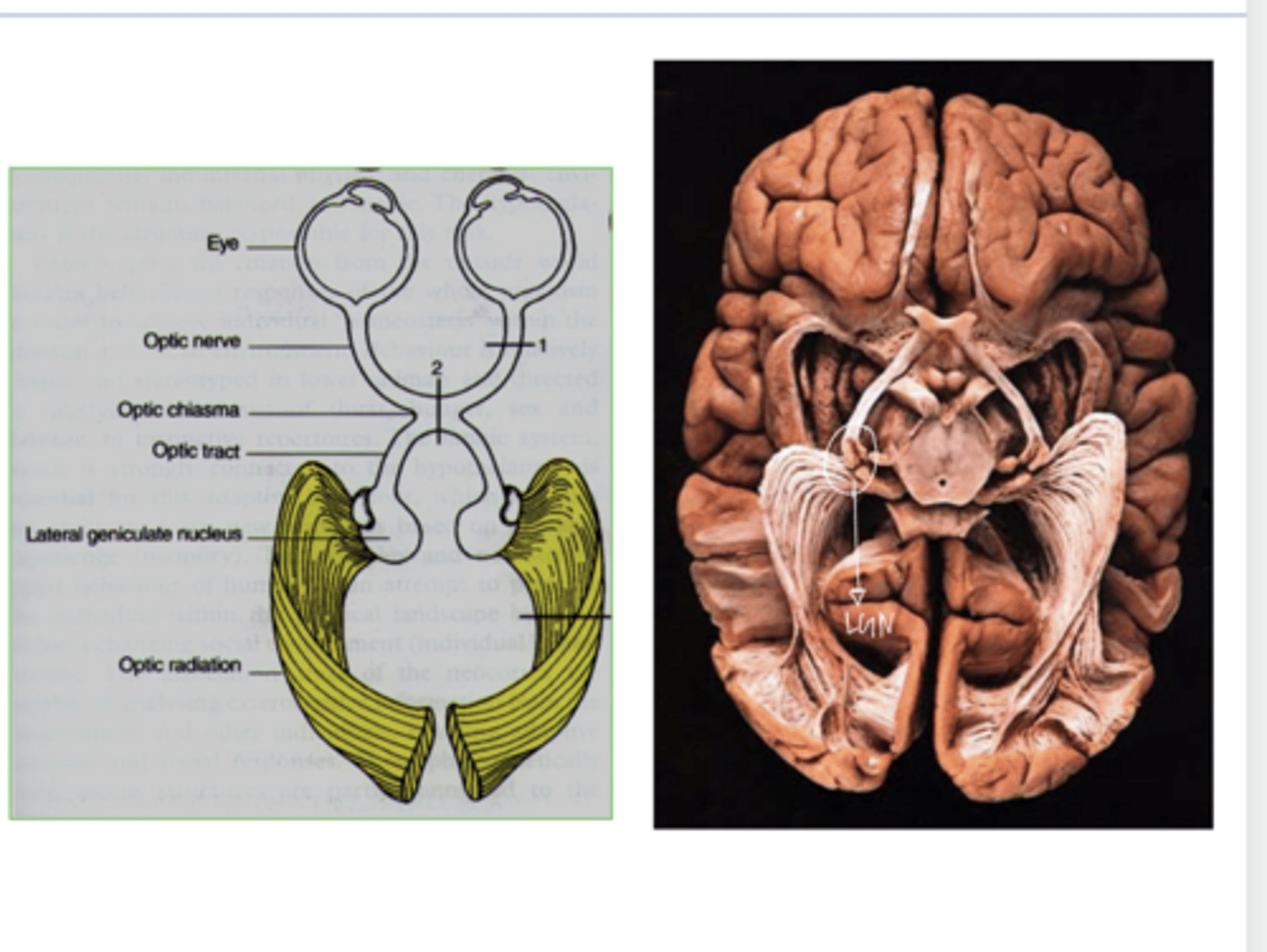
LGN in Brain (Pic)
LGN in Brain (Pic)
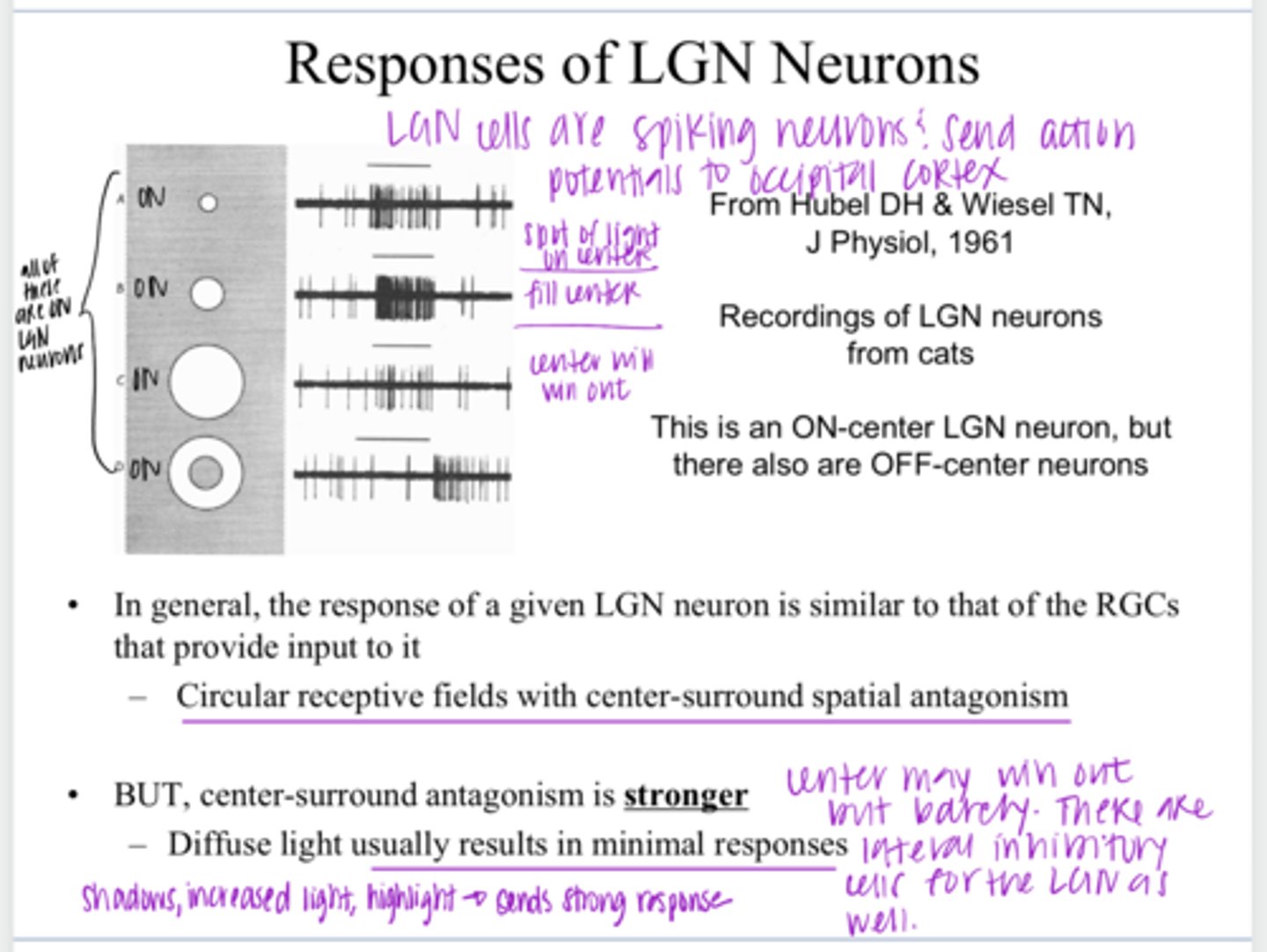
True or False:
In general, the response of the LGN neuron is similar to that of the RGC that provides input to it
true
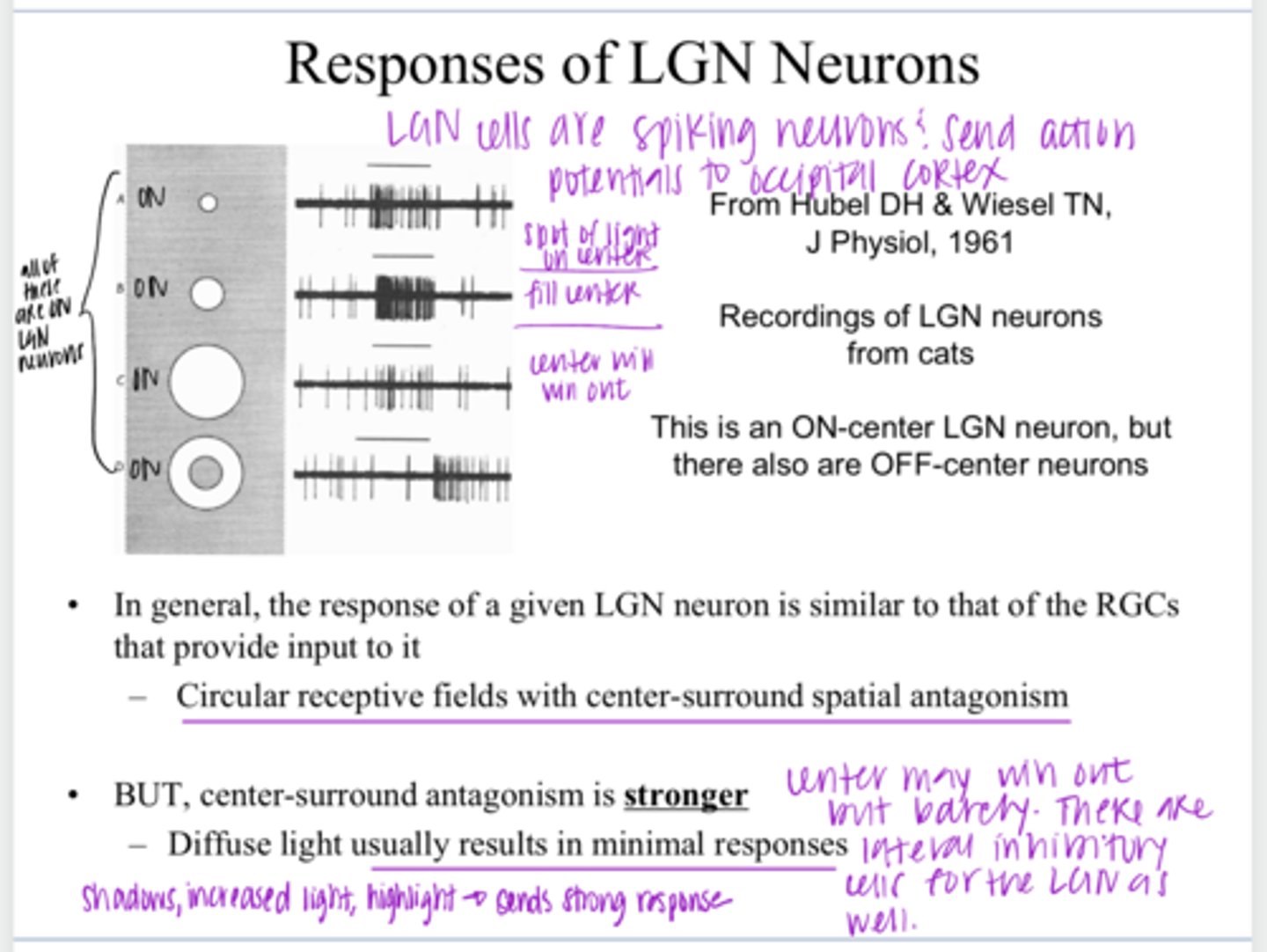
Do LGN neurons have center-surround spatial antagonism?
Yes
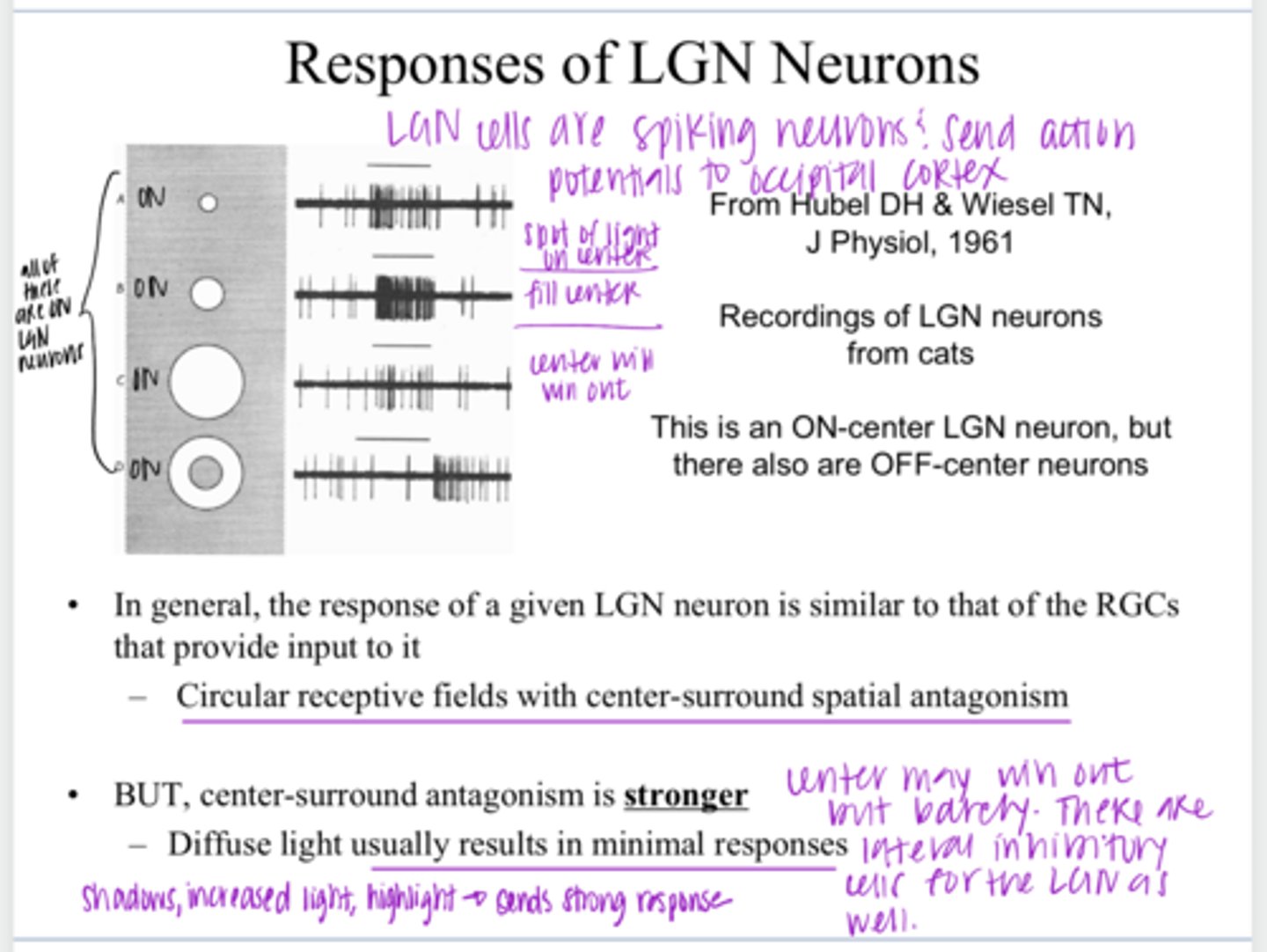
Is center-surround antagonism stronger in RGCs or LGN nuerons?
LGN neurons have stronger center-surround antagonism
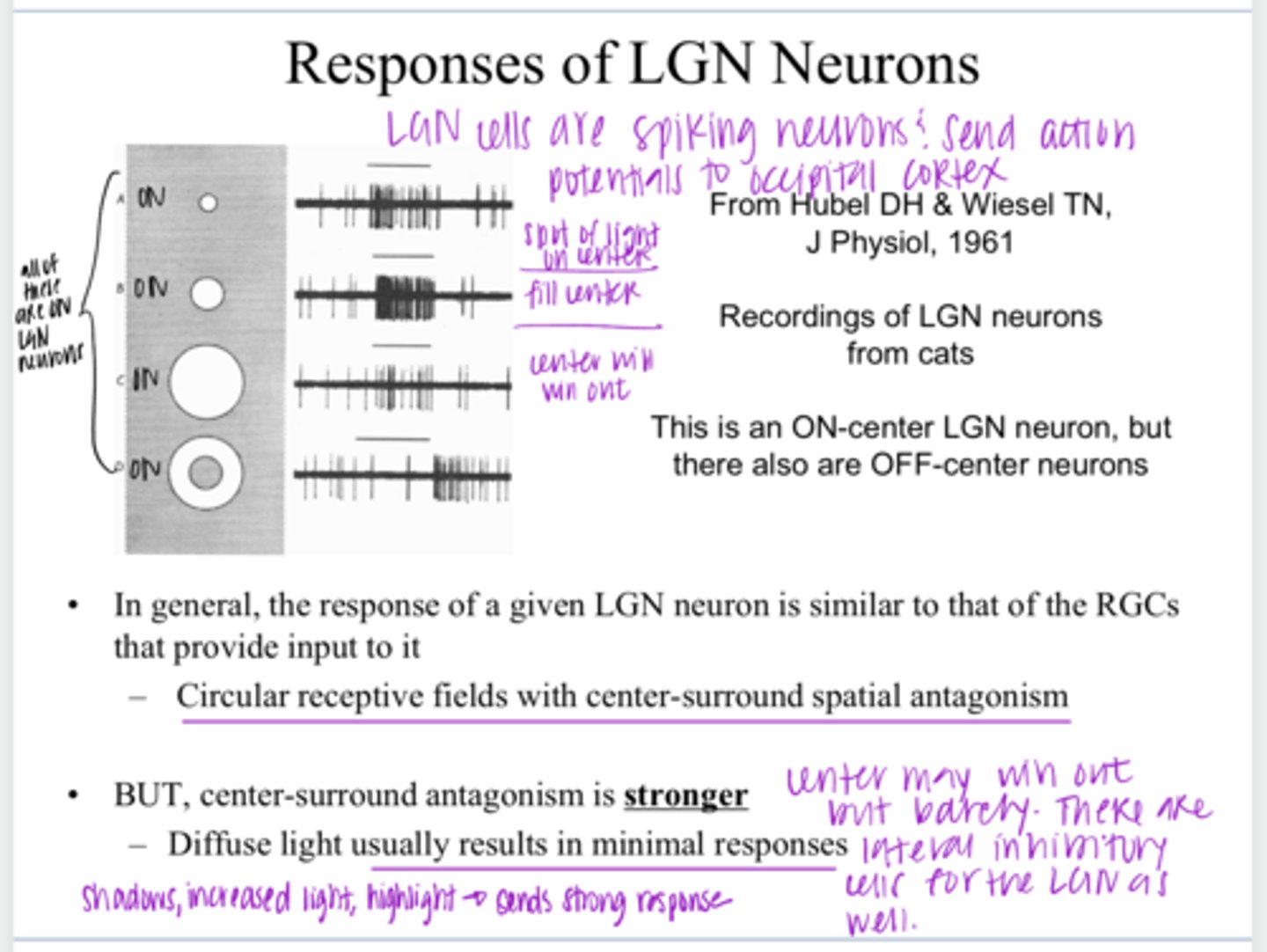
Diffuse light to LGN neurons results in what d/t strong center-surround antagonism?
minimal response
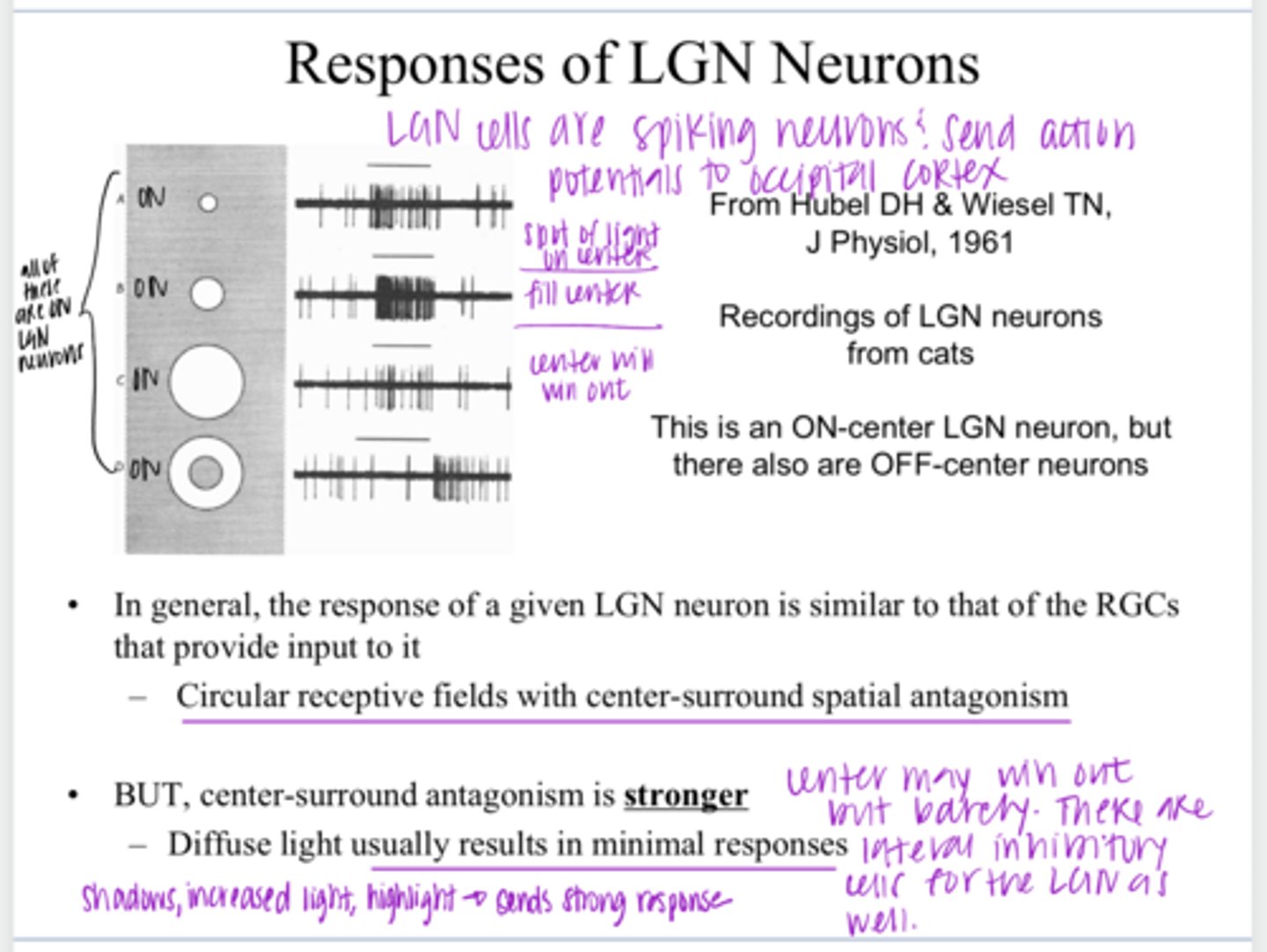
When will the LGN neurons send stronger responses to the visual cortex?
When shadows, increased light, or highlights are present
Is the LGN a "relay station"?
No -- there is not dramatic processing of the visual signal here but it is not only a relay station either
Is there modification to the visual signal at the LGN?
Yes -- increased lateral inhibition (center-surround antagonism) at this structure
The LGN can be thought of as a "____-"
gate
Why can the LGN be thought of as a gate?
Controlling the flow of info to higher brain centers so that only the most relevant or interesting info passes through
In addition to excitatory input from the retina, LGN also receives _____ input
inhibitory
Where does the LGN receive feedback inhibition from?
From the visual cortex
Mesencephalic reticular formation for saccadic suppression
Inter-neurons within the LGN -- Magno neurons can inhibit Parvo
True or False:
Different qualitative attributes of the visual image separated out within the retina into and carried onto the brain (LGN) via different pathways?
true
What is the basic organizational principle that is often applied to the visual pathway?
Separate RGC classes transmit different sensory messages to the brain
True or False:
The cells of the LGN have a specific anatomical orientation
True
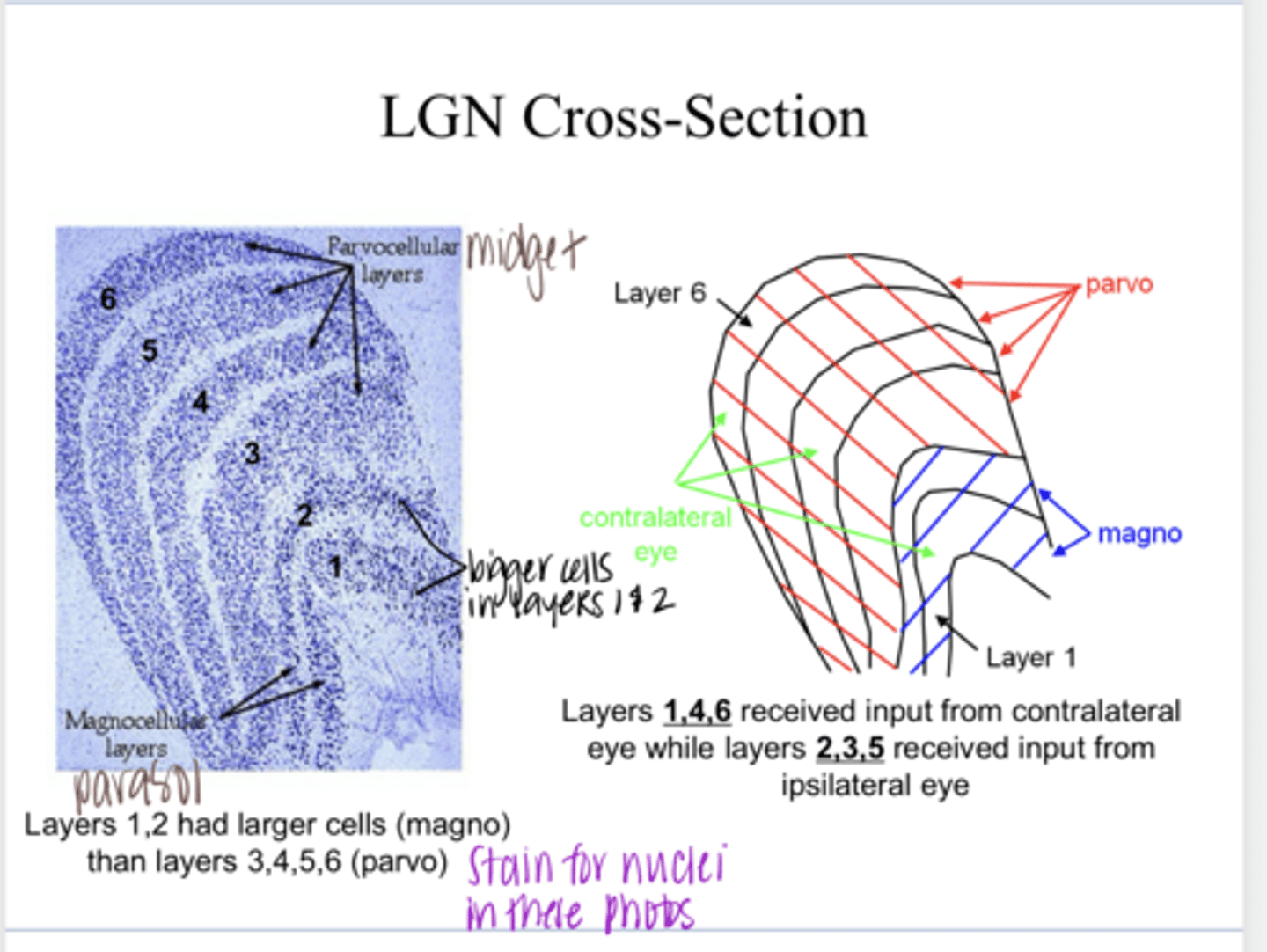
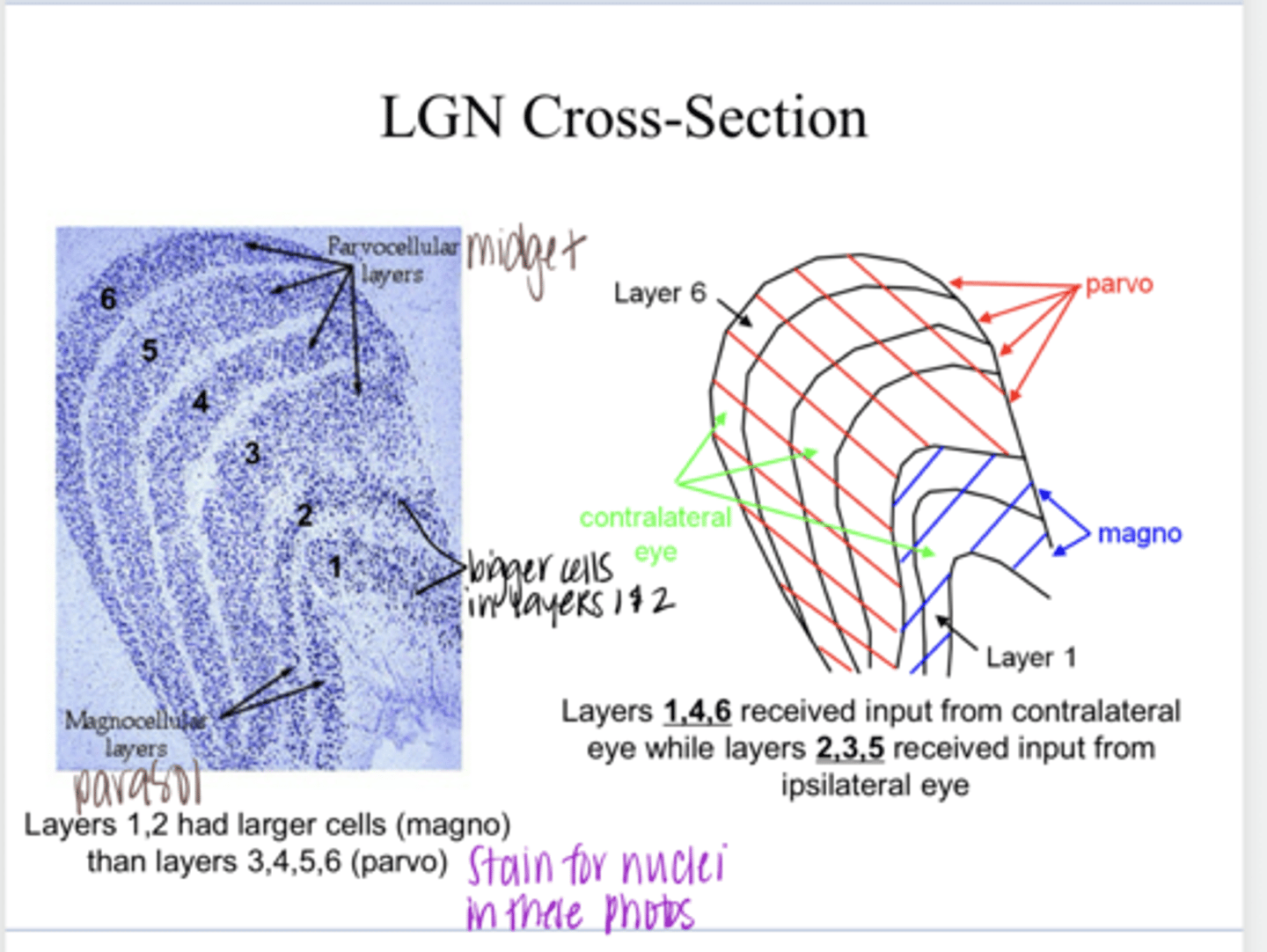
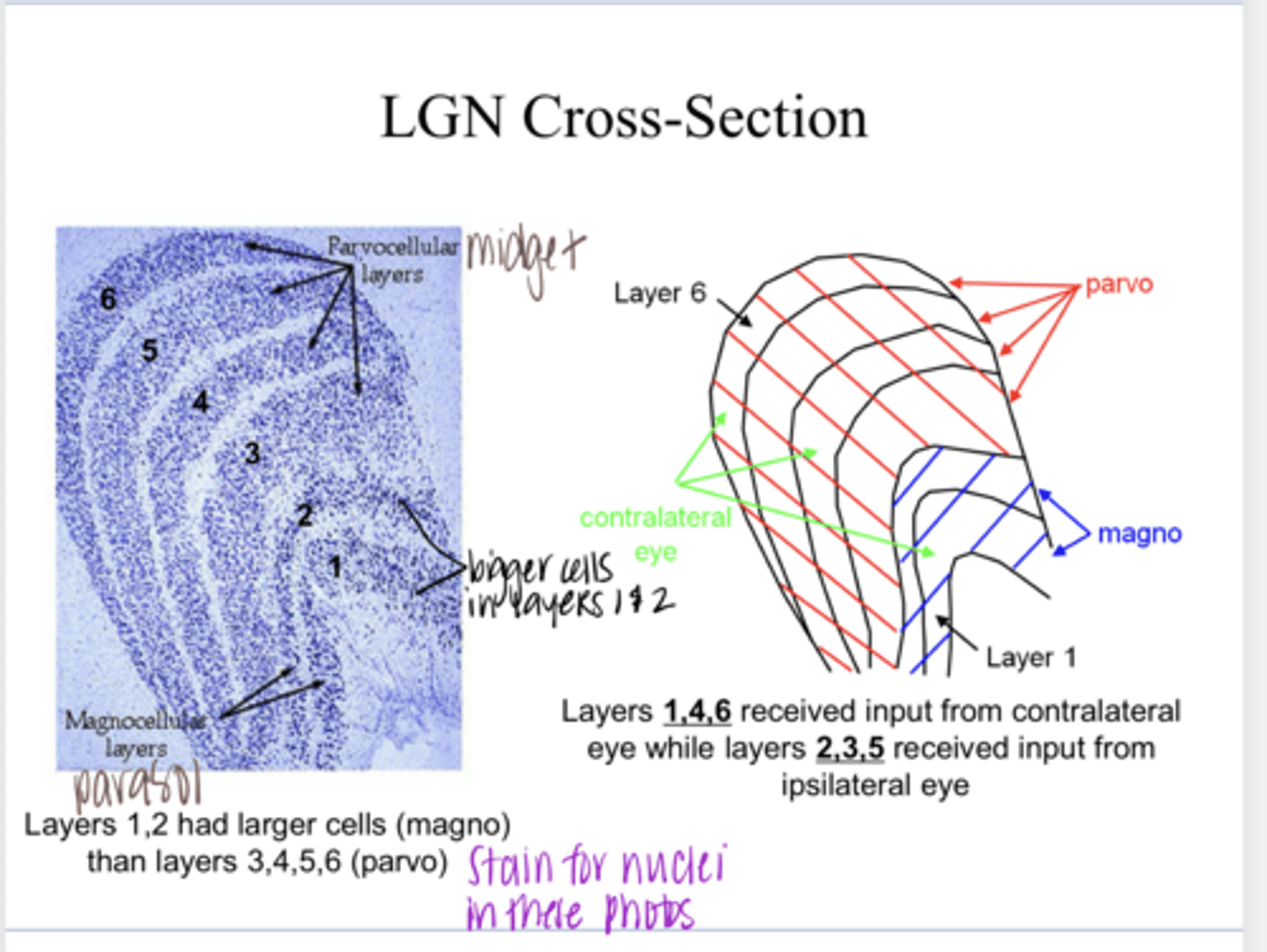
How many layers are in the LGN in cross-section?
6
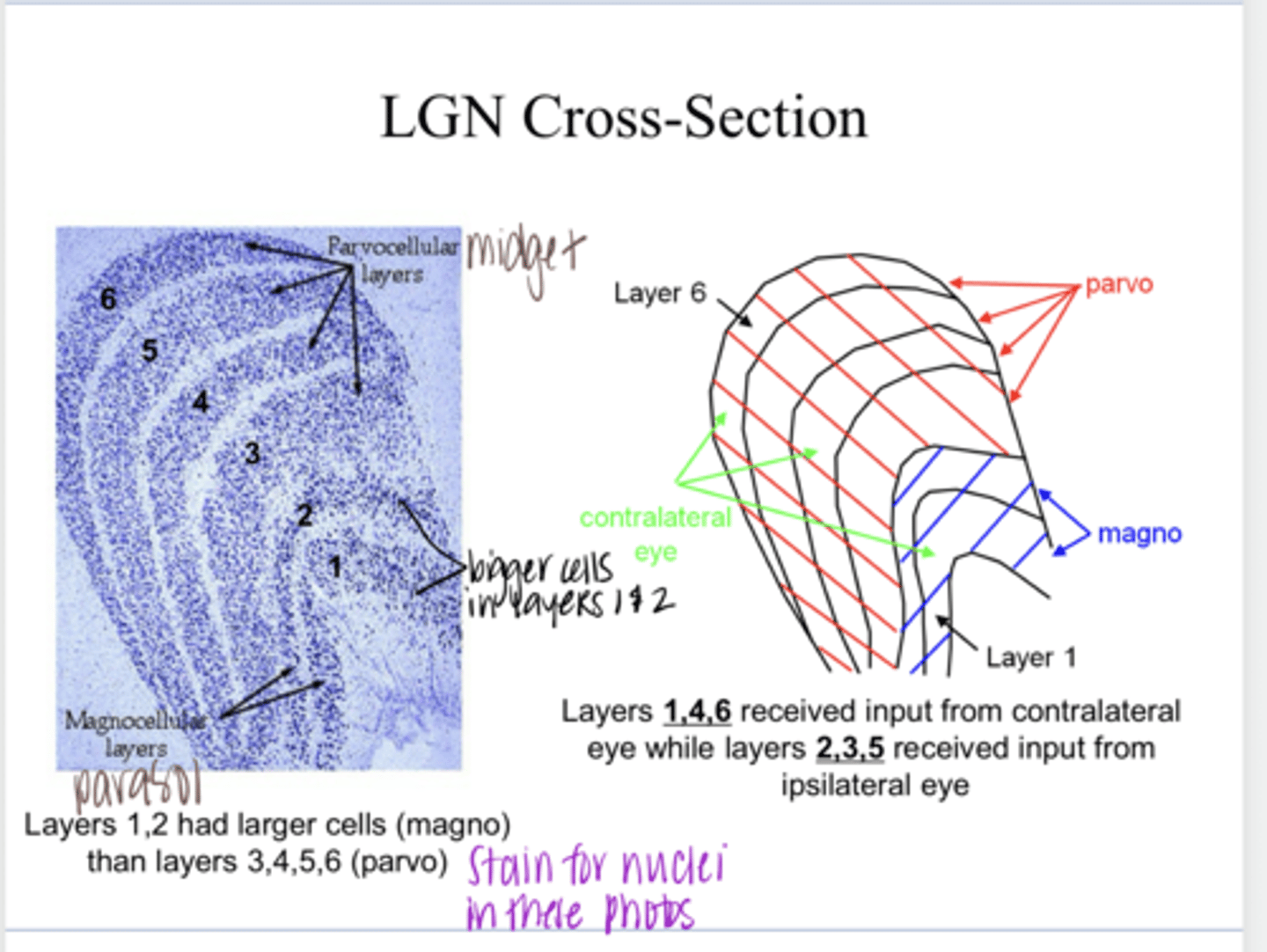
What is the importance of each of the 6 LGN layers?
each layer received input from either the ipsilateral or contralateral eye
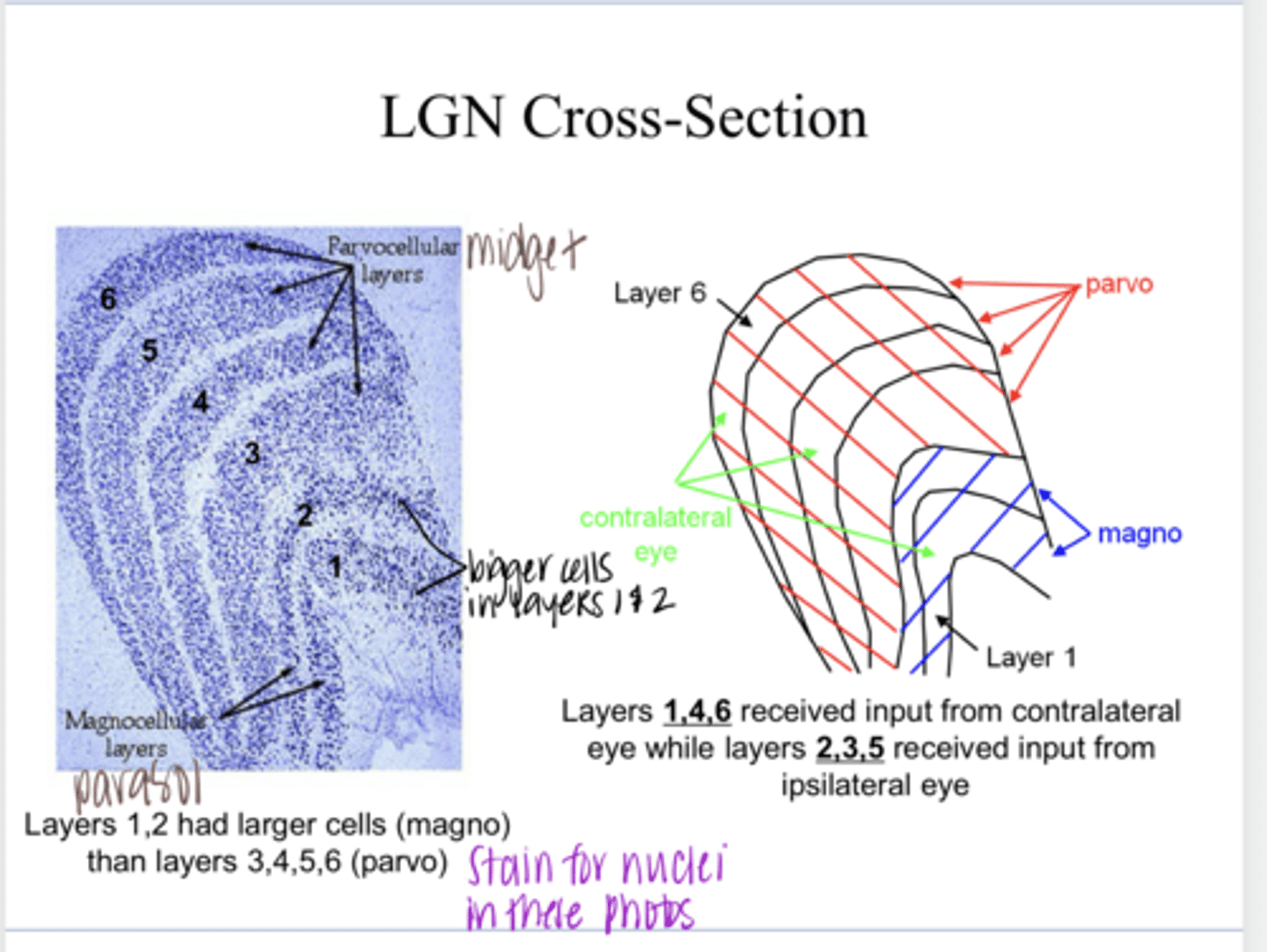
True or False:
The cells in each of the different layers of the LGN have a different physiological property
true
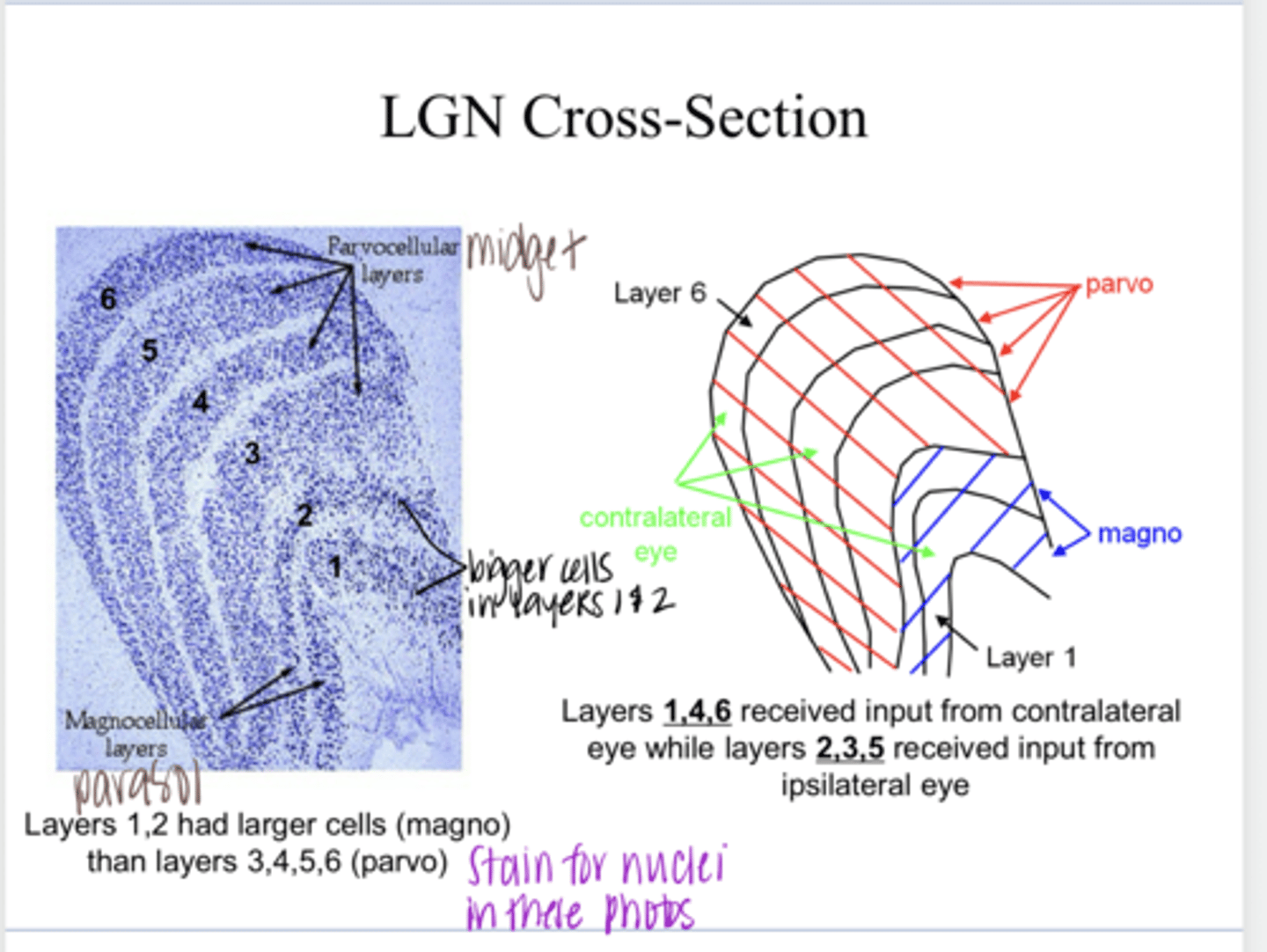
What is the name of the 2 bottom-most layers of the LGN?
Magno Layers
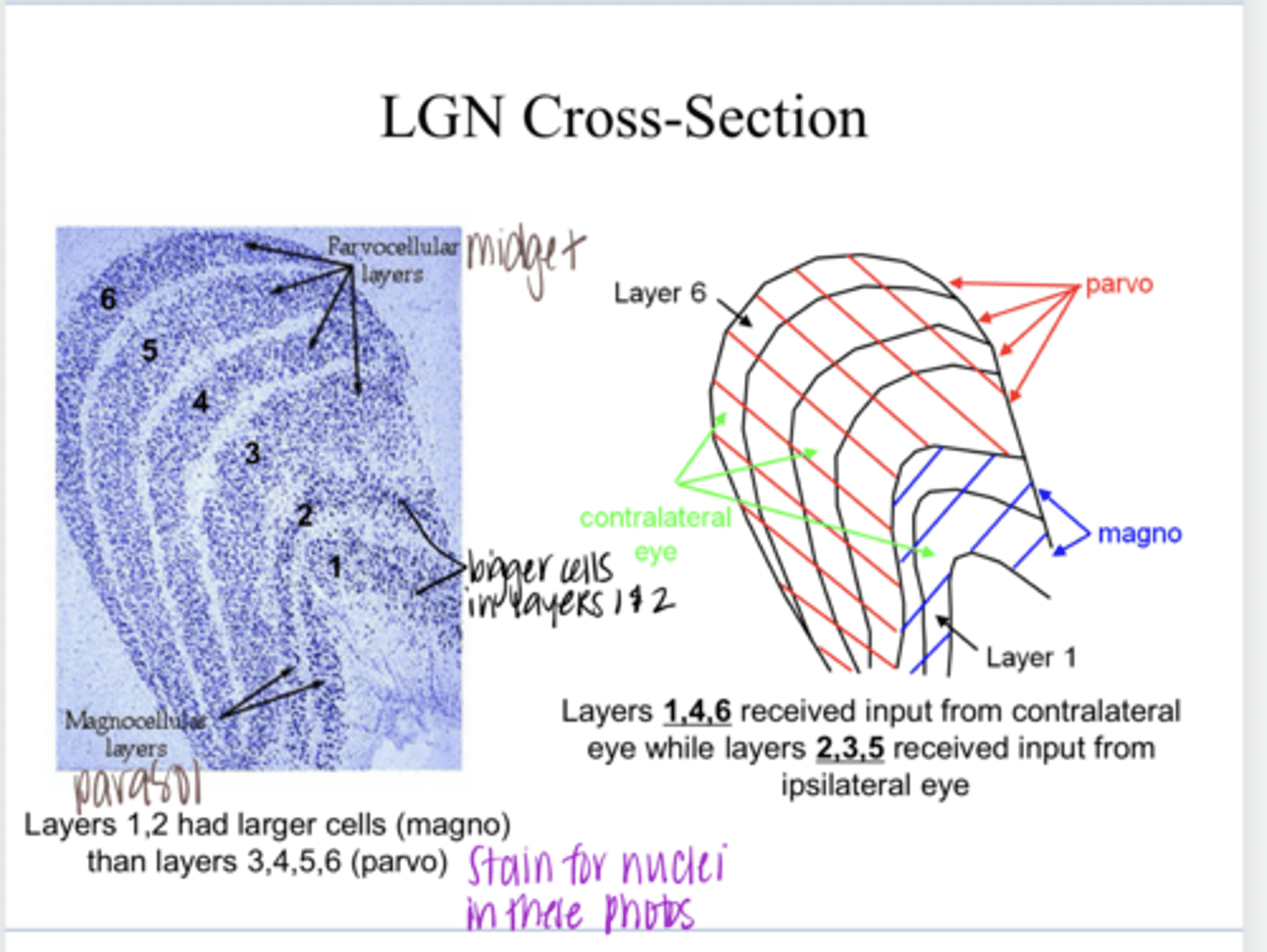
What are the histological characteristics of the Magno layers compared to Parvo?
Larger cells
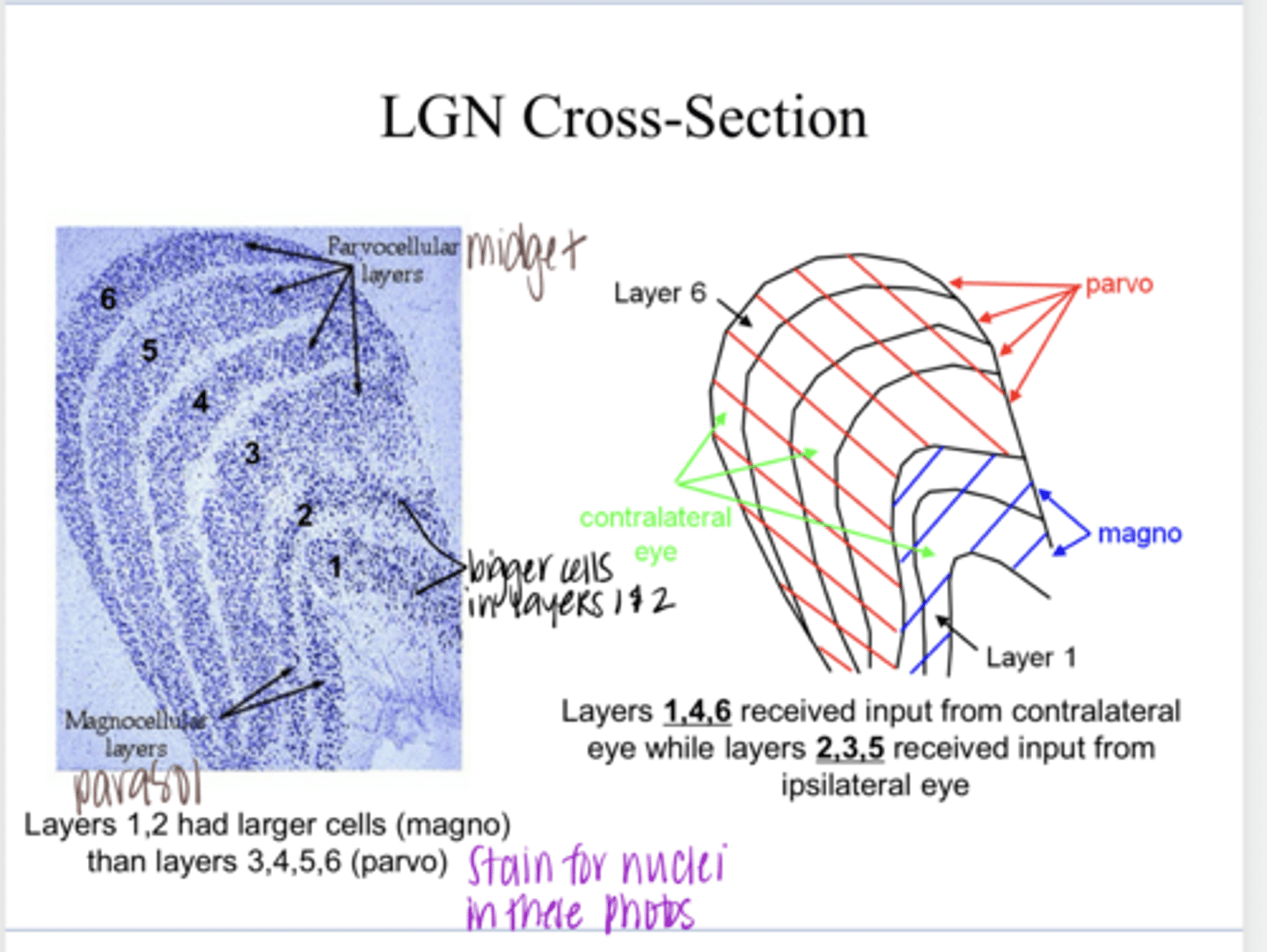
What are the "parvo" layers of the LGN?
3, 4, 5, 6
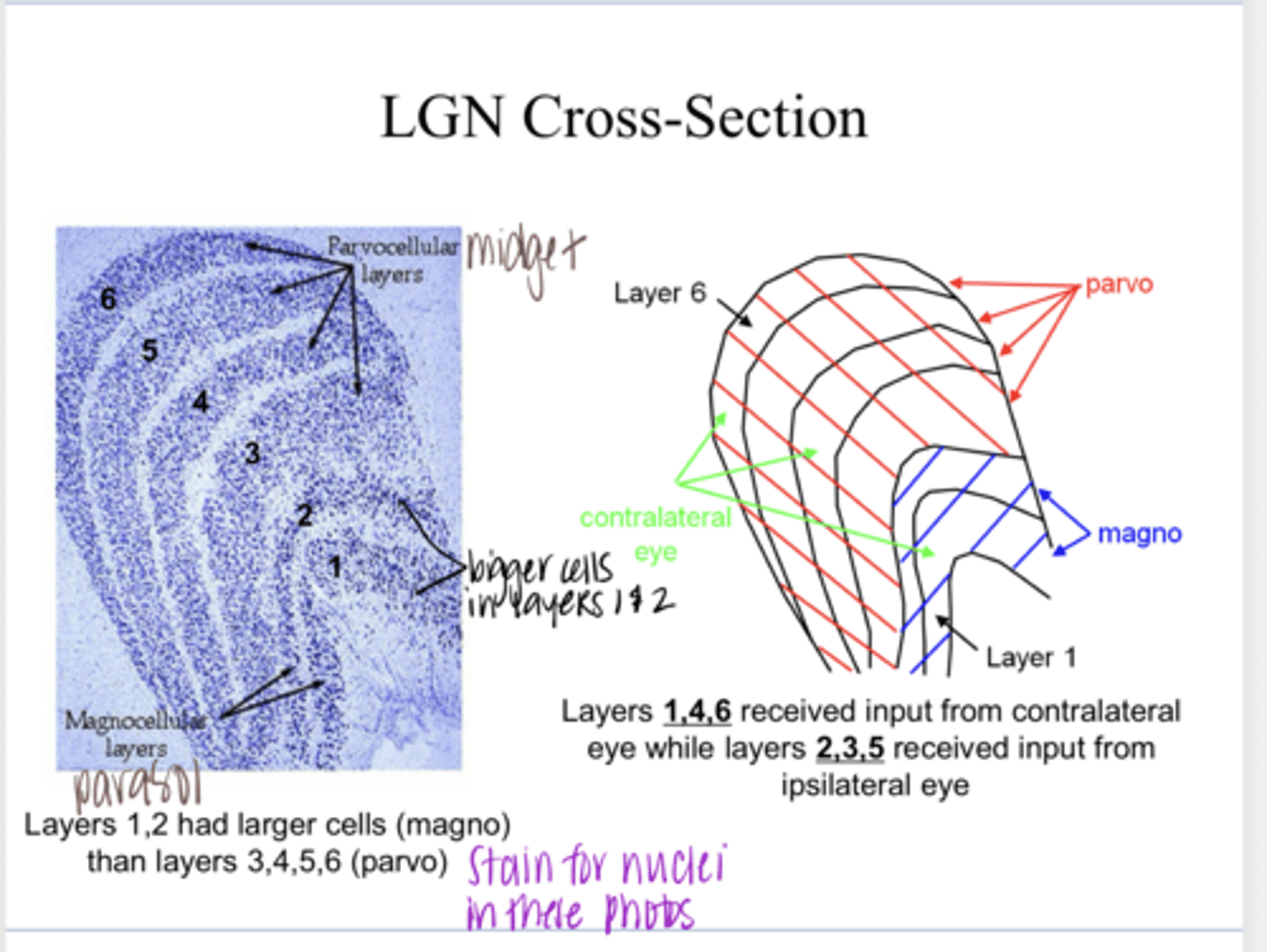
What layers of the LGN receive contralateral eye input?
1, 4, 6
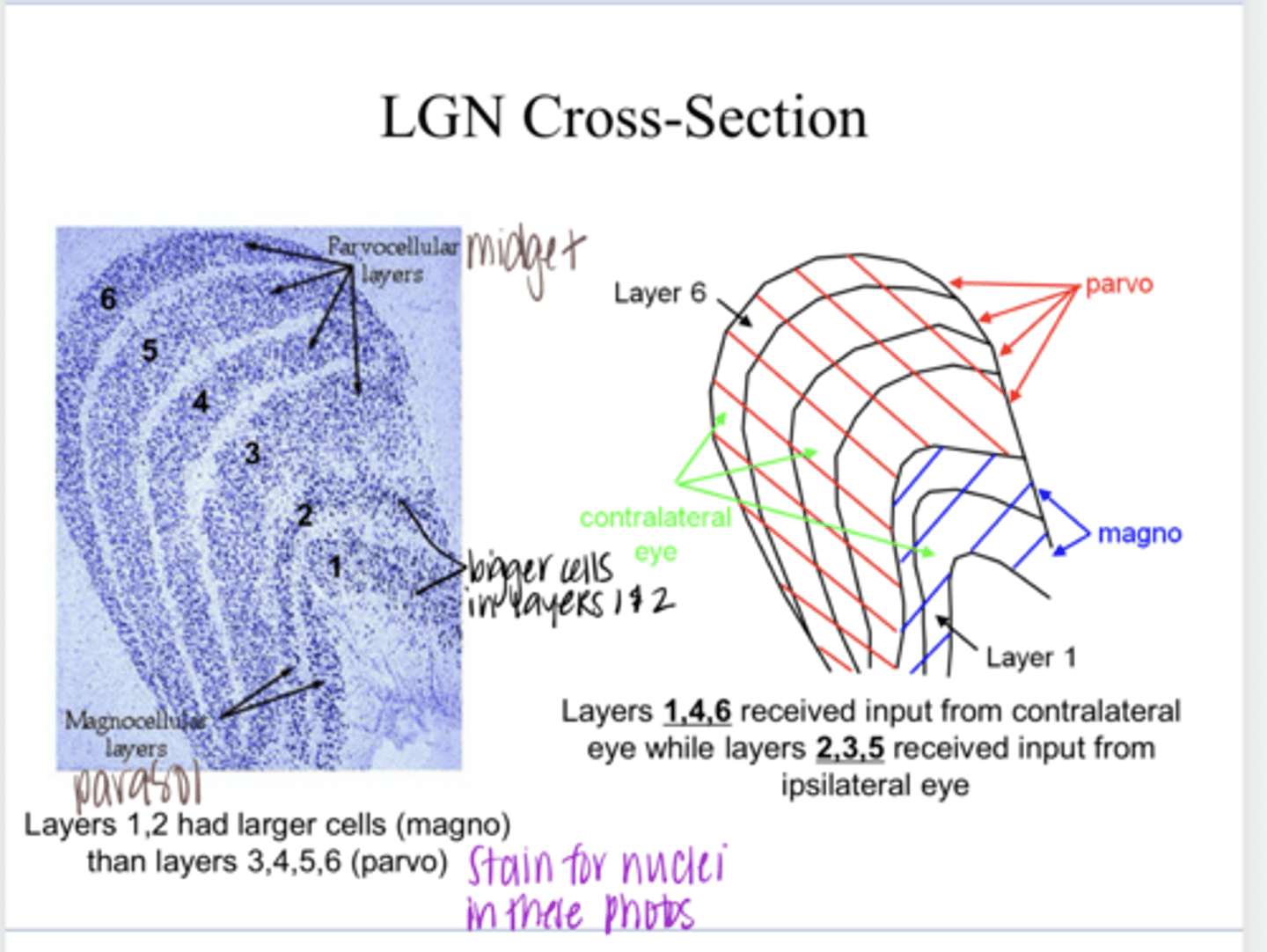
What layers of the LGN receive ipsilateral eye input?
2, 3, 5
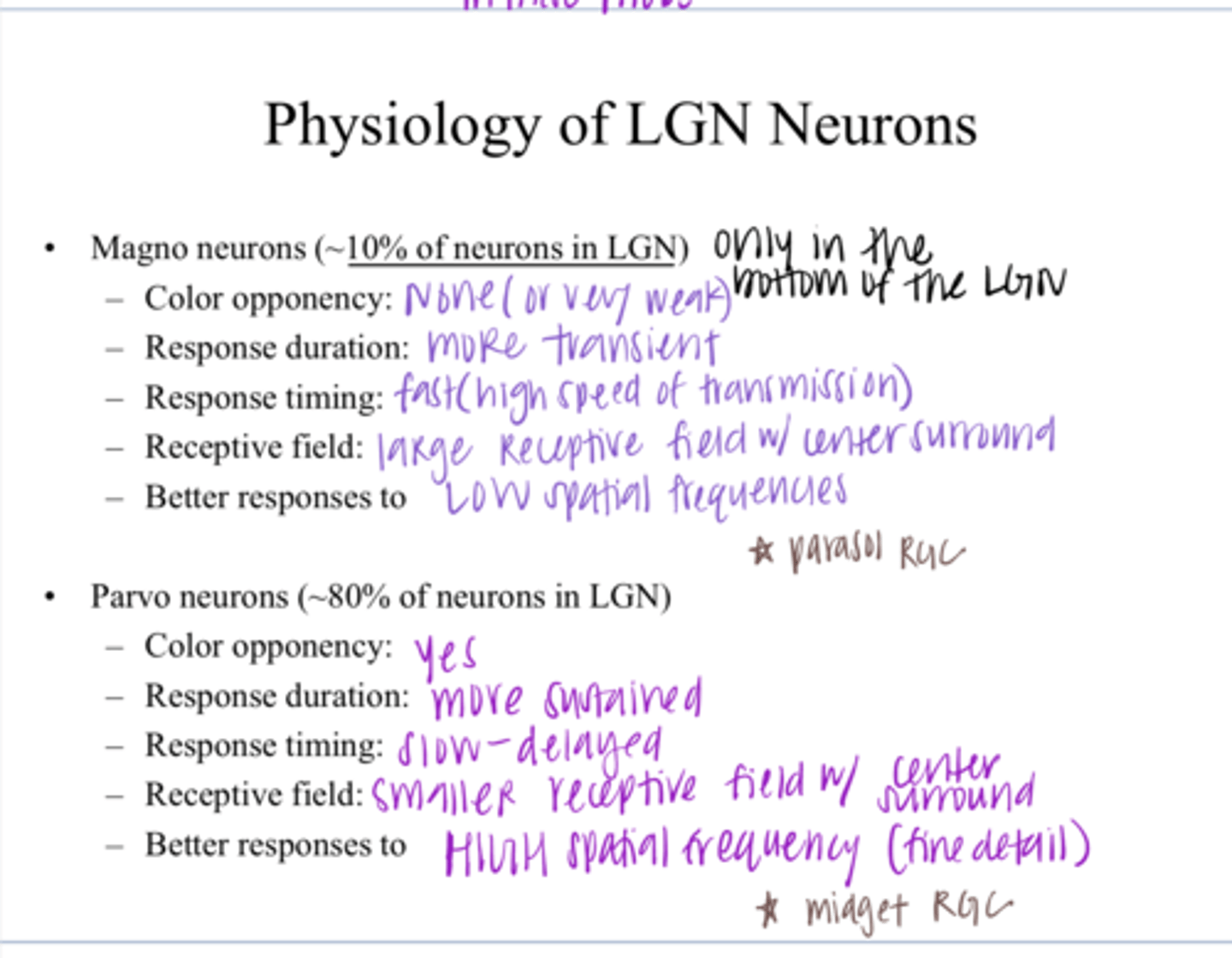
Magno vs Parvo Physiology of LGN Neurons
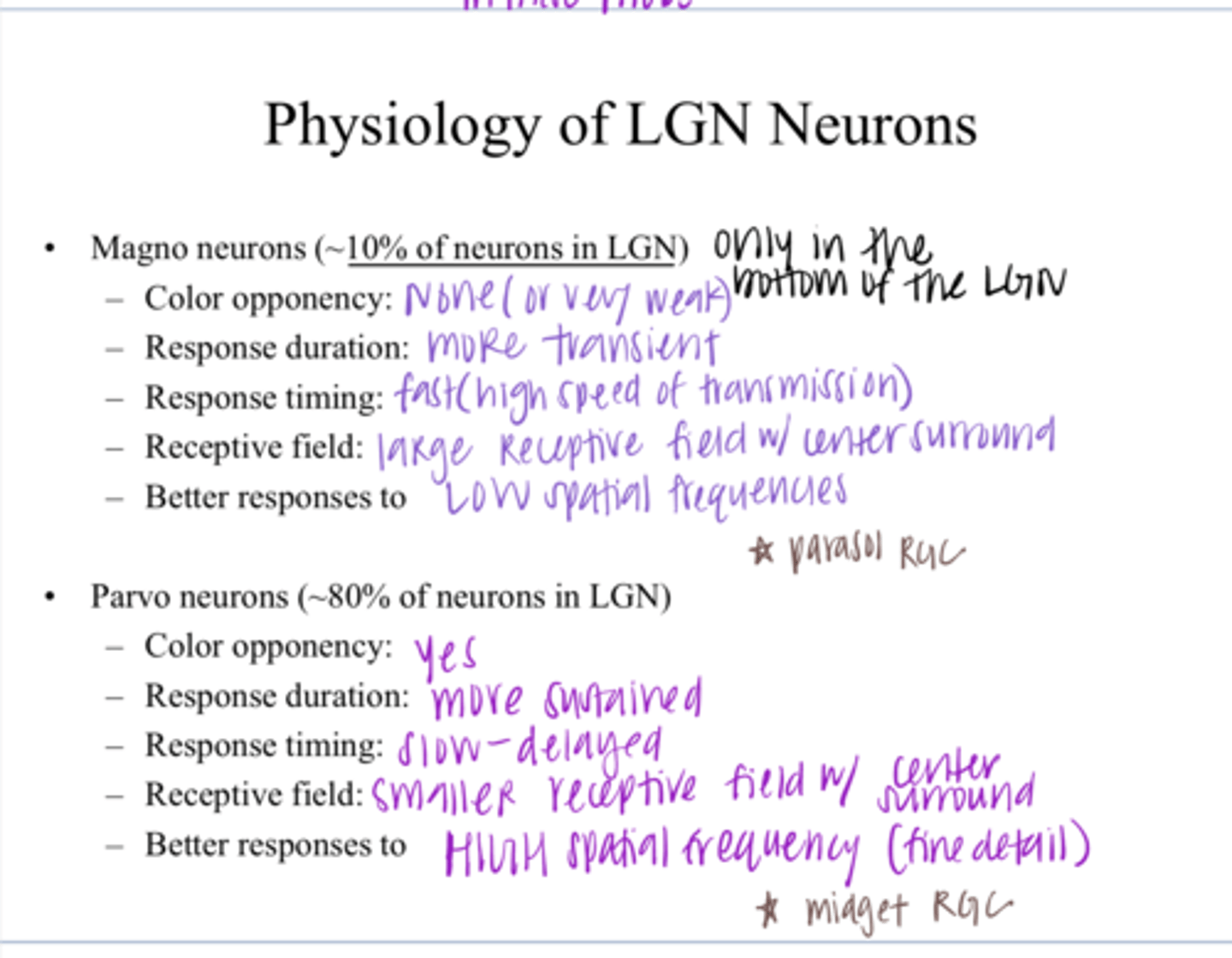
Which are more predominant?
Parvo (90%); Magno (10%)
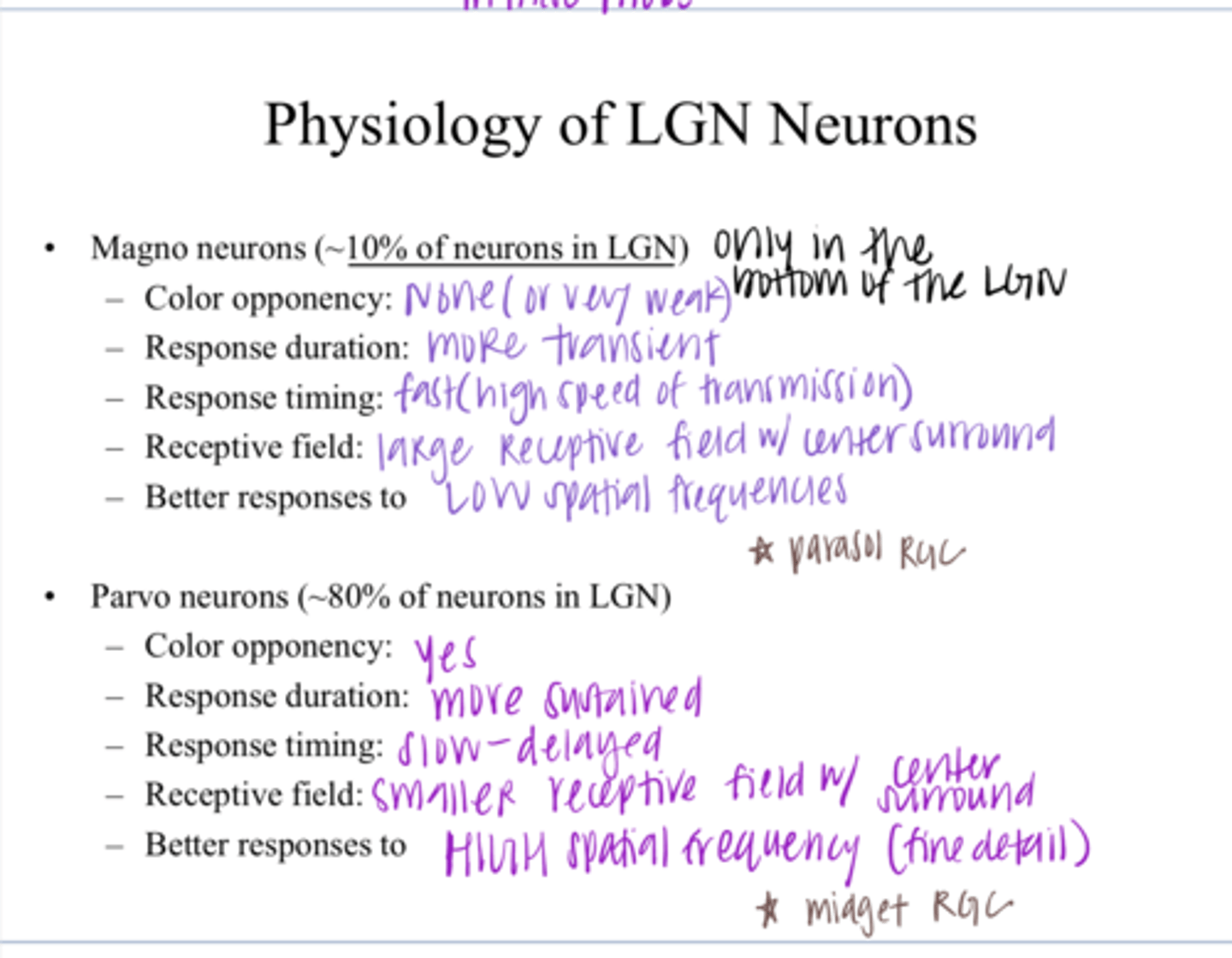
Magno vs Parvo Physiology of LGN Neurons
Color Opponency of Magno Neurons present?
None
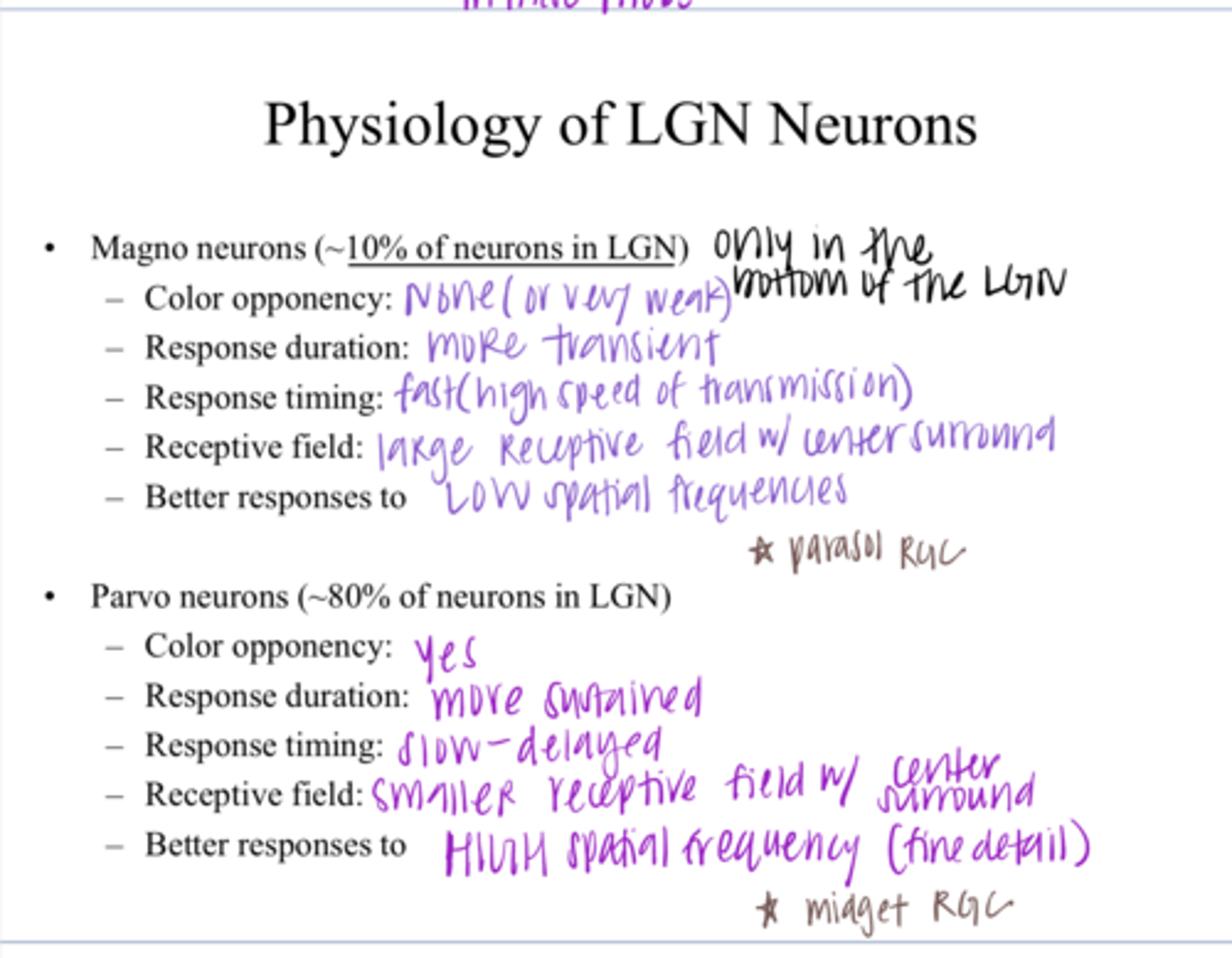
Magno vs Parvo Physiology of LGN Neurons
Response duration of Magno Neurons?
More transient
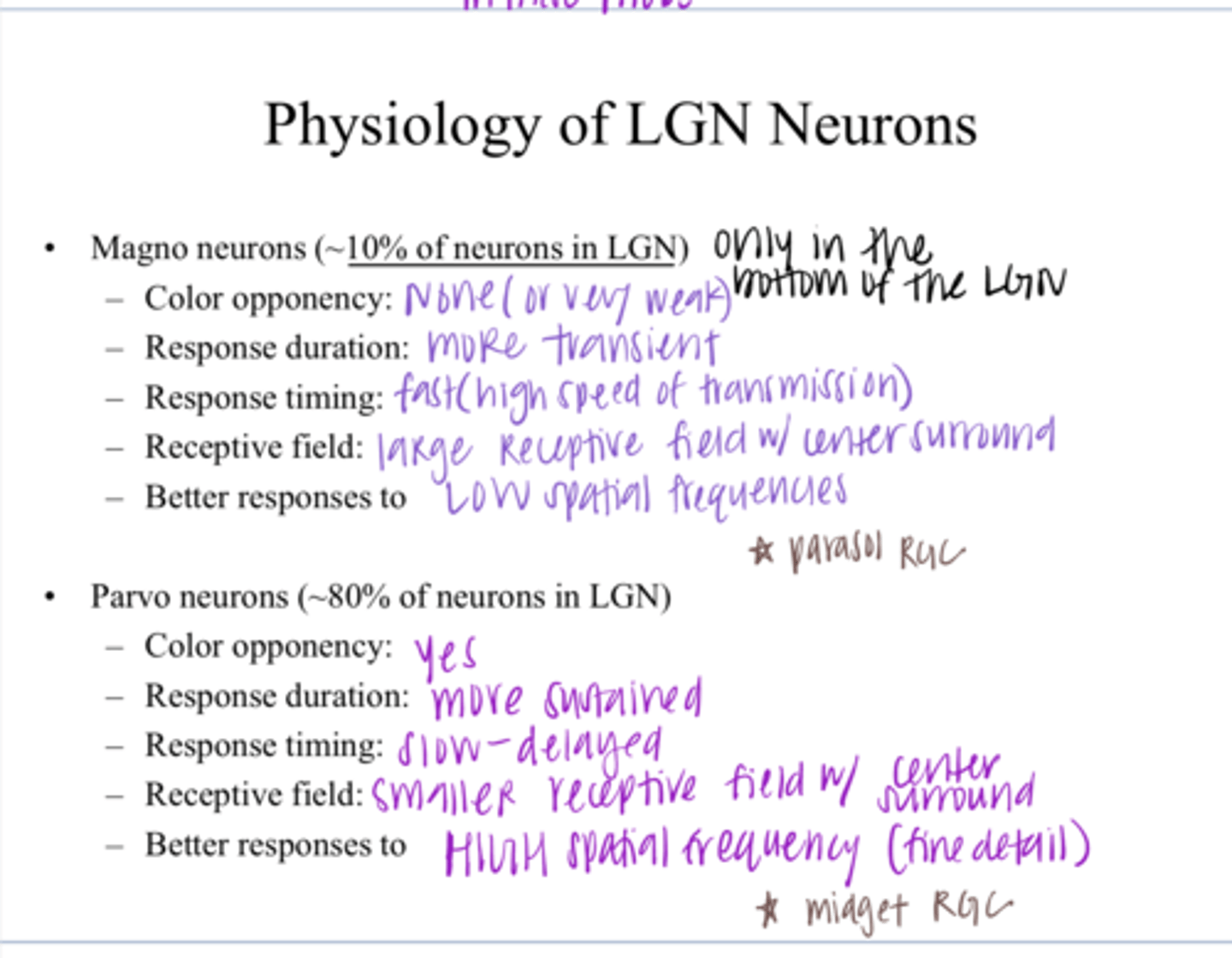
Magno vs Parvo Physiology of LGN Neurons
Response Timing of Magno Neurons?
fast (high speed of transmission)
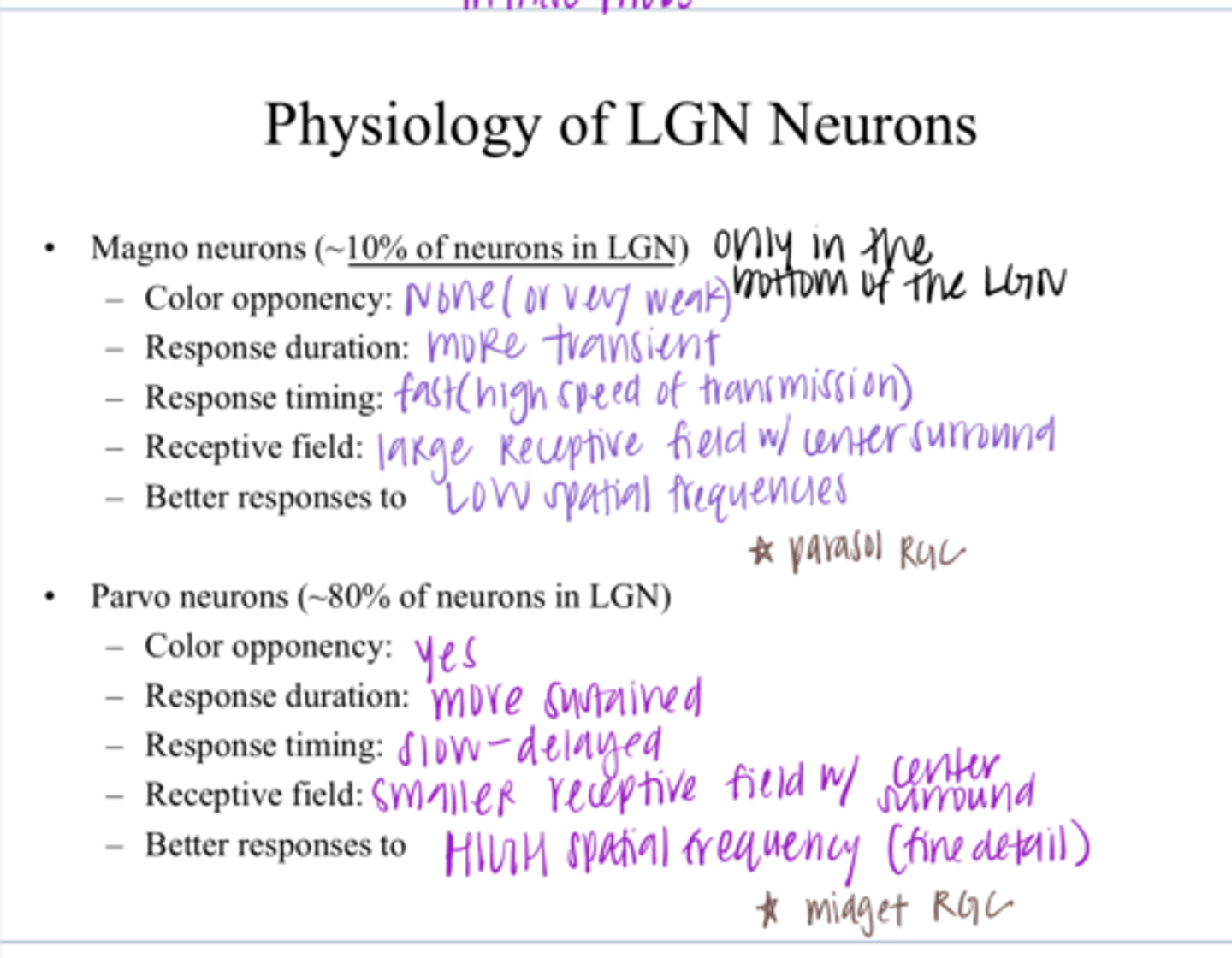
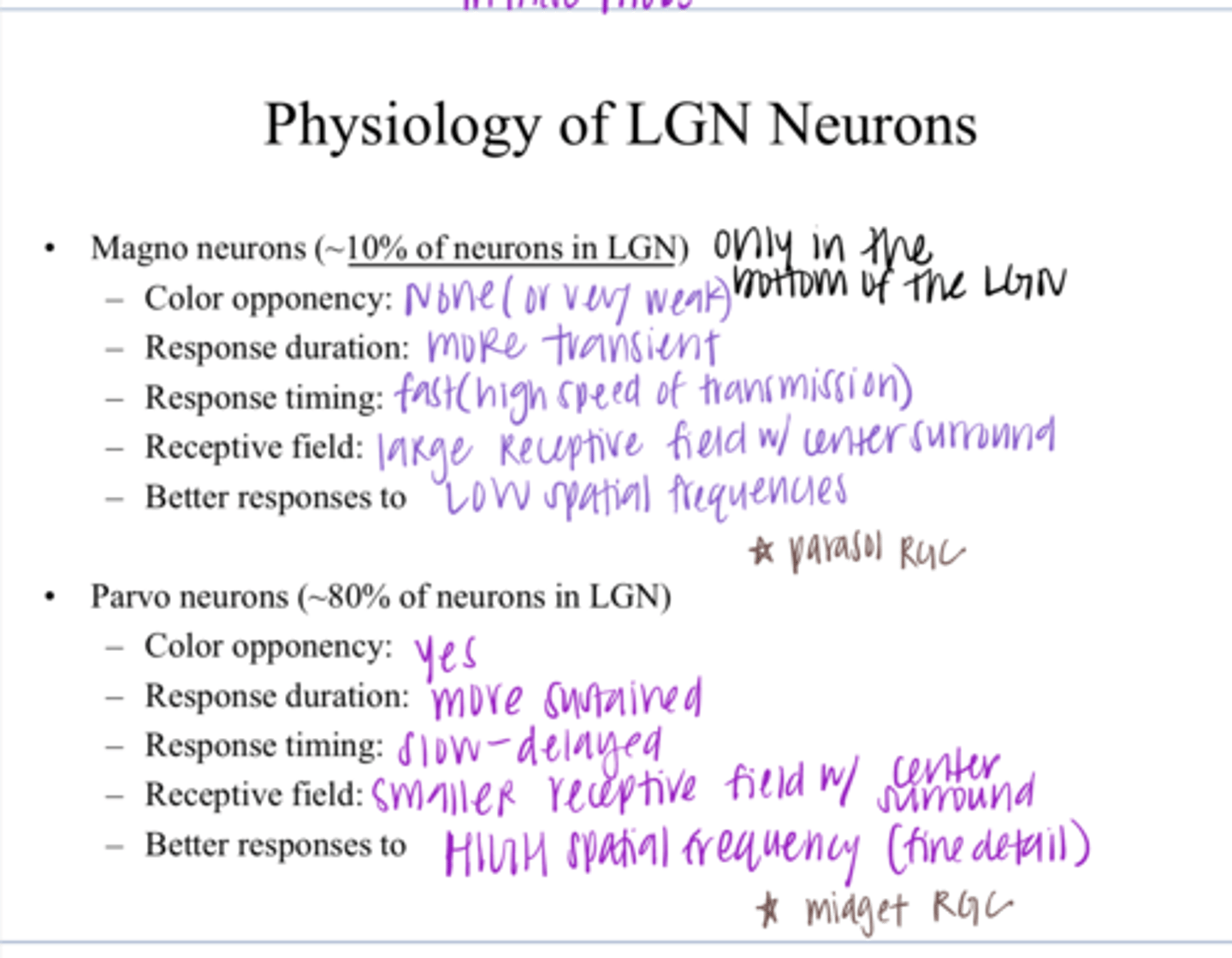
Magno vs Parvo Physiology of LGN Neurons
Receptive field of Magno Neurons?
Large receptive field w/ center-surround antagonism
Magno vs Parvo Physiology of LGN Neurons
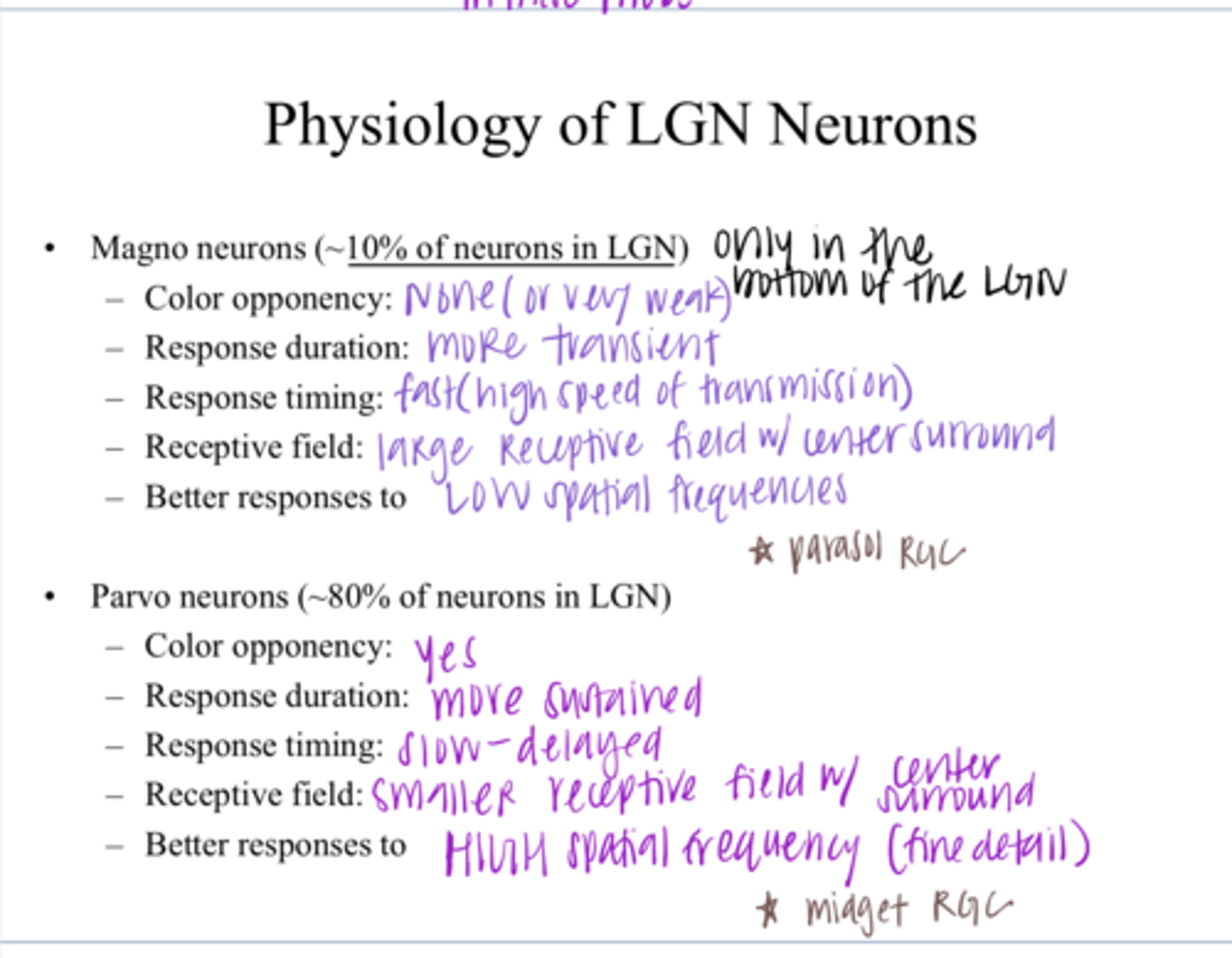
Magno: Better responses to what spatial frequencies?
LOW
Magno vs Parvo Physiology of LGN Neurons
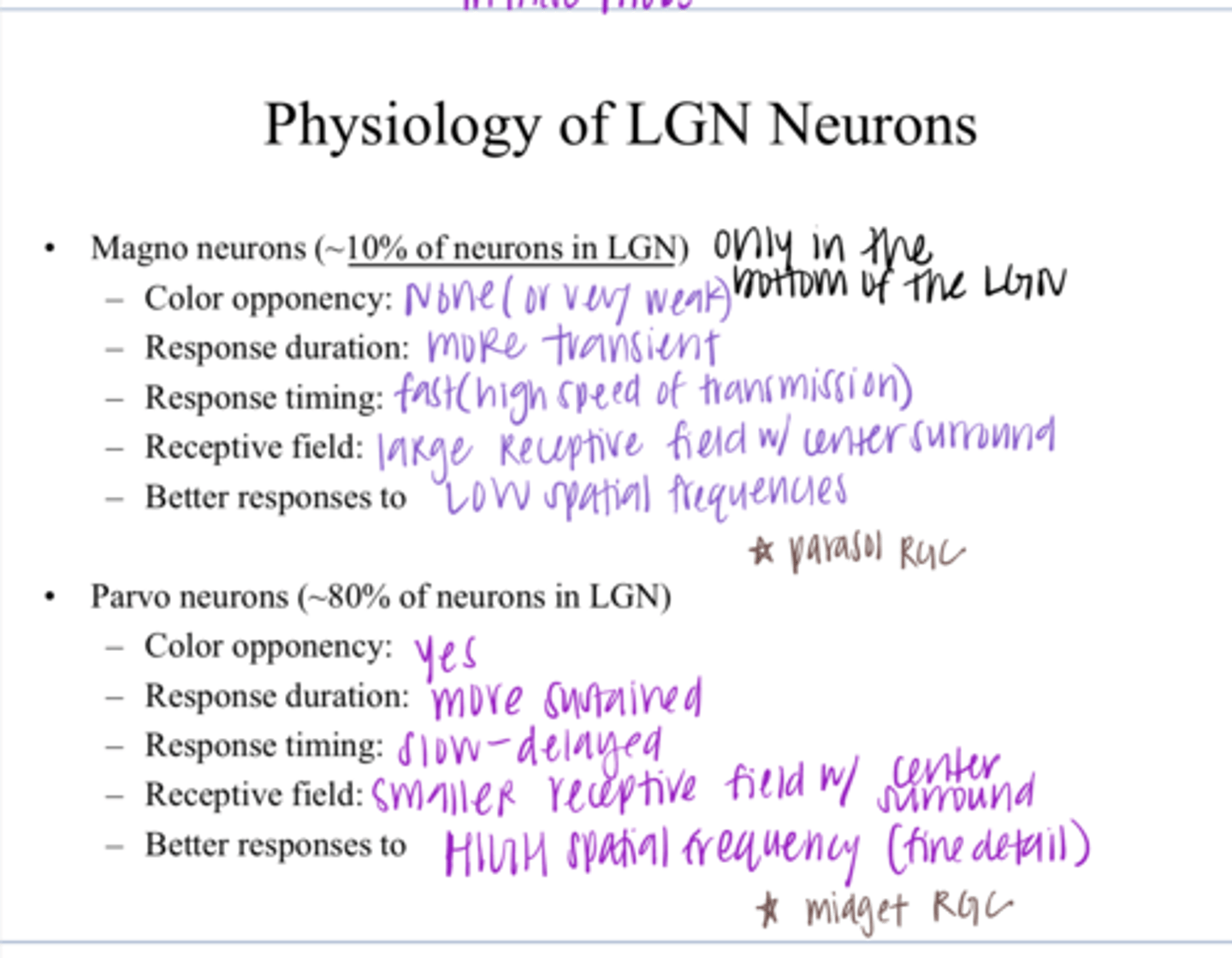
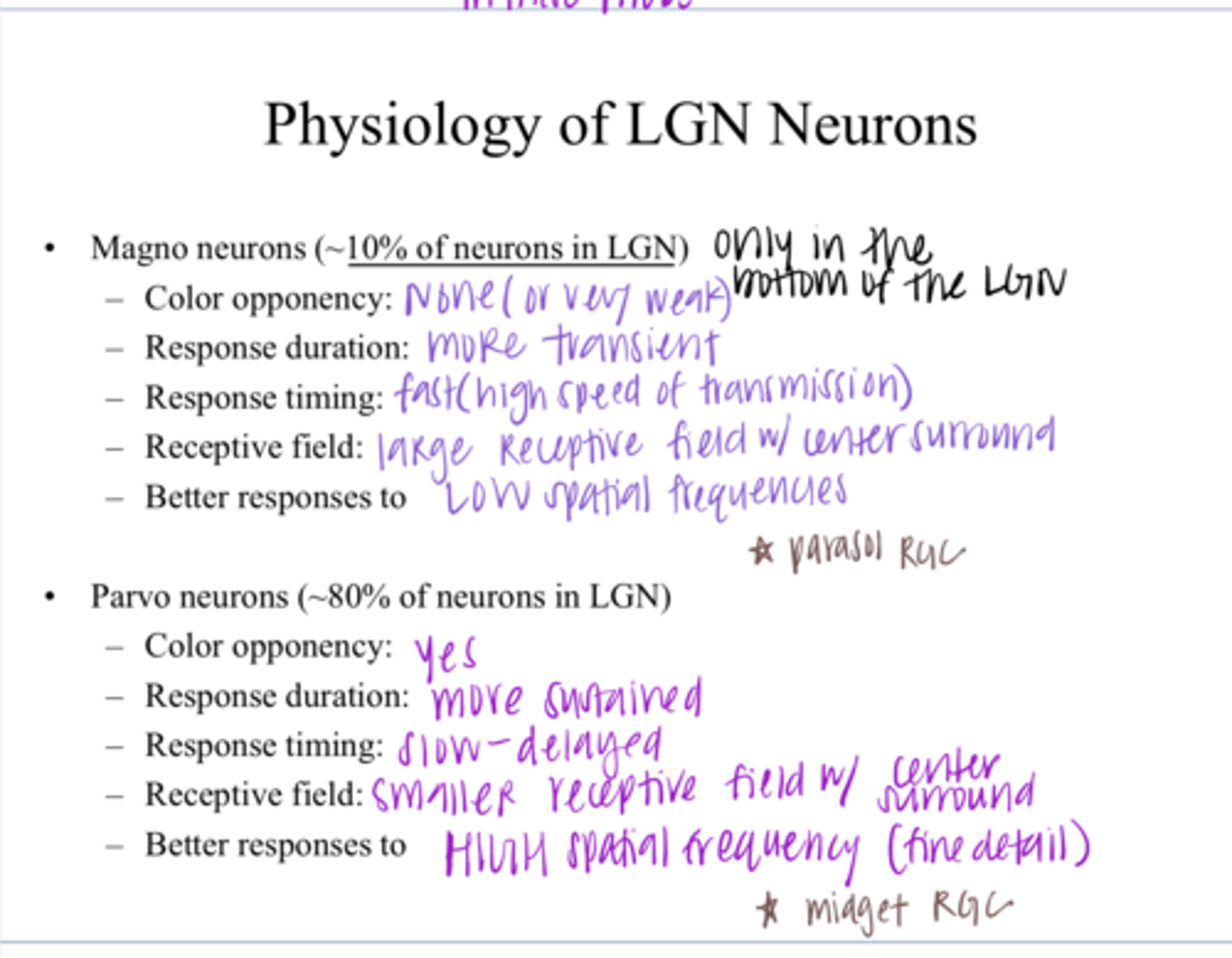
Color Opponency of Parvo Neurons?
Yes
Magno vs Parvo Physiology of LGN Neurons
Response Duration of Parvo Neurons?
more sustained
Magno vs Parvo Physiology of LGN Neurons
Response timing of Parvo Neurons?
slower -- more delayed
Magno vs Parvo Physiology of LGN Neurons
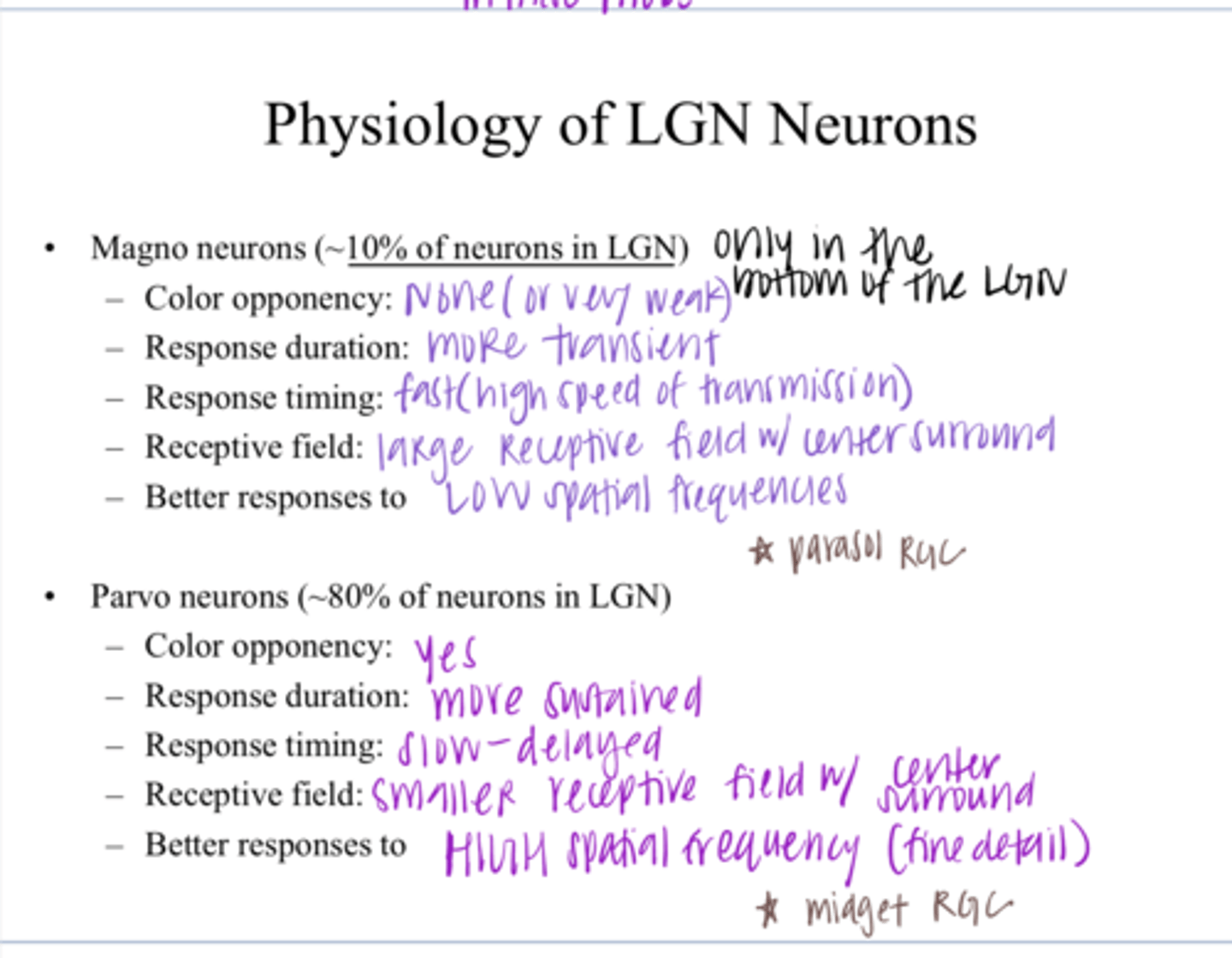
Receptive Field of Parvo Neurons?
Smaller receptive field w/ center-surround antagonism
Magno vs Parvo Physiology of LGN Neurons
Parvo: Better responses to what spatial frequencies?
HIGH
True or False:
The differences in the responses of the two classes of LGN neurons should remind you of the differences between parasol and midget RGCs
true
Midget RGCs project to what LGN neuron?
Parvo (P pathway)
Parasol RGCs project to what LGN neuron?
Magno (M pathway)
The idea emerged in the 1980s that there where two major visual pathways -- a ____ system and a _____ system
where; what
What is the Magno system good at detecting?
Flicker
Movement
Alerts us to the presence of a visual stimli
What is the Parvo system good at?
providing info regarding the spatial details of a stimulus
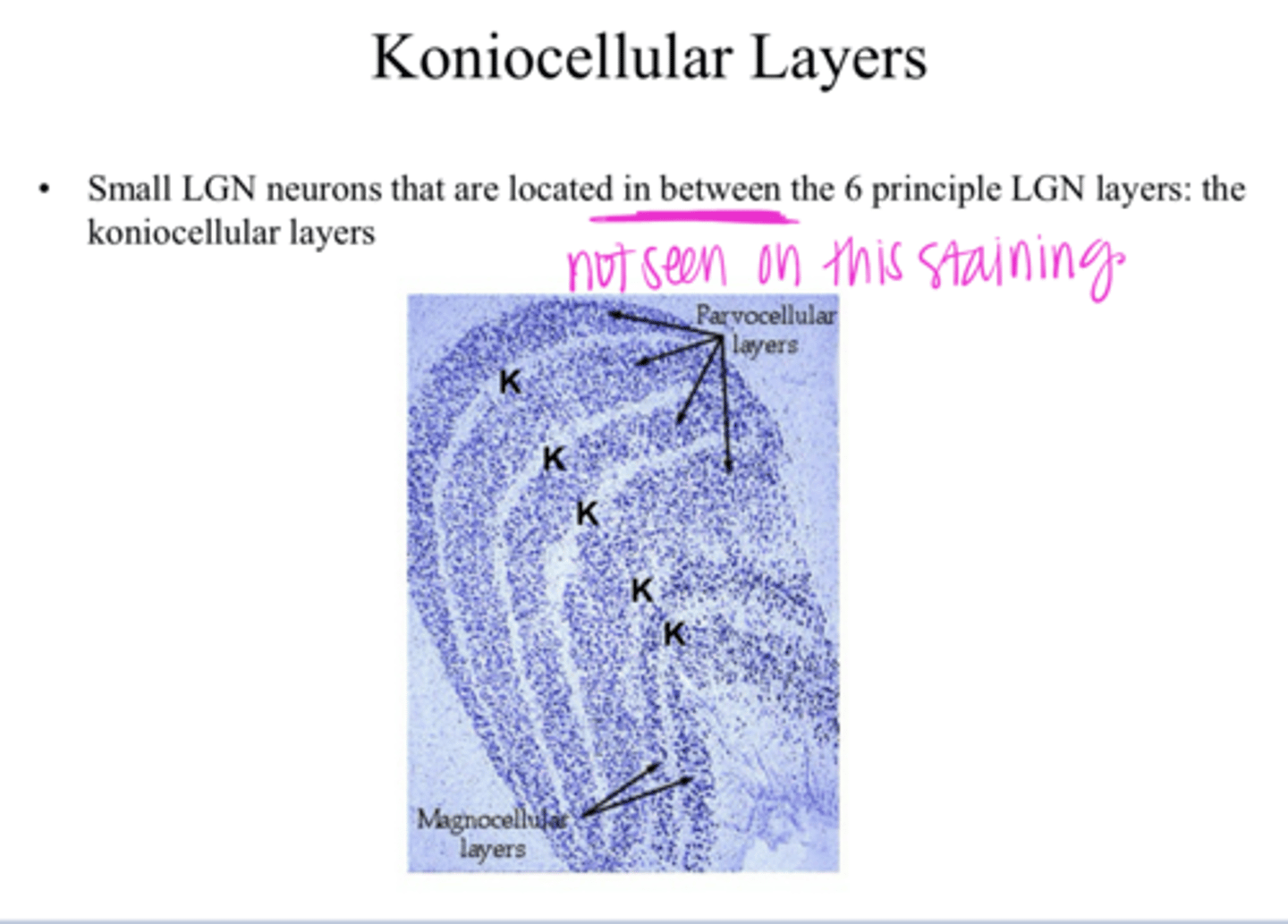
What is the retinal component that connects to the konicellular pathway of the LGN?
small bistratified RGCs
Does the koniocellular pathway of the LGN show color opponency?
Shows limited Blue ON, Yellow OFF color opponency
What is the size of the receptive field of the konicellular pathway of the LGN?
large receptive field
Does the konicellular pathway of the LGN have center-surround antagonism?
No
What spatial frequency does the koniocellular pathway of the LGN best respond to?
Lower
What is the speed of responses of the konicellular pathway of the LGN?
slow responses -- very slow speed of transmission
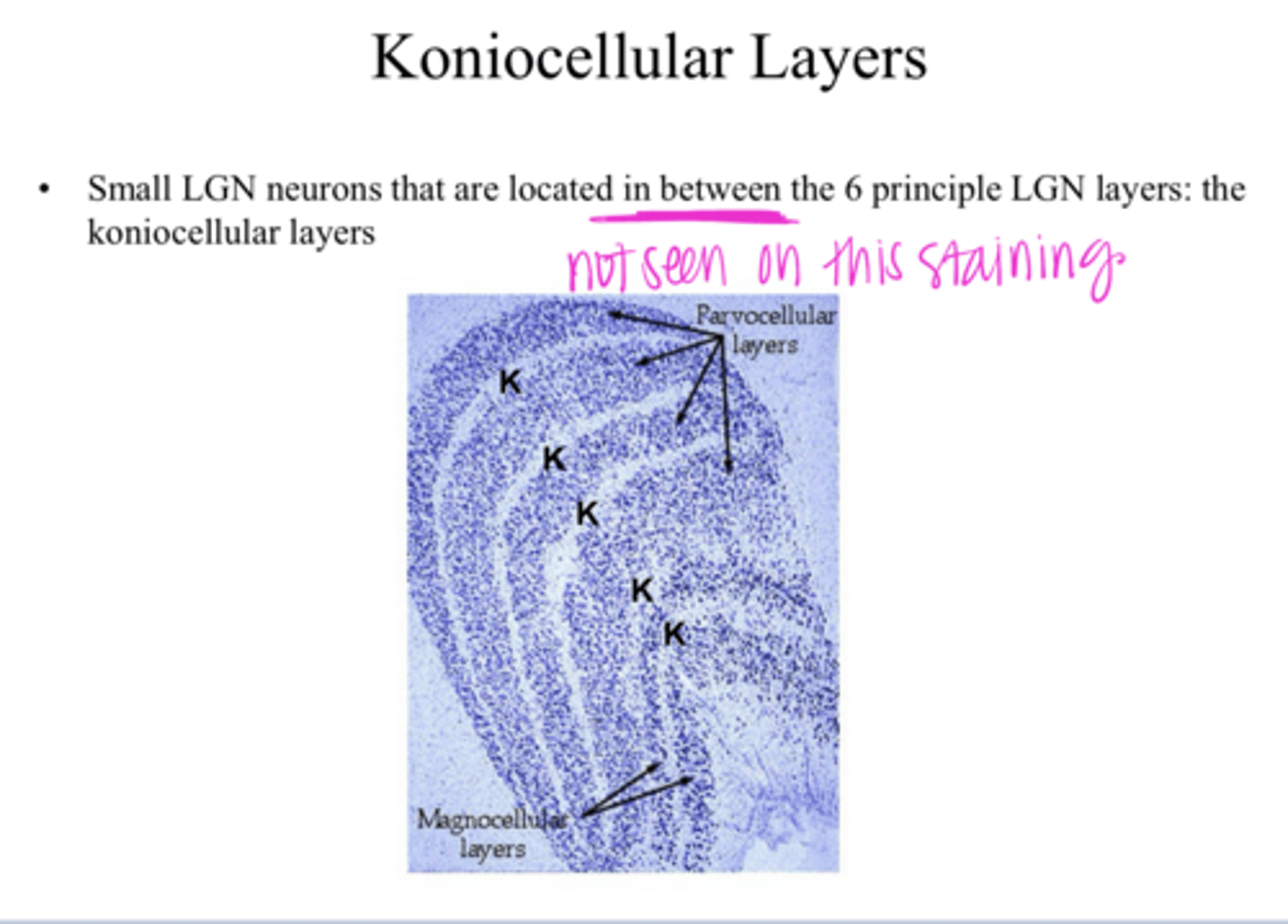
Where are the koniocellular pathway neurons of the LGN located?
IN BETWEEN the 6 principle LGN layers
Why is the visual system classified as a Fourier analyzer?
The idea is that different channels in the visual pathway are tuned into specific spatial frequencies that exist within a given image
Does each cell of LGN have a peak sensitivity in terms of spatial frequency?
Yes
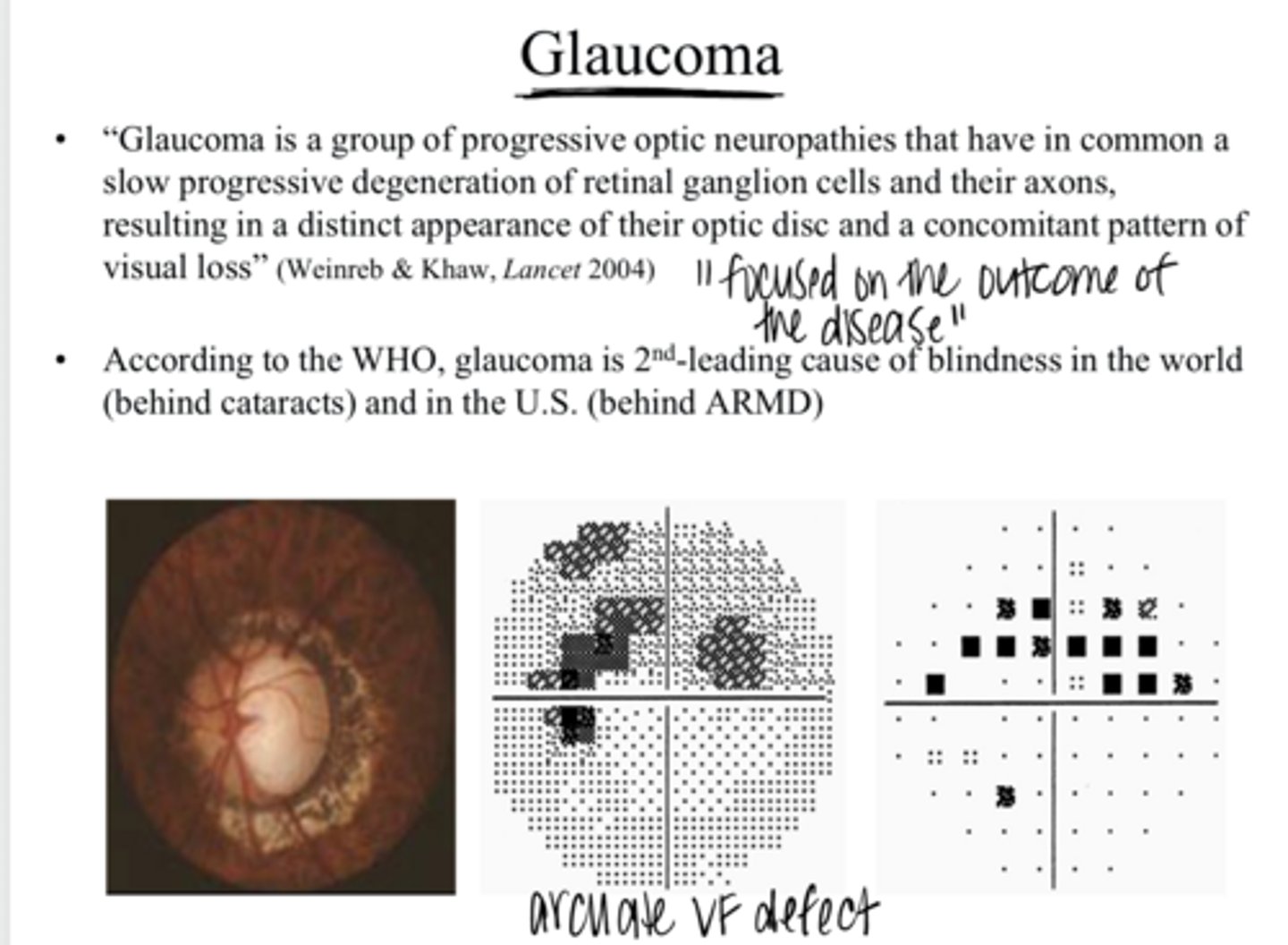
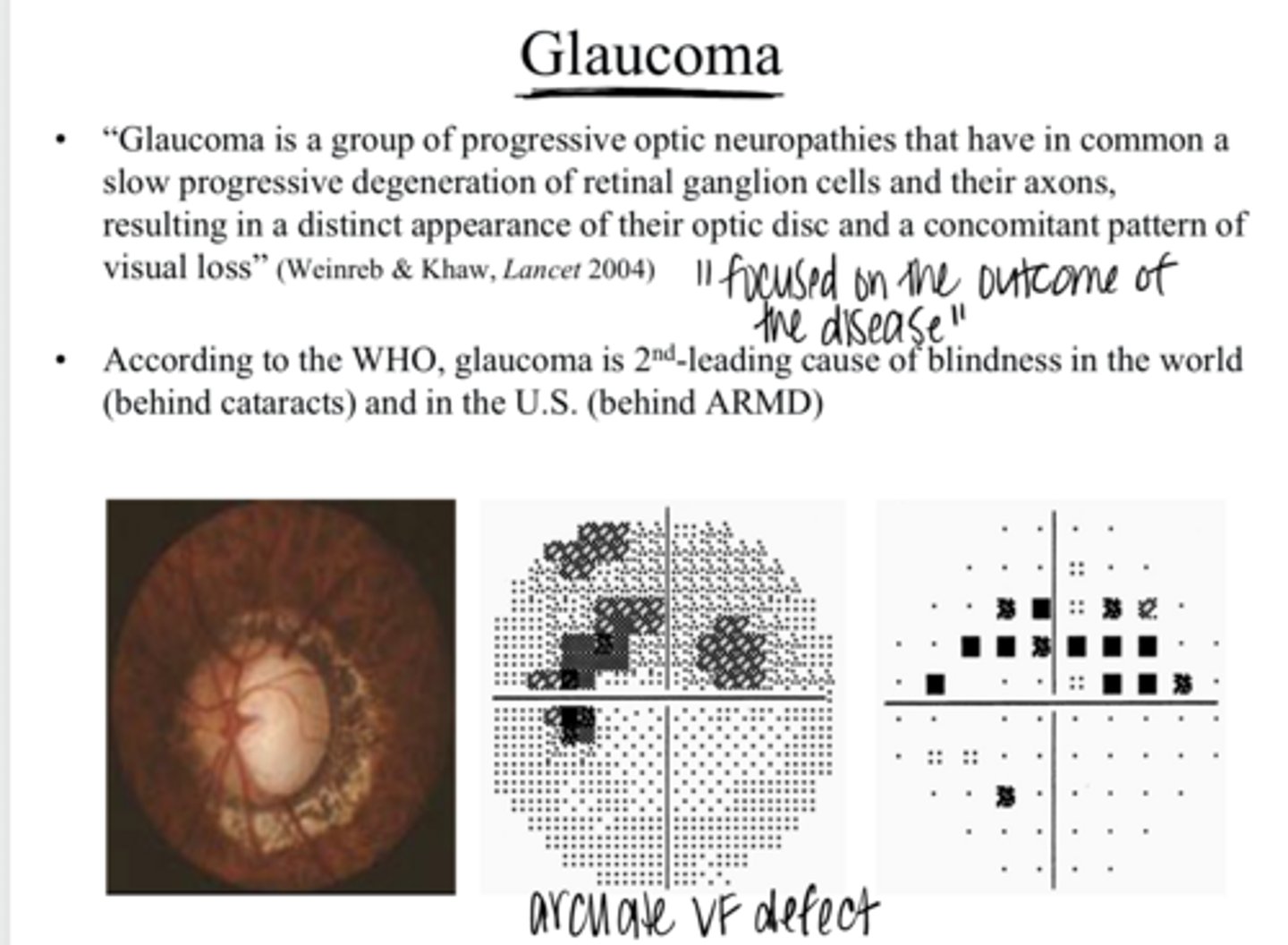
What is the definition given for glaucoma?
Glaucoma is a group of progressive optic neuropathies that have in common a slow progressive degeneration of RGCs and their axons; resulting in a distinct appearance of their optic disc and a concomitant pattern of visual loss
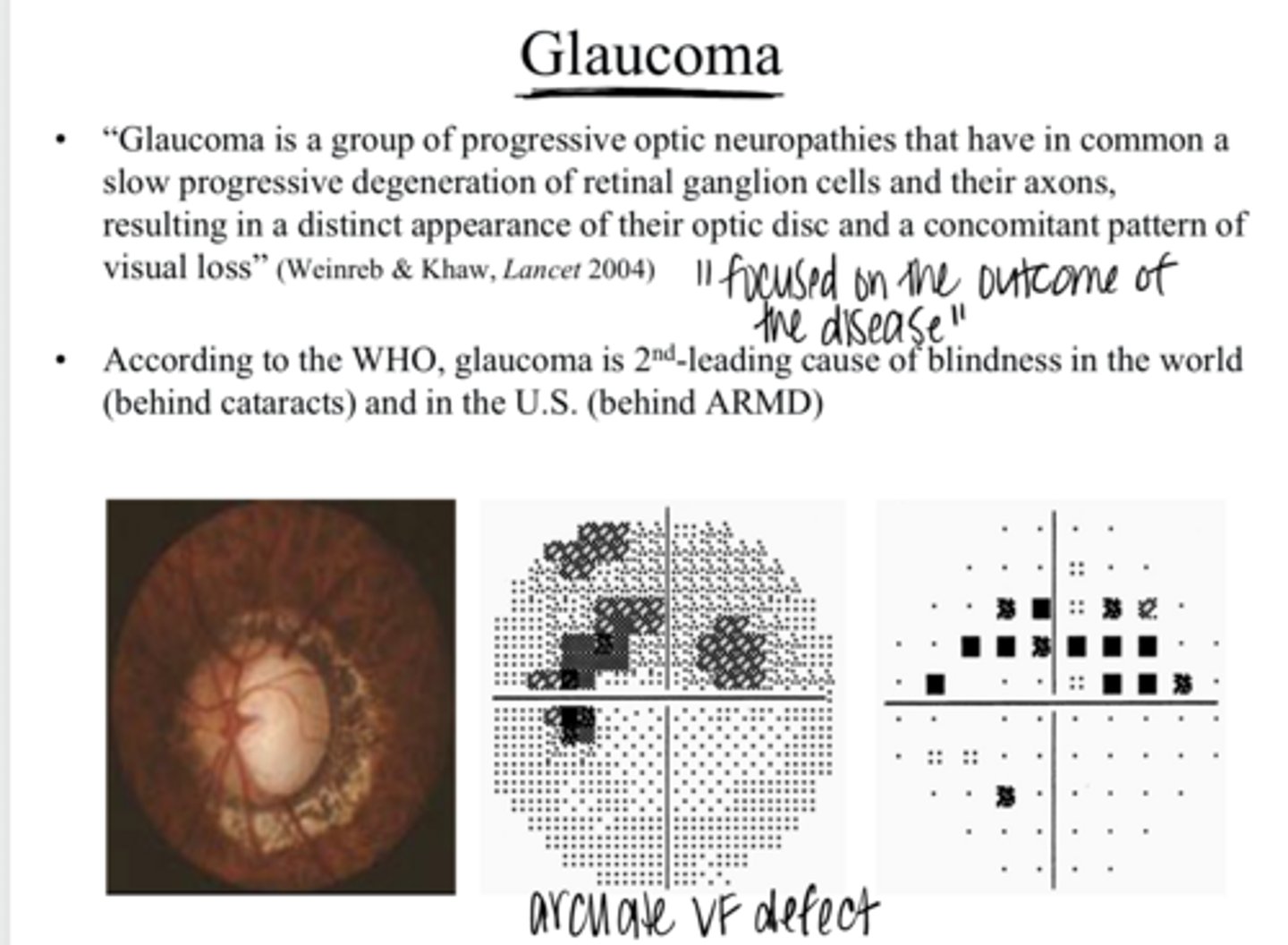
What is the most important known risk factor for primary open angle glaucoma?
Intraocular pressure
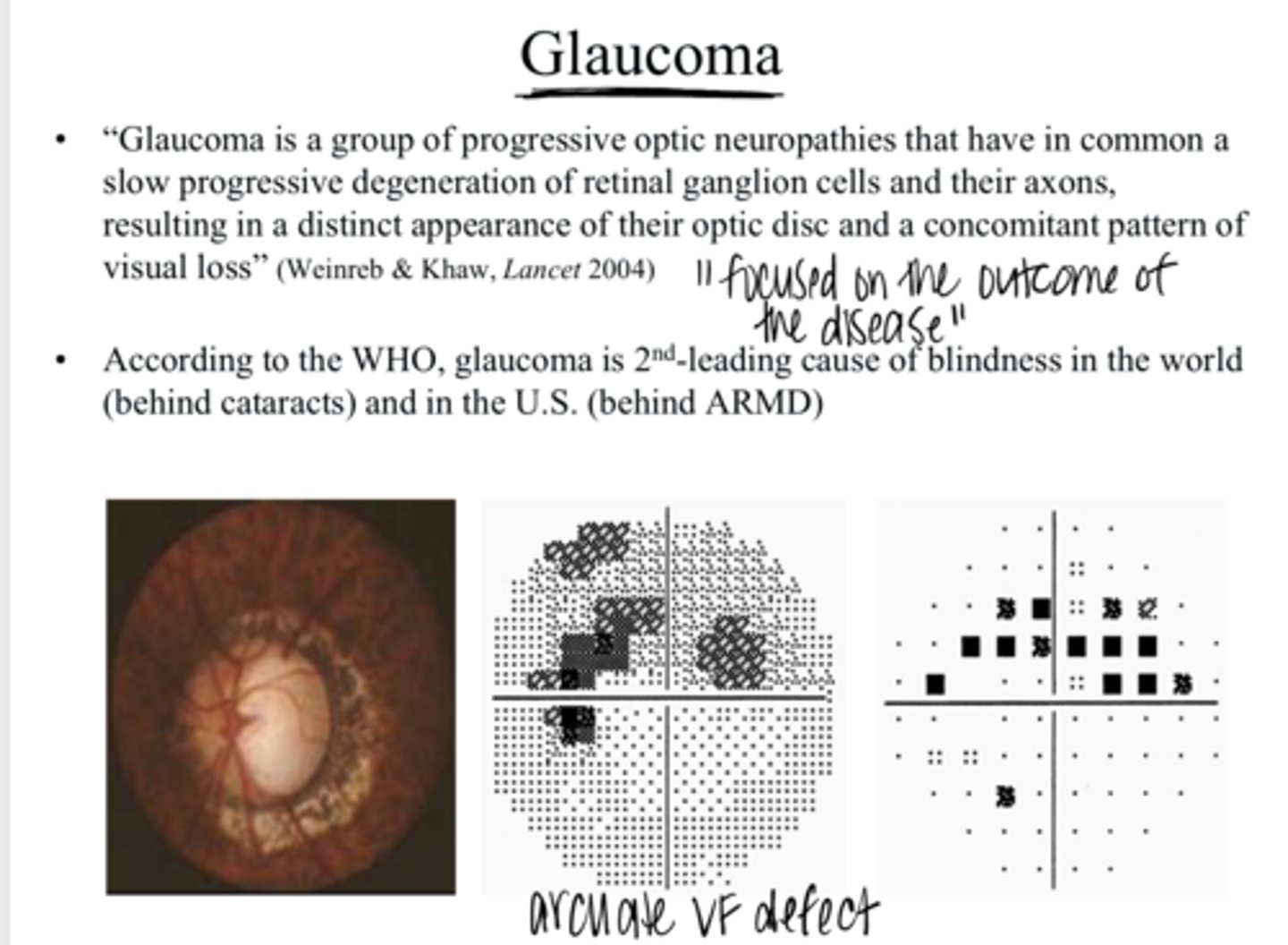
All current therapies for this disease involve what?
medical or surgical procedures designed to lower IOP
Do the results of wide-scale clinical trials support that IOP reduction is beneficial in decreasing POAG incidence/progression?
Yes
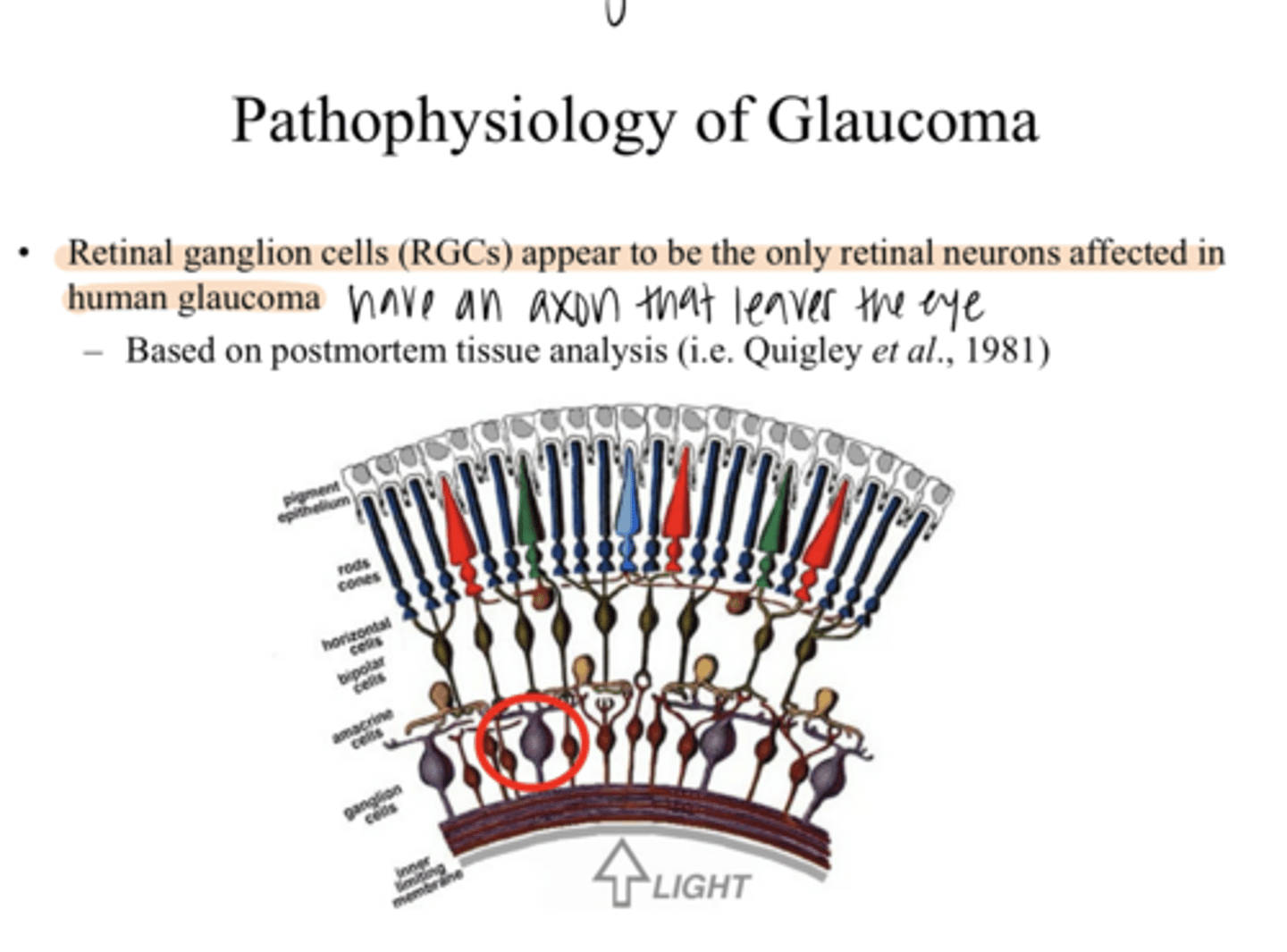
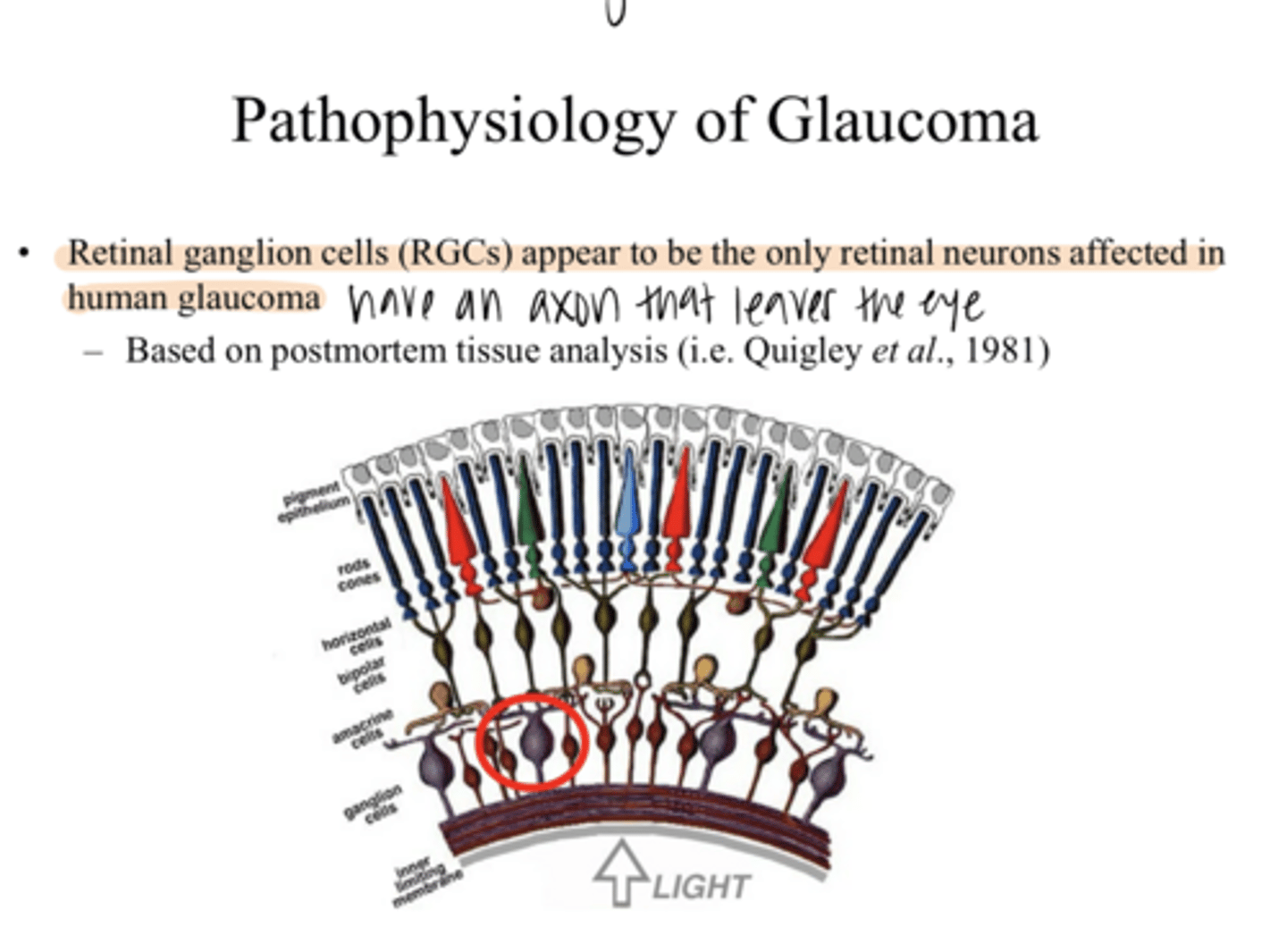
_____ are the only cell that is affected in human glaucoma
RGCs
Where are RGCs injured in glaucoma?
The initial damage to the RGC axon occurs at the lamina cribosa. This is AXONAL injury -- not CELL BODY injury.
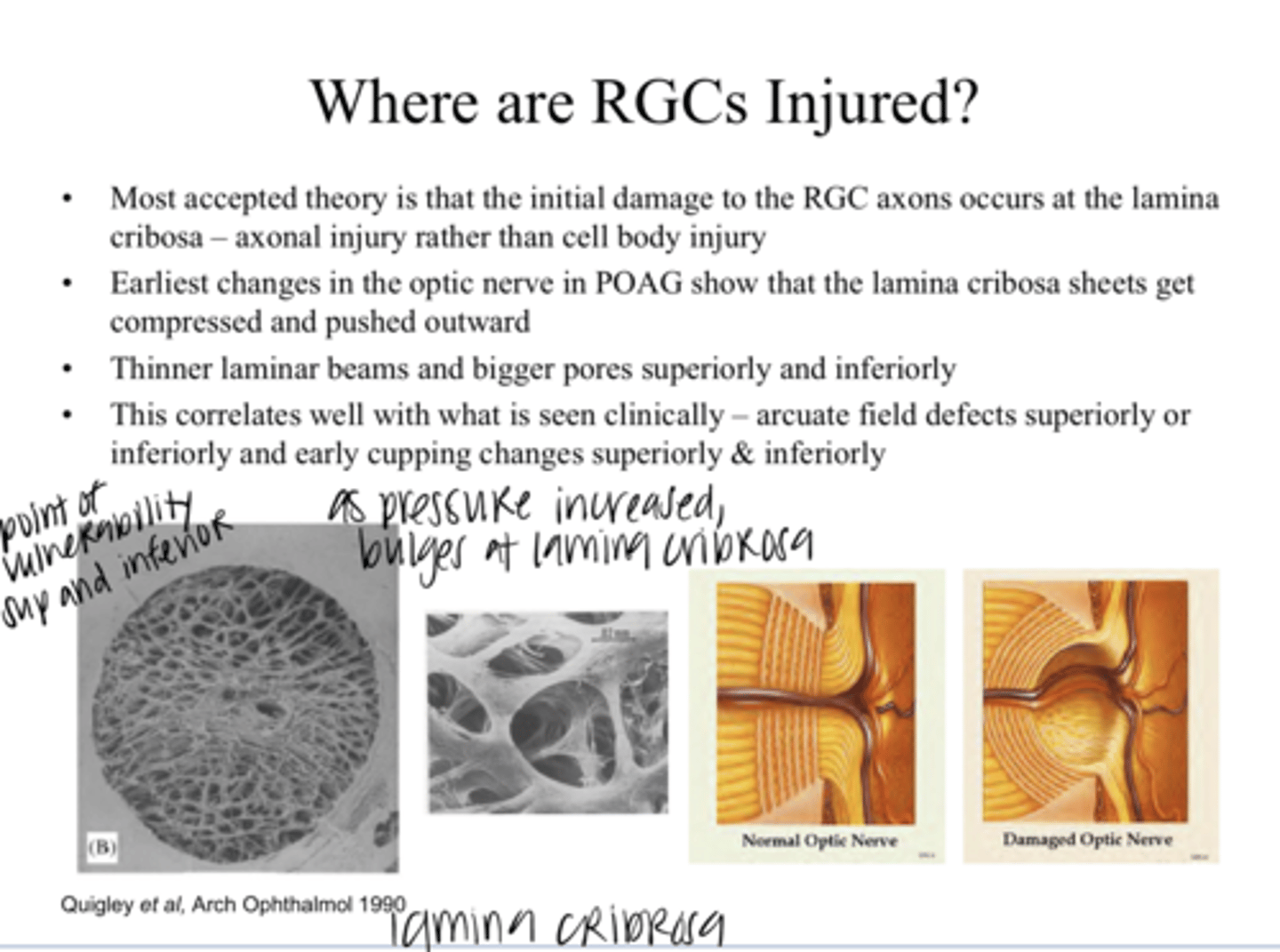
Earliest changes in the optic nerve in POAG show what happening to the lamina cribosa?
sheets of the lamina cribosa get compressed and pushed outward
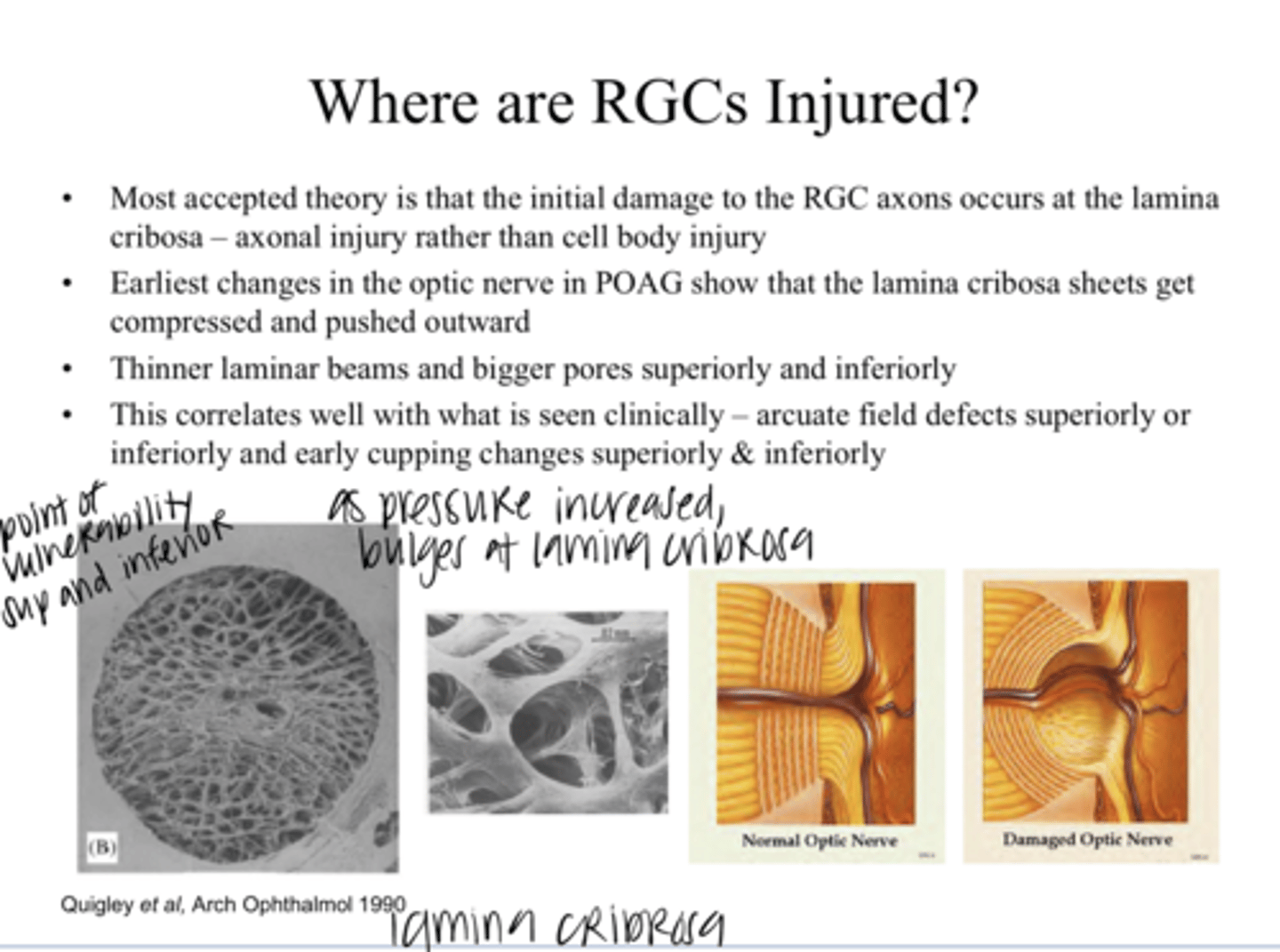
Where are the thinner lamina cribosa beams & bigger pores? What is the clinical implication of this?
superior and inferior; arcuate defect superior and inferiorly and early cupping changes superior and inferior
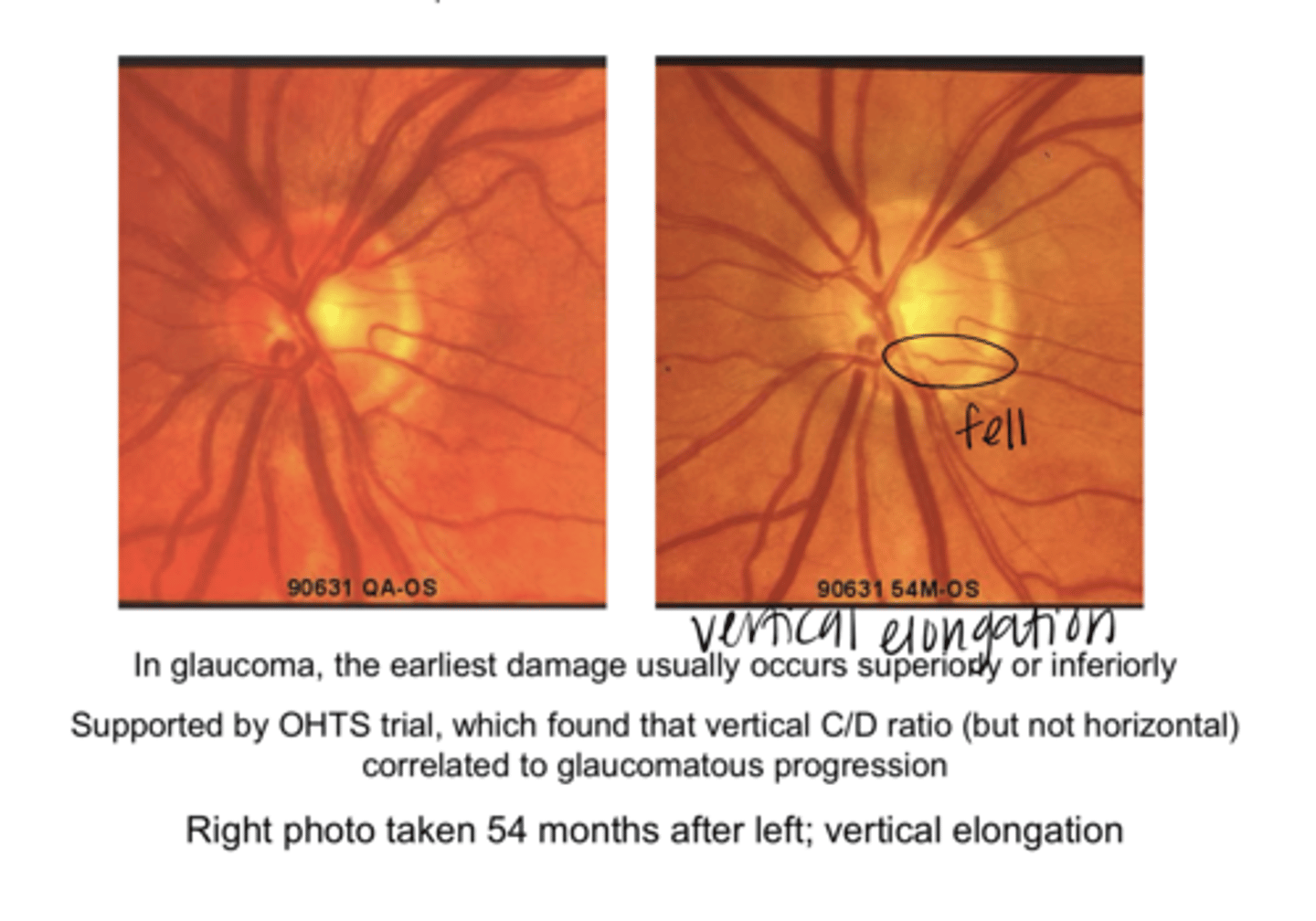
In glaucoma, the earliest changes appear ____ or ____
superior or inferiorly
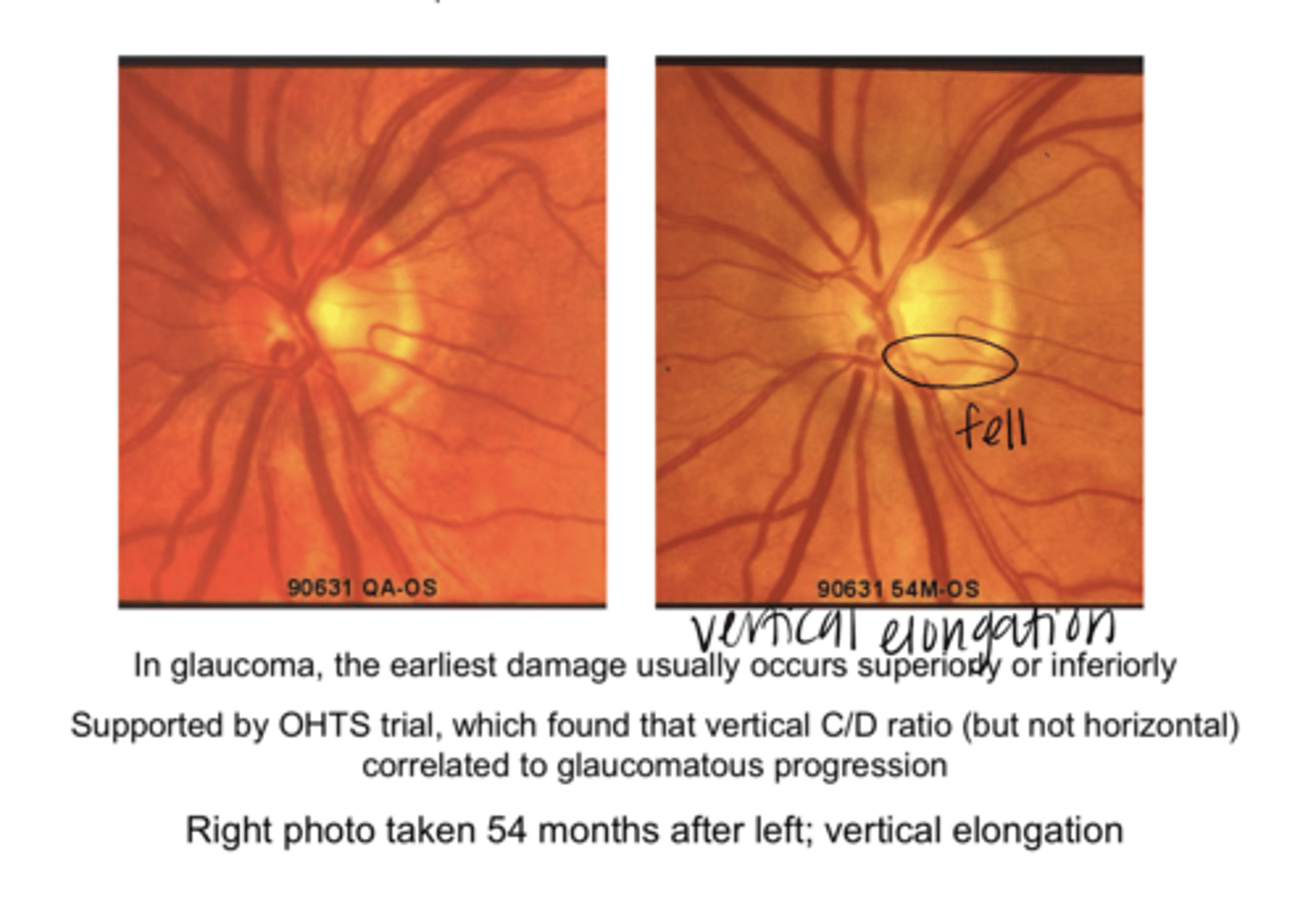
The (vertical/horizontal) C/D ratio correlates to glaucomatous progression
vertical
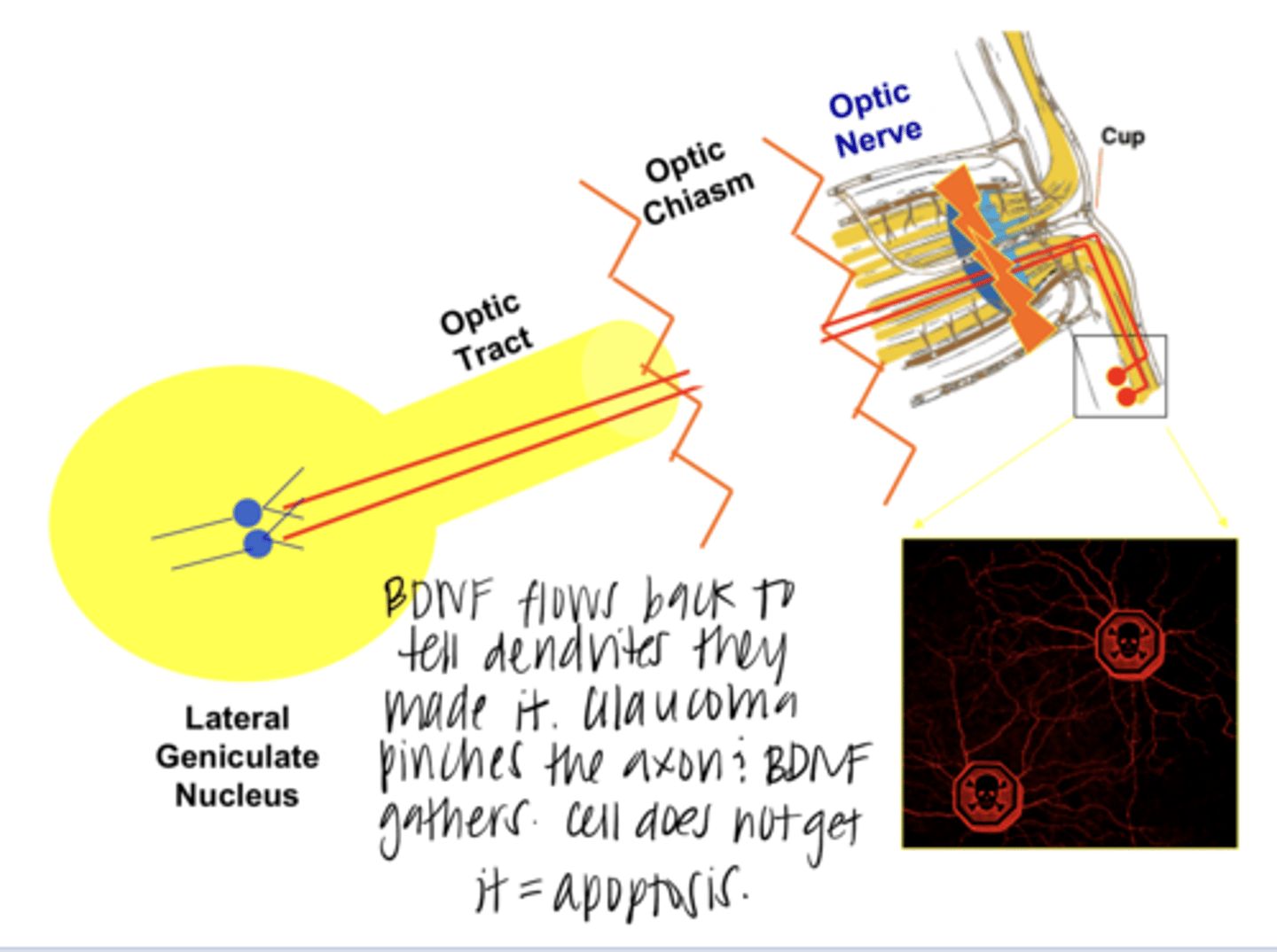
What is the neurotrophic deprival hypothesis that explains why RGCs die in glaucoma?
RGC axons are pinched at the lamina cribosa, disrupting axoplasmic flow. This flow constantly carries vital messengers (neurotrophins like BDNF) from the brain target back to the RGC cell bodies of the retina. If the axonal transport is affected and BDNF does not reach the RGC cell bodies, the cell will initiate its own death.
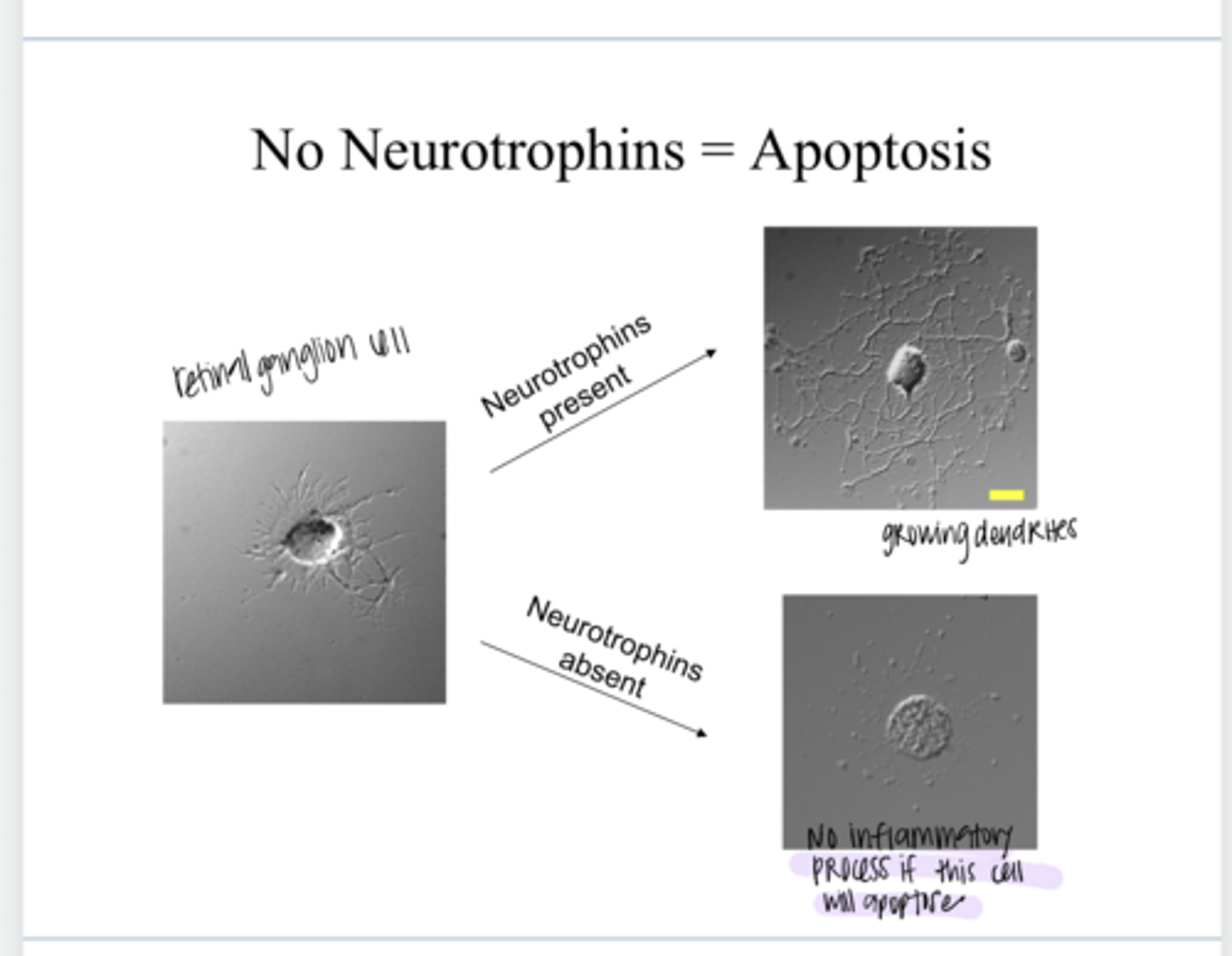
What happens if the BDNF neurotrophin is affected and does not reach RGC cell bodies?
The RGC will initiate its own death
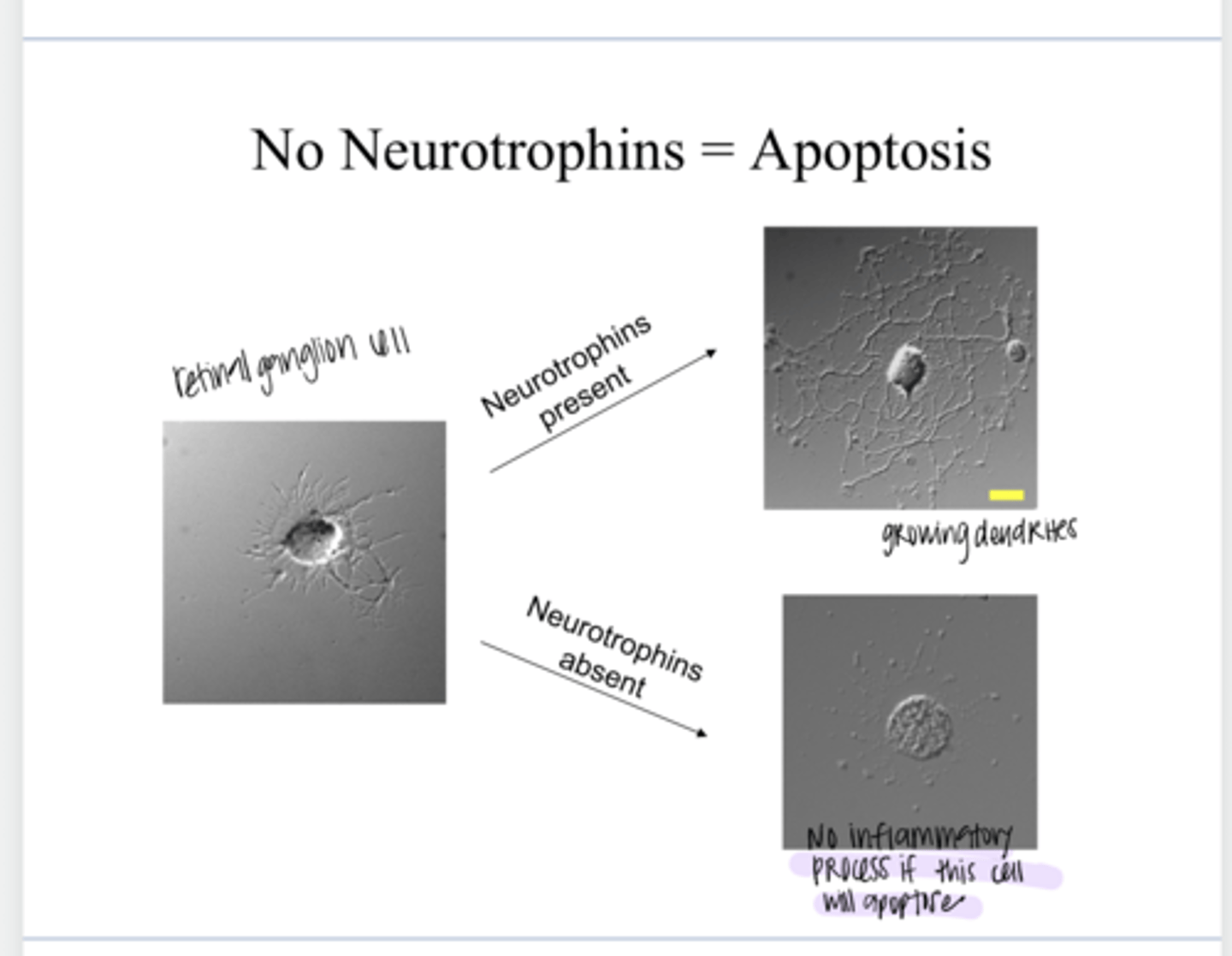
Is BDNF important embryonically?
Yes -- RGCs that do not reach the correct target eliminate themselves
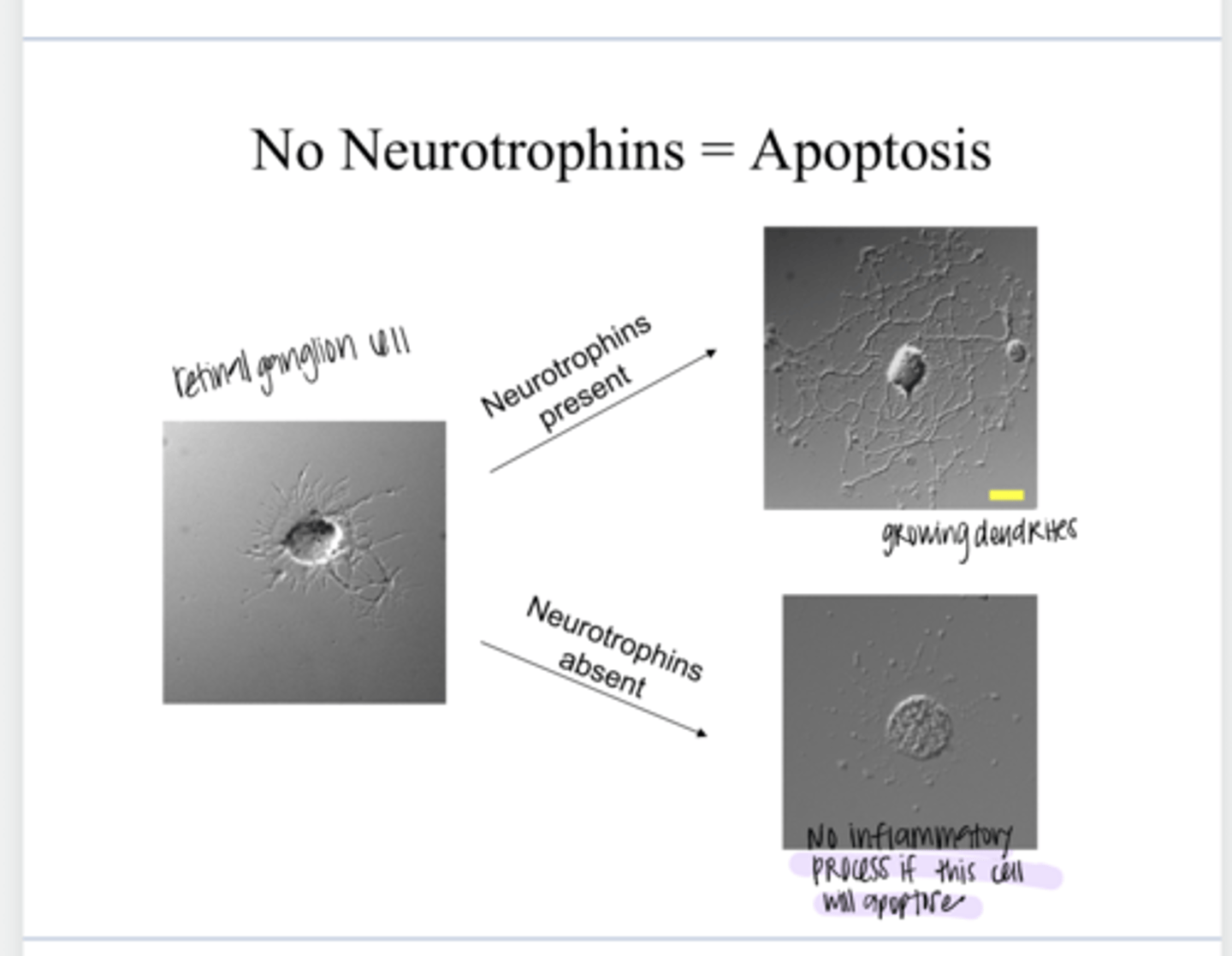
Neurotrophin deprivation will genetically program cell death called ______
apoptosis
How does a cell undergo apoptosis?
-Each affected cell expresses enzymes to digest its own DNA and other cellular components
-The cell then fragments into small vesicles (no membrane rupture) and removed without inducing inflammation
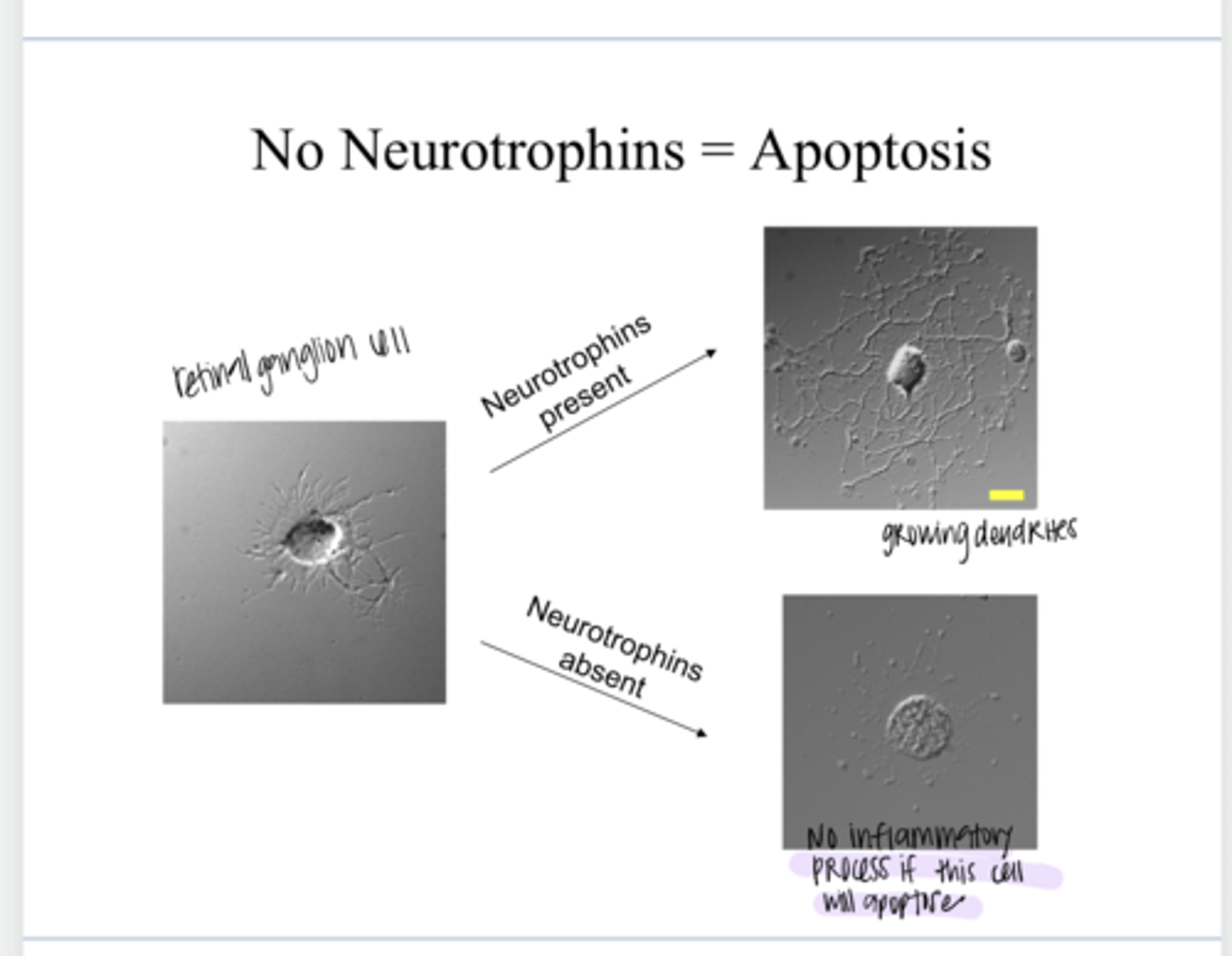
After apoptosis of a RGC, will inflammation result?
No
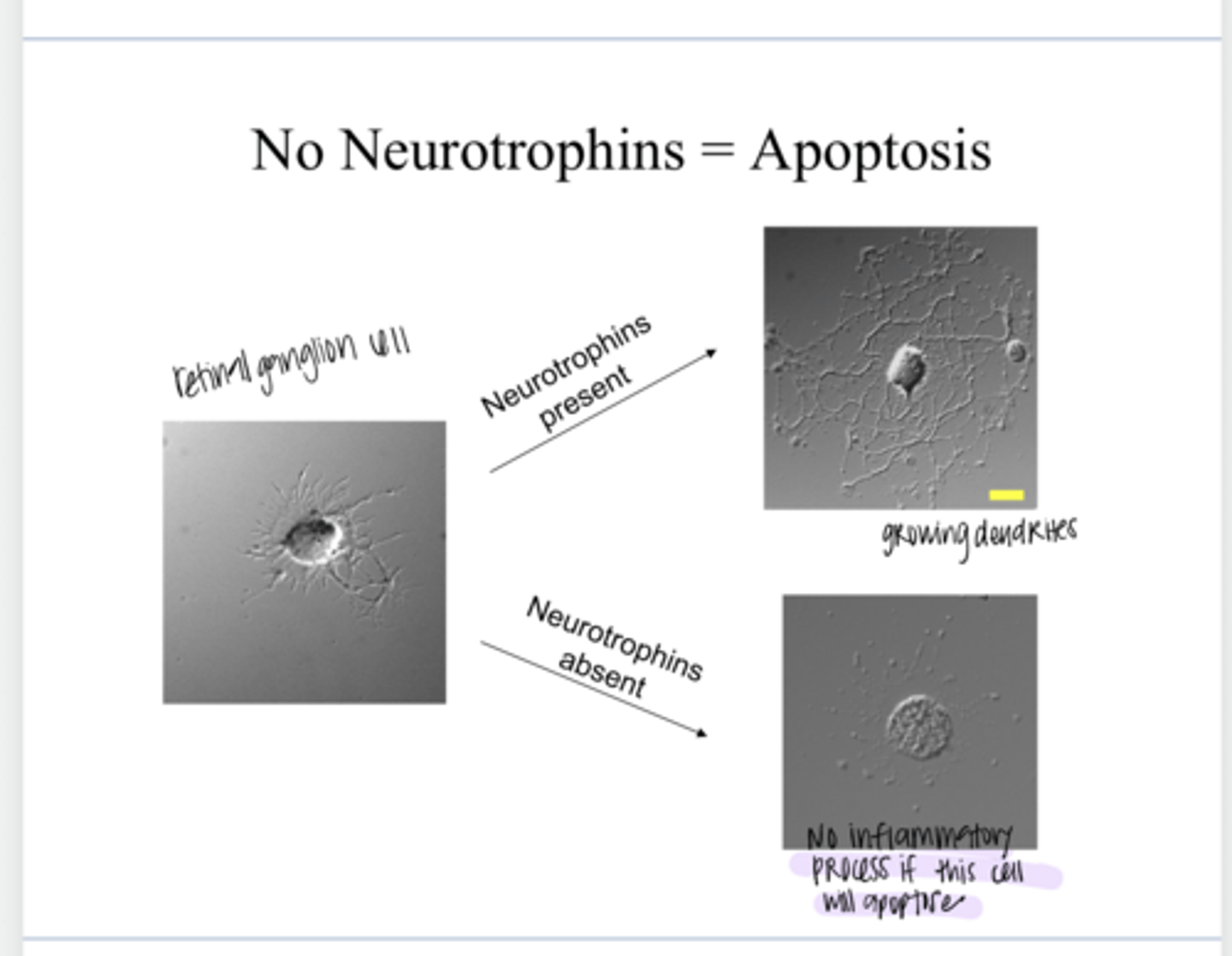
No Neurotrophins = Apoptosis
Neurotrophins Present = RGC Growth (Pic)
No Neurotrophins = Apoptosis
Neurotrophins Present = RGC Growth (Pic)
is neurotrophin deprivation an attractive theory for glaucoma?
Yes -- meshes well with classical mechanical theory of damage
How can you induce neurotrophin deprivation experimentally?
by cutting the optic nerve (in vivo) or depriving cultured RGCs (in vitro)
________ RGCs have been detected in human glaucoma
Apoptotic
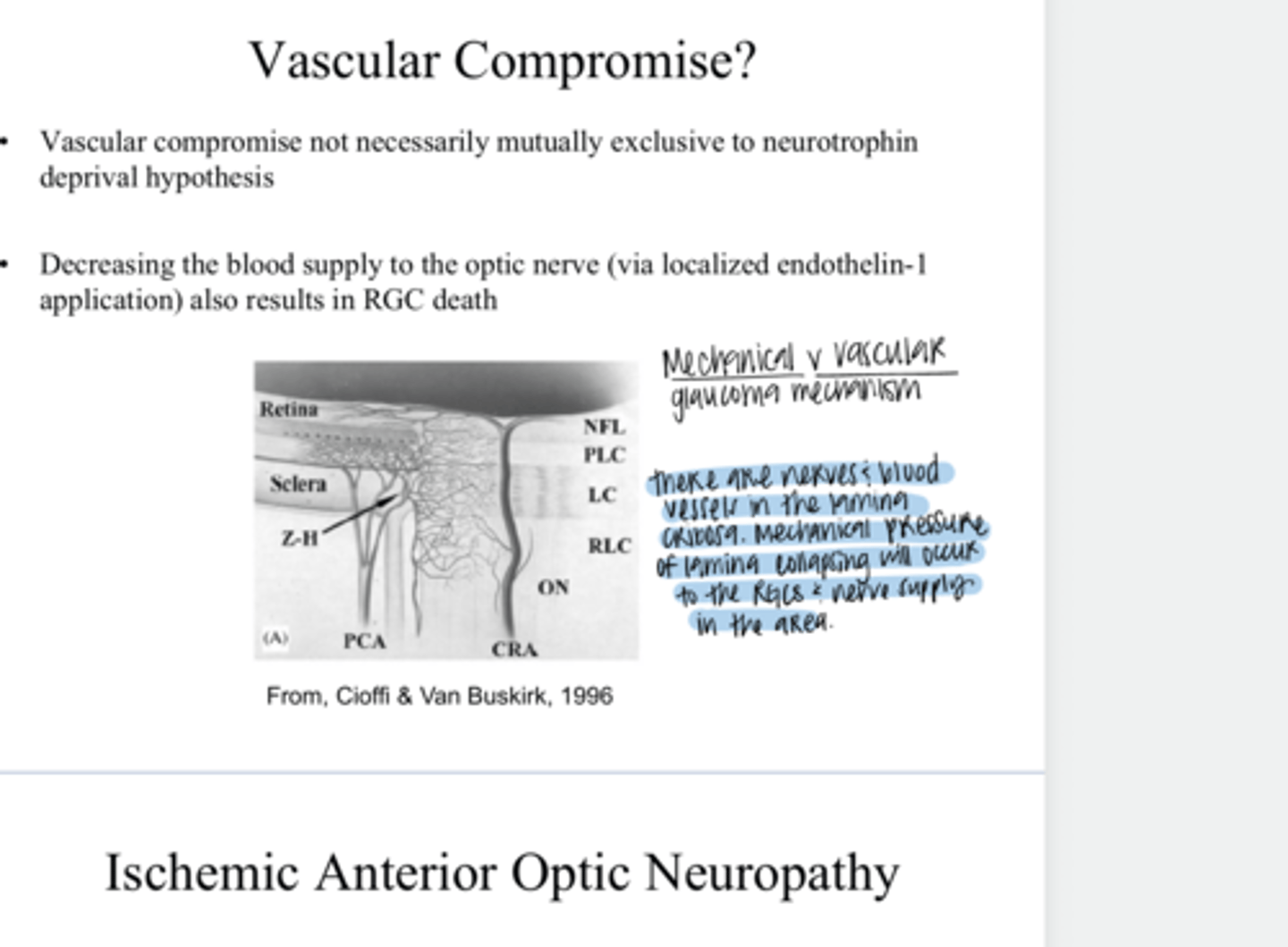
What is vascular compromise and how does it relate to RGCs? Is vascular compromise mutually exclusive to neurotrophin deprival hypothesis (in other words does this only occur separately from neurotrophin deprival?)
Occurs when blood supply to optic nerve is decreased via localized endothelin-1 application and results in RGC death; No both things can occur at simultaneously.
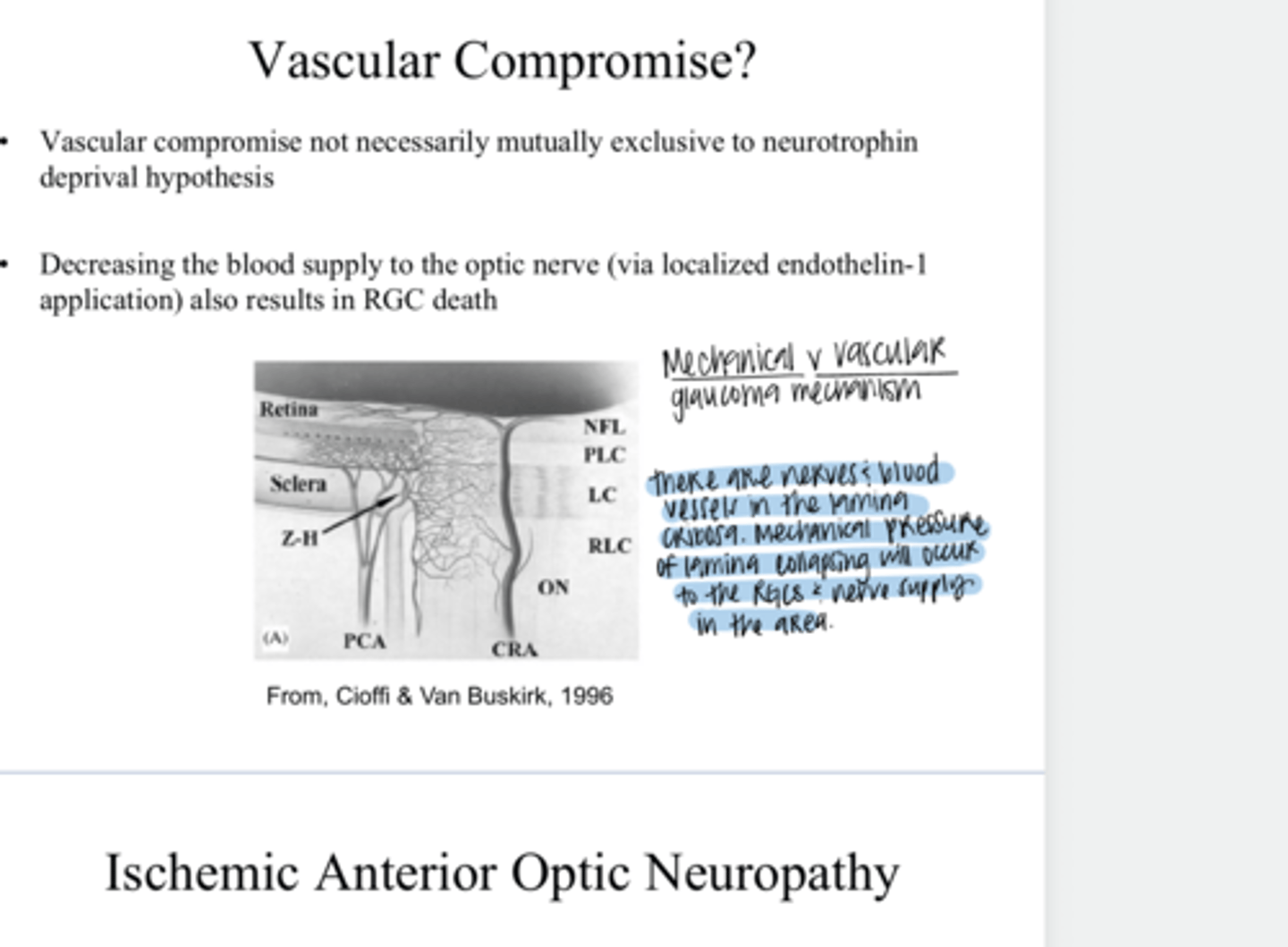
Does decreasing the blood supply to the optic nerve also result in RGC death?
Yes
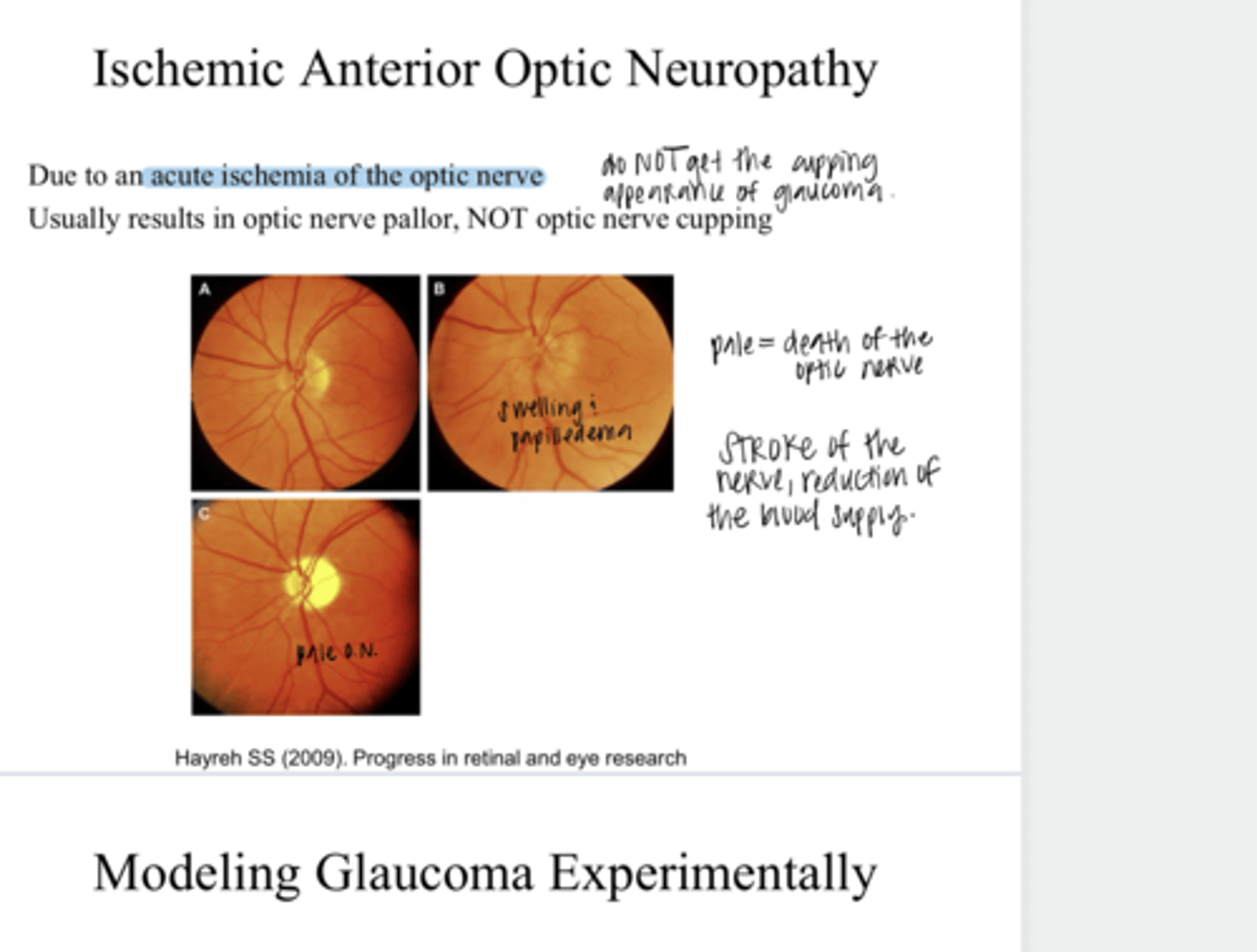
What is ischemic anterior optic neuropathy d/t?
acute ischemia of the optic nerve
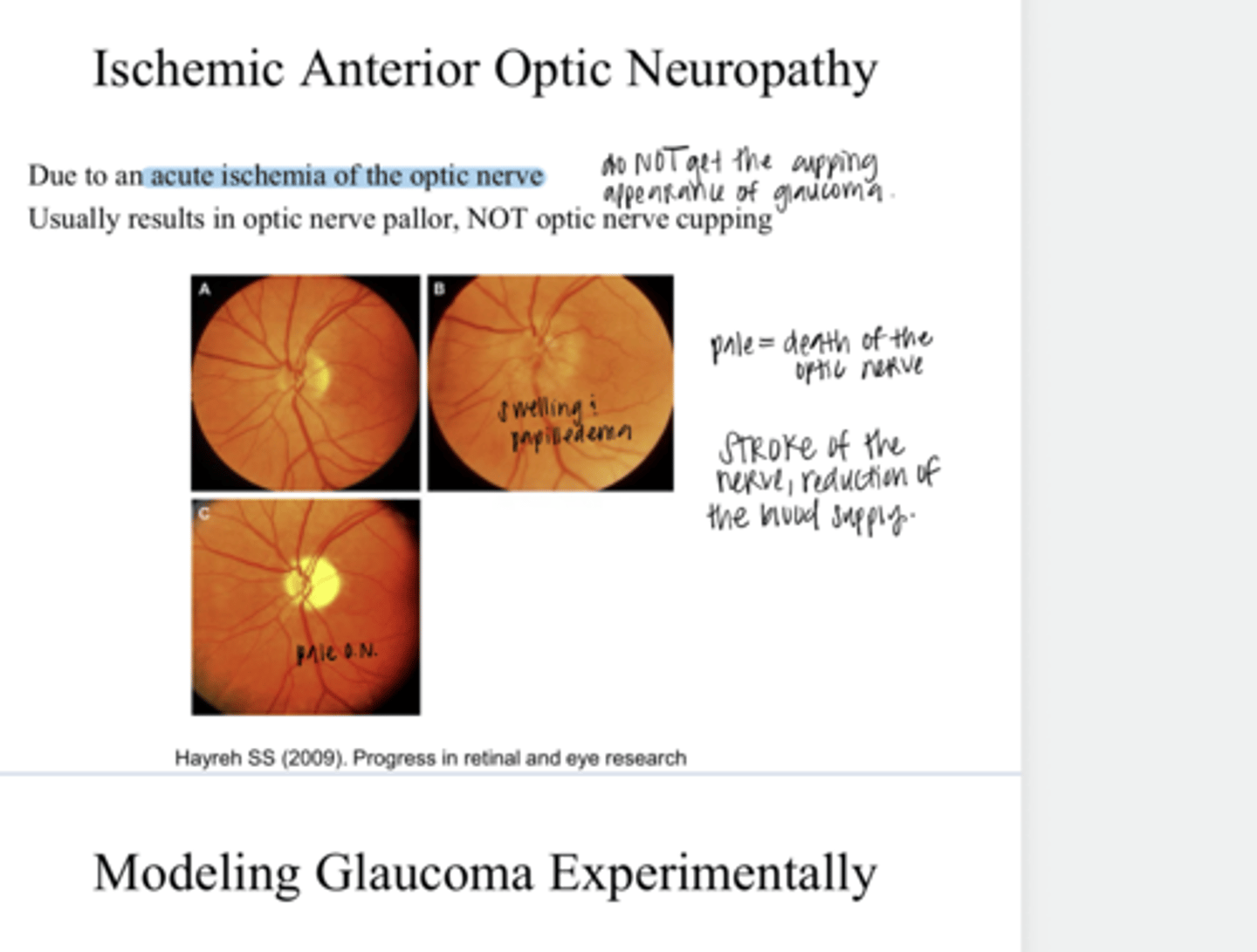
What does ischemic anterior optic neuropathy result in?
optic nerve pallor
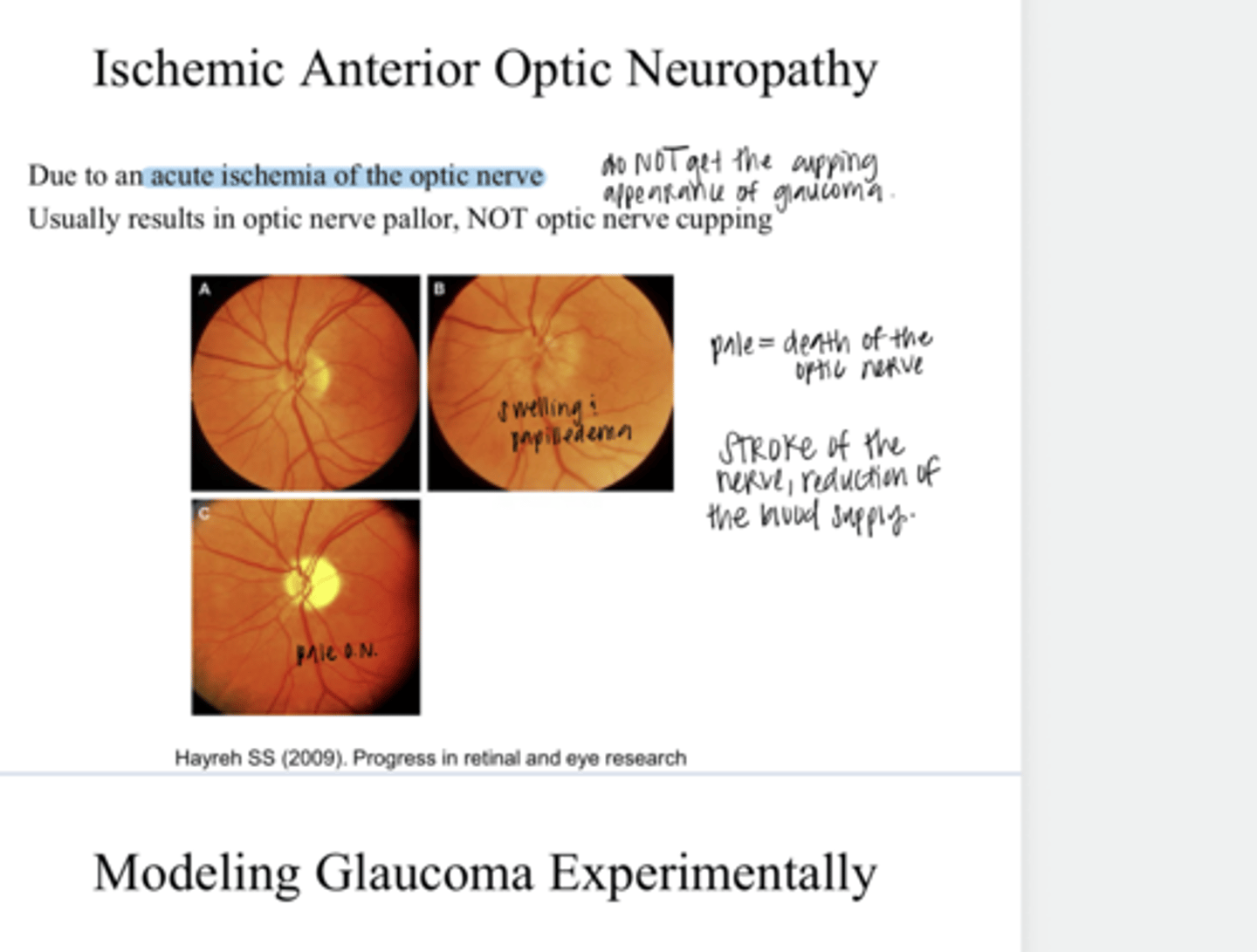
What does ischemic anterior optic neuropathy NOT result in?
Optic nerve cupping (as seen with glaucoma)
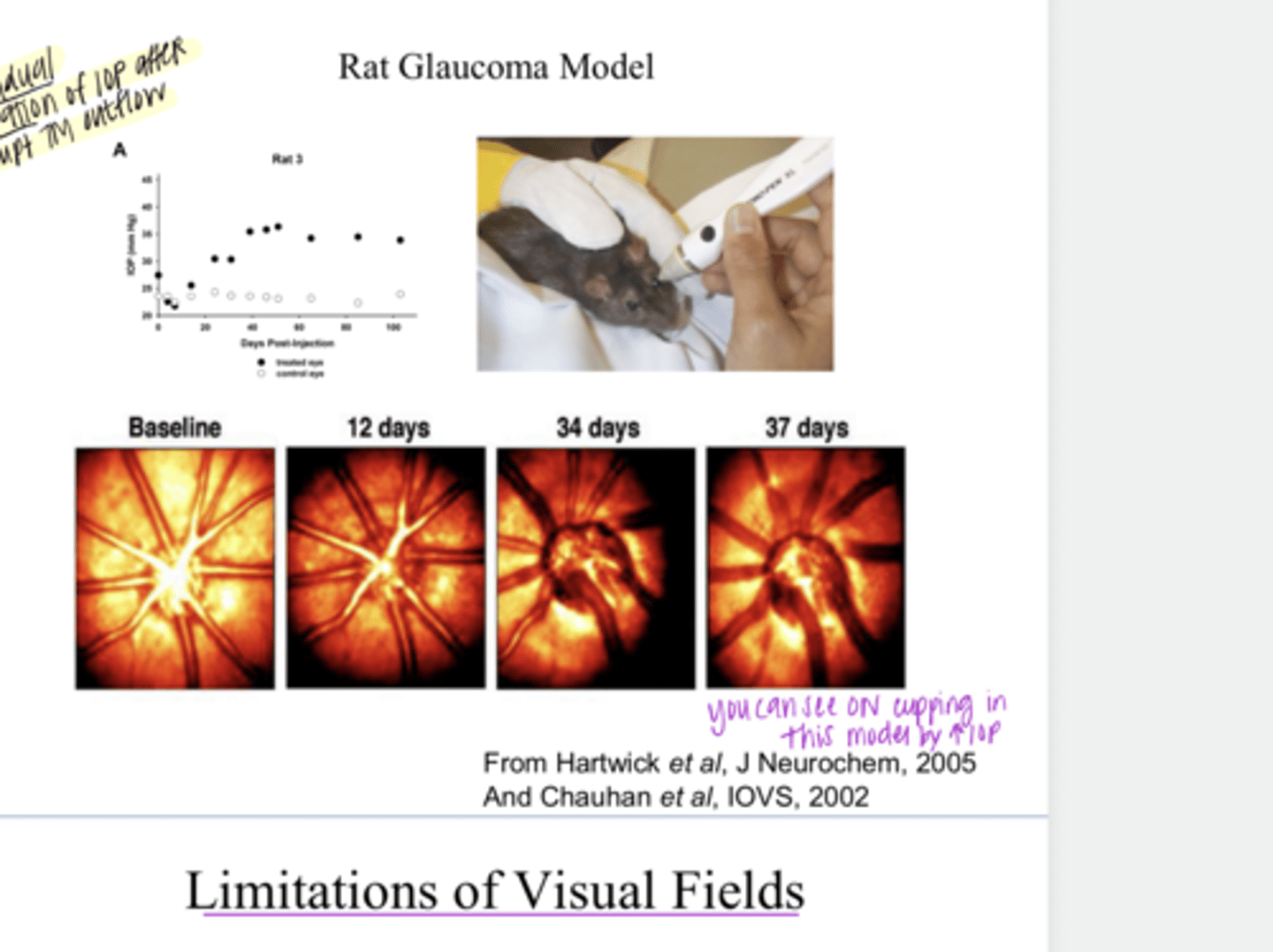
What does the experimental elevation of IOP in an animal induce? Why?
RGC death — elevated IOP is a causative factor for glaucomatous damage
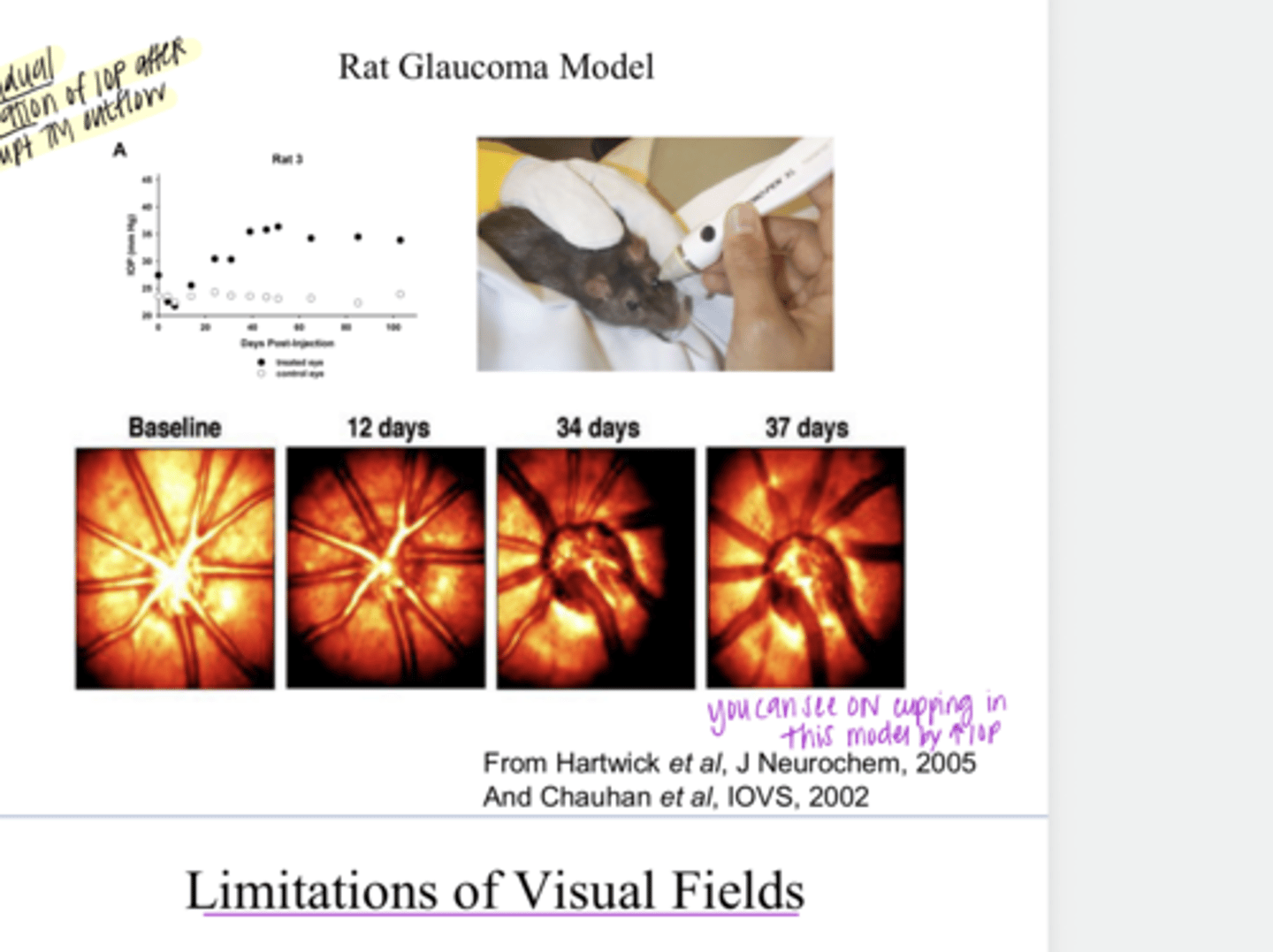
Does chronic and moderate elevation in IOP induce RGC death & optic nerve cupping?
Yes
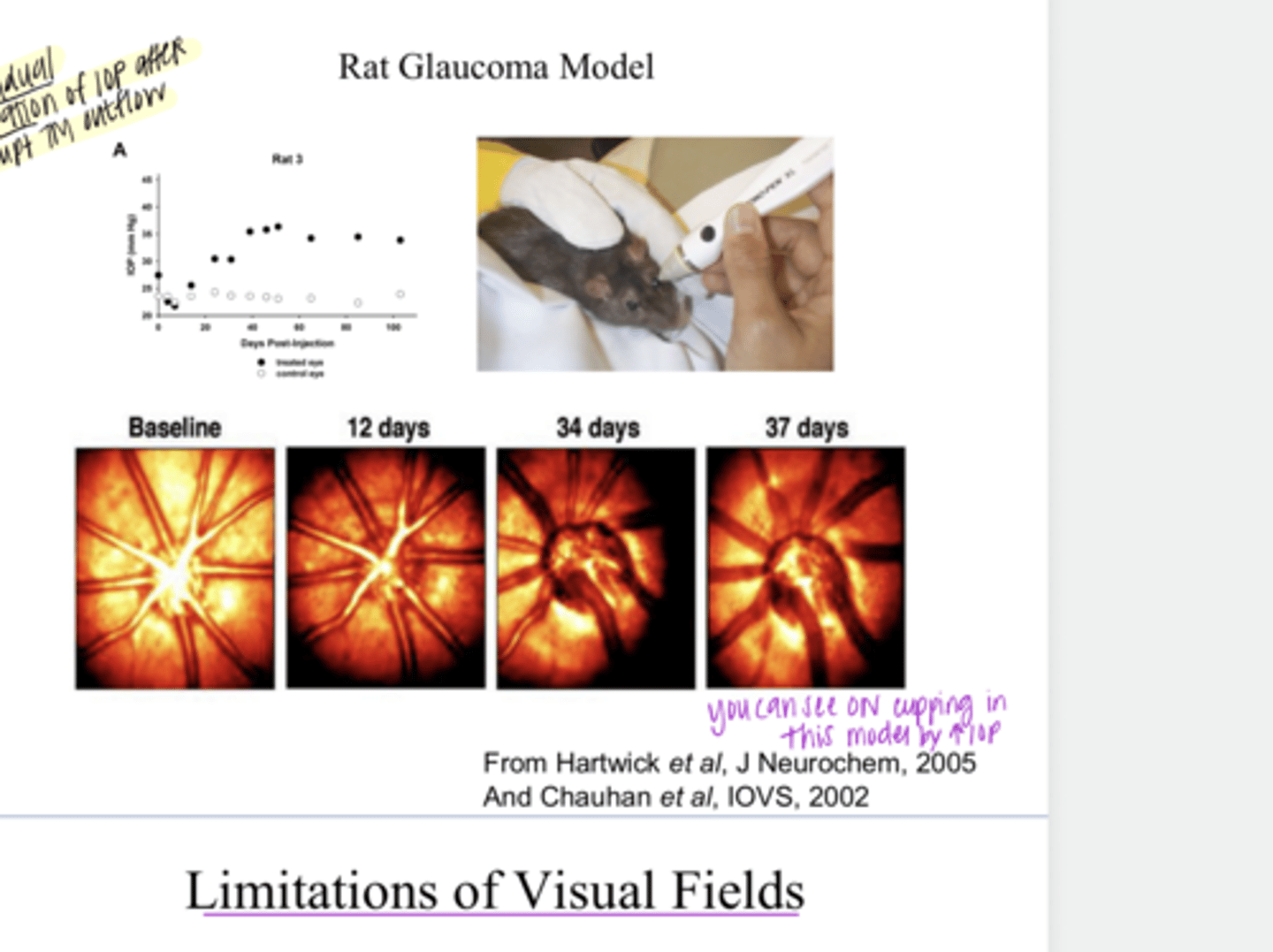
Rat Glaucoma Model -- Disrupting TM outflow w/ Gradual Elevation of IOP (Pic)
Rat Glaucoma Model -- Disrupting TM outflow w/ Gradual Elevation of IOP (Pic)
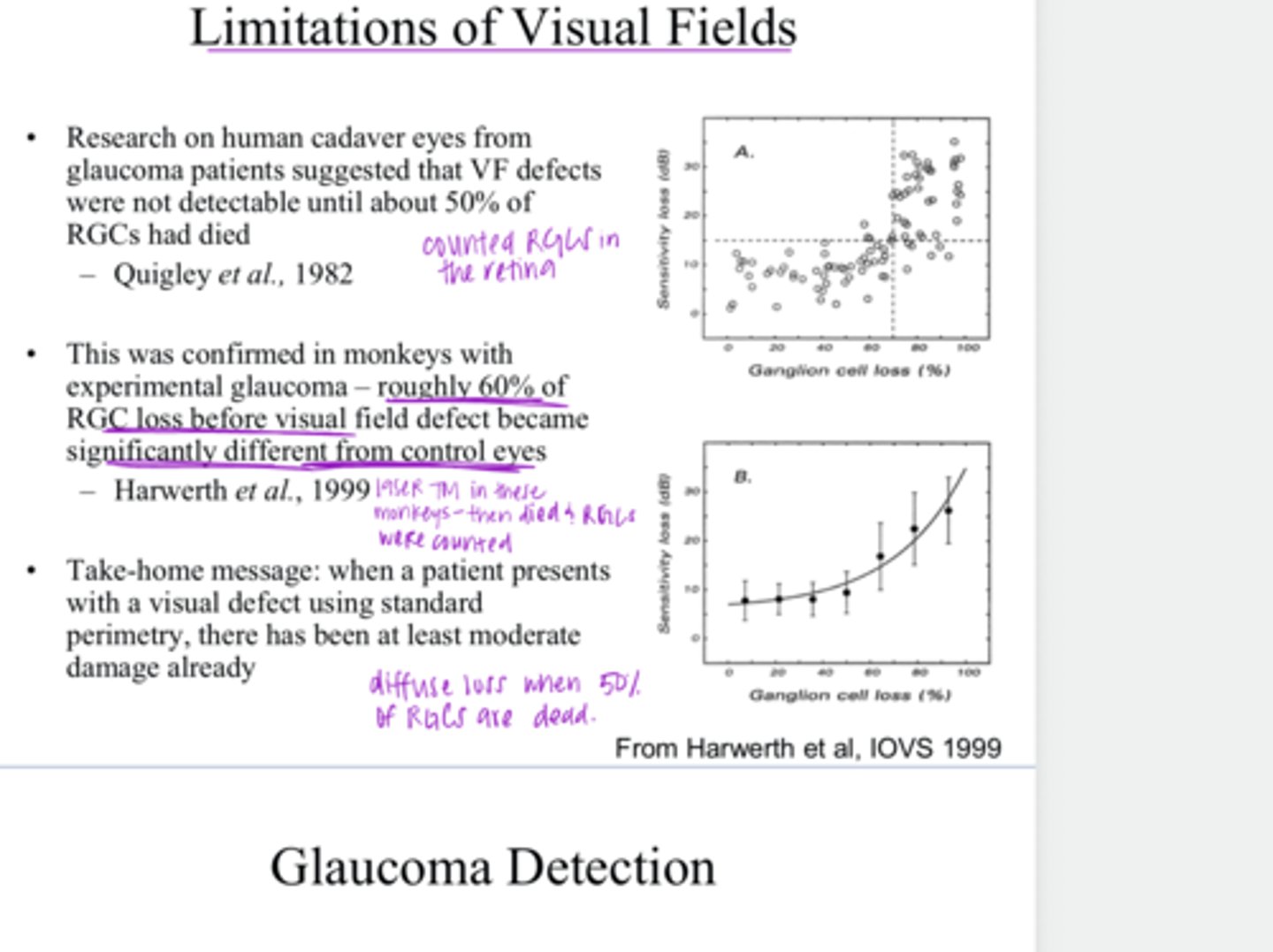
Research on human cadaver eyes from glaucoma patients suggested that VF defects were not detectable until about _____% of RGCs had died
50
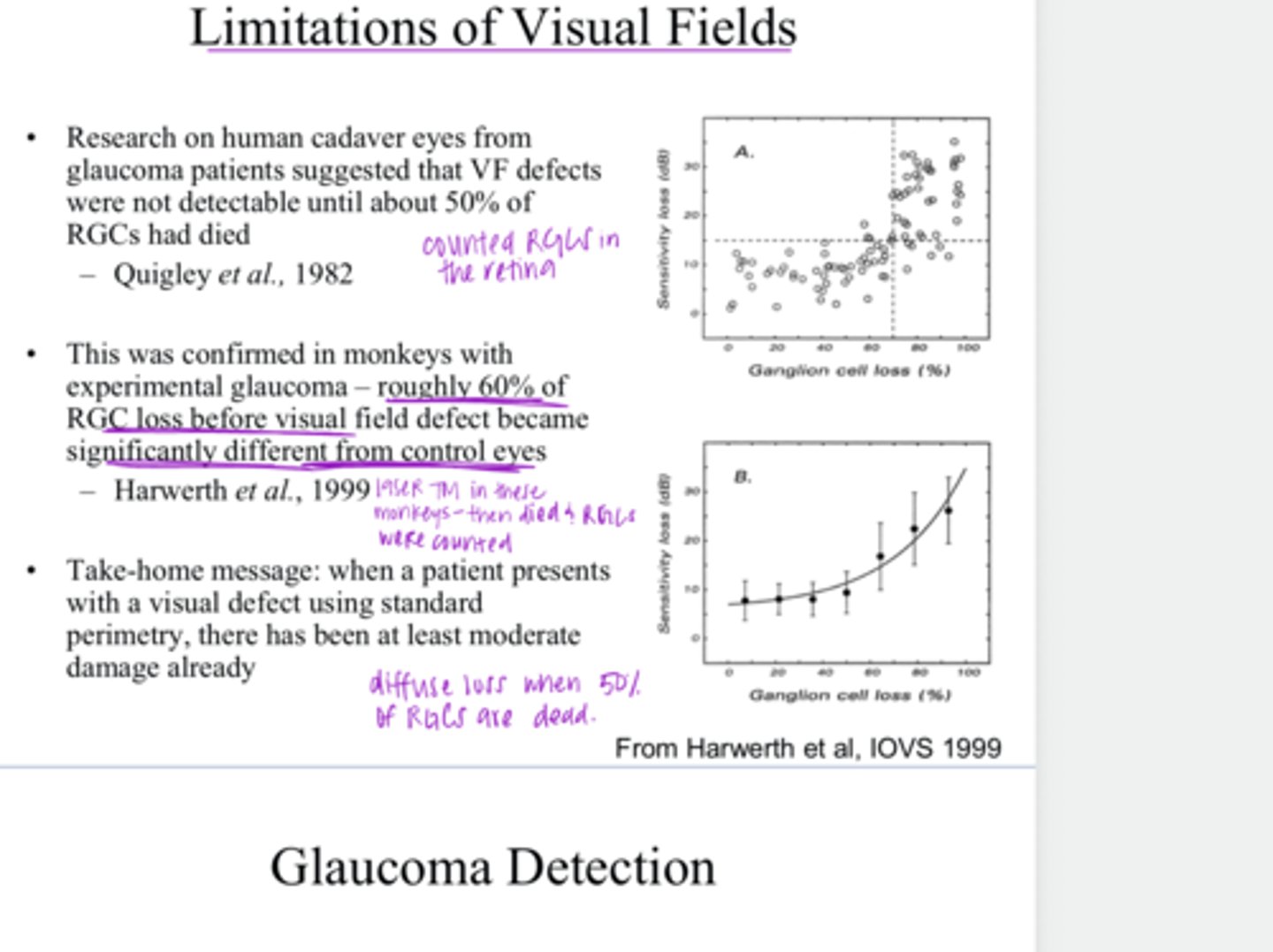
TAKE HOME MESSAGE: When a patient presents with a VF defect using standard perimetry, what does that suggest?
There been a least moderate damage already -- loss seen when 50% of RGCs already gone
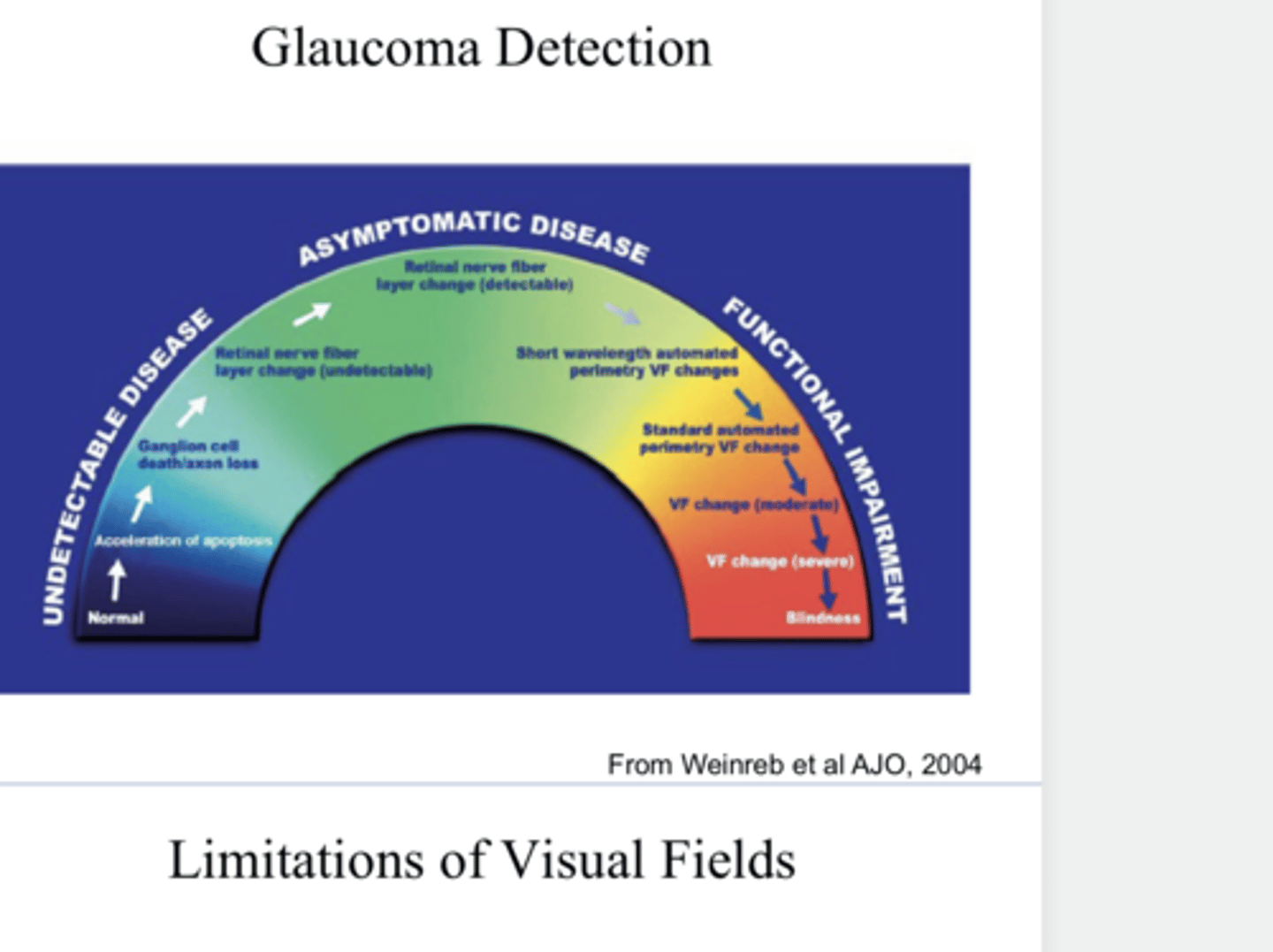
Glaucoma Detection Model (Pic)
Glaucoma Detection Model (Pic)
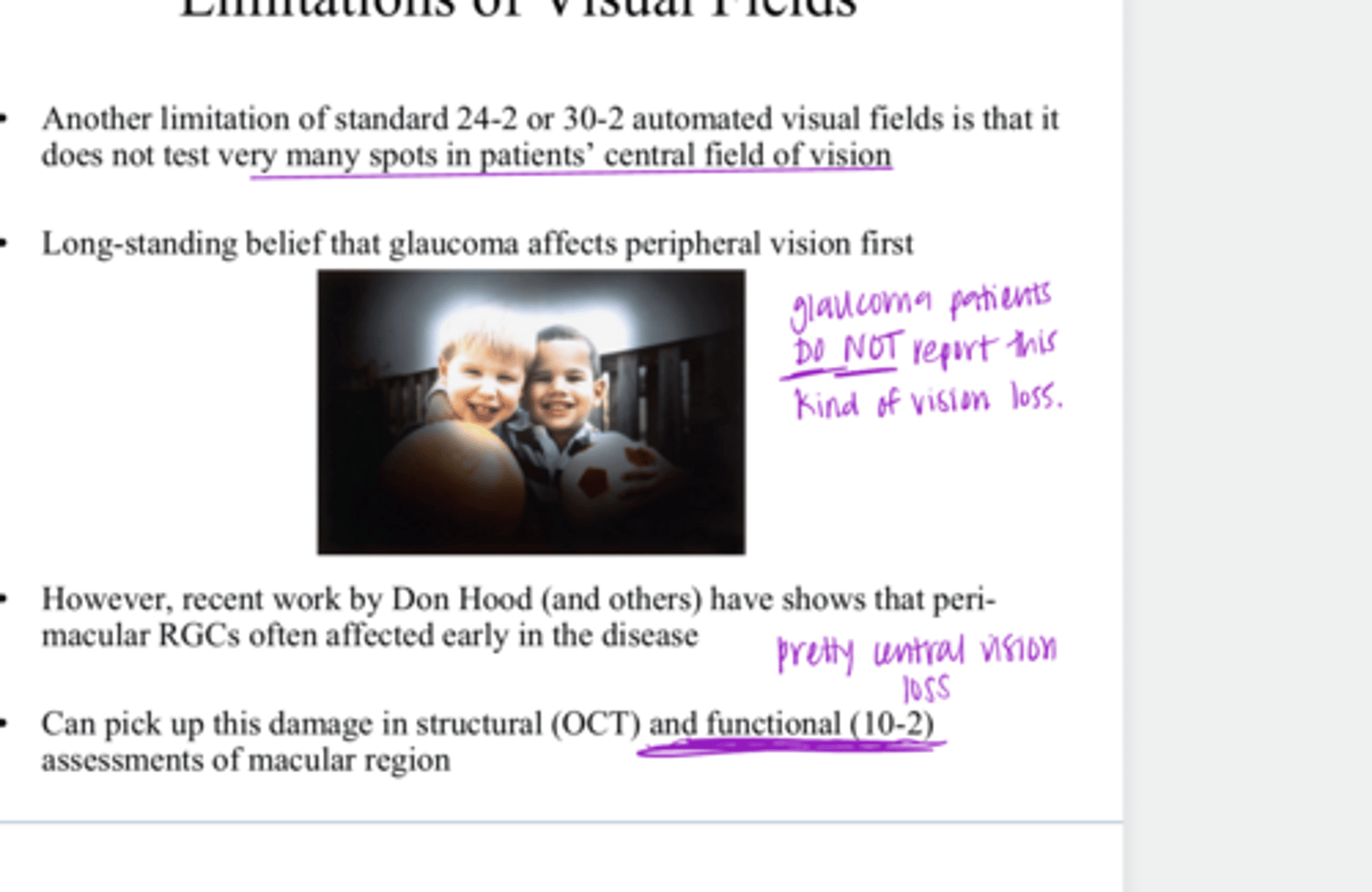
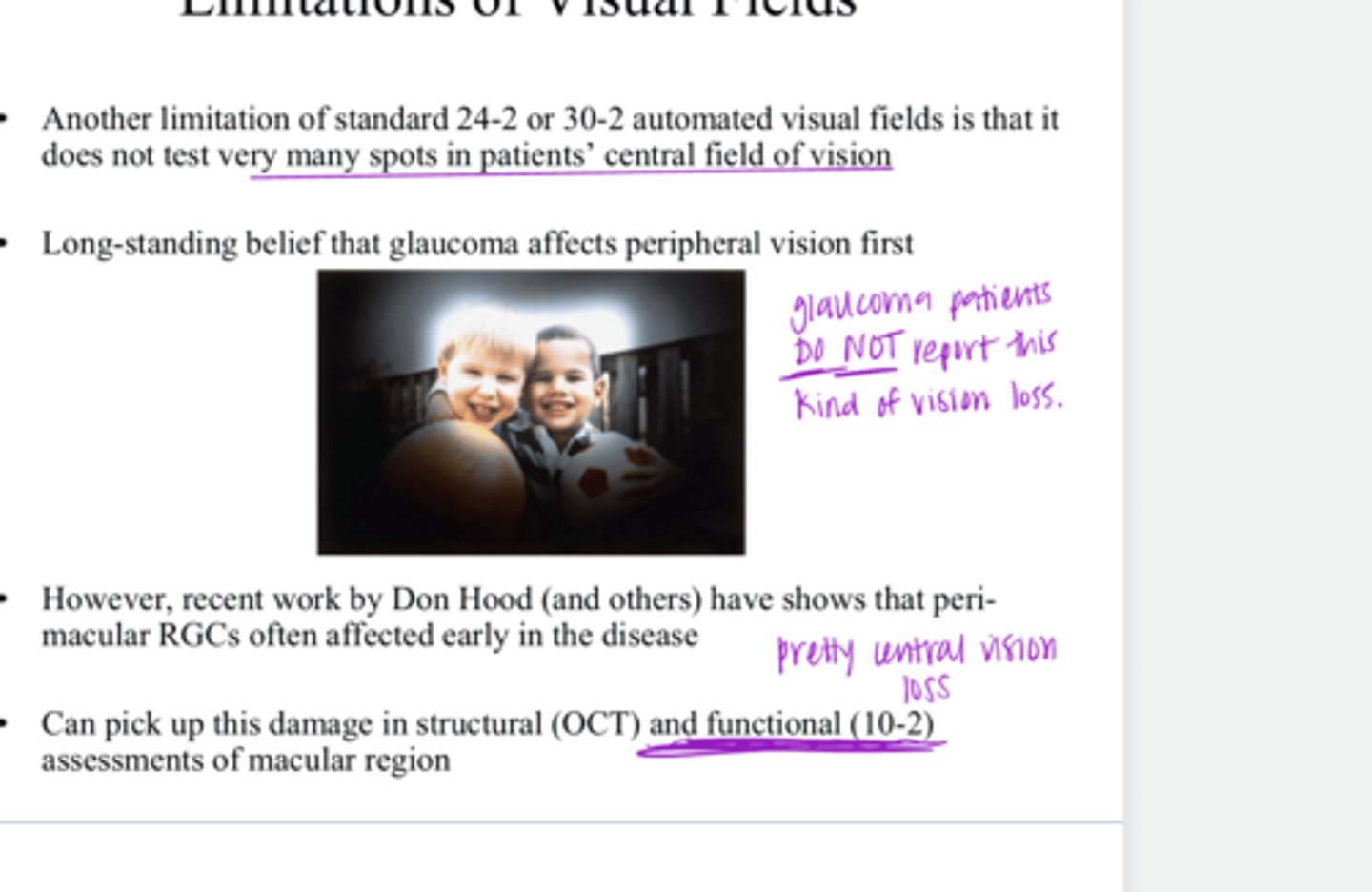
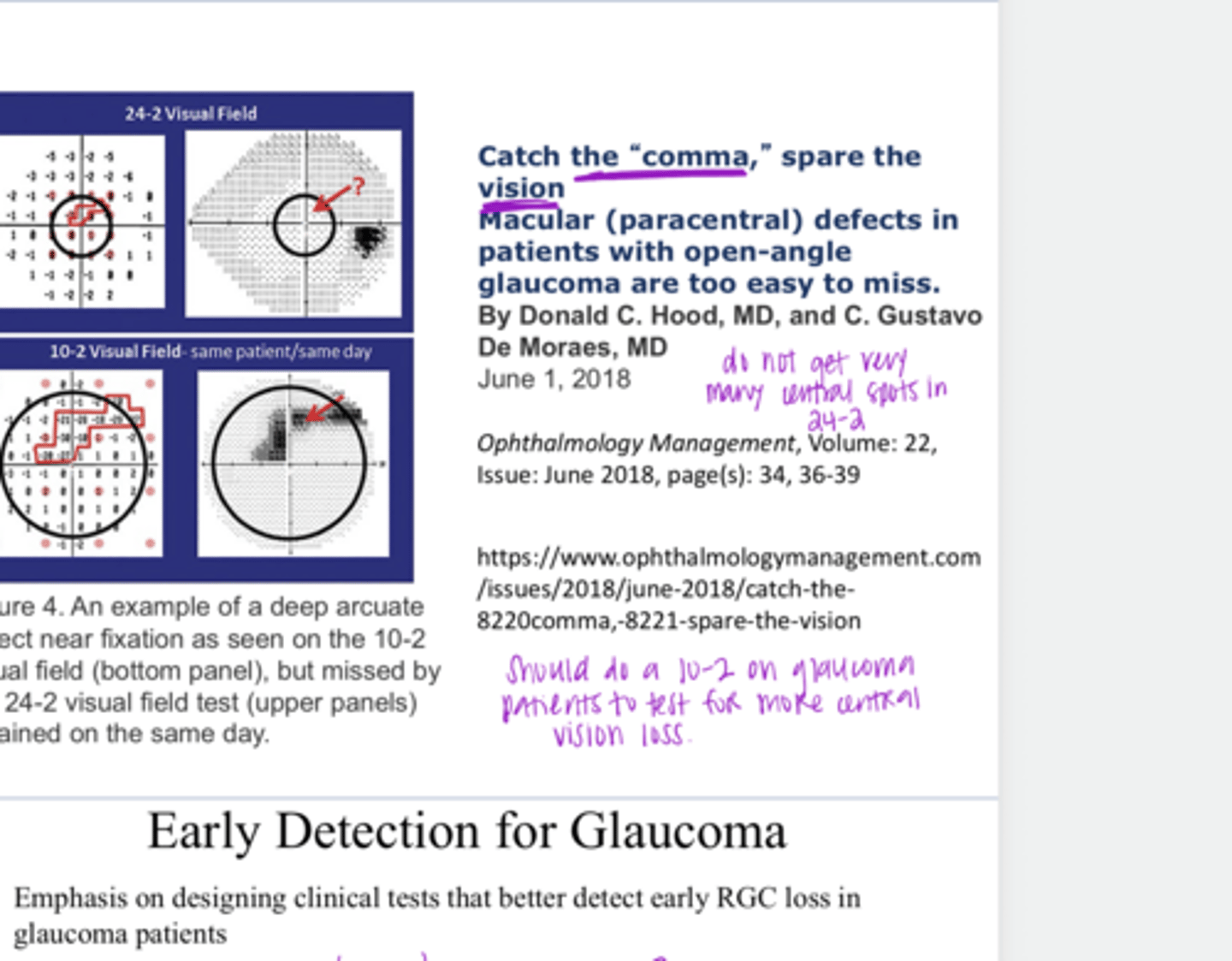
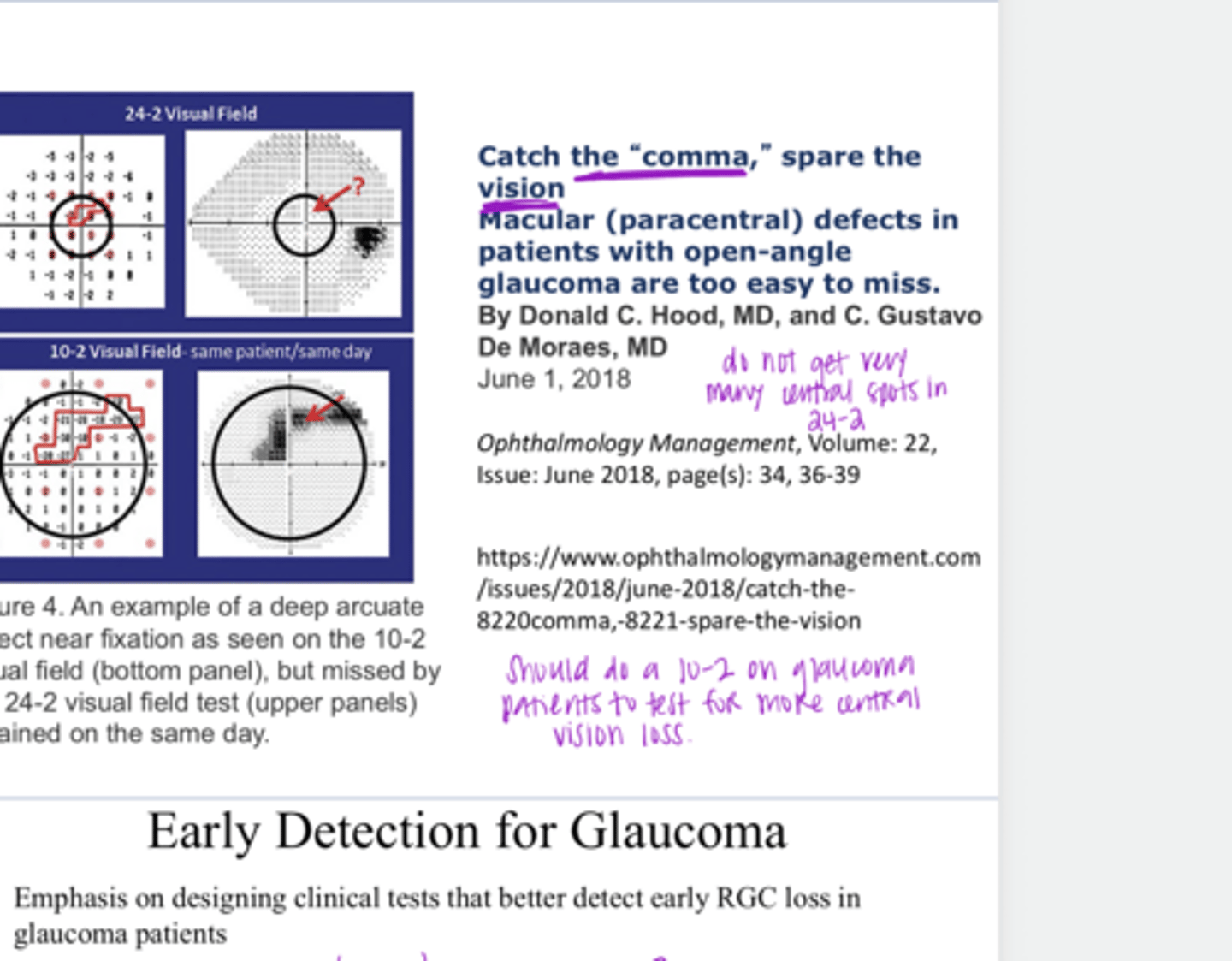
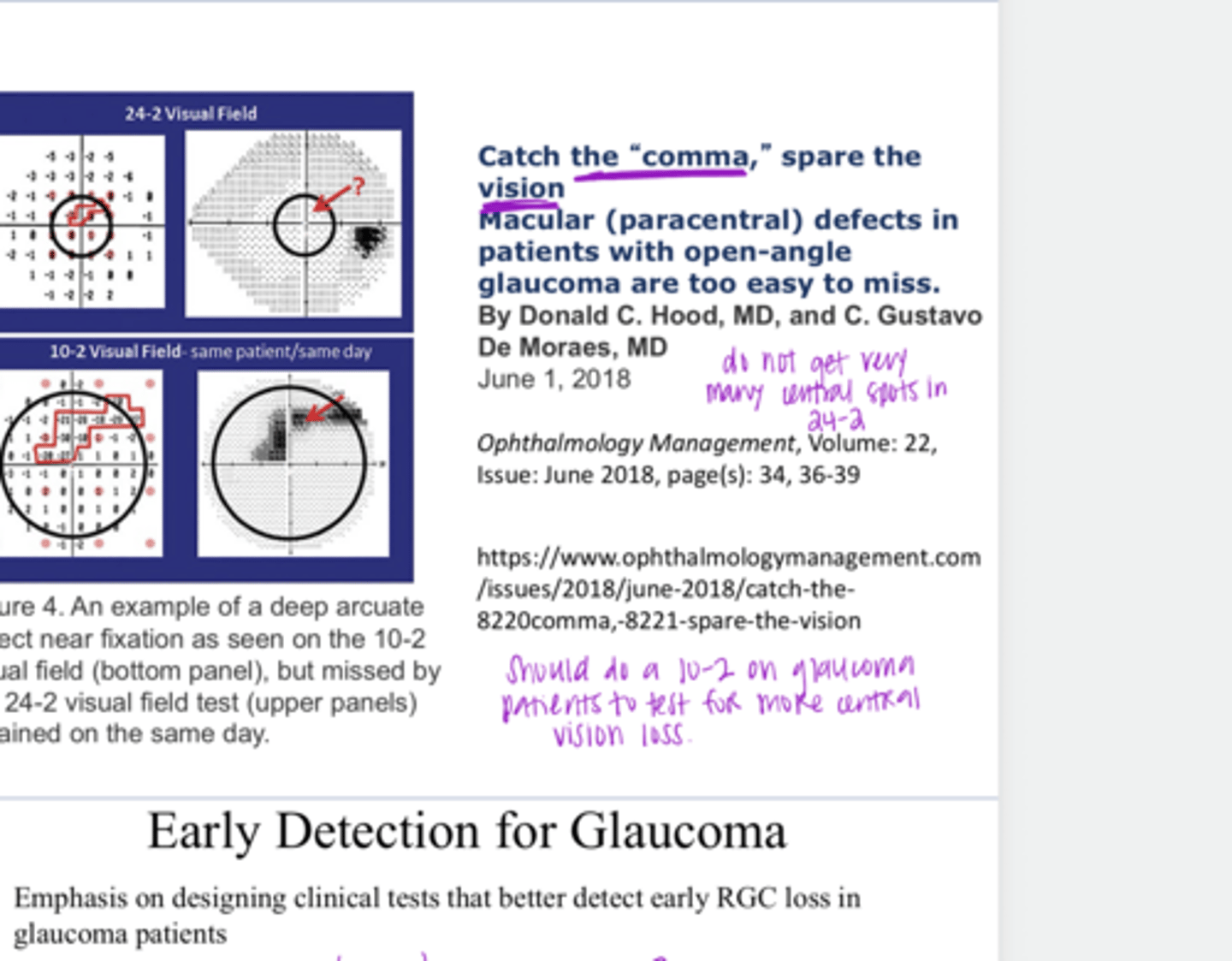
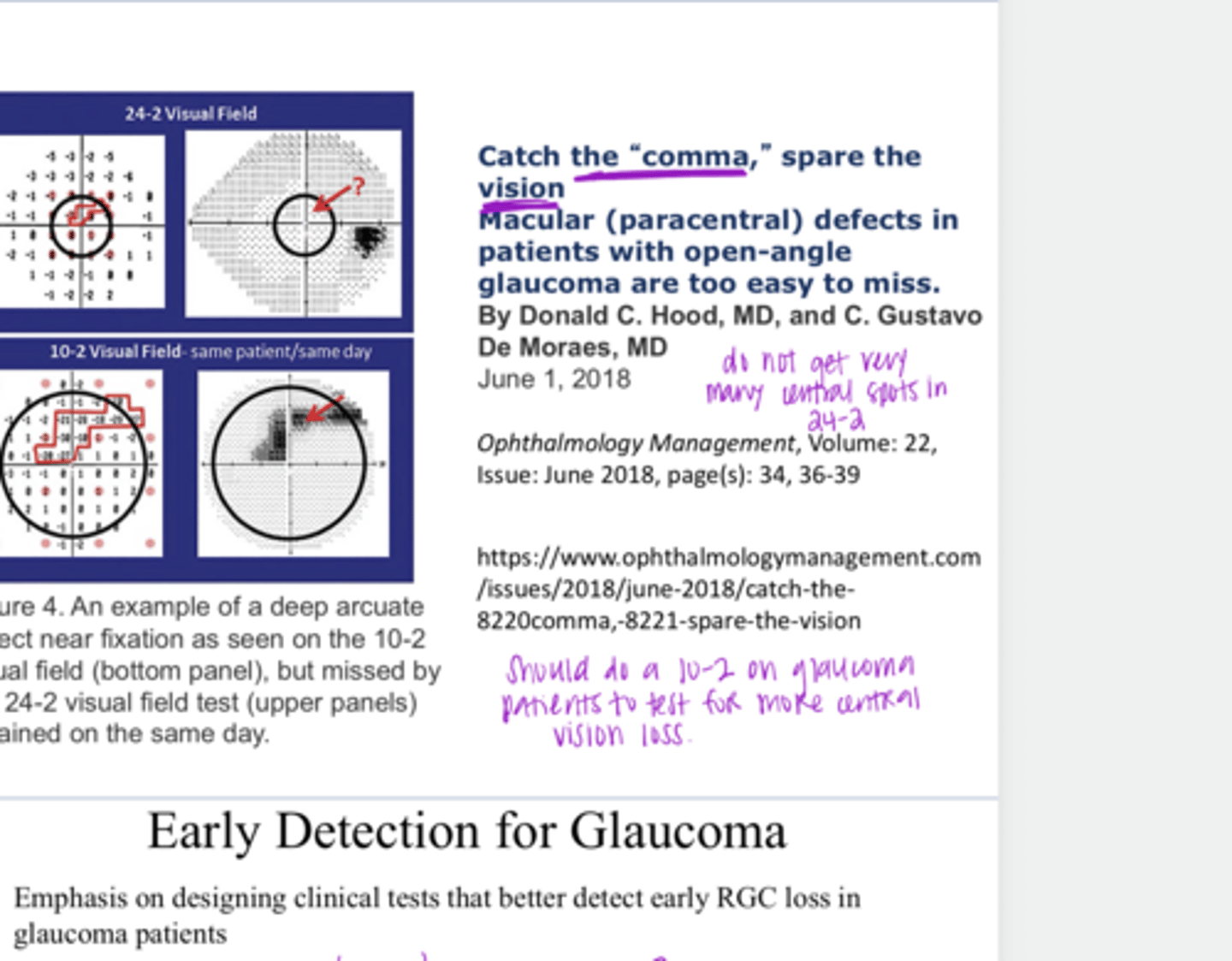
What is a limitation of standard 24-2 or 30-2 automated VFs?
does not test very many spots in a patient's central field of vision
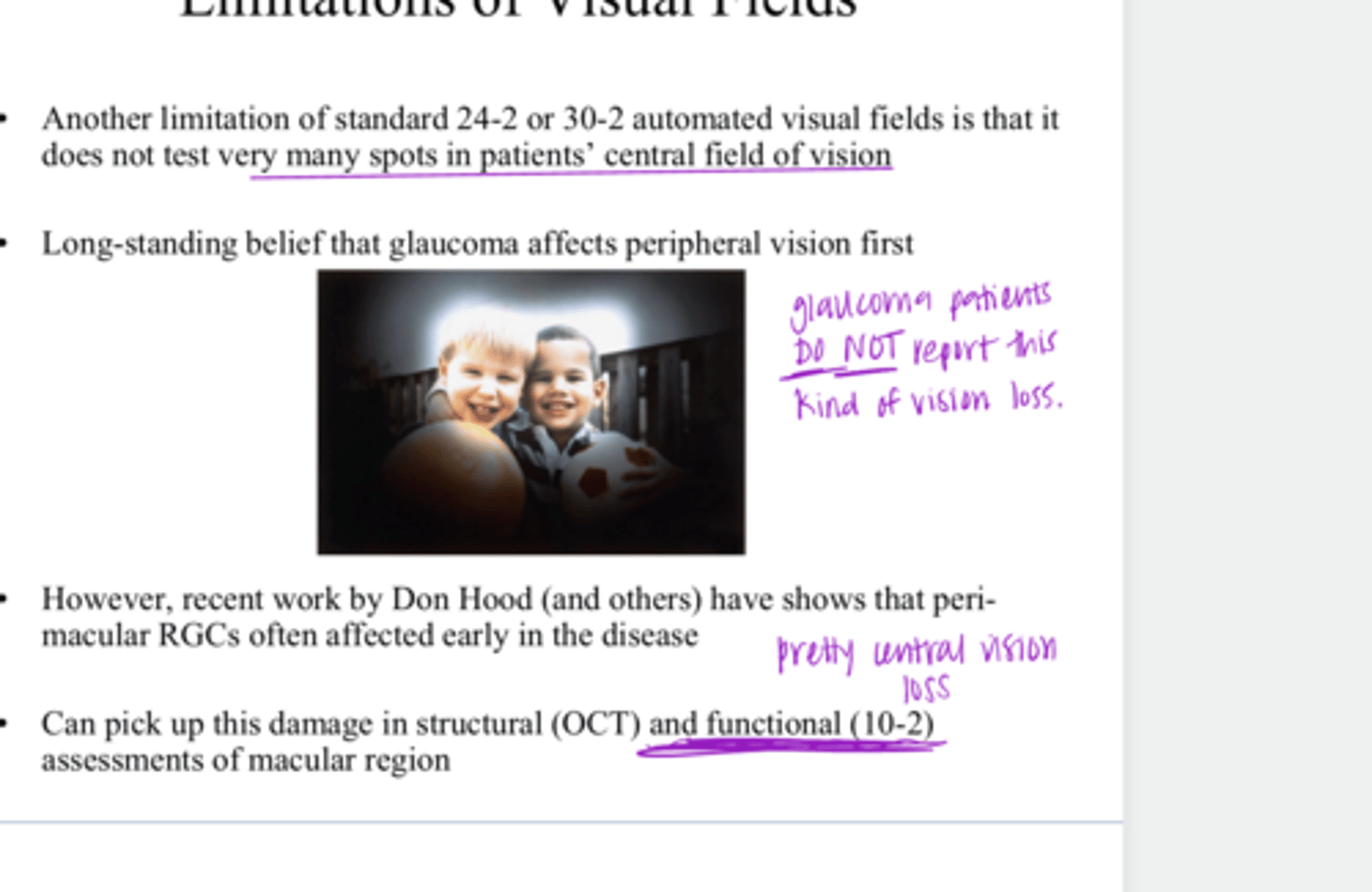
What is the long standard belief? Glaucoma affects _____ vision first
peripheral
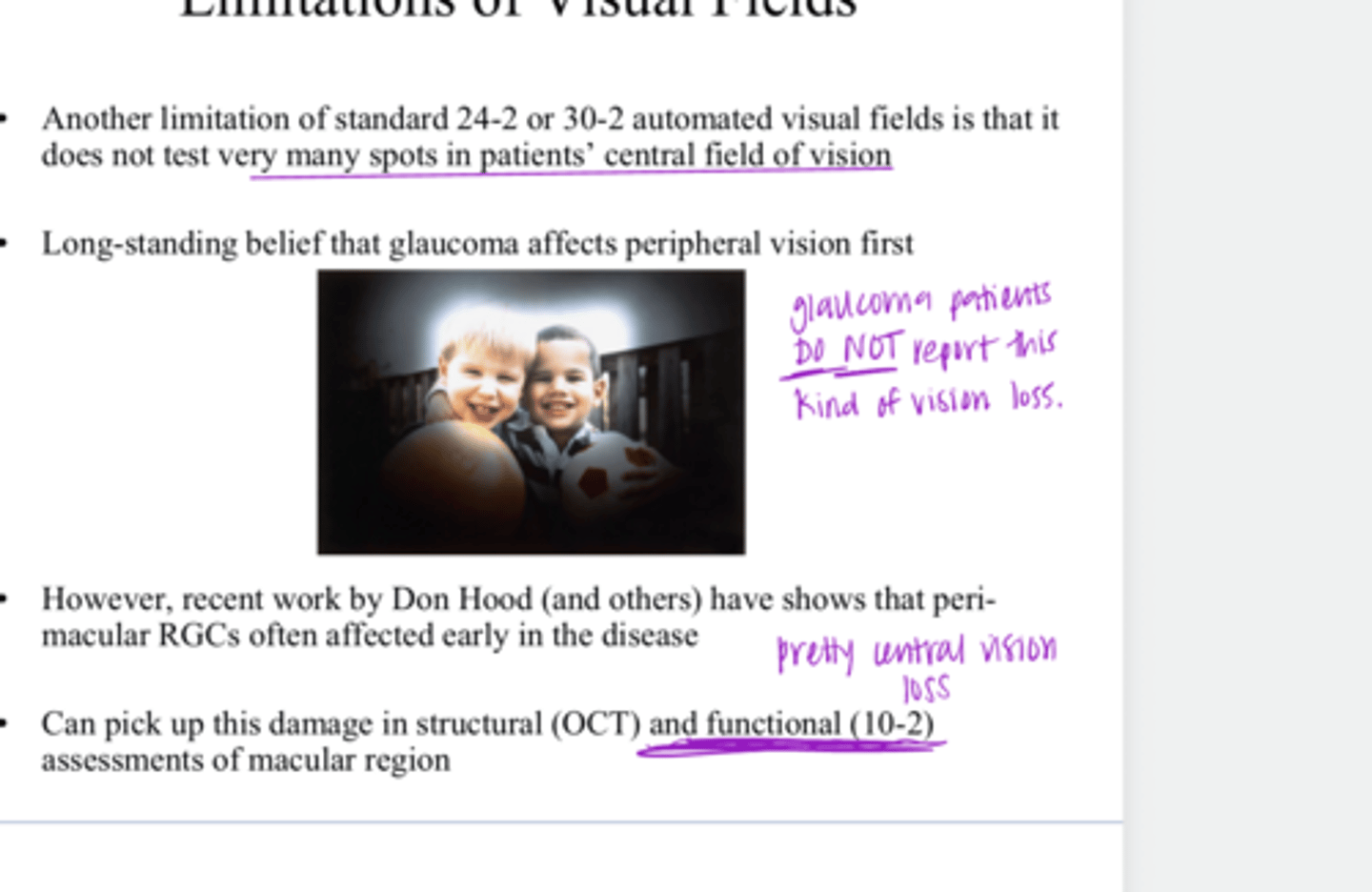
Recent work by Don Hood shows that _____ are affected early in glaucoma
perimacular RGCs
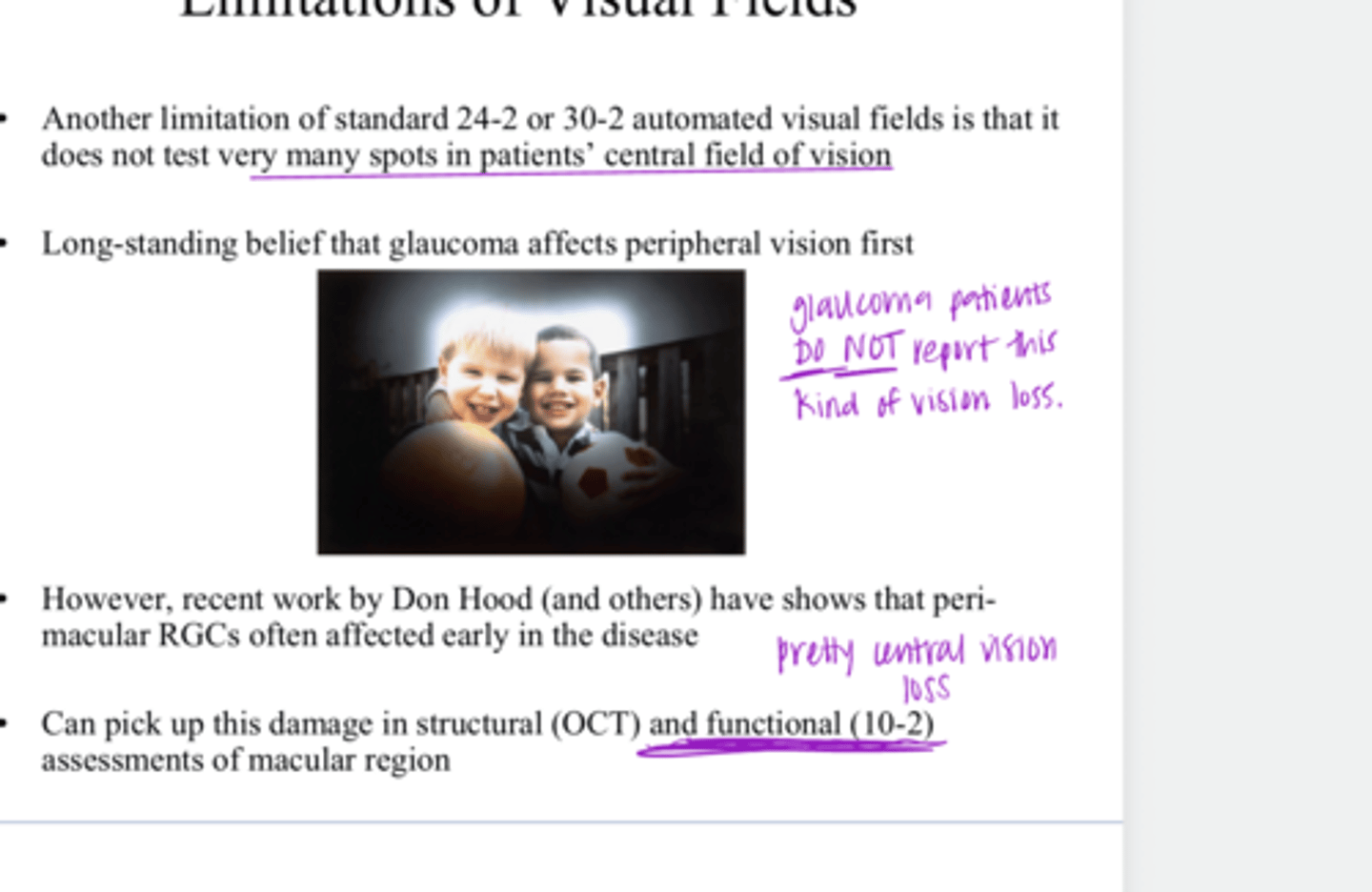
On what tests can you pick up the early changes in vision and perimacular RGC loss in glaucoma?
structural OCT and 10-2 functional assessment of the macular region
Are macular defects in patients with POAG easy to miss?
Yes -- do not necessarily show up on 24-2 VF
What is the emphasis on in early detection for glaucoma?
designing clinical tests that better detect early RGC loss in glaucoma patients
What are the structural tests that are involved in the early detection of glaucoma?
-OCT
-Scanning Laser Polarimetry
-HRT
-FAF
What are the functional tests that are involved in the early detection of glaucoma?
VF (speed, reliability)
SWAP
Frequency doubling
20-40 years ago, _____ were the main structural assessments of glaucoma
Clinician grading of the ONH
Fundus photo
Can certain diseases impact one pathway more than another?
Yes
Why is it important to know which pathway of vision a certain disease will impact?
You might be able to detect the disease earlier with special clinical tests
_______ pathway shows reduction in diabetic retinopathy and glaucoma
S cone driven konio
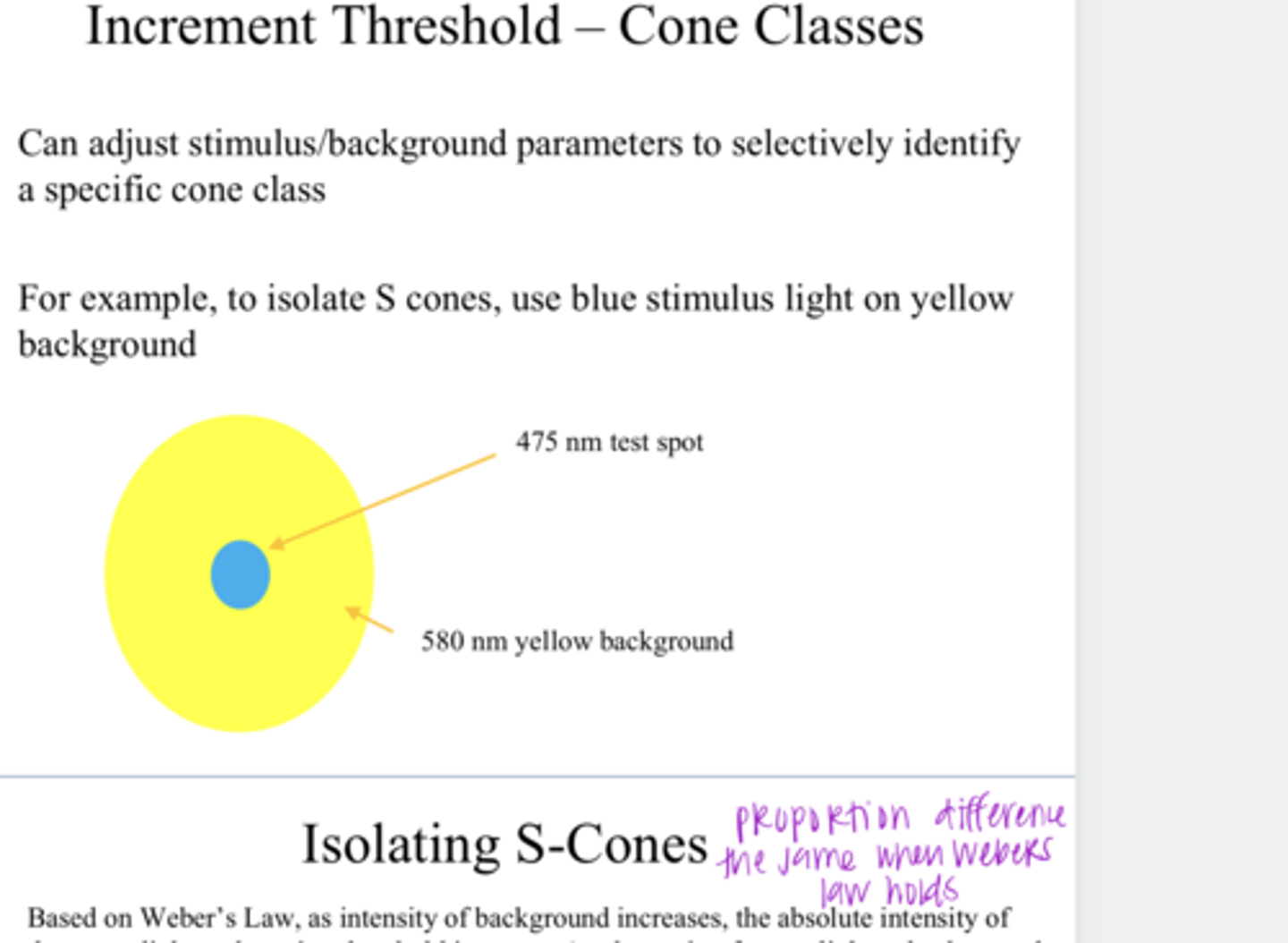
You can adjust the ______ parameters to selectively identify a specific cone class
stimulus/background
To isolate S cones, use a ____ stimulus light on a ____ background
blue; yellow
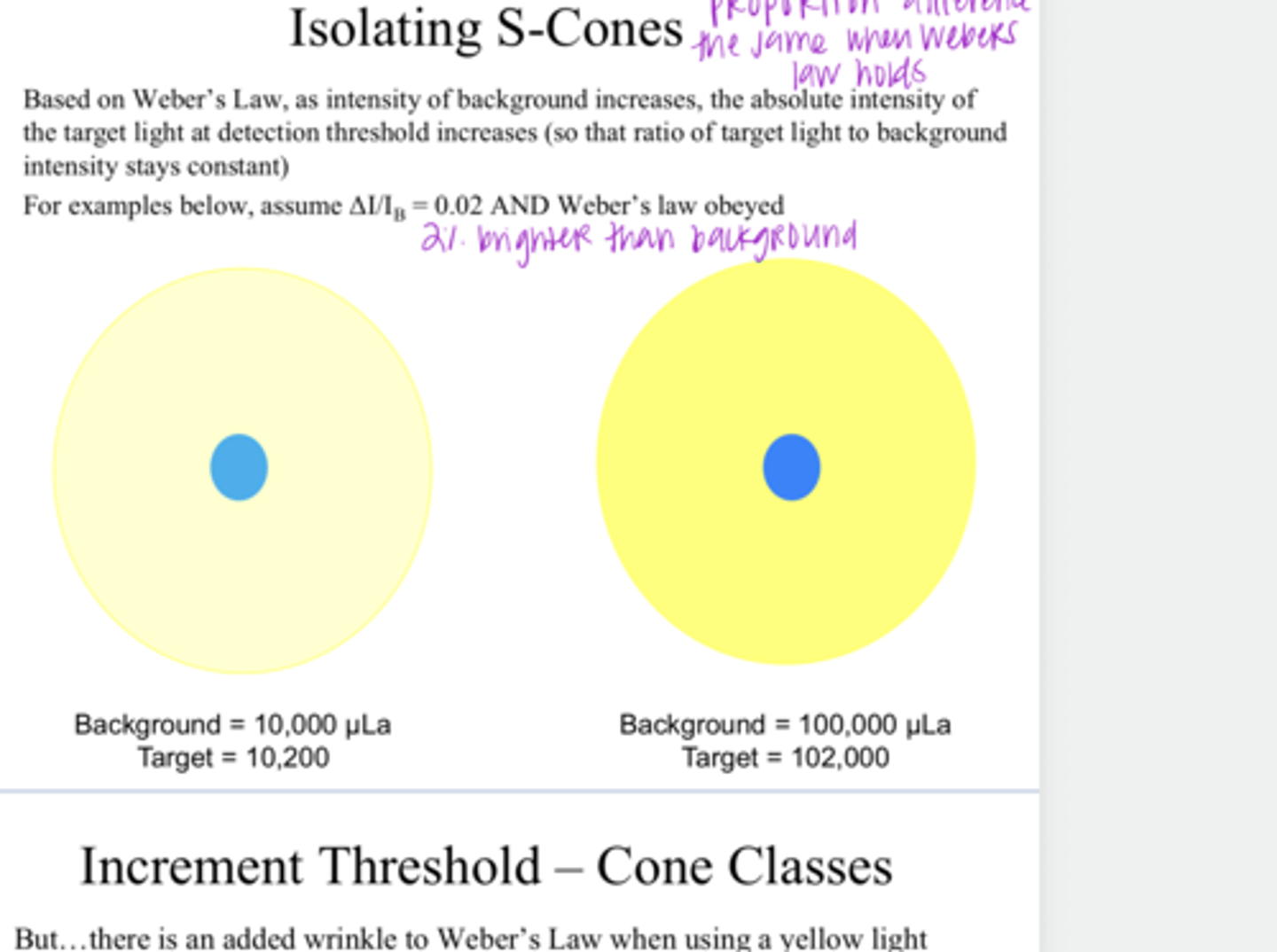
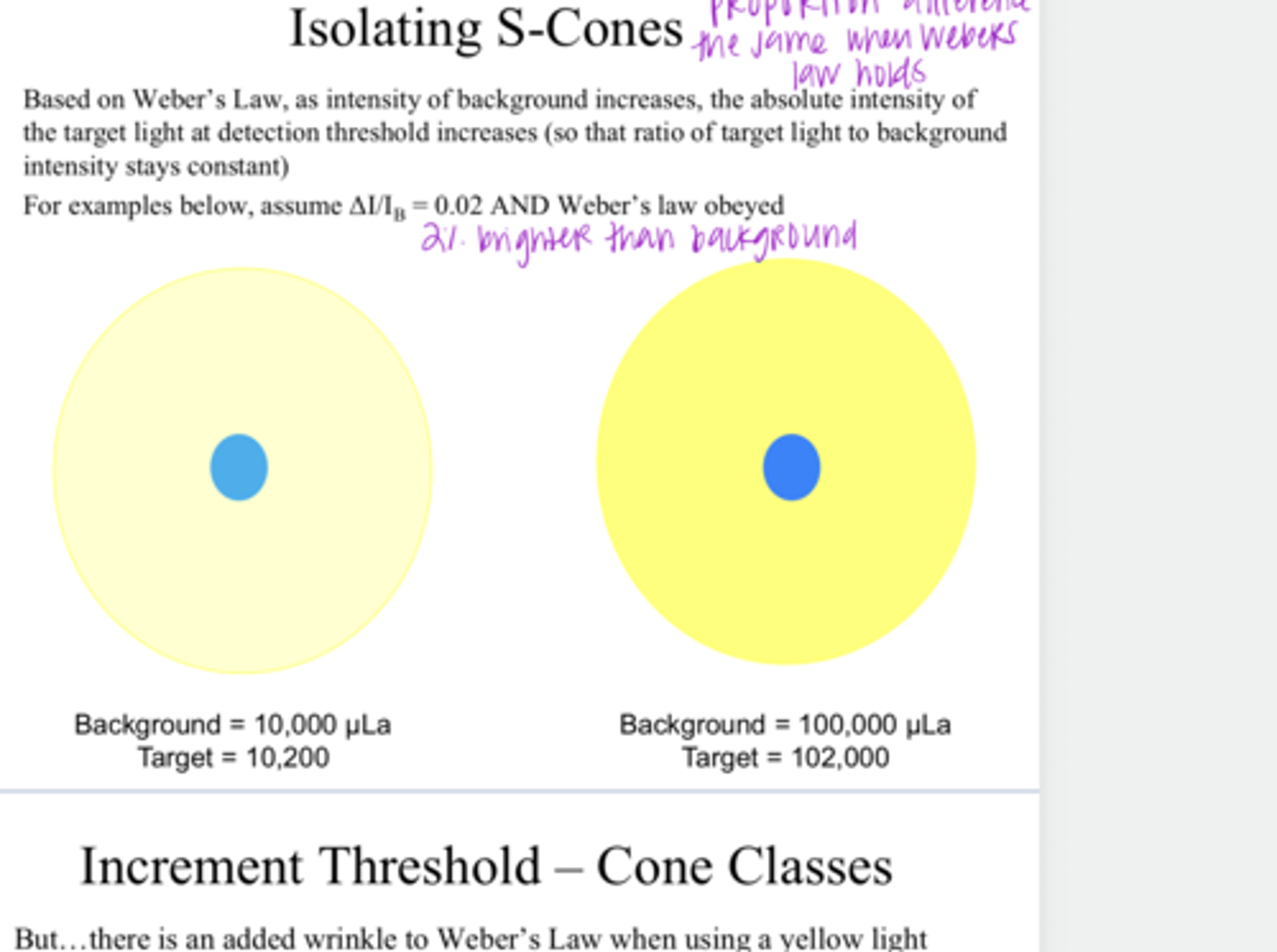
Isolating S Cones:
Based on Weber's Law, as intensity of a background increases, the absolute intensity of the target light at detection threshold (increases/decreases) -- so that the ratio of the target light to the background intensity stays constant
Increases
Do cones adapt to light?
Yes
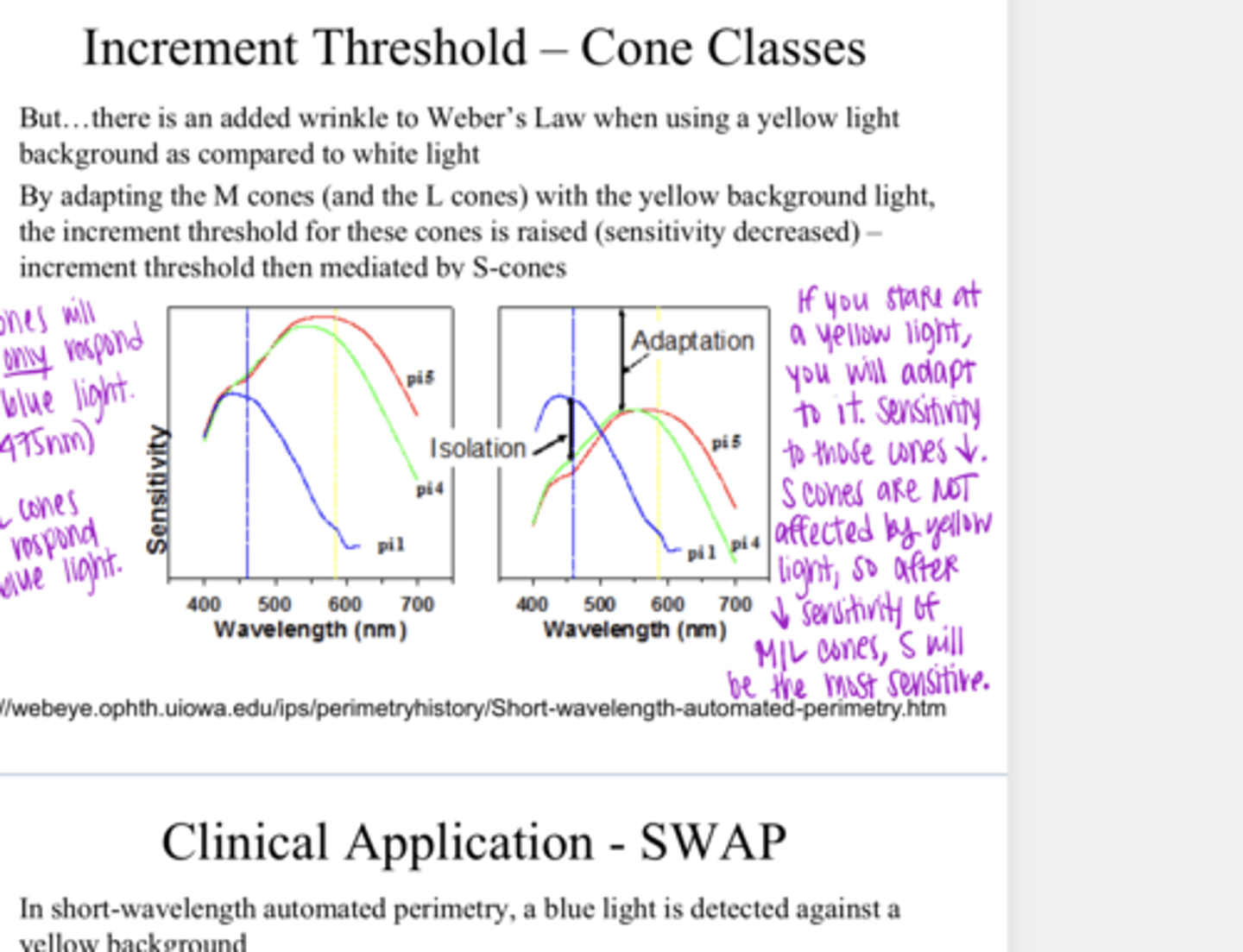
What is the wrinkle to Weber's Law when using a yellow light background compared to a white light?
M and L cones will adapt to the yellow light background, the threshold is raised (sensitivity decreased), and increment threshold will then be mediated by S cones (helpful because if the s cone driven konio pathway is not working, then we will see M cone take over on the curve graph)