Human Osteology
 Call Kai
 Learn
Learn Practice Test
 Spaced Repetition
 Match
Match Flashcards
 Knowt Play
1/83

There's no tags or description
Looks like no tags are added yet.
Name | Mastery | Learn | Test | Matching | Spaced | Call with Kai |
|---|
No analytics yet
Send a link to your students to track their progress
84 Terms
How many bones typically makeup the adult human skeleton?
a) 168
b) 206
c) 326
d) 226
b) 206
The clavicle is located distally from the humerus T/F
False
C1 is commonly referred to as “Axis” T/F
False
Which of the following does the femur articulate with?
a) os coxa
b) fibula
c) humerus
d) radius
a) os coxa
Which of the following bone or bones does the humerus articulate with?
a) Tibia
b) Carpals
c) Scapula
d)Clavicle
c) scapula
How many vertebrae are regularly found in the human skeleton?
a) 26
b) 24
c) 28
d) 18
b) 24
The bones distal to the metacarpals are referred to as the
a) Carpals
b) Epiphyses
c) Phalanges
d) Tuberosities
c) phalanges
The bone(s) articulating medio-anteriorly with the scapula
a) Clavicles
b) Humerus
c) Sacrum
d) Cervical Vertebrae
a) clavicles
The most proximal and distal ends of the long bones is called
a) Metaphyses
b) Epiphyses
c) Cartilage
d) Diaphyses
b) Epiphyses
The term that addresses changes of the bone over time
a) Rehabilitate
b) Remodel
c) Revolution
d) Recasting
b) remodel
A bone that articulates with the temporal bone in a fossa
a) Lacrimal
b) Maxilla
c) Orbital
d) Mandible
d) Mandible
The caudal surface of the vertebral body is also the….
a) Lateral Surface
b) Superior Surface
c) Inferior Surface
d) Anterior Surface
c) Inferior Surface
What bone(s) contain the following feature- Mental foramen
a) Sphenoid
b) Malar
c) Maxilla
d) Mandible
d) Mandible
What bone(s) contain the following feature- Cruciform eminence
a) Frontal
b) Occipital
c) Parietal
d) Temporal
b) Occipital
What of the following is a characteristic that cannot be estimated from a human skeleton?
a) Sex
b) Age
c) Gender
d) Stature
c) Gender
The ramus is located on the distal portion of the femur T/F
False
How many segments does the sacrum normally have?
a) 3
b) 5
c) 7
d) 9
b) 5
What is repatriation?
a) The return of someone or something to its own country,affiliation,or place of origin.
b) To deport or remove someone or something from a country,affiliation,or place of origin.
c) A person forced to live outside their native country,typically for political reasons.
d) A person who has left their own country to settle in another for no particular reason
a) The return of someone or something to its own country,affiliation,or place of origin.
What does supernumerary mean in osteology?
a) A need for more MRIs on skeletal remains
b) A request sent to a forensic office
c) Exceeding the usual,stated,or prescribed number of elements
c) Exceeding the usual,stated,or prescribed number of elements
The landmark on the posterior margin of the foramen magnum in the sagittal plane?
a) Opisthion
b) Bregma
c) Prosthion
d) Gonion
a) Opisthion
How many cervical vertebrae does the human adult skeleton typically contain?
a) 7
b) 12
c) 5
d) 24
a) 7
Which bone group does the following description describe?
“ Lack costal pits and transverse foramina; Large body/small arch; Thin transverse process; Hatchet shaped spinous process”
a) Lumbar vertebrae
b) Cervical Vertebrae
c) Thoracic Vertebrae
d) Sacral Vertebrae
a) Lumbar vertebrae
As you age the cranial sutures spread apart T/F
False
What bone group does the following description describe?
“Triangular Articular facets on lateral sides - to support the ribs; Demifacets; Vertebral canals small relative to body size; Transverse process- lateral projection; Superior and inferior articular facets”
a. Cervical Vertebrae
b. Thoracic Vertebrae
c. Lumbar Vertebrae
d. Sacral Vertebrae
b. Thoracic Vertebrae
What is osteology?
a) The study of bones
b) The study of inorganic material
c) The study of any organic material
d) The study of archaeology
a) The study of bones
What two bone groups are used the most in sex estimation?
a) Sacrum and Skull
b) Skull and Long Bones
c) Pelvis and Long Bones
d) Pelvis and Skull
d) Pelvis and Skull
Which of the following is a feature used for sex estimation?
a) Stature
b) Thickness
c) Sub-pubic Angle
d) Pelvic Girdle
c) Sub-pubic Angle
What can measurements tell us (forensic anthropologists) about the biological profile?
a) Gender
b) Race
c) Stature
d) Strength
c) Stature
What bone is commonly referred to as the “tailbone”?
a) Sacrum
b) L5
c) Coccyx
d) C1
c) Coccyx
What is the cervico-thoracic junction?
a) Axis/Atlas
b) C7/T1
c) T12/L1
d) L5/L6
b) C7/T1
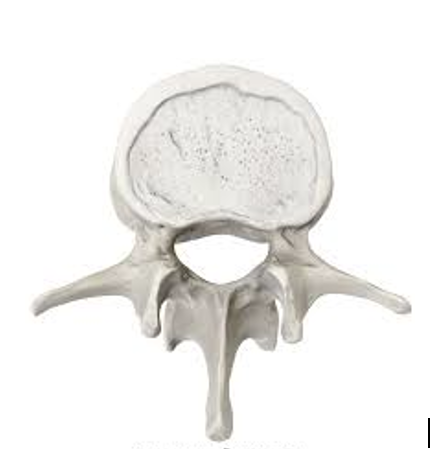
What type of vertebrae is in the following photo?
a. Cervical
b. Thoracic
c. Lumbar
c. Lumbar
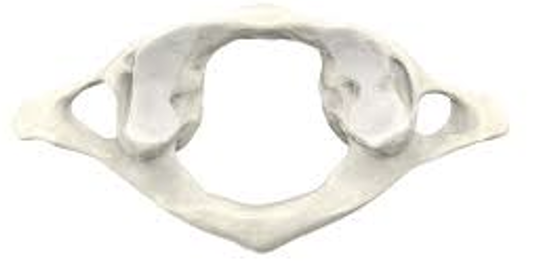
What type of vertebrae is in the following photo?
a. Cervical
b. Thoracic
c. Lumbar
a. Cervical
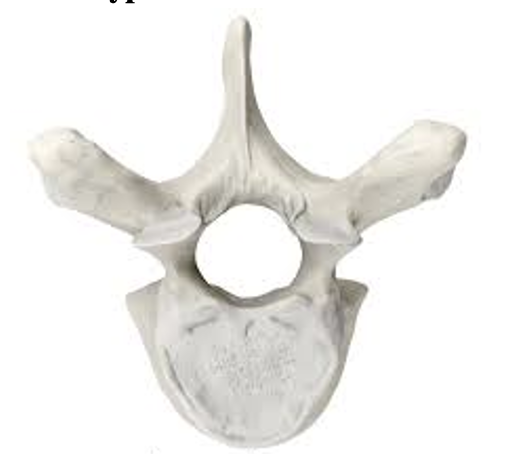
What type of vertebrae is in the following photo?
a. Cervical
b. Thoracic
c. Lumbar
b. Thoracic
What are the bones in the pectoral girdle
a) Clavicle, Scapula, Ribs, Sternum
b) Clavicle, Scapula, Humerus, Sternum
c) Occoxa, Pubis, Femur
d) Ribs, Vertebrae, Sternum
b) Clavicle, Scapula, Humerus, Sternum
What are the bones in the pelvic girdle
a) OS Coxa, Sacrum, Coccyx, Femur
b) Illium, Ischium, Acetabulum
c) Scapula, Humerus, Clavicle, Sternum
d) Patella, Femur, Tibia
a) OS Coxa, Sacrum, Coccyx, Femur
What is not a sexually dimorphic feature of the os coxa
a) Auricular Surface
b) Subpubic Angle
c) Obturator Foramen
d) Gonial Flare
d) Gonial Flare
Where is the only coracoid process located in the human skeleton?
a) Clavicle
b) Scapula
c) Humerus
d) C2
b) Scapula
Which if the following is a distinguishing feature of the Ulna?
a) Greater trochanter
b) Trochlear notch
c) Tibial tuberosity
d) Medial epicondyle
b) Trochlear notch
Which of the following describes the distal end of the humerus?
a) The shaft widens distally and the lateral supracondylar ridge is more prominent than the medial
b) Olecranon fossa is posterior, the medial epicondyle is larger and the capitulum is lateral and oriented anteriorly.
c) The malleolus is medial and its distal most projection is anterior.
d) The styloid process is posterior and the groove for extensor carpi ulnaris is lateral to the process
b) Olecranon fossa is posterior, the medial epicondyle is larger and the capitulum is lateral and oriented anteriorly.
Which of the following describes the shaft of the Radius?
a) The entire shaft tapers distally and the interosseous crest is lateral and posterior.
b) Interosseous crest is medial,oblique line is anterior
c) Shaft tapers distally and the nutrient foramen exits the bone distally and is located on the anterior shaft surface.
d) The nutrient foramen opens distally, the bone widens distally and the lateral posterior surface is more concave
b) Interosseous crest is medial,oblique line is anterior
Which of the following is a distinguishing feature of the Fibula?
a) Ulnar notch
b) Distal malleolar articular surface
c) Anterior surface/crest
d) Styloid Process
b) Distal malleolar articular surface
Which of the following describes the proximal end of the Tibia?
a) The head is proximal and faces medially. The lesser trochanter and linea aspera are posterior
b) The tibial tuberosity is anterolateral, the fibular articulation is placed posterolateral and the lateral femoral articular surface is smaller,rounder, and set laterally
c) Styloid process is lateral, proximal,and displaced posteriorly.
d) The head is medial and the lesser tubercle and intertubercular groove are interior
b) The tibial tuberosity is anterolateral, the fibular articulation is placed posterolateral and the lateral femoral articular surface is smaller,rounder, and set laterally
How many distal phalanges are there in one hand?
a) 5
b) 4
c) 3
d) 2
a) 5
How many intermediate phalanges are there in one hand?
a) 5
b) 4
c) 3
d) 2
b) 4
What is a sesamoid bone?
a) Organic material that connects ribs to the sternum
b) Bones between vertebrae
c) Undifferentiated extra bones in the body
d) The carpal bones
c) Undifferentiated extra bones in the body
How many proximal phalanges are there in one foot?
a) 2
b) 3
c) 4
d) 5
d) 5
What is the best way to differentiate cuneiform bones?
a) Size
b) Color
c) The largest has a mohawk
d) Smallest has the largest facet
a) Size
How many adult teeth do most humans have?
a) 20
b) 42
c) 32
d) 4
c) 32
What is rebsorption?
a) When you swallow one of your baby teeth
b) The process that occurs after tooth loss where alveolar bone fills the socket
c) 3rd molars do not erupt
d) As you age the molar cusps disappear
b) The process that occurs after tooth loss where alveolar bone fills the socket
Which of the following is a feature of the parietal bones
a) Glabella
b) Occipital Protuberance
c) Linea Aspera
d) Meningeal Grooves
d) Meningeal Grooves
Which bone is located at the most distal aspect of the upper appendage?
a) Distal phalange
b) Hamate
c) Metacarpal
d) Humerus
a) Distal phalange
Which of the following is a feature of the sacrum
a) Transverse lines
b) Coronoid process
c) Meningeal grooves
d) Xiphoid process
a) Transverse lines
Which of the following is a feature of the sternum
a) Transverse lines
b) Coronoid process
c) Meningeal grooves
d) Xiphoid process
d) Xiphoid process
Which of the following is a feature of the ulna
a) Transverse lines
b) Coronoid process
c) Meningeal grooves
d) Xiphoid process
b) Coronoid process
Which of the following is a feature of the tibia
a) Acromion process
b) Lateral malleolus
c) Intercondylar eminence
d) Lesser trochanter
c) Intercondylar eminence
Which of the following is a feature of the scapula
a) Acromion process
b) Lateral malleolus
c) Intercondylar eminence
d) Lesser trochanter
a) Acromion process
Which of the following is a feature of the femur
a) Acromion process
b) Lateral malleolus
c) Intercondylar eminence
d) Lesser trochanter
d) Lesser trochanter
Which of the following is a feature of the Os Coxa
a. Ala
b. Iliac crest
c. Pisiform
d. Transverse fossa
b. Iliac crest
Which of the following is a carpal
a. Cuneiform
b. Iliac crest
c. Pisiform
d. navicular
c. Pisiform
Name a feature of the temporal bone
a) Glabella
b) External Auditory Meatus
c) Meningeal Grooves
d) Cruciform eminence
b) External Auditory Meatus
Name a feature of the frontal bone
a) Glabella
b) External Auditory Meatus
c) Meningeal Grooves
d) Cruciform eminence
a) Glabella
Name a feature of the maxilla bone
a) Nasion
b) Maxillary fossa
c) Mandibular molars
d) Zygomatic process
b) Maxillary fossa
Name a feature of the occipital bone
a) Glabella
b) External Auditory Meatus
c) Meningeal Grooves
d) Cruciform eminence
d) Cruciform eminence
Which of the following is a feature of the radius
a. Interosseous crest
b. Medial condyle
c. Spinous process
d. Ischial tuberosity
a. Interosseous crest
The femur articulates directly with the fibula T/F
False
The sacrum articulates with the coccyx T/F
True
The radius articulates with the 3rd metacarpal T/F
False
The 5th lumbar vertebrae articulates with the os coxa T/F
False
The talus articulates with the metacarpals T/F
False
The mandible articulates with the temporal bone T/F
True
The frontal bone articulates with the palate T/F
False
The zygomatic process articulates with the parietal bone T/F
False
The dentition are embedded in the alveolar bone T/F
True
The thumb consists of 3 phalanges and 1 metacarpal T/F
False
The manubrium articulates with the thoracic vertebrae T/F
False
Name 50 bones of the human skeleton (No repetition between right and left)
k
Describe in anatomical terms the position of the tibia
The tibia is located in the lower leg and is the larger of the two leg bones. It is inferior to the femur and superior to the bones of the foot. It lies medial to the fibula. The proximal end of the tibia articulates with the femur at the knee joint. Its distal end forms part of the ankle joint with the talus. The tibia is an important weight-bearing bone of the lower limb.
How do anthropologists estimate sex? Be specific and name features.
Anthropologists estimate biological sex by examining skeletal features, especially the pelvis and skull. The pelvis is usually the most reliable because it reflects differences related to childbirth. Female pelves often have a wider subpubic angle, a broader greater sciatic notch, and a rounder pelvic inlet. Male pelves tend to be narrower and more robust. In the skull, anthropologists examine the brow ridges, mastoid processes, nuchal crest, and chin shape. Male skulls are often more robust, while female skulls tend to be smoother and more gracile. These traits allow anthropologists to estimate sex with reasonable accuracy.
What is osteometrics and why is it important?
Osteometrics is the scientific measurement of bones using standardized tools and techniques. Anthropologists measure bone length, width, and other dimensions to collect objective skeletal data. Common bones measured include the femur, humerus, and skull. Osteometrics is important because it helps estimate sex, age, stature, and population affinity. It is also useful in forensic identification of unknown remains. Standardized measurements allow comparisons between populations and across time. This makes osteometrics essential in biological anthropology and forensic science.
Describe the orientations and directions of the teeth.
Teeth are described using anatomical directional terms. Mesial refers to the surface facing toward the midline of the dental arch. Distal refers to the surface facing away from the midline. Buccal describes the surface facing the cheek. Lingual describes the surface facing the tongue, while palatal is used for the tongue side of upper teeth. Occlusal refers to the chewing surface of premolars and molars. Incisal refers to the cutting edge of incisors. These terms help describe tooth position and orientation accurately.
Describe 5 of the 8 carpal bones.
The carpal bones are small bones located in the wrist. The scaphoid is located near the thumb side and helps articulate with the radius. The lunate is located in the center of the proximal row and helps form the wrist joint. The triquetrum lies next to the lunate on the medial side. The pisiform is a small round bone located on the palmar surface. The trapeziumhelps form the thumb joint and allows thumb movement. These bones contribute to wrist flexibility and stability.
Name all of the long bones, describe how they differ, and where they are located.
The major long bones include the humerus, radius, ulna, femur, tibia, fibula, metacarpals, metatarsals, and phalanges. Long bones are longer than they are wide and have a shaft with enlarged ends. The femur is the largest and strongest bone in the body. The humerus is found in the upper arm and helps with shoulder and elbow movement. The radius and ulna form the forearm. The tibia and fibula are located in the lower leg. These bones differ in size, shape, and function depending on the stresses placed on them.
Describe the locations of 5 cranial landmarks.
Cranial landmarks are specific points on the skull used in anthropology. Nasion is located where the frontal bone meets the nasal bones. Bregma is located where the coronal and sagittal sutures meet. Lambda is where the sagittal and lambdoid sutures intersect. Asterion is found where the parietal, temporal, and occipital bones meet. Mastoidale is located at the tip of the mastoid process of the temporal bone. These landmarks help with skull measurement and identification.
Describe how the femur is different from the humerus.
The femur and humerus are both long bones, but they differ in size, shape, and function. The femur is located in the thigh and is the longest and strongest bone in the body. It supports body weight and helps with walking and standing. The humerus is located in the upper arm and is generally lighter and less robust. The femur has a large head and neck that fit into the hip joint, while the humerus articulates with the scapula at the shoulder. The distal femur forms part of the knee, while the distal humerus forms part of the elbow. These differences reflect their different roles in movement and weight-bearing.