Topic 2 - Electricity
 Call Kai
 Learn
Learn Practice Test
 Spaced Repetition
 Match
Match Flashcards
 Knowt Play
1/76

There's no tags or description
Looks like no tags are added yet.
Name | Mastery | Learn | Test | Matching | Spaced | Call with Kai |
|---|
No analytics yet
Send a link to your students to track their progress
77 Terms
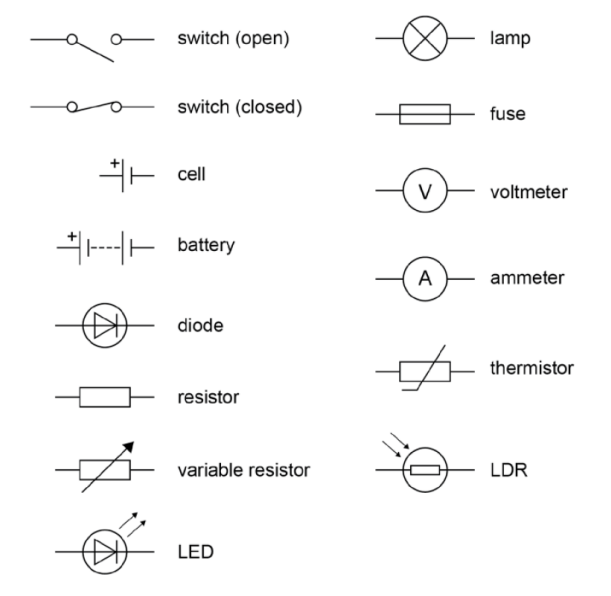
Circuit Symbols
What is needed for electrical charge to flow in a circuit
Circuit must be closed (no open switches)
There must be a source of potential difference (battery/cell)
Electric current definition
Electric current is a measure of the rate of flow of charge in a circuit
What is electric charge measured in
Coulombs
What two factors does current in a circuit depend on
Potential difference
Resistance
What does the size of current tell us about electrical charge
The size of current is the rate of flow of charge
More charge passes around the circuit when a bigger current flows
Equation to calculate charge flow
charge flow = current × time
Q = It
Compare the value of the current at any point in a single closed loop
In a single, closed loop the current has the same value everywhere in the circuit
How the resistance and potential difference affect the current through a component
The current (I) through a component depends on both the resistance (R) of the component and the potential difference (V) across the component
The greater the resistance of the component the smaller the current for a given potential difference (pd) across the component
Equation to calculate the potential difference across a component
Potential difference = current × resistance
V = IR
What is potential difference
The product of a component’s resistance and the magnitude of current flow through it
What is resistance
A measure of the opposition to current flow
Factors affecting resistance
Long wires have more resistance than short wires
Hot wires have more resistance than cold wires
Thin wires have more resistance than thick wires
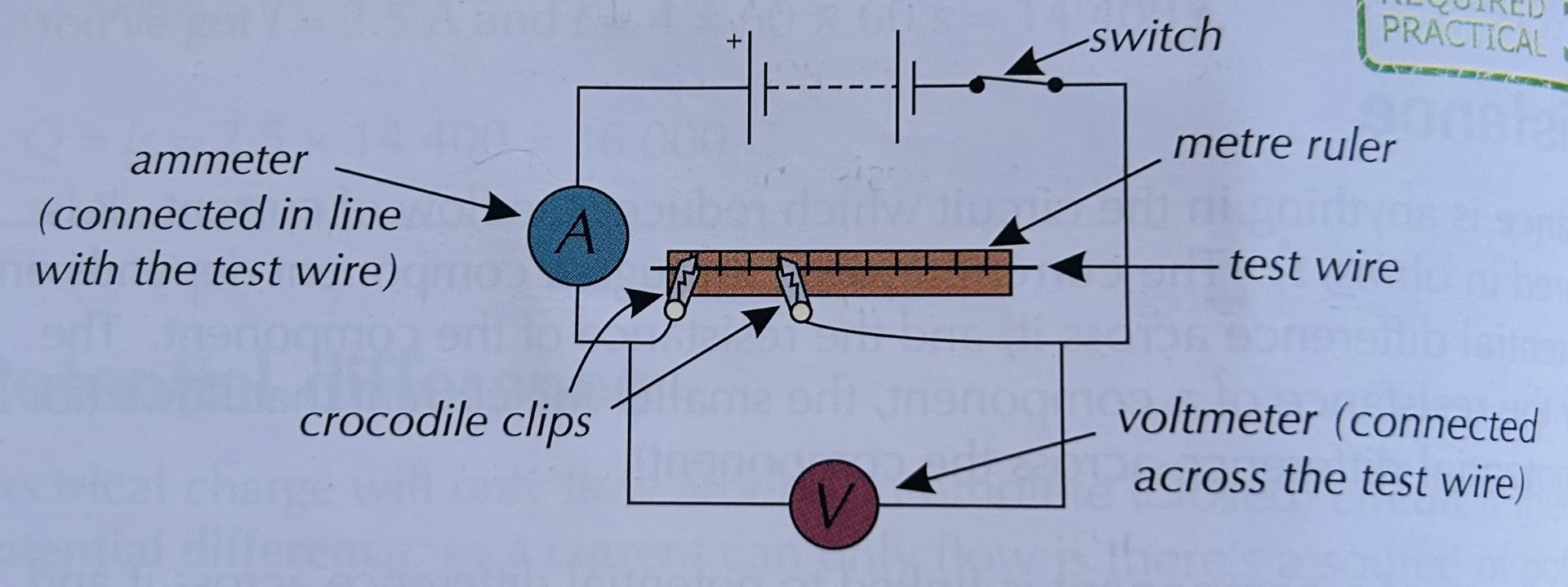
Investigate the factors affecting the resistance of electrical circuits
To investigate how the length of a wire affects resistance:
One crocodile clip is attached to the wire at the 0cm position on the ruler. It should remain fixed at this point throughout the investigation. The second crocodile clip can be moved left and right along the test wire. The value written on the ruler at the point you attach this clip gives the length of the wire connected in the circuit
Now that you have your test circuit set up, you can begin your investigation. Attach the second crocodile clip to the wire and record the length of the wire between the two crocodile clips. Close the switch and record the current shown on the ammeter and the potential difference shown on the voltmeter
Move the second crocodile clip, close the switch and record the new length, current and potential difference. Repeat this for a number of different lengths of wire
Use the data you have recorded to work out the resistance for each length of wire, using R = V/I. Plot a graph of resistance against wire length and draw a line of best fit
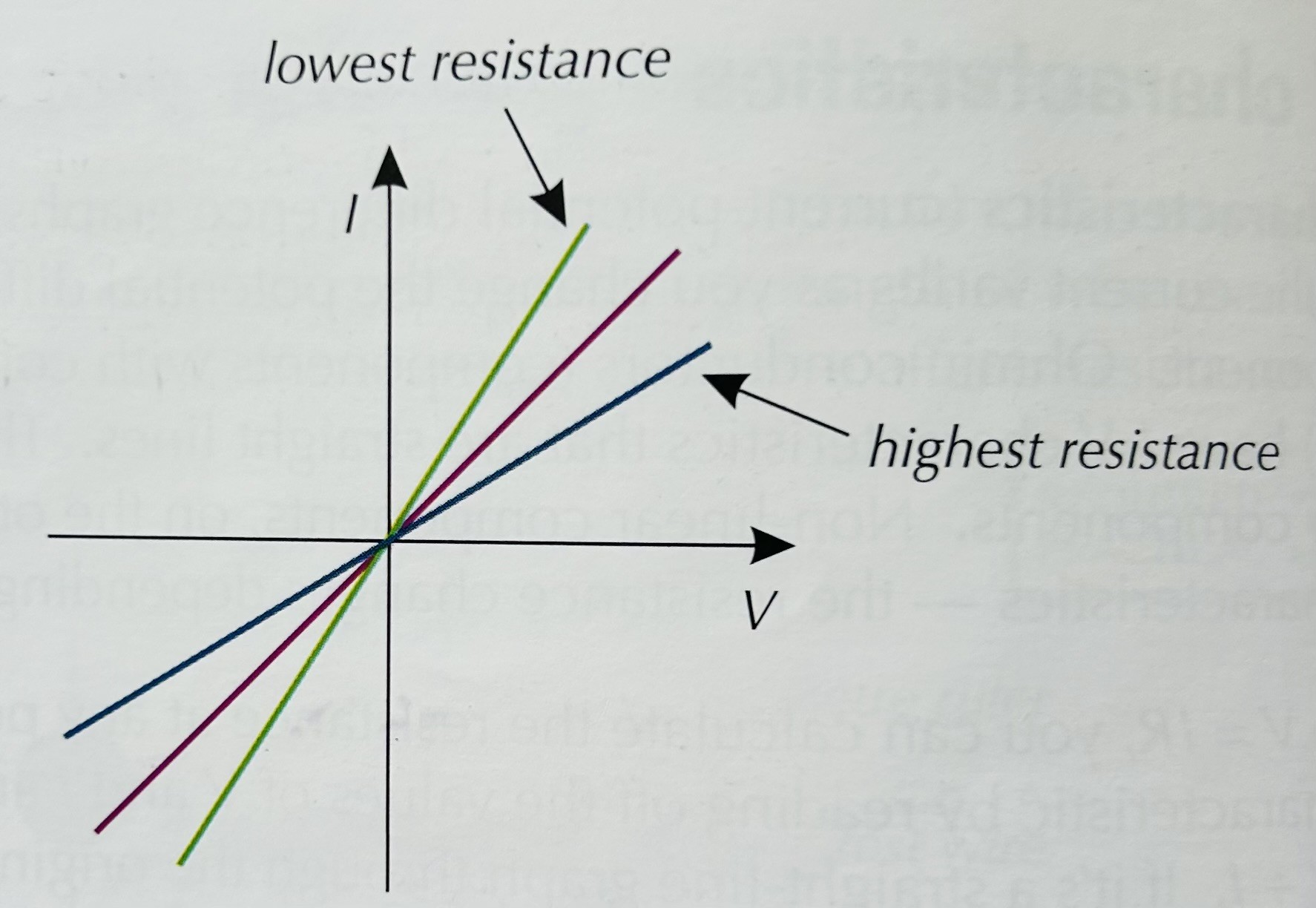
Whats an ohmic conductor
A conductor whose current flow is directly proportional to the potential difference across it, when held at a constant temperature.
Describe how the current through an ohmic conductor is related to the potential difference across the resistor
The current through an ohmic conductor is directly proportional to potential difference, so you get a straight line I-V characteristic
Describe what happens to the resistance of an ohmic conductor as the current through it changes
If the resistance of components such as lamps, diodes, thermistors, and LDRs is not constant, it changes with the current through the component
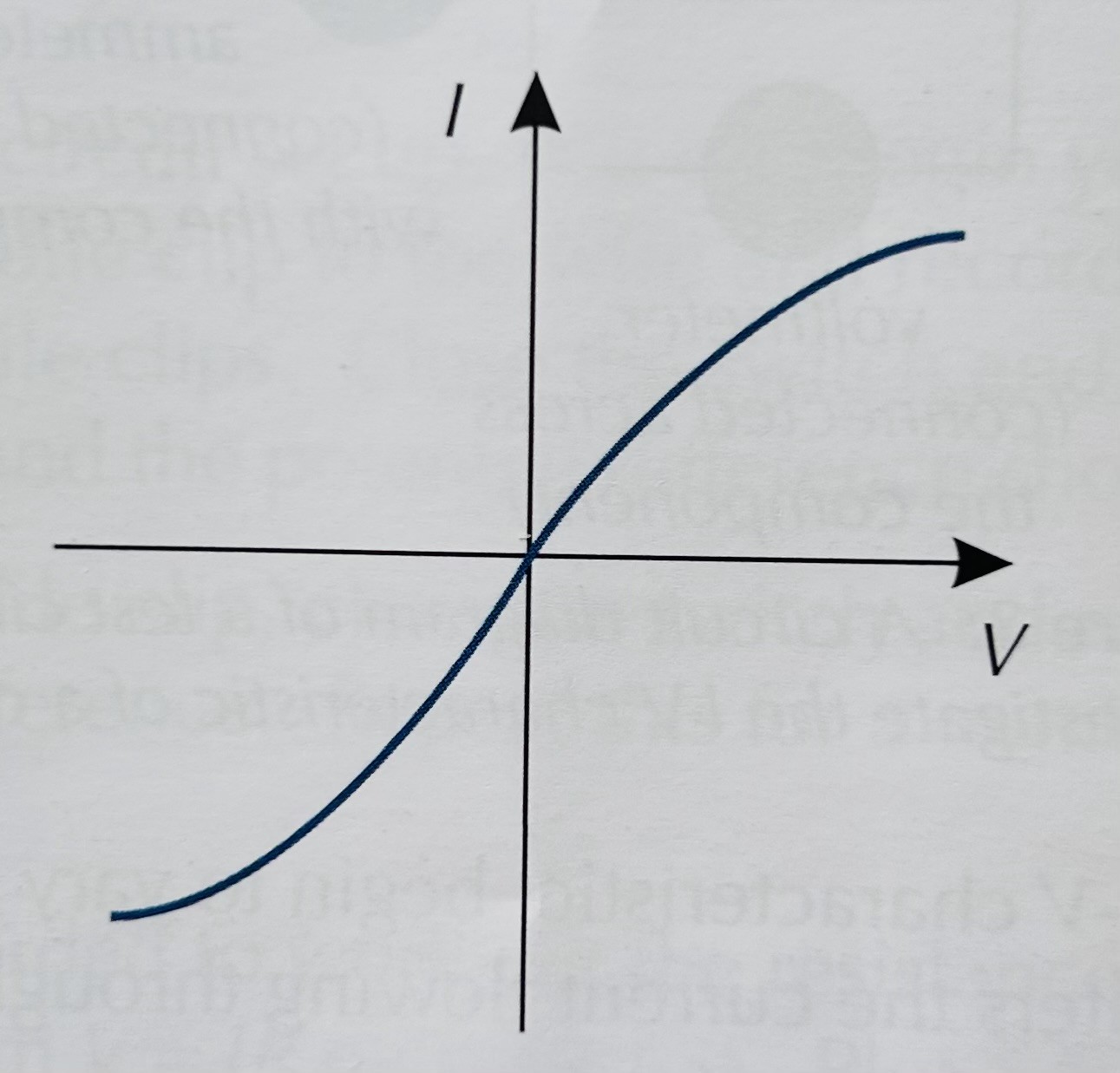
What is a filament Lamp
A light emitting component consisting of an enclosed metal filament. Its resistance increases as the filament’s temperature increases.
Describe how the current through a filament lamp is related to the potential difference across the resistor
It is not directly proportional; the I-V characteristic is non linear
Describe what happens to the resistance of a filament lamp as the temperature of the filament increases
The resistance of a filament lamp increases as the temperature of the filament increases
Why? - Ions in metal have more energy, so vibrate more, causing more collisions with electrons as they flow through the metal, creating greater resistance to current flow
What is a diode
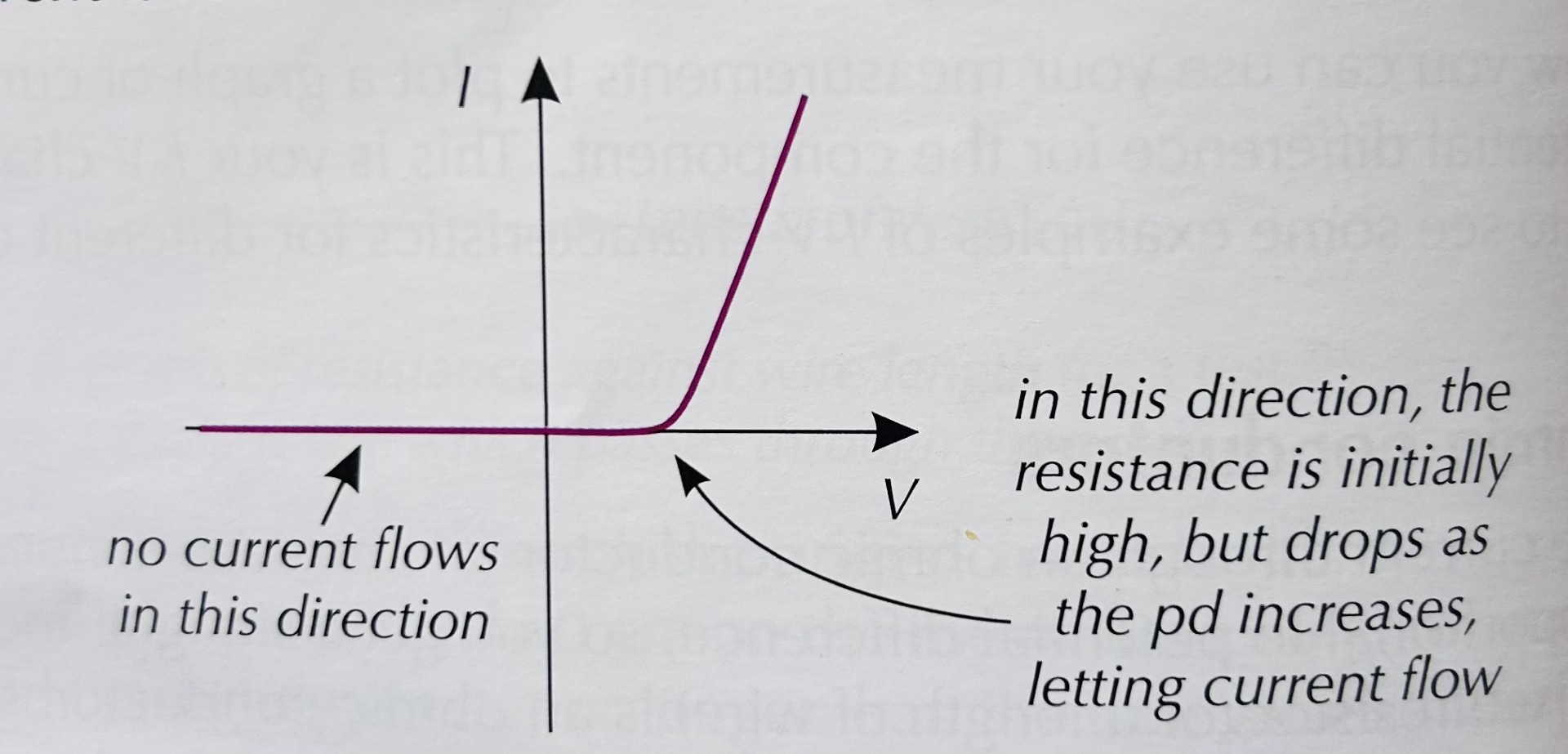
A component that only allows current to flow through in the forward direction. They have very large resistances in the reverse direction.
The relationship between the current through a diode and the potential difference across the resistor on a graph
Describe how the current flows through a diode
Current through a diode flows in one direction only
Describe what happens to the resistance of a diode when current flows in the reverse direction
It will increase if the current is reversed
What is a thermistor
A temperature dependent component, whose resistance increases as its temperature decreases.
Describe how the resistance of a thermistor changes as the temperature increases
Causes the resistance to decrease
I can describe how thermistors can be used to control a circuit
Thermistors can be used to control a circuit to provide temperature measurement or regulation, as their resistance changes with temperature, allowing them to act as sensors or control devices.
Explain how the resistance of an LDR changes as light intensity increases
The resistance will decrease
Describe how LDRs can be used to control a circuit
LDRs can be used to control a circuit by decreasing their resistance as light intensity increases, allowing them to act as automatic light sensors
Graphs that represent the relationship between the current and potential difference for:
• an ohmic conductor
graphs that represent the relationship between the current and potential difference for:
• a filament lamp
graphs that represent the relationship between the current and potential difference for:
• a diode
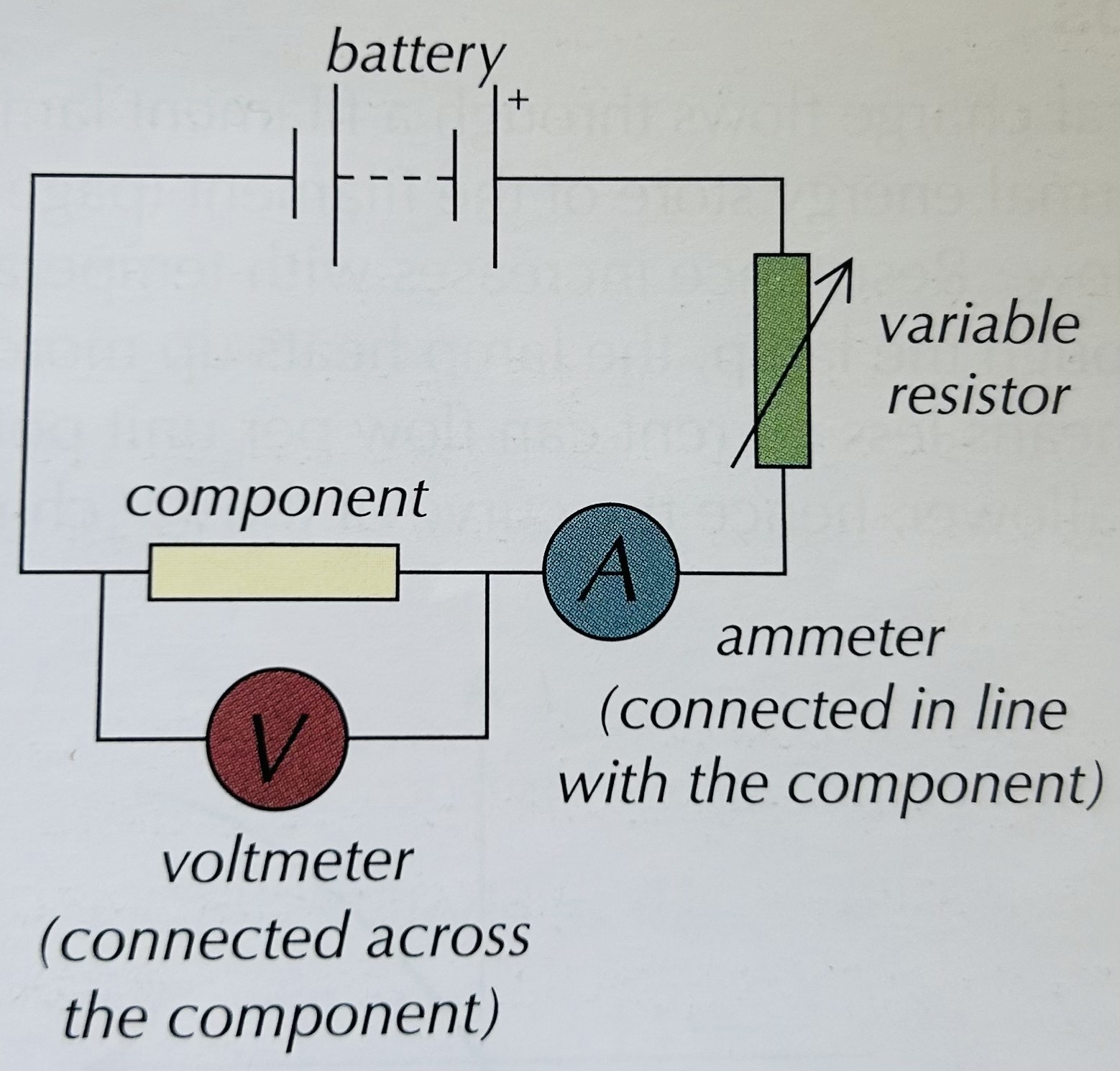
A circuit to measure the resistance of a component by measuring current through, and potential difference across, a component
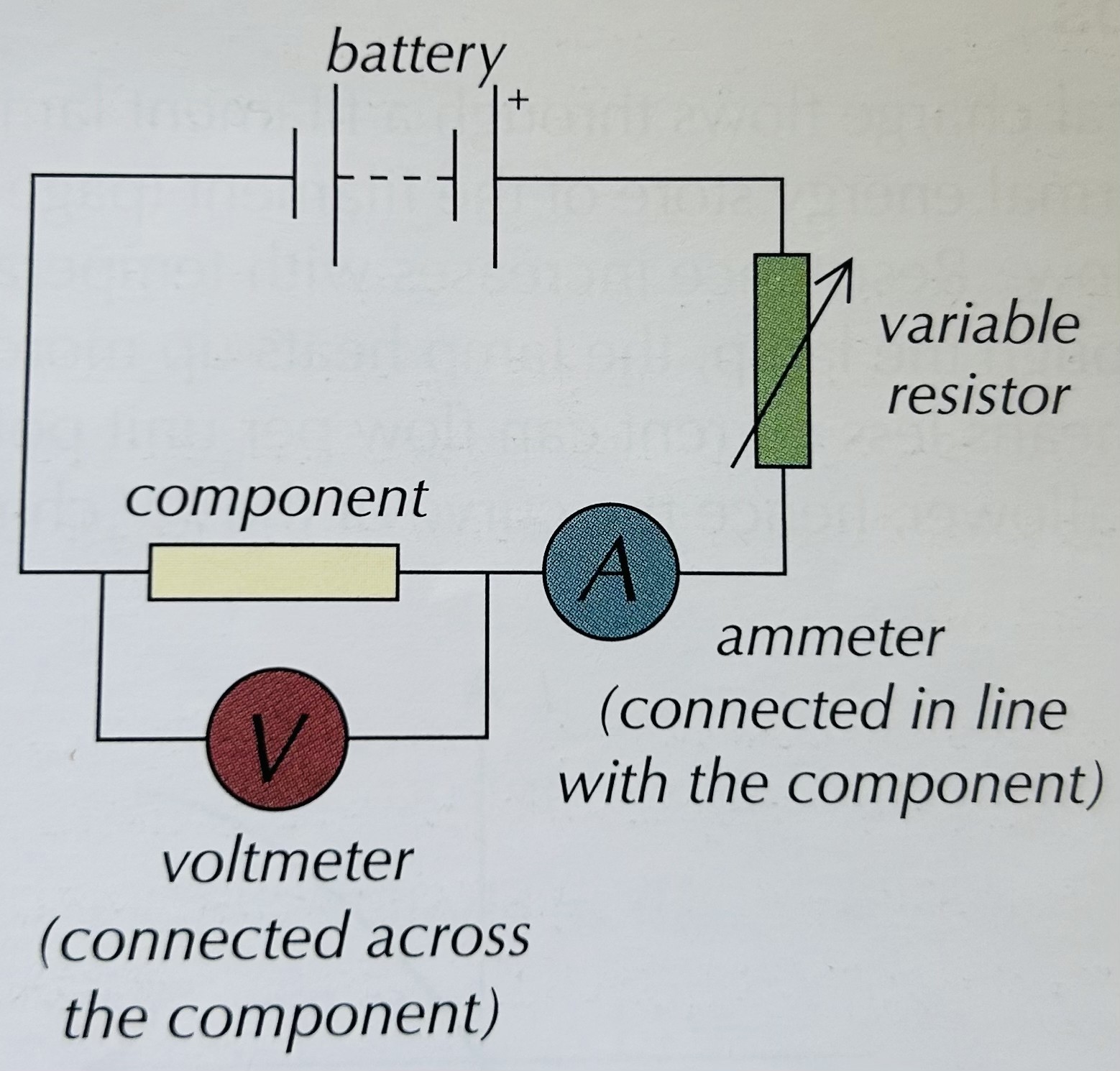
Investigate the I-V characteristics of a variety of circuit elements, including a filament lamp, a diode, and a resistor, at constant temperature
To find a component’s I-V characteristic, begin to vary the resistance of the variable resistor. This alters the current flowing through the circuit and the potential difference across the component
Each time you use the variable resistor to alter the current, record the potential difference across the component for that value of current. Repeat each reading twice more to get an average pd for each measurement
Swap over the wires connected to the battery to reserve the direction of the current. Measure negative values of current and potential difference using the same method as described above
Now you can use your measurements to plot a graph of current against potential difference of the component. This is your I-V characteristic.
State the two ways of joining electrical components in a circuit
Series
Parallel
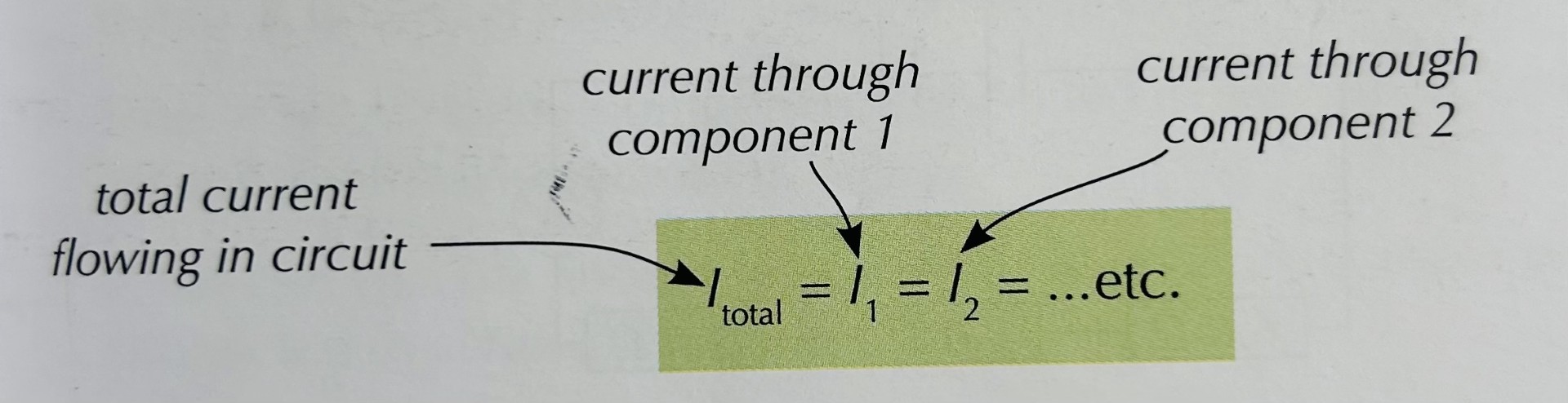
Describe the current through components connected in series
Current is the same at all position since the charge only has on path to flow through
Describe the potential difference across components connected in series
Potential difference is shared across the whole circuit
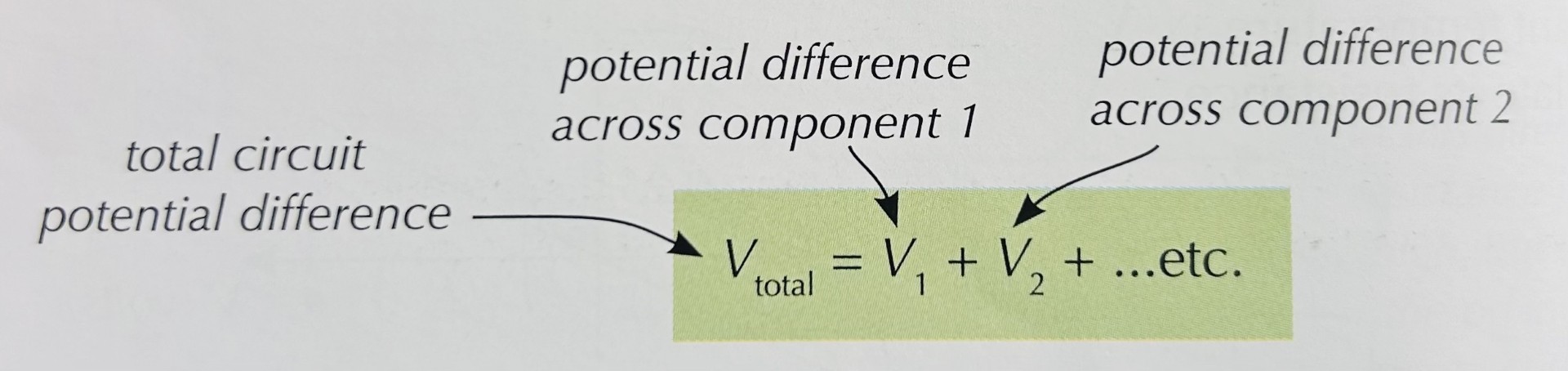
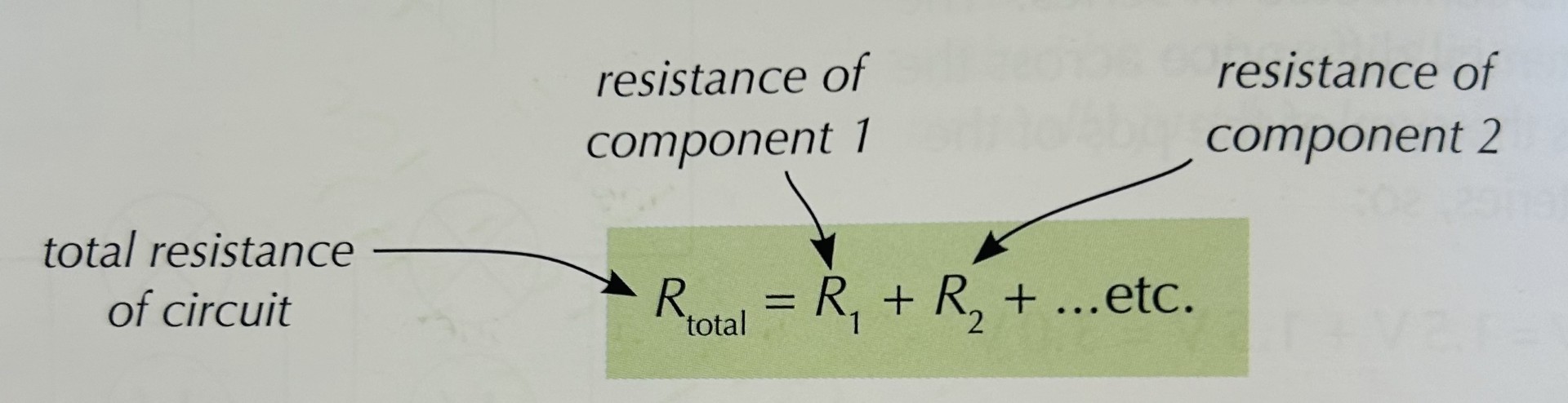
Describe the total resistance of two components connected in series and represent this as an equation
Resistance of two components is bigger than just one of them, because the charge has to push through both of them when flowing round the circuit
Describe the current through components connected in parallel
The current is shared between the different branches. When the charge reaches a junction it splits
Describe the potential difference across components connected in parallel
Potential difference is the same across all branches
Describe the total resistance of two components connected in parallel
Two resistors in parallel will have a smaller overall resistance than just one
Because charge has more than one branch to take, so only some charge will flow along each branch
How should you connect an ammeter and a voltmeter in a circuit to measure current and potential difference
Ammeters should be connected in series with the component that they are measuring current through
Voltmeters should be connected in parallel to the component that they are measuring the potential difference of
Why is it an advantage to connect lamps in parallel
If one lamp blows, the rest will be unaffected and can still receive current
Describe the difference between series and parallel circuits.
Series:
Components are connected end to end
All the current flows through all the components
Can only switch them all off at once
Potential difference is shared across the whole circuit
PD of power supply = sum of PD across each component
Current is the same through all parts of the circuit
Current at one point = current at any other point
Total Resistance is the sum of the resistance in each component
Resistance of two components is bigger than just one of them, because the charge has to push through both of them when flowing round the circuit
Parallel:
Components are connected separately to the power supply
Current flows through each one separately
You can switch each component off individually
Potential difference is the same across all branches
PD of power supply = PD of each branch • Because charge can only pass through any one branch
Current is shared between each of the branches
Current through source = sum of current through each branch
Total resistance is less than the branch with the smallest resistance
Two resistors in parallel will have a smaller overall resistance than just one, because charge has more than one branch to take, so only some charge will flow along each branch
Why adding resistors in series increases the total resistance while adding resistors in parallel decreases the total resistance
If we add more components in series we increase the total resistance, as the total resistance is the sum of the individual restistances
If we add more components in parallel we decrease the total resistance, as there are more paths for the electrons to take
Explain the design and use of dc circuits for measurement and testing purposes
What does ac and dc stand for and what they do
Ac - alternating current, current that is constantly changing direction, they are produced by alternating voltages in which the positive and negative ends keep alternating
Dc - direct current, current that is always flowing in the same direction. It’s created by a direct voltage where the positive and negative ends of the source are fixed
state whether mains electricity is an ac or dc supply
ac supply
What is the frequency and voltage of the UK mains electricity supply
Frequency - 50Hz
Voltage - 230V
What are the colours and the purposes of the:
Live wire
Earth wire
Neutral wire
Live wire:
Brown
Provides the alternating potential difference from the mains supply
Earth wire:
Green and yellow
For protecting the wiring and for safety, it stops the appliance casing from becoming live. It doesn’t usually carry a current, only when there is a fault. It is at 0V
Neutral wire:
Blue
Completes the circuit by connecting the appliance back to the mains supply and carries away current. It is around 0V
Explain that a live wire may be dangerous even when a switch in the mains circuit is open.
Your body, just like the earth is at 0V. This means that if you touch the live wire, a large potential difference is produced across your body and a current flows through you. This causes a large electric shock which could injure or even kill you
Even if a plug socket or a light switch is turned off (the switch is open) there is still a danger of an electric shock. A current isn’t flowing, but there is still a pd in the live wire. If you made contact with the live wire, your body would provide a link between the supply and the earth, so a current would flow through you
Any connection between live and the earth can be dangerous. If the link creates a low resistance path to the earth, a huge current will flow, which could result in a fire
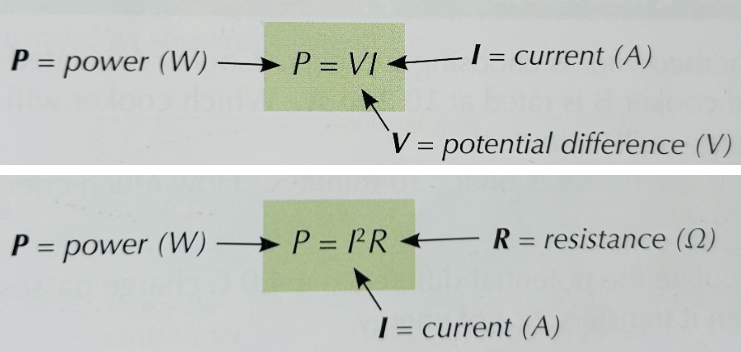
Power defintion
The rate at which energy is transferred or work is done
Equations to calculate power
Equations to calculate energy transferred
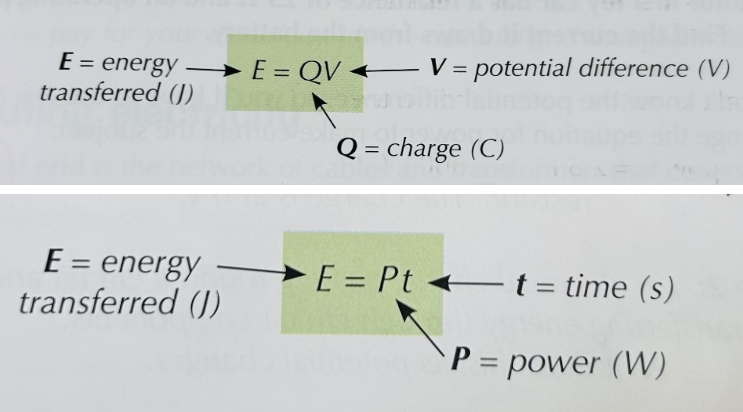
Describe what affects the amount of energy an appliance transfers
How long the appliance is being used for
The power of the appliance
Describe how different domestic appliances transfer energy from
batteries
Ac mains to electric motors
heating devices
Battery converts chemical energy into electrical energy
Motor converts electrical energy into kinetic energy as well as waste energy in the form of heating due to friction
Explain how the power transfer in a circuit device is related to the
Potential difference across it
The current through it
The energy transferred over a given time
Describe how charge causes work to be done in a circuit
Whenever something moves, something else is providing effort to move it
The thing putting the effort in needs a source of energy
It then does work by moving the object, energy is transferred from one store to another
Whenever this energy is transferred usefully or is wasted, work is still done
Describe, with examples, the relationship between power ratings for domestic electrical appliances and the changes in stored energy when they are in use
Describe the purpose of the National Grid
Its a system of cables and transformers which links power stations to consumers so that they have access to a source of electricity
Step up transformers and Step down transformers
Step up:
Used just after the power station
Increases volume and decreases current
Step down:
Used just before houses and factories
Decreases volume and increases current
Name the parts that make up the National Grid and there voltages
Power station - 25KV
Step up transformers
Power lines - 132KV
Step down transformers
Factories - 33KV
Homes - 230V
Explain why the National Grid system is an efficient way to transfer energy
Why must we reduce the potential difference before the electricity reaches homes
Appliances are designed to be 230V of pd, therefore its a bigger risk to us and our appliances
Why do we increase the pd on the national grid
Because a high voltage will deliver more energy down the cables
Because increasing the Pd will decrease the current
Because the same power is delivered in a more efficient way
So that less energy is wasted as heat in the cables
Because the electricity will travel faster down the cables
Because a smaller current will mean less collisions between electrons and metal ions so the cables don’t get as hot
Describe how some insulating materials can become electrically charged
By being rubbed together
Why? -
Electrons are rubbed from one material onto the other
The material gaining electrons becomes negatively charged
The material loosing electrons becomes equally positively charges
Examples of materials which are electrical conductors and insulators
Plastic and wool = insulators
Metal and graphite = conductors
What is it that makes a material able to conduct electricity
Has delocalised electrons
If electrons move from object A to object B, what can we say about the size of the charge on both objects
Would be the same but oppsoitely charged
When charged objects are placed near each other, what two things affect the size of the force the objects experience
The amount of charge on the object
How close together they are
Why does the Van der Graff generator make your hair stand on end
Because they have the same charge and like charges repel
Explain the concept of an electric field
A region in which a charged object will experience a non-contact electrical force
Describe how the strength of an electric field around a charged object varies with distance from the object
The field decreases in strength the further away you get making it a force
Where can electric fields be found
Surrounding any charged object
The electric field pattern for an isolated charged sphere
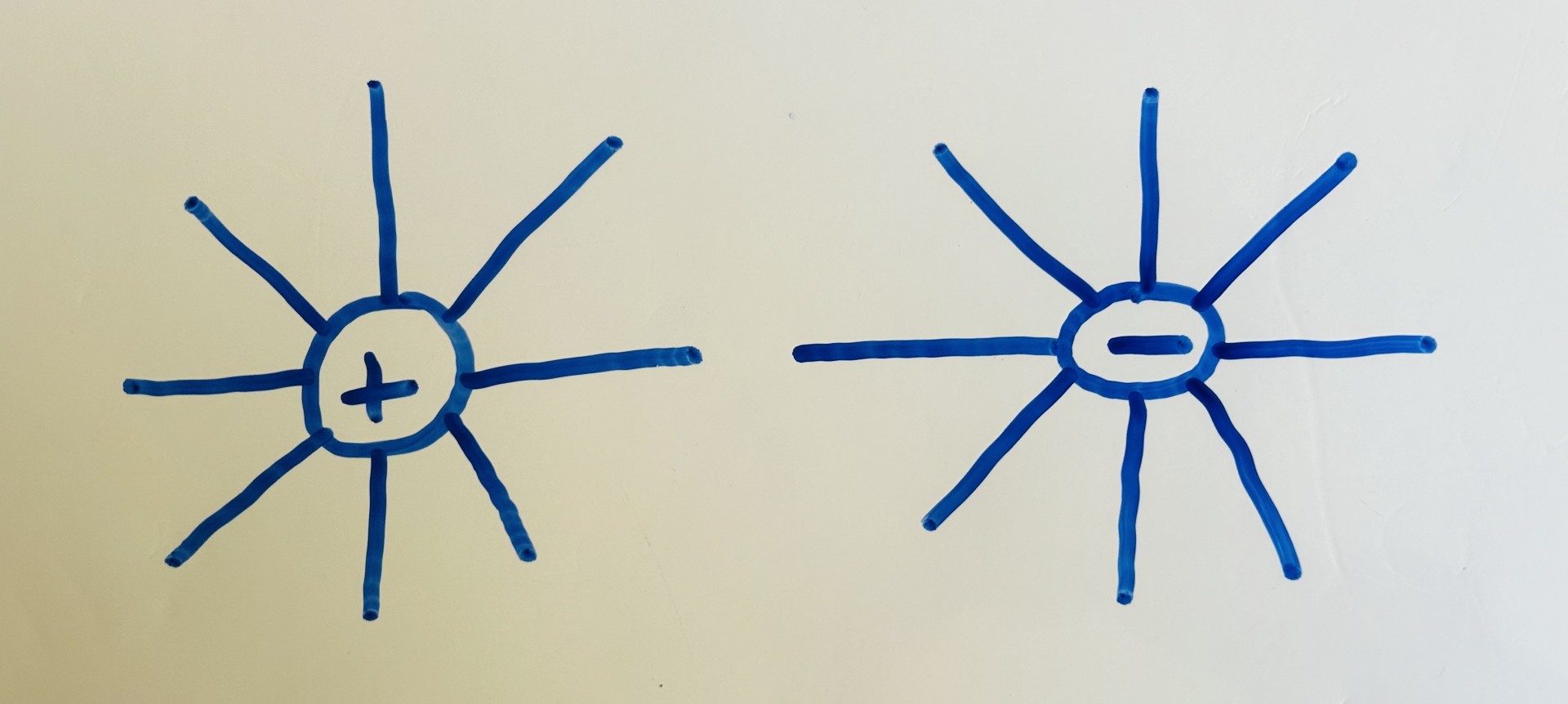
Explain how the concept of an electric field helps to explain the non-contact force between charged objects
Describe what happens to a second charged object placed in the electric field created around the initial charged object
it experiences a non-contact electrostatic force