FW 453 Exam 1
 Call Kai
 Learn
Learn Practice Test
 Spaced Repetition
 Match
Match Flashcards
 Knowt Play
1/25

There's no tags or description
Looks like no tags are added yet.
Name | Mastery | Learn | Test | Matching | Spaced | Call with Kai |
|---|
No analytics yet
Send a link to your students to track their progress
26 Terms
Which of the following is NOT a foundation of appropriate sampling design?
Cluster sampling
Which of the following statements about logistic population growth is FALSE?
The recruitment into the population ( dN/dt) is maximized at K.
Which of the following is NOT an approach to test hypotheses (i.e., inference):
Maximum Likelihood estimates
Which of the following is the key step in Adaptive Management that differentiates it jrom Structured Decision Making:
Monitoring to learn
The top row of a population projection matrix (i.e., "reproductive contribution") strictly contains the fecundity or reproductive rates.
False: contains fecundity and survival
An estimate with high precision will also be unbiased.
False: precision deals with variability or spread around an estimate. Bias deals with how close to the truth you are on average.
Even in a completely constant environment, with mean vital rates remaining constant, a population could fluctuate wildly in numbers due to demographic stochasticity or due to stage structure being very different from stable stage structure.
True
The geometric mean growth rate will be greater than the arithmetic mean growth rate in a population with variable growth (i.e., lambda changes from year to year).
A population can exhibit chaotic dynamics in the absence of demographic or environmental stochasticity.
Exponential population growth tends to stabilize populations.
One benefit of using the continuous (exponential) growth rate r is that population growth rates between two different species can be compared directly.
An exponential growth model may be appropriate for newly established populations or invasive species.
spatial heterogeneity
one of the main sources of variability when sampling populations
bias
cannot be determined from a single data point; how good “on average" an estimate is
effect size
difference between two or more treatments
sample
subset of individuals from within a population used to estimate characteristics of the whole population
sampling variance
inherent observation error arising from estimating something by incomplete sampling
process variance
genuine biological variance that arises because environmental conditions vary
precision
closeness of repeated measurements to the same quantity
Akaike's Information Criterion
a common measure that quantifies parsimony
In an information theoretic approach, the most parsimonious model has what two key attributes?
a. model fit
b. model complexity
In a Bayesian framework, there are three primary components: prior belief, a likelihood, and a ________ which represents a combination of your prior belief and the likelihood.
posterior (distribution)
The analytical sensitivity, or amount that λ changes with an infinitesimal change in a vital rate, depends on the reproductive value and the ______ of the stage class with that vital rate
SSD
A population of endangered Gunnison sage grouse in Colorado, has shown an average 11 % annual decrease in abundance per year over the past 3 years.
a) What is lambda, what is r?
b) How many grouse would be expected if this decline of 11% was constant for 4 more years (time steps) and we started with 20 grouse?
c) Suppose the average 11% decrease occurred as the following actual changes each year: 6%, 17%, 13 %, 8%
Show that the arithmetic mean ( or average) λ indeed represents a 11 % decrease
What is λ_G (=λ_S)?
How many grouse would you expect after 4 years in this case (question c, part ii)? Is that the same or less or more than what you calculated in (b)?
Here's a simple projection matrix for a spotted owl population: The 3 stages are: juveniles (ends at year 1), first-year subadults (age 1 to age 2), and adults (> age 2)
0 | 0 | 0.39 |
0.29 | 0 | 0 |
0 | 0.83 | 0.83 |
a) Define in precise words what these numbers in the matrix represent:
0.83
0.39
b) If there were 8 juveniles, 12 subadults and 18 adults this year, how many ADULTS would you expect next year (show work)
c) Suppose there are two separated owl populations each with 40 individuals in 2018, and the constant vital rates given in this matrix. One population has 5 juveniles, 20 subadults and 15 adults while the other has 20 juveniles, 15 subadults, and 5 adults. In 100 years (year 2118), and assuming constant vital rates, would you expect the two populations to have
The same population size? why/why not?
The same population growth rate? (why/why not?)
The same proportion of individuals in each stage class? (why/why not?)
You know about this awesome quote from W.C. Allee:
“Many have written pointedly about over-crowding, and while there is still much to be learned in that field, it is in the recently demonstrated existence of undercrowding, its mechanisms and its implications that freshness lies. Without for one minute forgetting or minimizing the importance of the right-hand limb of the last curve, it is for the more romantic left-hand slope that I ask your attention.”
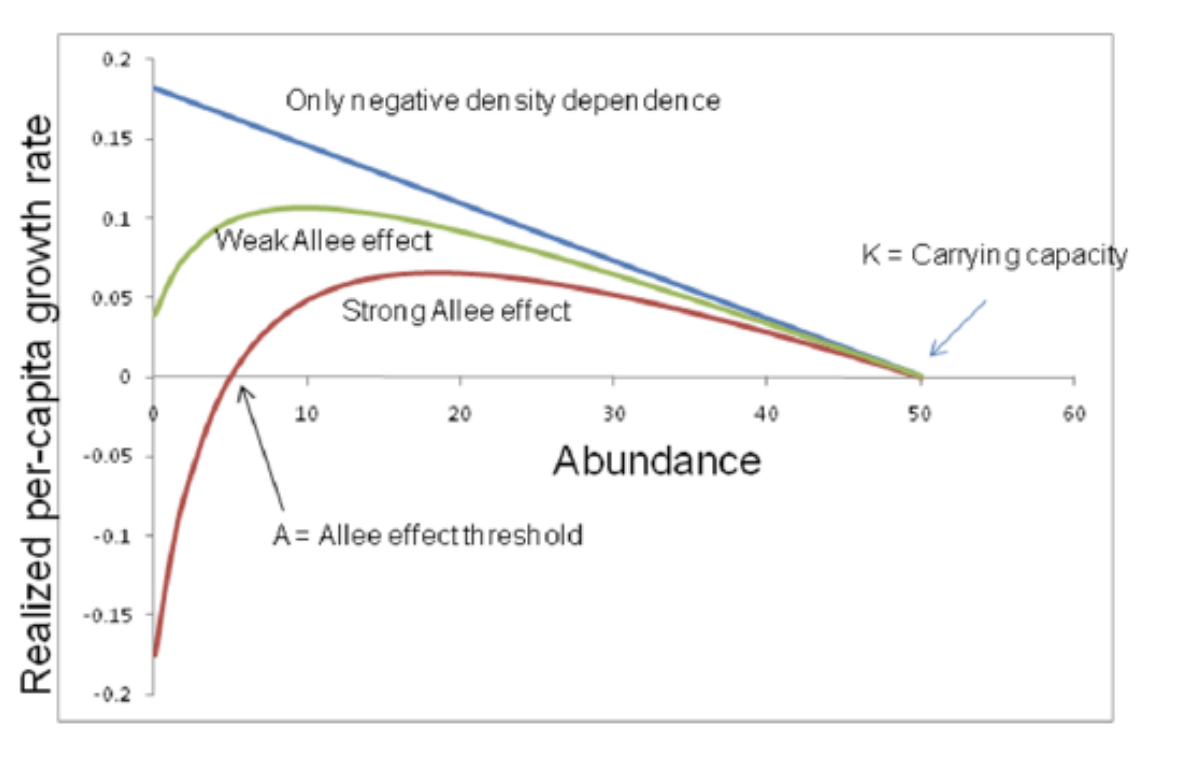
Of course, the curve he’s talking about is realized per capita growth rate (variously described by either [ln(Nt+1/Nt)] or dN/dtN), plotted against density.
a) What is the difference between a “weak” and “strong” allee effect and what is the Allee effect threshold (A)?
b) What does the “romantic left-hand slope” refer to? Please give an example of this in action, making sure that your example clearly shows the concept.
c) What does the “right-hand limb” refer to? Please give an example of this in action, making sure that your example clearly shows the concept