Interactions Between Cells and their Environment
 Call Kai
 Learn
Learn Practice Test
 Spaced Repetition
 Match
Match Flashcards
 Knowt Play
1/16

There's no tags or description
Looks like no tags are added yet.
Name | Mastery | Learn | Test | Matching | Spaced | Call with Kai |
|---|
No analytics yet
Send a link to your students to track their progress
17 Terms
What are tissues? How are they made?
Epithelial cell sinteract with one another through junctions to form tissues
All junctions from top of the epithelial cell to the bottom - 5 parts
Which junctions holds the sheets together
Only name them
What functions are cell-cell anchoring junctions
Which are cell-ECM anchoring junctions
Polarity of epithelial cells: naming
Tight junctions
Adherens junctions
Desmosomes
Gap junctions
Hemidesmosome
Top three holds the sheets together
Cell to cell: adherens junctions and desmosomes
Cell to ECM: Hemidesmosomes
Polarity
apical vs basal
Apial towards extracellular matric
Basal towards the basal lamina
tight junctions
Functino of tight junctions (two functions)
What do tight junctions form
What two transmembrane proteins make up the tight junctions
How do the proteins bind and what do they do
Create a seal between cells to prevent the mixing of extracellular matrixs
Prevent the mixing of membrane protein (recall the slices with glucose and Na pumps)
Forms a sealing strand or tight junction belt
Transmembrane proteins
claudin and occludin (namming cluaudia and occula)
For the interactions between the two extracellular domains
Homophilic binding
O with O
C with C
Anchoring Junctions
adheren junctions/desmosome - what do they do/achor
Hemidesmosomes - what do they do/anchor
What proteins are involved in anchoring
Two types of proteins and their functions
One type of protein has two domains explain what they do
Second type: what kind of protein are they - referring to the types from the previous lecture
Do the types of proteins differ according to the type of anchoring junctions?
Type of protein for adheren, desmosome, hemidesmosomes
What does the linker protein bind to what kind of filament
Adheren junctions/desmosomes: anchor the cytoskeletons of the neighbouring cells together
Hemidesmosomes - anchor the cutoskeleton of one cell to the basal lamina
Proteins
transmembrane adhesion proteins
Extracellular domain links with other adhesion proteins or the matrix
Intracellular domain links with the linker proteins
Linker proteins
They are cytosolic proteins
Links the adhesion proteins to the cytoskeleton filaments
differs: yes
adheren: cadherins
Homophilic binding
Linker binds to actin
Desmosomes: desmoglein and desmocollin
Homophobic and heterphilic binding
Linker proteins link to keratin filaments - intermediate filaments
Hemidesmosomes: integrins
No philic, phobic binding
Linker proteins binds to the keratin filaments - intermediate filament
Gap junctions
Structure building block
What does it allow - what kind of structure entails if the function is turned on or off
Coupling cells
How does it couple cells
What does it allow in
Gated function
How does doapmine work with the gates
Why do we have gates?
1 subunit = connexin
6 connexin = connexons
2 connexons = channel
Channel forms = communication between cells
Only one connexon = no communication
Coupling through metabollical and electrically
Allow passahe of metabolites and ion but only very small
e.g. AA, glucose, nucleotides, cAMP
Gated function
Allows the opening and closeing state based on extracellular ot intracellular signals
Dopamine closes gate
Very important to protect the cell if neighbouring cell dies e.g. Ca leaves very quickly = cell dies = neighbouring cell must close or else loses their own Ca as well and dies
Intercellular Junctions in plant cells
What is unique compared to epithelial cell junctions
What is one cell junction do they have and why is it super unique
How is the movement of things regulated - how do gates work
do not have cell junction similar to the ones in animal cells
Plasmodesmata
Communication between cells
Movement
Smaller electrically charged molecules allow to move freely
Larger soluble molecule controlled by gating
uniqueness: sharing to the cytoplasm, ER, plasma membrane, and cell wall
Gating
Works by the control of cellulose composition, control by its reverse
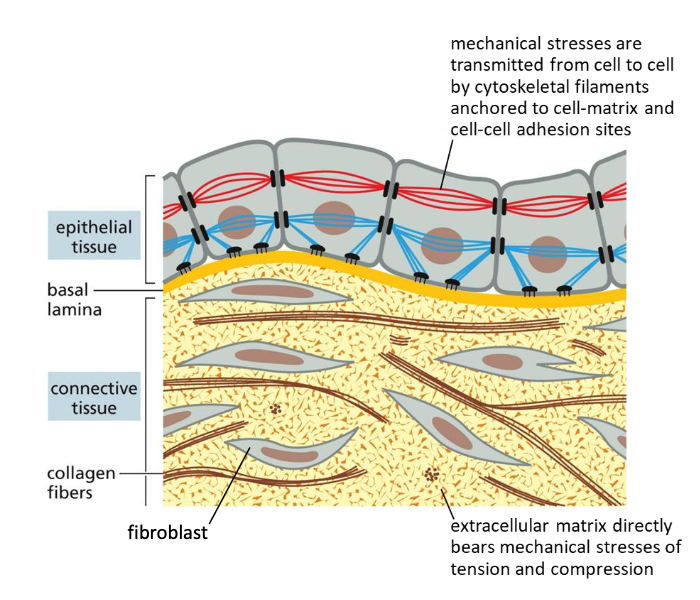
Parts of an animal tissue
3 main parts - only name
epithelium
Basal lamina
Connective Tissue
Epithelial tissue
cell compositions and how they interact
Amount of ECM access
What provides resistance to mechnical stress
cells are closely together and attached to one another
Limited access to ECM by only the basal lamina
The cytoskeleton filaments provide resistance to mechincal stress
Connective tissue
cell composition and what do they interact with
Amount of ECM
What provides resistance to mechanical stress
Cell not close to each other, very closely interacting with ECM
Lots of ECM
ECM provides resistance to mechanical stress
Extracellular matrix
3 macromolecules of the extracellular matrix
Only list
1) glycosaminoglycans and proteoglycans
2) Fibrous proteins
3) Glycoproteins
Glycosaminoglycans (GAGs)
What is it
Its charge
What does it help in
What is hyaluronan?
Where is it made in
a repeating disaccharide sugar
negatively charged
Form gels that resist compression
Hyaluronan
Made specifically by the plasma membrane enzyme complex and is up to 25000 subunits long and disaccarides
Proteoglycans
what makes them unique from glycoproteins
How much of its weight is sugar
proteoglycans are a type of glycoproteins that have at least on GAG bound to it
95 percent of its body weight is just sugar
Fibrous proteins
what are the two types; just list
collagen
elastin
What does collagen do? - fibrous protein
what is it made out of
What is it function (2)
Where is the site of synthesis (example building block structure)
Explain its interaction with the ECM
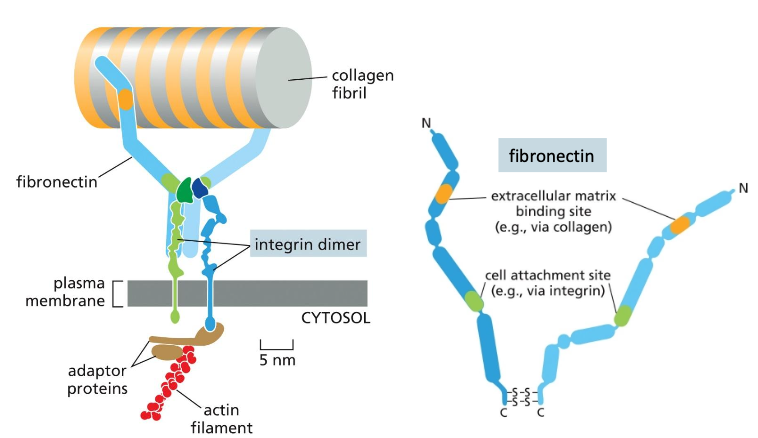
How does it bind (two proteins and how do they bind and what else do they bind to?)
Made out of ribrous protein
Provides tensile strength
Resist Stretching
Site of synthesis from fibroblasts and osteoblasts as procollagen
Procollagen into collagen and then collagen fibrils which can then form collagen fibers
Interaction with ECM
Integrin (adhesion receptor): binds to the fibronectin (glycoprotein) outside and binds to adaptor proteins inside
Fibronectin: will bind to the collgen and bind to integrin
elastin
What type of protein
What does it help with the tissues
fibrous protein
Provides elasticity and resilience
Basal lamina
main function 3 functions
Three parts of the lamina and what they do (as well as what kind of protein are they)
separates the pithelial with the connective tissue
prevent interactions to fibroblost with epithelial tissue
Allows the passage of macrophages and lymphocytes (both are releated to the immune cell)
Laminin (glycoprotein): interacts with the ECM components
Type IV collagen (fibrous protein): provides strength
Integrin (transmembrane adhesion protein): binds to the laminin and epithelial cells
Plant cell wall
main components
What function do they help with the cell wall
What synthesizes them
rigidity compared to animal tissue
main components
Cellulose provides tnesile strength
Produced by the cellulose synthease complex and made parallel to the microtubules
Pectin
space filling to resistance to compression
Rest synthesized by the golgi and exocytosis