SAC
 Call Kai
 Learn
Learn Practice Test
 Spaced Repetition
 Match
Match Flashcards
 Knowt Play
1/50

Earn XP
Description and Tags
syllabus points
Name | Mastery | Learn | Test | Matching | Spaced | Call with Kai |
|---|
No analytics yet
Send a link to your students to track their progress
51 Terms
Qualities to make someone a Social & Cultural literate person:
Avoids making judgement of another cultures practices using values of their culture
Scene of social responsibility and displays active citizenship by engaging critically with social issues and takes consideration for the welfare, dignity, social justice and human rights
Aware of & sensitive to major national and global issues
Considered the impact of globalisation, technologies and rapid change as well as continuity and its implications for the future.
personal knowldge
refers to the knowledge gained from reflecting on individual experiences
pubic knowldge
refers to general knowledge & the knowledge available to everyone. The term also refers to all knowledge found in the public domain that's the word or research of others.
Continuity
what persists/remains the same despite change. eg/ traditions, cultural practices.
change
Involves the alteration modification of these cultural elements. It's often driven by modernisation processes leading to cultural transformations.
persons
each individual who develops in a social and environmental setting in which they are influenced.
society
made up by people, groups, networks, institutions, organisations and systems which form groups which have patterns of interactions that contribute to unique cultures.
culture
shared knowledge, attitudes and behaviours that give each society its coherence, identity and distinctive way of life, its shaped around beliefs, customs, values,norms, rules, laws and governance
emvironment
located in a particular physical setting and interacts within its environment. Attitudes people have in regard to their environment affect interactions between persons, society and culture.
time
everyone is located in a period of time and it continues to change with time, like the past, present and future trends. Time is studied in relation to continuity and change.
power
the ability to influence or persuade others into a pov or action.
authority
linked to power and the right to make decisions and determine, adjudicate or settle issues and disputes in society. eg/ government, police.
gender
socially constructed differences between females and males as well as cultural ideals, identities and stereotypes.
identity
refers to a sense of self and can be viewed from a personal, social and cultural level.
technology
the tools that we use to assist our interaction in and within society.
globalisation
process of integration and sharing of goods, capital, labour, services, knowledge, leisure, sport, ideas and culture between countries.
micro
personal interactions that occur between individuals and their family, peers and individuals in the community. It's your immediate sphere of influence. Its where identity is formed and negotiated.
meso
It's the bridging gap between micro and macro by examining how larger social structures impact smaller groups. Groups in communities, village, workplace, school, clubs, organisations and state.
macro
Interactions impersonal interactions that relate to large institutions, the media, law/government and are evident at national and international level. Societal structures like economy, politics and culture, shape the behaviour/interactions of individuals and groups.
Enculturation
It means multiculturalism; when the dominant culture shares their language, religion, traditions and values with a minority culture and they blend. EG/ Muslims having christmas photos with non muslim friends.
Acculturation
It means hybrid; when a dominant culture shares with a minority group to almost create a new culture, they pass things back and forth. EG/ Japan's influence in Hawaii, Maori language in New Zealand.
Assimilation
It means monocultural; when the dominant culture forces their language, religion and ways upon the minority group resulting in the minority group losing their own culture. EG/ indigenous people losing culture due to invasion of britain, North Korea, the holocaust.
Personality
Refers to the set of traits and patterns of thought and feeling that make you, You.
Everybody has their own unique personality which can develop and change as you age.
Personality development factors
Life experiences
Genes
Adverse events
Community
Culture
Early bond
Family
Environment
Social status
Education
Why are early childhood experiences important?
A child isn't intellectually developed=> no idea of self or what a person is
A child needs emotional support from others to learn, develop and understand feelings of others.
How a child is treated by a carer will affect what they think about themselves and others
self awareness
The ability to reflect on one's own thoughts, feelings and behaviours.
Developed over time with children becoming more self aware as they age.
In adolescence, self awareness often leads to the formation of self concept and identity, influenced by peer groups, media and social norms.
It's the conscious knowledge of ones own character, feelings, motive and desires
Self Concept
It's the idea you have of yourself
It’s made up of our self image, self esteem, and ideal self
3 factors that influence self concept
Self image: your social role, personality, how we see ourselves
Self esteem: how we see ourselves, positive/negative, do we like who we are
Ideal self: the person we would like to be
Biological theoy of personality development
Personality is largely determined by generic factors, including biological and physiological influences.
Behavioural theory of personality development
Personality is shaped by environment factors through learning, reinforcement and punishment.
Psychodynamic theory of personality development
Personality developed from unconscious drives and childhood experiences, shaped by internal conflicts and desires.
Humanist theory of personality development
Personality develops as individuals strive to realise their potential, with an emphasis on personal growth, self actualisation and positive development.
Trait theory of personality development
Personality is made up by a set of stable traits that can be measured and used to predict behaviour.
Identity and Social self
Identity is a dynamic and evolving concept that reflects an individual's sense of self through social and cultural dimensions
Shaped through interactions at a m,m,m level
Key factors=> gender, sexuality, family, ethnicity, beliefs & social status
Idenity and social self are split into 2 parts
Personal identity- the unique ways that you define yourself. Your personal identity consists of all things that are different and unique to you.
Social identity: refers to your sense of who you are based on your membership in certain groups. Social identity emphasises the things that make you the same.
Social self
Refers to how we perceive ourselves in relation to others. Think about how you interact with family, friends, teachers, boss etc
Charles Cooleys looking glass self theory
How we imagine we appear to others
How we imagine others to judge us
How we feel about the judgement of others
socialisation
Process where individuals learn to become functioning members of society by internalising the roles, norms and values of that society. It accounts as a result of the individual's interactions (m,m,m) with the agents of socialisation, through which they learn to perform social norms.
socialisation helps individuals
Learn social norms and expectations
Develop values and beliefs
Understand acceptable behavior
Forms a sense of belonging
Develops personal identity and social identity
Learn how to perform social roles such as student, sibling, worker, parents.
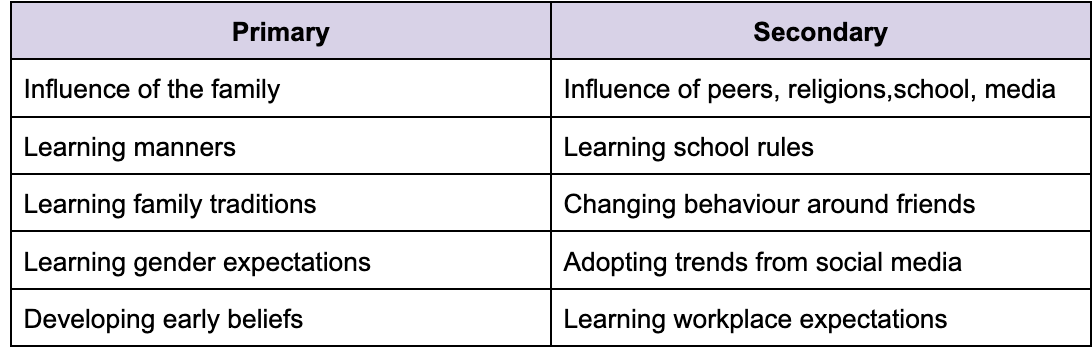
socialisation occours in 2 stages
Genie Wiley-Impact on the development of human identity:
Wasn't able to develop language to express through needs and emotions
Wasn't able to build confidence through positive relationships
Wasn't able to develop emotional security through care and attachment
Wasn't able to form values and beliefs through family interactions
Wasn't able to understand herself as an individual through feedback from others
Genie Wiley-How did this affect social identity:
Wasn’t able to belong to a family group on a healthy way
Wasn’’t able to learn social roles like child, daughter, friend or student
Wasn’t able to understand social roles and expectations
Wasn't able to practice communication and cooperation
Wasn't able to develop cultural knowledge and awareness
Wasn't able to form friendship or community connections
Primary Agent; Family
Children learn norms, values, beliefs & attitude through both the families behaviours & explicit messages
Begins at birth & continues throughout his or her lifetime through other agents of socialisation like school or media
Race & Ethncicity
Race is based on physical appearance (social construction)
Ethnicity is the cultural group their from (ethnic background based on ancestry, language, religion, cuisine)
Nationality is nation origin
Gender & Sexuality
Gender refers to the socially constructed differences between people, rather than biological differences.
Sexuality refers to a persons sexual orientations, attractions & or expressions of intimate identity
Beliefs
A set of opinions or convictions; ideas we believe in as the truth.
Beliefs influence our perception of perceiving the social, cultural, physical & psychological world
Location, Class & Status
People typically have a strong sense of identity with where they live. Location can mean a home but also a play of allegiance & identity
Status is a measurement used to compare people or groups based on criteria such as income, employment & residential location
Class is a system in which societies are organised into hierarchical levels based on power, privilege & wealth.
Peer & Schools
Peers are friends we spend time with regularly in social context, they provide a powerful opportunity to explore the world from beyond family
Schools are responsible for teaching students how to develop & discipline themselves, how to work & compete with others & how to obey rules
Media & Identity
Media shapes identity by influencing what people see as normal, desirable, successful or acceptable
It shapes how individuals understand themselves, others & society
Nature
is what we think of as per-writing & is influenced by genetic inheritance & other biological factors
Nurture
is generally taken as the influence of the external factors after conception eg/ social, economic & environment influence