Algebra 2 H.
 Call Kai
 Learn
Learn Practice Test
 Spaced Repetition
 Match
Match Flashcards
 Knowt Play
1/56

Name | Mastery | Learn | Test | Matching | Spaced | Call with Kai | Chat |
|---|
No analytics yet
Send a link to your students to track their progress
57 Terms
Decibel Level (equation)
Decibels in dB

Neutral Substance
pH = 7
Acidic Substance
pH < 7
Alkaline Substance
pH > 7
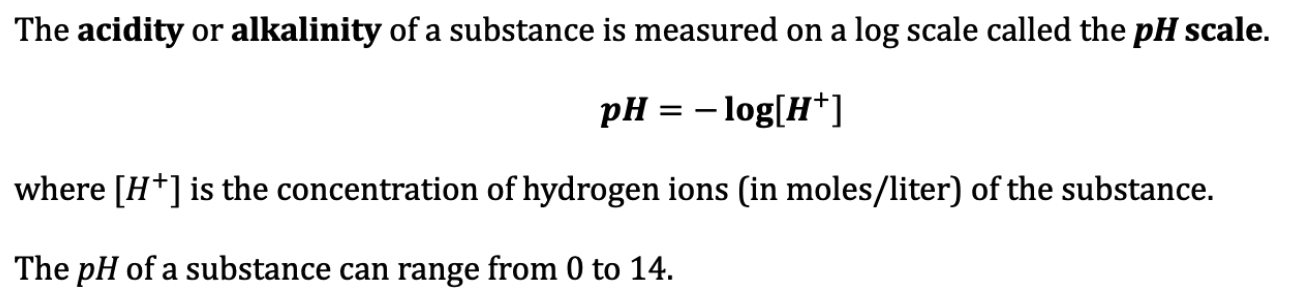
pH scale
0 to 14
[𝐻+]
the concentration of hydrogen ions (in moles/liter or mol/L) of the substance.
Equation for the pH of a Substance
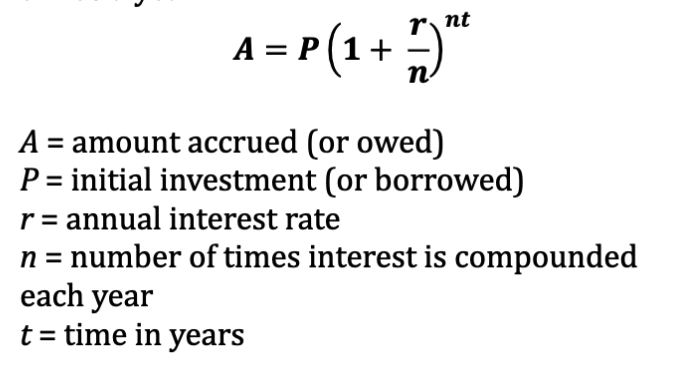
The formula for interest compounded n times a year
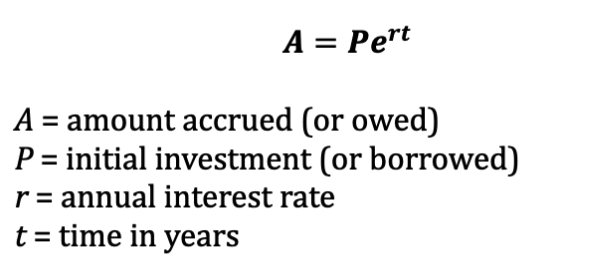
The formula for interest compounded continuously
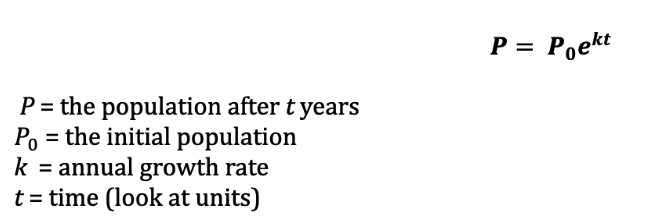
Exponential Growth Formula
Exponential Decay Formula
Square Root Property
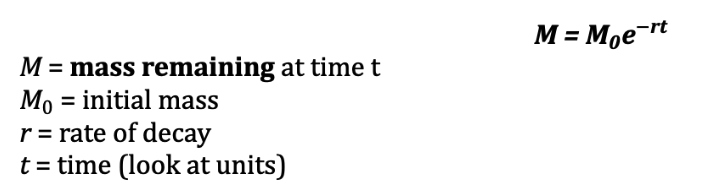
The square root property states that if x^2 = k (where k is a real number), then x = ±√k.
This method is used to solve quadratic equations by taking the square root of both sides, ensuring both the positive and negative roots are included
a3+b3
(a+b)(a2-ab+b2)
a3-b3
(a-b)(a2+ab+b2)
multiplicity
the number of times a specific value (or factor) appears as a root/zero in a given polynomial or multiset.
Discriminant
D = b2 - 4ac
D < 0
No real roots; 2 imaginary roots
D = 0
One real root
D > 0
2 real roots
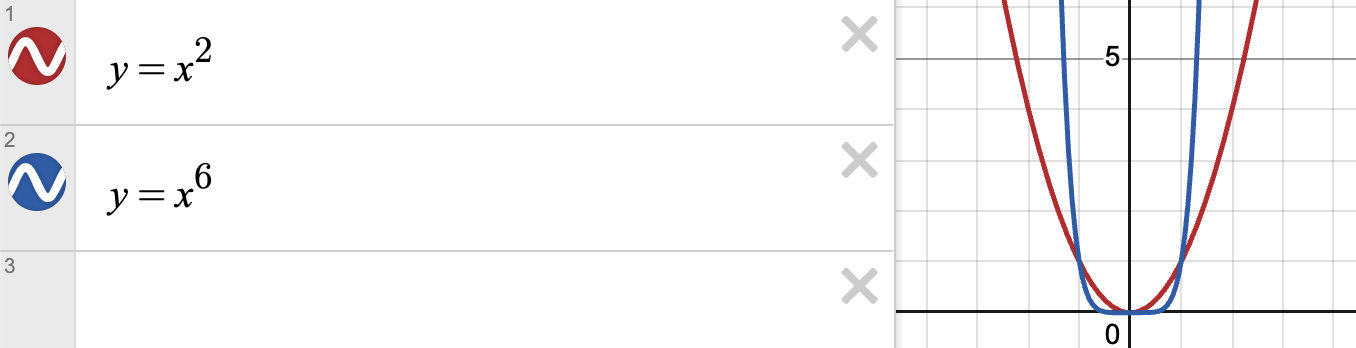
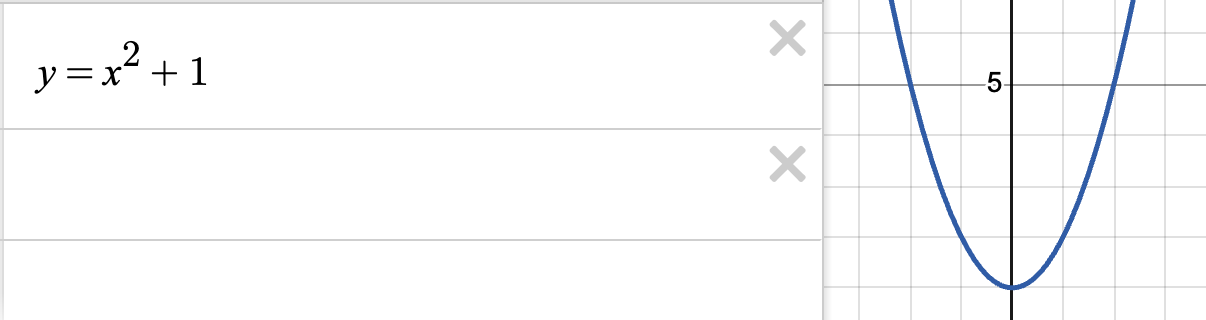
For f(x) = xn where n is and even number.
What happens when you change n?
As n increases, the graph becomes flatter and closer to the x-axis.
As n decreases, the graph becomes steeper, shooting up more rapidly toward infinity.
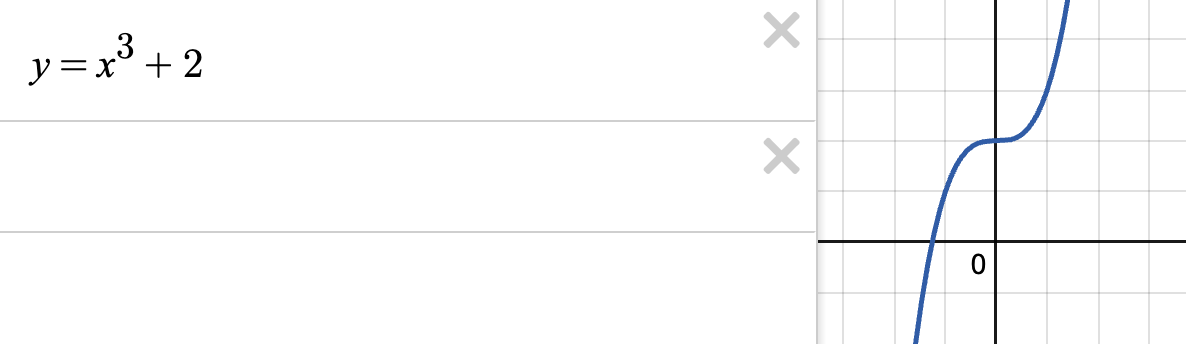
End behavior of an odd function with a positive leading coefficient
f(x) → +♾ as x → +♾
f(x) → -♾ as x → -♾
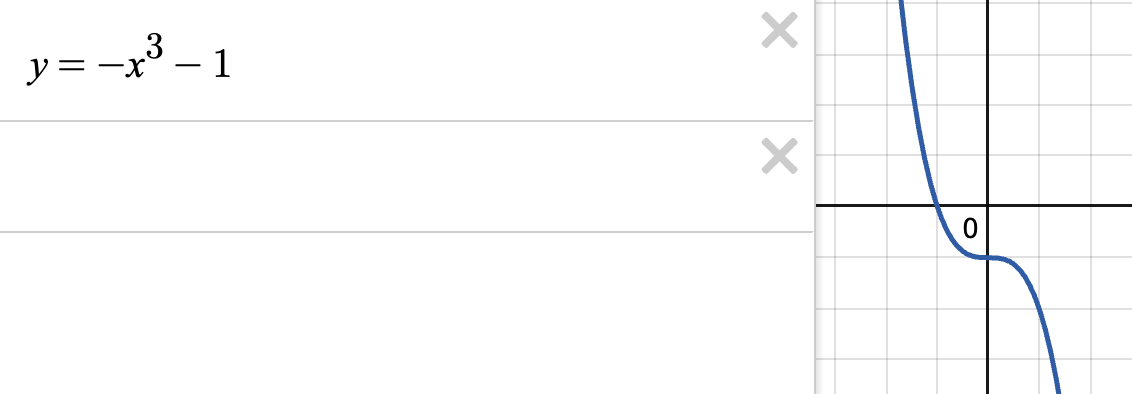
End behavior of an odd function with a negative leading coefficient
f(x) → -♾ as x → +♾
f(x) → +♾ as x → -♾
End behavior of an even function with a positive leading coefficient
f(x) → +♾ as x → +♾
f(x) → +♾ as x → -♾
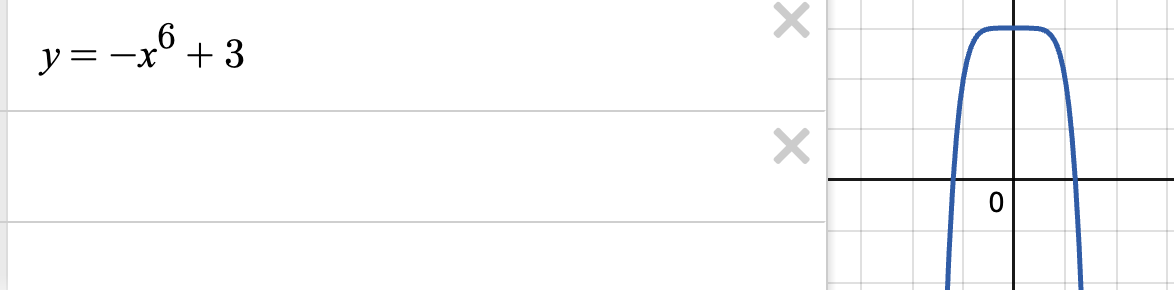
End behavior of an even function with a negative leading coefficient
f(x) → -♾ as x → +♾
f(x) → -♾ as x → -♾
Direct Variation
y varies directly as x
y = kx
k is the constant of variation or the constant of proportionality
Inverse Variation
y varies inversely as x
y = k/x
k is the constant of variation or the constant of proportionality
Joint Variation
y varies jointly as the other variables
y = kxz
y = kxzw
ect.
k is the constant of variation or the constant of proportionality
Finding the nth root of (an)
If n is an even positive integer, then the nth root of (an) is |a|
If n is an odd positive integer, then the nth root of (an) is a
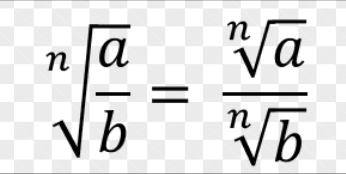
Quotient Rule for Radicals
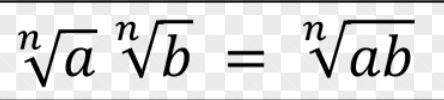
Product Rule for Radicals
Solving a Radical Equation
Isolate one radical on one side of the equation
Raise each side of the equation to a power equal to the index of the radical and simplify
If the equation still contains a radical term, repeat 1 and 2. If not ssolve the equation
Check all proposed solution in the original equation
Imaginary Unit
The imaginary unit, written i, is the number whose square is -1.
i2 = -1 and i = √(-1)
Complex Numbers
A no. that can be written in the form a + bi where a and b are real nos.
Sum of Complex Numbers
(a + bi) + (c + di) = (a + c) + (b + d)i
Difference of Complex Numbers
(a + bi) - (c + di) = a + bi - c - di = (a - c) + (b - d)i
Complex Conjugates
Ex: (a + bi) and (a - bi)
(a + bi)•(a - bi) = a2 + b2
Square Root Property
If b is a real number and if a2 = b, then a = ±√b
Quadratic Formula
Used when quadratic is in standard form: ax2 + bx + c = 0
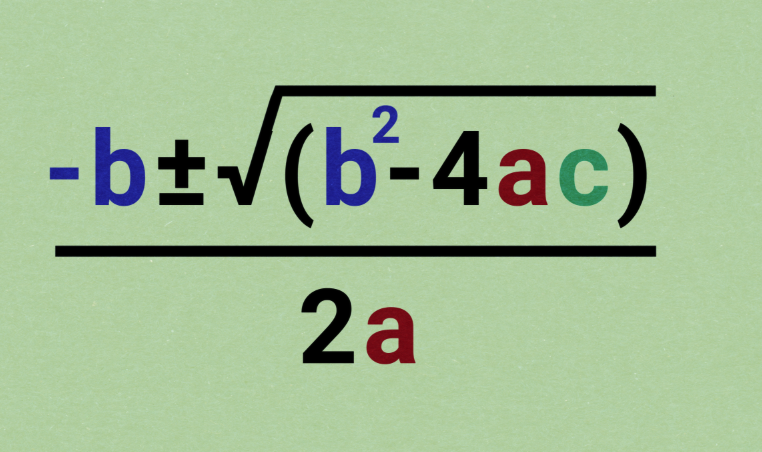
Solving a Quadratic Equation
If eqn. is in the form (ax + b)2 = c, use the square root property and solve. If not, go to step 2
Write the eqn. in standard form: ax2 + bx + c = 0
Try to factor. If it can’t be factored, go to step 4
Solve using the quadratic formula
Rational Zero Thm.
possible rational zeros = (factors of the constant term) / ( factors of the leading coefficient)
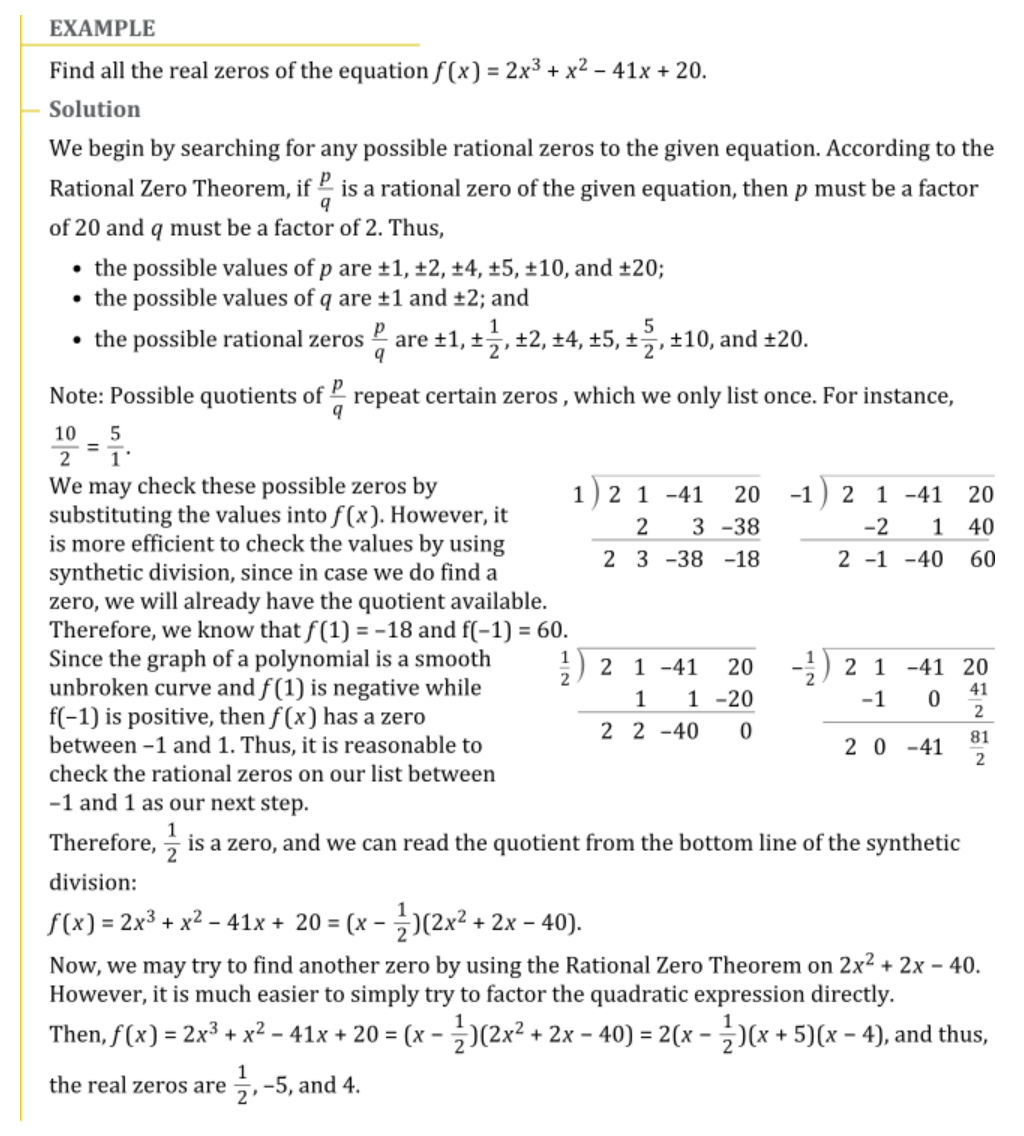
The Fundamental Thm. of Algebra
If f(x) is a polynomial of degree n, where n ≥ 1, then the eqn. f(x) = 0 has a least one complex root
One-to-One Function
each input (x-value) corresponds to only one output (y-value), and each output (y-value) corresponds to only one input (x-value)
Needs to pass both the horizontal line test and the vertical line test
A function needs to be a one-to-one to have and inverse function
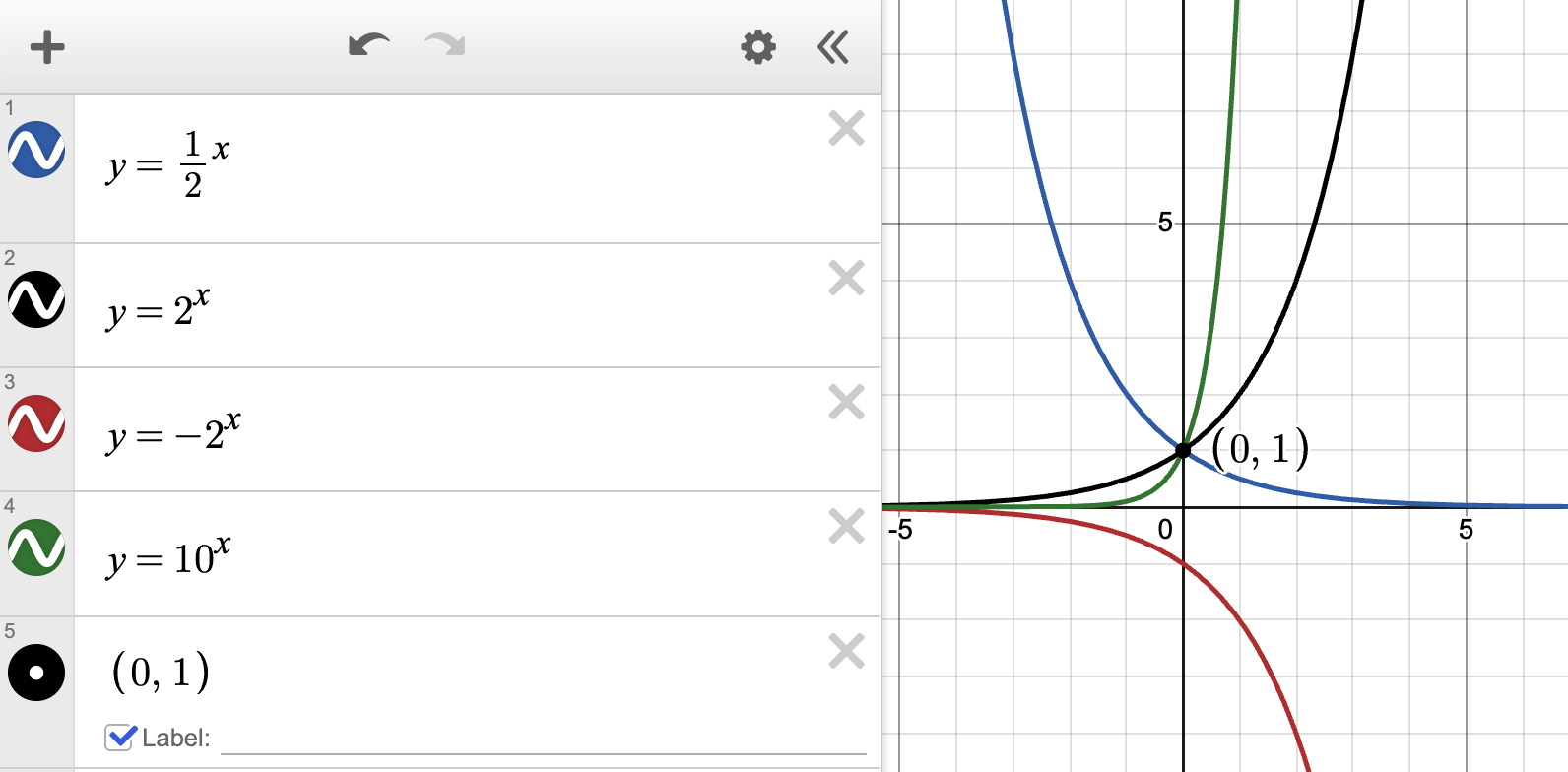
Exponential function
f(x) = bx
b > 0, b ≠ 1, and x is a real no.
one-to-one function
y-int: (0,1)
no x-int
d: all real nos
r: y > 0
Uniqueness Property of bx
Let b > 0 and b ≠ 1. Then bx = by is equivalent to x = y.
Logarithmic Definition
If b > 0 and b ≠ 1, then…
y = logbx means x = by
for every x > 0 and every real number y.
Properties of Logarithms
If b is a real number, b > 0, and b ≠ 1, then…
logb1 = 0
logbbx = x
blogbx = x
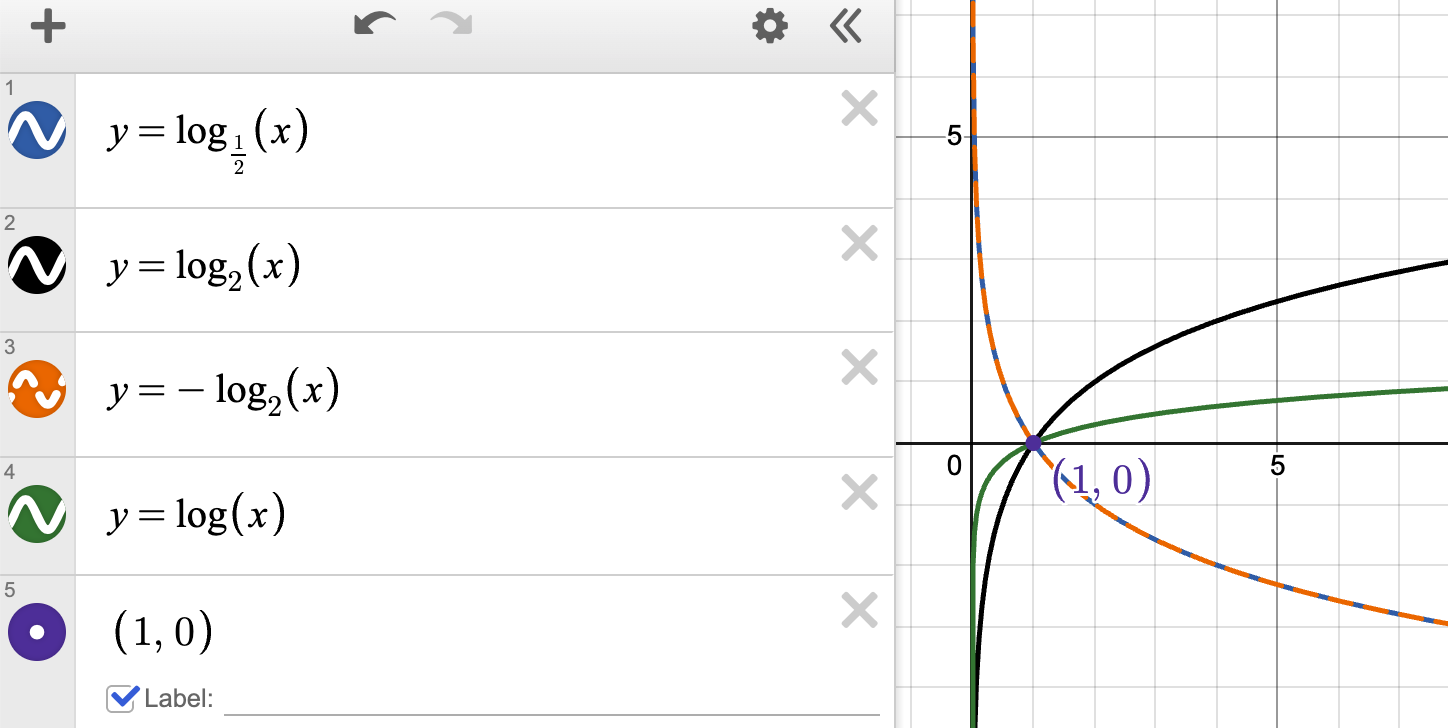
Logarithmic Function
If x is a positive real number, b is a constant positive real number, and b ≠ 1, then a logarithmic function can be defined by:
f(x) = logbx
The domain of f is the set of positive real numbers, and the range of f is the set of all real numbers
one-to-one function
x-int: (1,0)
no y-int
d: x > 0
r: all real nos
Product Property of Logarithms
If x, y, and b are positive real numbers and b ≠ 1, then…
logbxy = logbx + logby
Power Property of Logarithms
If x and b are positive real numbers, b ≠ 1, and r is a real number, then…
logbxr = r • logbx
Quotient Property of Logarithms
If x, y, and b are positive real numbers and b ≠ 1, then…
logb(x/y) = logbx - logby
Change of Base Property
If a, b, and c are positive real numbers and neither b nor c is 1, then…
logba = (logca) / (logcb)
Logarithm Property of Equality
Let a, b, and c be real numbers such that logba and logbc are real numbers and b ≠ 1, then…
logba = logbc is equivalent to a = c
Rational Functions
f(x) = p(x) / q(x)
q(x) ≠ 0
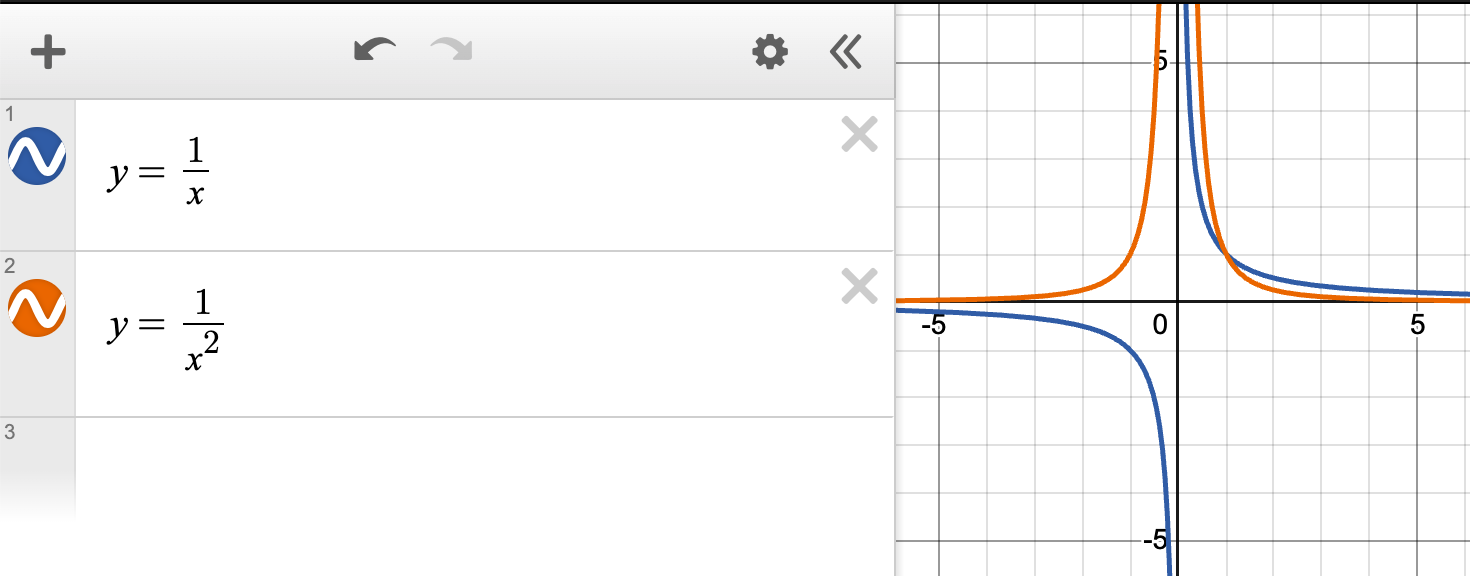
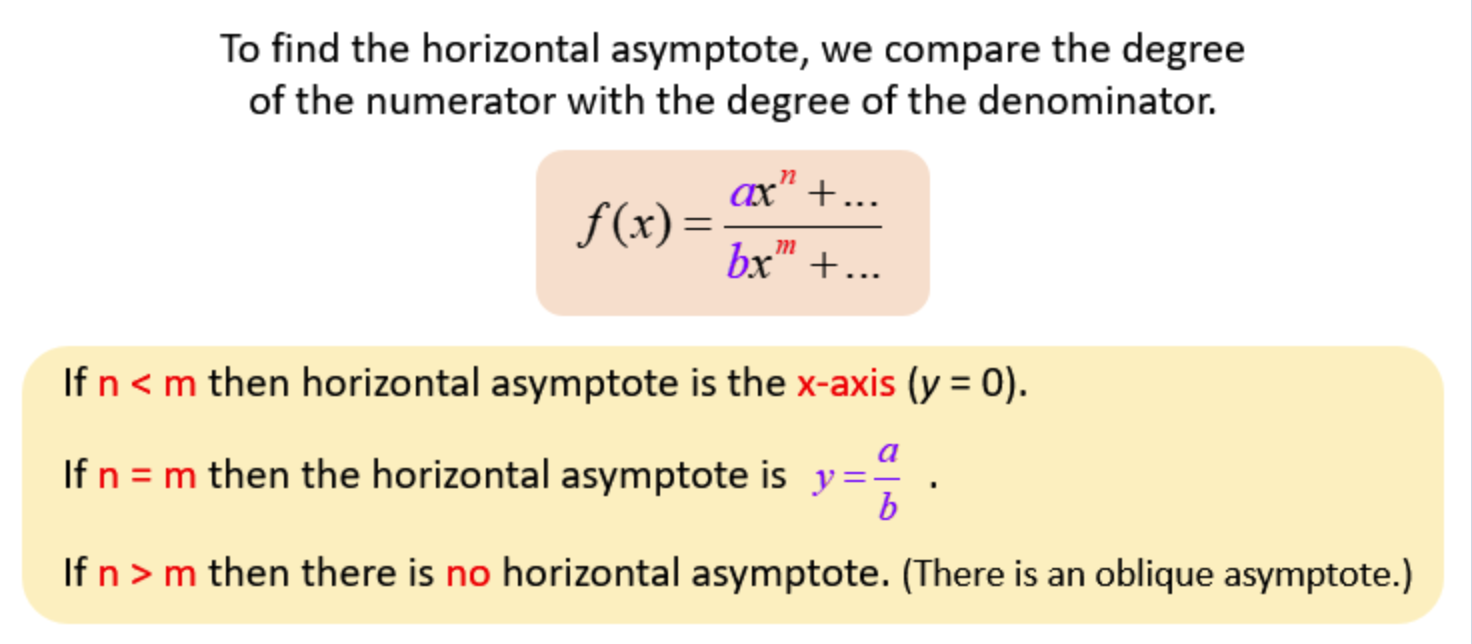
Horizontal Asymptotes of Rational Functions
Graphing Rational Functions
f(x) = p(x) / q(x)
Where p and q are polynomial functions with no common factors
Find the y-int. (if there is one)
Find the x-ints. (if there are any) by solving p(x) = 0
Find any VA(s) by solving q(x) = 0
Find the HA (if there is one) by using the rule for the HAs of rational functions
Plot at least 1 point between and beyond each x-int and VA
Use the info obtained prev. to graph the function
Horizontal Parabolas
Standard form: x = a(x - h)2 + k
Vertex: (h, k)
If a>0, then opens to the right
If a<0, then opens to the left
Axis of Symmetry: y = k
Circle
(x - h)2 + (y - k)2 = r2
Center: (h, k)
Radius: r