biology exam 3
 Call Kai
 Learn
Learn Practice Test
 Spaced Repetition
 Match
Match Flashcards
 Knowt Play
1/250

Earn XP
Description and Tags
Gene Regulation in Eukaryotes (Ch.14) Development in Eukaryotes (Ch.20) Darwin & Natural Selection (Ch.22) Microevolution and Population Genetics (Ch.23) Macroevolution and Phylogeny (Ch. 24,25)
Name | Mastery | Learn | Test | Matching | Spaced | Call with Kai |
|---|
No analytics yet
Send a link to your students to track their progress
251 Terms
True or False: Almost all the cells in an organism are genetically identical.
TRUE
what is regulation of gene expression is essential for?
cell specialization.
what is cell specialization (or differentiation)?
the process where generic stem cells develop unique structures and shapes to perform specific functions within a multicellular organism.
What eukaryotic gene expression processes happens in the Nucleus ?
1. Chromatin remodeling: Chromatin (DNA-protein complex).
2. Transcription: “Open” chromatin (some DNA not closely bound to proteins).
3. RNA processing to produce a mature mRNA.
Regulation of mRNA life span or stability.
What eukaryotic gene expression processes happens in the Cytoplasm ?
4. mRNA stability
5. Translation: folding and transport
6. Post-translational modification (folding, glycosylation, transport, activation, degradation of protein).
What is RNA Splicing?
a crucial post-transcriptional process in eukaryotes where non-coding sequences (introns) are removed from pre-mRNA and coding sequences (exons) are joined together to form mature mRNA. This edited mRNA is then used to create proteins. The process is carried out by a complex called the spliceosome.
Exons
coding sections of DNA that are transcribed and translated into protein, staying in the final mRNA.
Introns
non-coding, intervening sequences that are transcribed but removed during RNA splicing and do not appear in the final mRNA.
Spliceosome
a large molecular machine in the cell nucleus that acts like a "molecular editor." It cuts out non-coding junk sequences (introns) from premature messenger RNA (pre-mRNA) and pastes the protein-coding instructions (exons) together.
Chromatin
compact DNA & histones (associated proteins). Helps regulate gene expression in several ways.
TRUE OR FALSE: Genes within highly condensed heterochromatin are usually expressed.
FALSE; they are not usually expressed.
What is Heterochromatin?
a tightly packed, dense form of DNA found in the nucleus of eukaryotic cells.
What is Euchromatin?
a lightly packed, "open" form of chromatin (DNA + proteins) found in cells that allows easy access for gene transcription.
What is Epigenetics?
How your behaviors and environment can cause changes that affect the way your genes work. Unlike genetic changes (mutations), epigenetic changes are reversible and do not change the sequence of DNA bases, but they can change how your body reads a DNA sequence.
Genes can be switched “__” and switched “__”.
on ; off
Traits of DNA in Epigenetics
DNA is wound around histone protein complexes that can be covalently modified (acetylation, methylation, phosphorylation).
DNA itself can be methylated, usually repressive.
Methylation
is a reversible chemical modification where a methyl group (CH3) is added to DNA (usually at cytosine bases), typically acting as a "tag" to turn genes off and suppress transcription without altering the underlying genetic sequence.
Acetylation
adding acetyl groups to histones to loosens DNA in order to promote gene transcription.
what are the Histone Modifications?
Acetylation
Methylation
Phosphorylation
Ubiquitination
DNA Methylation
the addition of methyl groups to certain bases (usually cytosine) in DNA.
Individual genes are usually more heavily methylated in cells where they are not expressed.
What is Acetylation?
a chemical reaction that introduces an acetyl functional group (CH3CO) into an organic molecule, replacing a hydrogen atom in a hydroxyl, amine, or thiol group.
It is a vital process for modifying proteins, regulating gene transcription, metabolizing drugs, and increasing the stability of materials like wood.
What is Phosphorylation?
process of adding a phosphate group (PO3-4) to a protein or organic molecule, acts as a "switch" to turn protein functions on or off.
It alters a molecule's structure to regulate activity, metabolism, and signaling, typically catalyzed by enzymes known as kinases.
What is Ubiquitination?
a biological process where a small protein called ubiquitin is covalently attached to a target protein, marking it for destruction or changing its function.
Often called the "kiss of death," this tagging mechanism typically signals the cell to degrade damaged or unnecessary proteins, essential for regulating cellular health.
Epigenetic Inheritance
the inheritance of traits transmitted by mechanisms not directly involving the nucleotide sequence.
TRUE or FALSE: Epigenetic modifications can be reversed, unlike mutations in DNA sequence.
TRUE
Do ACTIVE GENES increase OR decrease gene expression?
INCREASE
Do INACTIVE GENES increase OR decrease gene expression?
DECREASE
Promoters
DNA sequences that tell transcription factors where the beginning of a gene is.
Transcription Factors
proteins that locate promoters and recruit RNA Polymerase to express a gene.
Enhancers
DNA sequence that help upregulate gene expression.
Silencers
DNA sequences that help down-regulate gene expression.
Moderators
proteins that communicate between regulatory elements (enhancers/silencers) and the transcription initiation complex.
Difference between RNA Polymerase I (Pol I) vs RNA Polymerase II (Pol II)?
RNA Polymerase I (Pol I)
Location: Nucleolus.
Function: Transcribes pre-rRNA (28S, 18S, 5.8S), responsible for producing roughly 50% of the total cellular RNA. Pol I is responsible for creating ribosomes (rRNA).
Sensitivity: Insensitive to -amanitin.
Components: ~14 subunits.
RNA Polymerase II (Pol II)
Location: Nucleoplasm.
Function: Transcribes mRNA, miRNA, and most snRNA/snoRNA. Pol II is responsible for creating proteins (mRNA).
Sensitivity: Extremely sensitive to -amanitin (inhibited by low concentrations).
Components: 12 subunits
DNA Polymerase vs. RNA Polymerase.
DNA polymerase adds deoxyribonucleotide (DNA) to the growing DNA strand while the RNA polymerase adds ribonucleotide (RNA) to the growing RNA strand.
Control elements
segments of noncoding DNA that serve as binding sites for transcription factors that help regulate transcription.
Control elements and the transcription factors they bind are critical for the precise regulation of gene expression in different cell types.
Proximal control elements
close to the promoter.
Enhancer Elements
thousands of nucleotides up- or downstream; genes can have multiple enhancers; gene expression increased or decreased.
Activators or repressors can bind to control elements of enhancers.
How do activators interact with general transcription factors?
through DNA bending
Where do general transcription factors interact with proteins?
at the promoter
Why do enhancers act at a distance?
because DNA loops
Function of DNA-bending protein
helps bring the enhancer-bound activators close to the promoter region.
Post-Transcriptional Regulation
RNA processing (cap, poly-A tail and intron splicing)
Alternative splicing
RNA half-life
miRNAs
siRNAs
Alternative splicing
a powerful regulatory mechanism that allows a single gene to produce multiple proteins.
miRNAs
Small non-coding RNAs (21-23 nucleotides) that bind target mRNAs and either repress translation or promote degradation.
siRNAs
20-24 nucleotide double-stranded RNAs that guide the RNA-induced silencing complex (RISC) to degrade complementary mRNA, preventing protein synthesis.
What does RNA processing transform into?
an unstable, non-functional primary transcript into a mature, translatable mRNA.
Post-Translational Regulation: Protein trafficking after translation
Secreted proteins enter ER as they are being synthesized by ribosome.
Protein exits ER in vesicle
Protein travels through the cisternae of the Golgi apparatus.
Protein enters a secretary vesicle that fuses with cell membrane.
Protein is secreted from cell.
Protein degradation
the essential cellular process of breaking down damaged, misfolded, or unneeded proteins into amino acids for recycling or disposal.
Primarily managed by the ubiquitin-proteasome system (UPS) and lysosomal proteolysis, this process regulates key cellular functions like cell cycle control, signal transduction, and quality control, preventing the accumulation of toxic protein aggregates.
When a protein is misfolded or no longer needed:
proteasome
When the cell needs to survive or has broken constituents:
autophagy & lysosome
What is Developmental Biology?
integrates genetics, biochemistry, cell biology, and evolution.
Allows a multicellular individual to form from one cell.
Zygote
Embryo
Eventually forms an organism with many different types of cells.
Zygote
single cell is a fertilized egg.
Embryo
divides and forms a ball of cells.
A few principles are common to all developmental processes in every multicellular:
1. Cells divide
2. Signal to one another what they are
3. Begin to express certain genes rather than others
4. Move or expand in specific directions
5. Some cells die
What does transformation from zygote to adult result from?
cell division, cell differentiation, and morphogenesis.
Programmed cell death
a highly regulated and essential part of development.
Occurs in both plants and animals
Helps tissues and organs take shape.
Apoptosis
the normal, planned death of damaged cells in your body. It's an important process that helps keep you healthy; most common type in animals.
Cells that form webbing between toes die.
About half of neurons die as the nervous system is wired.
Harmful immune cells are eliminated.
TRUE or FALSE: Differentiated cells are NOT genetically equivalent.
FALSE; they ARE genetically equivalent.
what does genetically equivalent mean?
it means they contain the same genes.
Pattern Formation
the development of a spatial organization of tissues and organs.
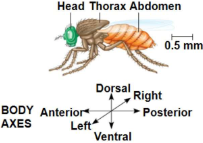
In animals, pattern formation begins in the early embryo with the establishment of the major axes.
Positional Information
the molecular cues that control pattern formation, tells a cell its location relative to the body axes and to neighboring cells.
Maternal effect genes
encode cytoplasmic determinants that initially establish the axes of the body of Drosophila.
Also called egg-polarity genes because they control orientation of the egg and consequently the fly.
Bicoid
a crucial maternal-effect gene and morphogen in Drosophila (fruit fly) embryos that determines the development of head and thoracic structures.
What did Fluorescent in situ hybridization (FISH) show?
Bicoid mRNA was distributed in a gradient in Drosophila embryos.
Highest concentration was at the anterior end.
Bicoid mRNA is made by cells of the mother and transferred into the egg.
Bicoid protein is also found in a similar gradient.
Bicoid mRNA is highly concentrated at the anterior end of the embryo.
What are Homeobox (Hox) Genes?
Master control (homeotic) genes that initiate pattern formation (organs development in specific parts of the body) in late embryo, larva, and adult stages.
These genes guide pattern formation in embryos.
Homeosis
The transformation of one organ into another via mutation.
Ex: antennapedia and bithorax.
Caused by mutations in Hox Genes.
Role of Homebox (Hox) genes
they guide pattern formation in embryos. It tells the cells of the body how to differentiate as the body grows.
reveal the shared evolutionary history of life.
What types of groups do Hox Genes occur?
prokaryotes
yeast
plants
animals
Evolutionary Conservation of Homeobox (Hox) Genes:
Drosophilia Hox Genes are found in clusters.
the order of the genes along the chromosome corresponds to the order of where the genes are expressed in the embryo.
Almost all animals contain related sets of Hox Genes.
they are arranged in clusters.
order of genes align with the order in Drosophilia.
have the same relationship between gene order and the order of expression in the embryo.
what happens when developmental processes are disrupted?
the embryo is likely to die.
what happens if the process is modified?
it may lead to changes in size, shape, or activity of a structure.
what is a novel phenotype? (in adults)
a brand-new, unique, or previously unseen physical trait or behavior in an organism that differs from its parents or ancestors.
These traits are often crucial for driving evolutionary change.
Ex: A new color on a beetle, a slightly different wing shape, or a newly developed tolerance to a toxin.
Evolutionary Developmental Biology or evo-devo
focuses on understanding the changes in developmentally important genes.
led to evolution of new forms.
changes in developmental gene expression drive evolutionary change
most snakes lack limbs, but some have tiny hip and thigh bones.
the ancestor of all snakes had 4 limbs.
in chicken embryos: Hoxc6 and Hoxc8 are both expressed in cells where ribs form.
only Hoxc6 is expressed in the region where forelimbs form.
why I evolution by natural selection referred to as like a “low-budget" remodeling job?
it is called this because it does not create complex structures from scratch, but rather tinkers with existing, ancestral body plans to make them "good enough" for survival. This perspective, famously described as "evolutionary tinkering" or bricolage (using whatever materials are available), highlights that natural selection works with constraints rather than designing optimal solutions from scratch
Sonic Hedgehog Gene (SHH)
a gene, found in humans and many species, encodes a signaling protein crucial for embryonic development, specifically patterning the brain, spinal cord, limbs, and facial structures. It directs cell growth and specialization, with dysfunction leading to developmental disorders, and abnormal signaling contributing to cancers.
Losses of sonic hedgehog signaling
Hindlimb loss in snakes is due to failure to produce the signaling molecule sonic hedgehog.
Loss of sonic hedgehog signaling in the pelvic region of whales led to the disappearance of their hindlimbs.
Evolutionary Mechanisms: Definitions and Notes
Natural Selection: Certain alleles are favored.
Genetic Drift: Random changes in allele frequencies; most important in small populations.
Gene Flow: Movement of alleles between populations; Reduces differences between populations.
Mutation: Production of new alleles.
Evolutionary Mechanisms: Effect on Genetic Variation
Natural Selection: Can lead to maintenance, increase, or reduction of genetic variation.
Genetic Drift: Tends to reduce genetic variation via loss or fixation of alleles.
Gene Flow: May increase genetic variation by introducting new alleles; may decrease it by removing alleles.
Mutation: Increases genetic variation by introducing new alleles.
Key Points
Multiple lines of evidence support common ancestry.
Evolution can be viewed as genetic change over time or as a process of descent with modification.
Natural selection, mutation, genetic drift, and gene flow can cause allele frequencies in a population to change over time.
Natural selection is the only evolutionary mechanism that consistently causes adaptive evolution.
what are the multiple lines of evidence that support ancestry?
Homologous Traits
Vestigial Traits
Biogeographic and Genetic Relatedness among species (phylogeography).
Homologous Traits
similar physical or genetic features in different species inherited from a common ancestor, often serving different functions (e.g., human arms vs. bat wings).
Vestigial Traits
remnants of structures that were functional in ancestors but are reduced or functionless in the modern species (e.g., whale hind legs).
Genetic Homology
a similarity in the DNA sequences of different species.
Example of genetic homology
the eyeless gene in fruit flies and the Aniridia gene in humans are so similar that their protein products are 90% identical in amino acid sequence.
Developmental Homology
is seen in embryos of different species.
Examples of Developmental Homology
Tails and gill pouches are found in the embryos of all chordates, including chickens, humans, and cats.
One explanation for these embryonic similarities is that the common vertebrate ancestor of these species had gill pouches and a tail.
Homologous Structures
structures in different species that share a common evolutionary origin, but may or may not have the same function.
Experimental Evidence for Homology
Many hypotheses about homology can be tested experimentally.
The theory of evolution by natural selection predicts that homologies will occur. If species were created independently of one another, these types of similarities would not occur.
Geography Relationships
There are often striking similarities among island species:
for example, Darwin collected mockingbirds from the Galapagos islands. The mockingbirds were superficially similar, but different island had distinct species.
Darwin proposed that the mockingbirds were similar bc they had descended from a common ancestor.
What is phylogeny?
a family tree of population or species.
the relationship between different species can be shown on a phylogenetic tree.
examples of vestigial traits
the human tailbone is a vestigial trait.
Goose bumps are a vestigial trait.
What are vestigial traits?
A reduced or incompletely developed structure in an organism that has no function, but is clearly similar to functioning organs or structures in closely related species.
Vestigial traits are evidence that the characteristics of species have changed over time.
Homology vs. Homoplasy?
Homology: occurs when traits are similar due to shared ancestry.
Homoplasy: occurs when traits are similar for reasons other than common ancestry.
for example, icthyosaurs (extinct aquatic reptiles) and dolphins (extant mammals) are very similar, but these similarities are not due to common ancestry.
Analogous Structures
Structures observed among organisms that serve similar functions, yet onto genetically arise from a separate origin.
How do species respond to variation in the physical environment?
Tolerate/acclimate
Migrate
Die
Adapt
Evolution
change in allele frequencies (proportions) in a population over time.
for example, if the frequency of b in a population is 0.4 or 40%, the frequency of B is 0.6 or 60%.
What can evolution be defined as?
Evolution can be defined more broadly as descent with modification.
Charles Darwin and Alfred Russell Wallace
“Mystery of mysteries: the origin of species”
Darwin: natural historian on the HMS Beagle (1831-1836).
Wallace: collector in SE Asia.
Both recognized geographic variation in forms.
Where does variation occur?
Variation occurs among individuals within a population.